
The way most applicants use “extra” residency applications is irrational.
Not emotional. Not suboptimal. Irrational. It’s driven by fear, prestige-chasing, and bad hallway advice—not by how interviews are actually offered or how people actually match.
Let’s fix that.
You’re reading this in the “how many programs should you apply to” phase. Translation: you’re about to spend thousands of dollars and hundreds of hours clicking boxes in ERAS. Most people will misallocate those clicks. They’ll over-apply to reach programs where they have no realistic shot, and under-apply to true safety or mid-tier programs that could actually save their match.
And then they’ll blame “the match” instead of their own strategy.
The Core Myth: “Extra” Apps Should Go To Higher Prestige
Here’s the dominant narrative I hear over and over:
- “Once you have your safeties, just throw the rest at top programs. You never know.”
- “You only need a handful of lower-tier programs. What if you magically click with a big-name place?”
- “Aim high, the worst they can say is no.”
I’ve heard this exact script from advisors, not just students.
The data says this is backwards.
Programs don’t read your file the way you read your dreams. They screen hard, quickly, and often using crude filters: Step scores, school name, visa status, red flags, geographic ties. Once you’re past a certain competitiveness gap, the marginal value of one more “reach” application is close to zero.
What saves people in the match is not one lucky interview at Mass General. It’s the 3–5 additional realistic interviews that push them past the “statistical danger zone.”
Let’s quantify that danger zone.
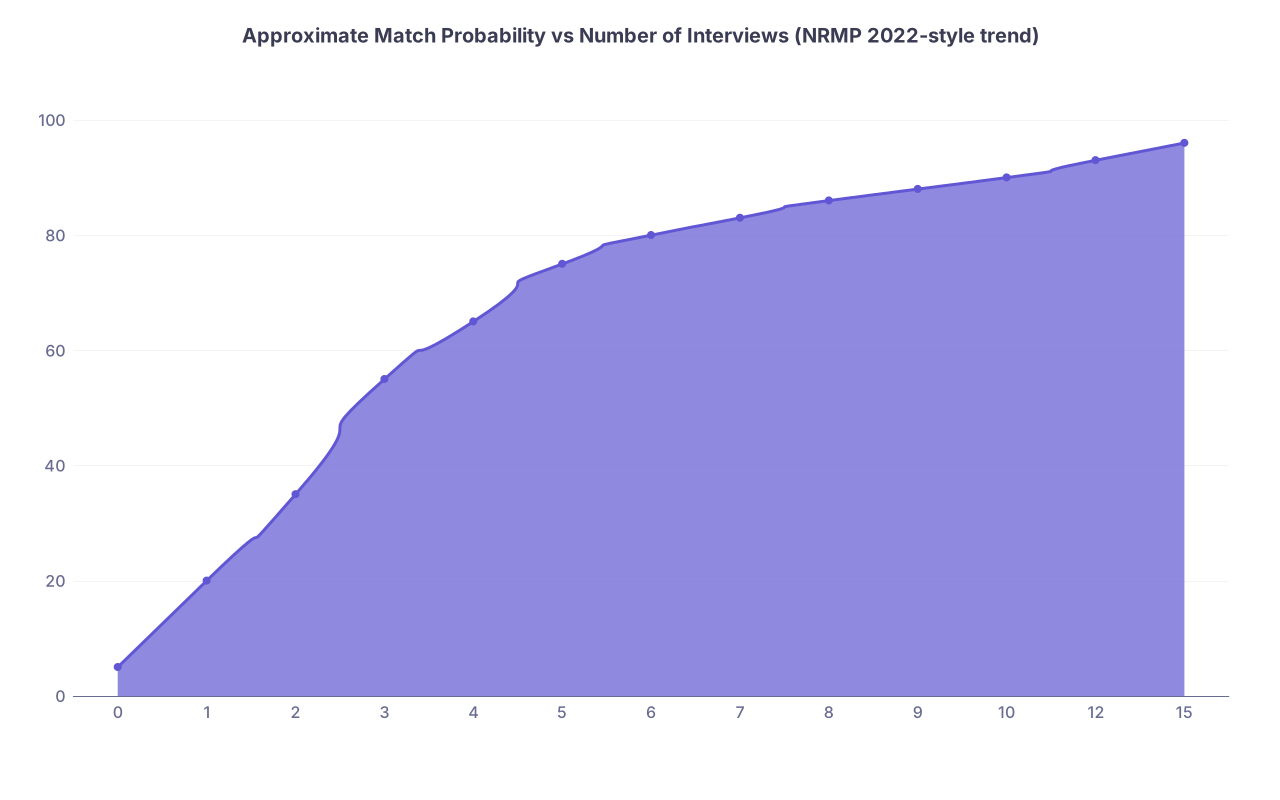
| Category | Value |
|---|---|
| 0 | 5 |
| 1 | 20 |
| 2 | 35 |
| 3 | 55 |
| 4 | 65 |
| 5 | 75 |
| 6 | 80 |
| 7 | 83 |
| 8 | 86 |
| 9 | 88 |
| 10 | 90 |
| 12 | 93 |
| 15 | 96 |
This isn’t exact for every specialty, but the pattern is consistent in NRMP data: going from 3 to 7–8 real interviews is where people’s match probability explodes upward. Going from 8 to 15 is nice, but not life-or-death.
Your “extra” applications should be ruthlessly focused on getting you into that high-probability interview range. Not on buying lottery tickets at brand-name places that are screening you out in under 10 seconds.
What The Data Actually Shows About Safety vs Reach
You’re not the first person to wonder how to distribute applications. NRMP has already done the experiment with tens of thousands of people per year.
Some consistent findings from multiple years of Charting Outcomes/Program Director surveys (paraphrased, but directionally accurate):
- Program directors report reading only a subset of applications in depth; initial cuts are often mechanical.
- Once you’re below a program’s rough score/school/research expectations, your chance of interview drops to near-zero no matter how many “extra” apps you send at that tier.
- A few more applications in the right competitiveness band (where your stats are middle-of-the-pack for that program) are far more likely to convert into interviews than the same number sprayed upward at prestige programs.
Let’s make this concrete. Take a hypothetical US MD applying to Internal Medicine:
- Step 2 CK: 232
- No Step 1 score (P/F era)
- Decent letters, some research, no red flags
For this applicant, Harvard, UCSF, and Johns Hopkins categorical IM are not “low probability.” They’re effectively no probability. Their median matched scores and profiles are far above what this applicant brings. Your window is closed before the dean’s letter PDF even loads.
By contrast, a mid-tier university program in the Midwest, or a solid community program affiliated with a med school? There, your score is within the normal range. You might be slightly below their mean, but you’re not disqualified by default. A thoughtful personal statement, aligned interests, or geographic ties can actually move the needle.
Your extra 20 applications can:
- Buy you… maybe 0–1 interviews from 20 hyper-reach programs, if the stars align,
or - Buy you 4–6 interviews from 20 realistic-but-not-glamorous programs
You do not need a PhD in statistics to see which choice protects your match more.
The Three Zones: Where Extra Applications Actually Matter
Think about your strategy in three “zones,” not prestige vs non-prestige.
| Zone Type | Your Profile vs Program | Interview Yield From Extra Apps |
|---|---|---|
| Safety Zone | Stronger than average | High |
| Target Zone | Around average | Moderate to high |
| Reach Zone | Clearly below average | Very low |
1. Safety Zone: Boring But Powerful
These are programs where your scores and CV are clearly above their typical matched applicant. You might feel “overqualified.” You will be tempted to drop them from your list because of ego.
Do not.
This is where each extra application has the highest probability of turning into an interview—and one or two extra interviews in this band is exactly what saves people who are sitting at 3–4 invites in January.
I’ve watched applicants cut 5 safety programs in December “because I already have 6 interviews, I think I’m fine” and then go unmatched. Meanwhile, their classmate with 9 interviews—4 of which were at pure “safety” community sites—matched comfortably.
Those “beneath me” interviews? Pure gold when the algorithm runs.
2. Target Zone: The Sweet Spot
This is where prestige obsession actually makes some sense—but still needs discipline.
These are programs where:
- Your scores are around their average matched resident
- Your school type fits their usual pattern
- You’re not obviously under their bar, but you’re not clearly above it either
This is your main hunting ground. Most of your applications should live here. When you have extra slots to allocate, this is usually the first place to shore up.
Within the target zone, you can play with geography, academic vs community mix, or specific interests (procedural-heavy IM, global health, etc.). But notice what we’re not doing: we’re not jumping three tiers above your profile just because the name is shiny.
3. Reach Zone: Where Hope Goes To Burn Money
Everyone likes to talk about “reach” as if it’s a spectrum. It’s usually not. There’s a cliff.
Once your Step 2 is 20+ points below a program’s unofficial floor, or your background is far outside their usual accepted patterns (IMG vs almost exclusively US MD, for example), you’re not in “reach” territory. You’re in “we are not reading this” territory.
Sending 10–20 extra applications into this bin feels emotionally satisfying. It feels like ambition. But operationally, these are donations to ERAS and credit card companies.
Apply to a few true reach places if you want. There’s nothing morally wrong with that. But those should not be where your marginal dollars go once you hit 40, 60, 80 applications. That’s fantasy budgeting.
The Geography Myth: “Just Add Extra Big-Name Cities”
Another common way people misallocate “extra” apps: they toss them at every big-name city in the country.
“I’ll mostly apply Midwest and South, but throw in some Boston/NYC/California programs with my extra 15 spots. Why not?”
Because those are massively oversubscribed markets. You’re competing against people who:
- Have strong, specific geographic ties
- Attended local med schools
- Have higher scores and more research (especially IM, neuro, psych in coastal cities)
If your application is already competitive in that city—great, those aren’t “extra” apps, they’re core. But if you’re under the bar and geographically cold, your yield will be dismal.
Those 15 coastal prestige apps could instead become:
- 5 more programs in a region where you actually have ties
- 5 mid-tier programs in non-coastal cities that everyone else is ignoring
- 5 safety community programs that basically interview anyone vaguely in range
Guess which group is more likely to convert into 3–5 additional interviews.
Case Studies: How People Misuse Extra Applications
Let’s walk through some real-world style scenarios. I’ve seen variations of all of these.
Case 1: The Mid-Range IM Applicant
US MD, IM, Step 2 = 235, average everything else.
What they do:
- 15 top academic IM programs (many top-25 hospitals)
- 20 mid-tier university programs
- 10 community programs they see as “backup”
Then, with “extra” 15 apps:
- Add 15 more high-prestige programs “just in case they like me”
What they should have done with those extra 15:
- +5 mid-tier universities in regions they didn’t cover yet
- +10 community or university-affiliated community programs where their stats are clearly above average
The result of the wrong choice?
- 1 or 0 extra interviews from the 15 prestige programs
- Still sitting at 6 interviews total in January. Nervous.
The result of the better choice?
- Realistic chance at 4–6 more interviews
- Now they’re at 10–12. Huge shift in match probability.
Case 2: The Competitive Derm Applicant
US MD, Derm, 260+ Step 2, heavy research, strong letters.
Here’s where nuance matters. For this person, “extra” apps to brand-name places are not insane, because for them those are not hyper-reach—they’re in the ballpark.
But even then, people overdo it.
What many do:
- 50 applications, heavy on top-20 academic derm programs
- 5–10 “safety” derm programs (as if those actually exist)
With “extra” applications, they just add more of the same top-20 names. Why? Ego and FOMO.
A smarter move:
- Use extra applications to widen geography and institutional type within realistic range: university-affiliated community derm programs, strong but not famous academic programs, etc.
- Maybe sprinkle in 3–5 mega-brand “just in case” programs if they weren’t already on the list, but don’t make that the default.
Even at the top tier, the principle holds: extra impressions are most valuable where the program might actually say yes.
Case 3: The IMG in Internal Medicine
Non-US IMG, Step 2 = 238, solid clinical experience, some research, no US MD/DO degree.
What I see constantly:
- 20 very competitive university IM programs that historically take 0–2 IMGs per year
- 20 mid-tier programs that sometimes take a handful of IMGs
- 20 community programs with high IMG acceptance
Then they get nervous and use extra 20 apps to add even more competitive university programs “because my cousin got in with a 235 once.”
Their cousin was an exception. That’s why they keep telling the story.
If this person instead put those extra 20 apps into:
- Lower- and mid-tier programs with a clear track record of taking IMGs
- Community hospitals with university affiliations in IMG-friendly regions
- A few more pure community safety programs
Their interview count would go up significantly. NRMP data shows IMGs need more interviews on average to reach a similar match probability. That means every “extra” app is more precious, not less.
Throwing these apps at programs that structurally do not interview IMGs is strategic malpractice.
How To Decide Where Your Extra Applications Go
You want a simple rule? Here:
Every time you’re about to click “add program,” ask:
“If this program looked at my application for 30 seconds, would I be in their plausible yes pile… or their auto-no pile?”
If you’re obviously in the auto-no pile—scores way below, no IMGs historically, wildly off their usual profile—your extra apps are wasted there.
A more methodical way to allocate “extra” apps:
- Identify how many realistic interviews you currently expect, based on past seasons for people like you. Be honest.
- If that number is below the “comfort zone” for your specialty (often 8–10+ for categorical fields, higher for IMGs/very competitive specialties), your extra apps go almost entirely to:
- Safety and target programs
- In regions and institutional types where your profile matches what they historically take
- Only once your likely interview count is in a safe range should you start sprinkling a few aspirational programs for fun.
Stop treating prestige as the default destination for overflow. Treat match probability as the thing you’re trying to maximize.
A Quick Reality Check On Costs
People act like ERAS fees are annoying but minor. For many students, they’re not.
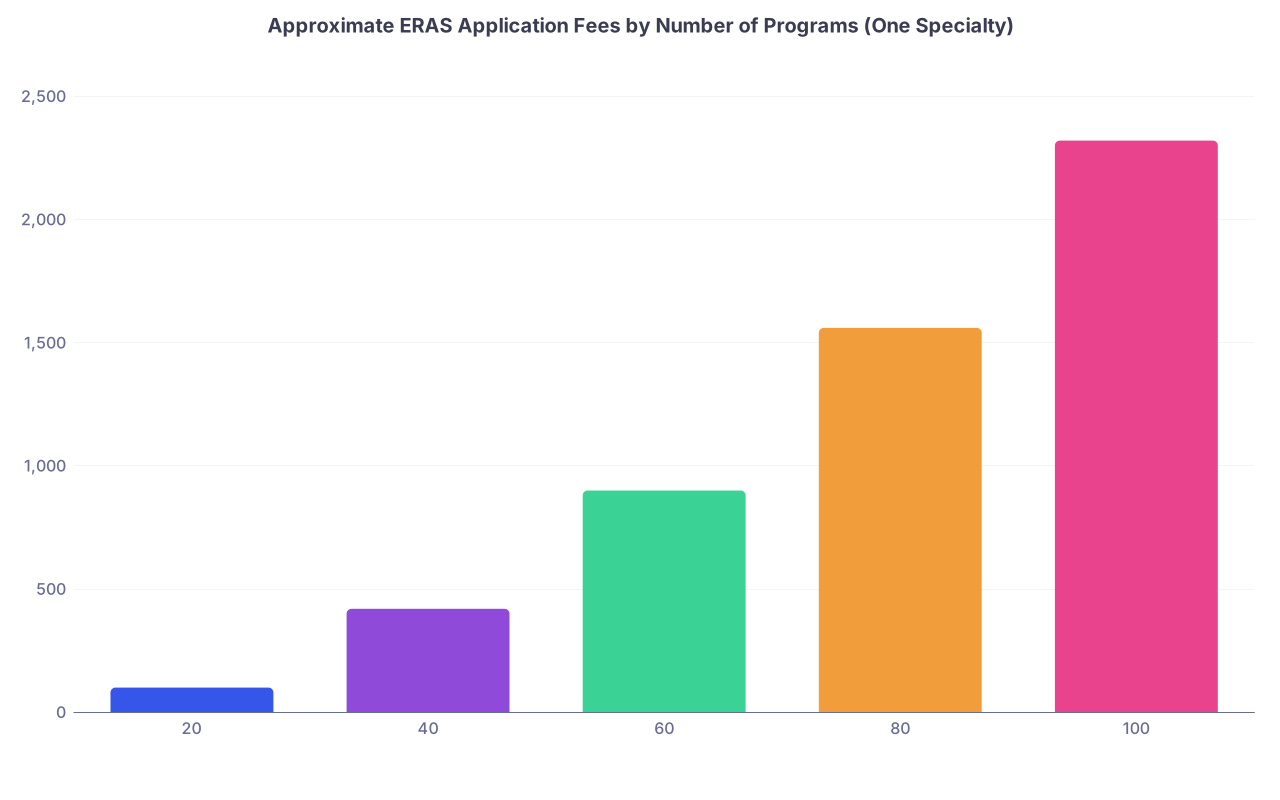
| Category | Value |
|---|---|
| 20 | 99 |
| 40 | 419 |
| 60 | 899 |
| 80 | 1559 |
| 100 | 2319 |
Those aren’t precise current-cycle numbers, but the curve shape is real: it gets expensive fast.
If you’re going to spend an extra $500–1500 because you’re scared, at least spend it where it has a meaningful chance to generate interviews. Throwing that money at long-shot prestige programs is like buying 500 lottery tickets when you could have bought a used parachute.
One of those will actually help you land.
The Hard Truth: Prestige Mostly Matters After You Match
The prestige-obsessed advice has the timing backwards.
Yes, program reputation can matter for:
- Certain fellowships
- Academic career paths
- Specific niche jobs
But all of that assumes something subtle: you matched.
Prestige doesn’t help you recover from going unmatched. It doesn’t override the psychological hit, the cost of a SOAP scramble, a research year you didn’t plan, or the risk you never re-enter the match in that specialty.
Your top priority in this game is not maximizing average program prestige. It’s maximizing your odds of holding any match letter at all in March.
Once you understand that, “where should my extra applications go?” stops being a philosophical question and becomes a boring expected-value problem. The answer changes:
- From: “As many big names as I can afford.”
- To: “As many programs as possible where I’m in the realistic yes pile and not obviously below their bar.”
That will not impress your classmates on group chat. But it will get you a job.
Key points:
- Extra applications should almost never default to higher-prestige “reaches”; they should go to safety and target programs where your stats are actually in range.
- Match probability is driven by reaching a safe interview count, not by landing a miracle invite at one or two elite programs.
- Treat prestige as a bonus once your interview numbers are secure—not as the main destination for your last, most expensive applications.