
It’s September 28th. You just submitted ERAS. You clicked “Apply to all” in three different states. Your credit card is whimpering. You’ve got 62 applications out, a spreadsheet that looks like a hedge fund model, and this thought stuck in your head:
“If I apply to 60+ programs, someone has to interview me… right?”
Let me tell you what really happens on the other side of that “Submit” button. Because the number of programs you apply to is only loosely related to who actually interviews you. The way program directors screen, who they pull up from the pile, and why some people with far fewer applications still end up with more interviews than the mass-appliers—none of that is obvious from your side of the fence.
You’re about to see how it actually works in the back room.
What Happens to Your Application the Second You Submit
Forget the fantasy that everyone who applies gets “reviewed holistically.” That phrase is for public websites and recruitment slide decks.
Inside the program office, here’s the real sequence.
Most mid-sized to large programs do some version of this:
Bulk download from ERAS
One or two people—usually the coordinator and a PD or APD—pull down hundreds of applications the first few days. For a moderately competitive specialty, 800–1500 apps is normal. For the big ones (EM, IM, Anesthesia, Psych), 3000+ is increasingly common at name-brand programs.Automatic or semi-automatic filtering
Before anyone “reads” anything, the list gets sliced. Hard.
Typical filters:- Step 1: pass vs fail (or number thresholds based on older years)
- Step 2 CK: specific numeric cutoff or “review if ≥X, soft-review 5–10 below X”
- Visa requirement: sometimes filtered early, sometimes later
- IMG vs AMG: separate buckets, often different thresholds
- Home institution / affiliate: flagged
- Couples match: flagged but rarely prioritized at this stage
“Buckets” are created
Inside GME and Excel files they won’t show you, candidates are quietly grouped like this:- “Auto-interview” (home students, rotators who did well, known quantities)
- “Priority review” (top stats, strong letters, desirable backgrounds—e.g., research-heavy at an academic IM program)
- “Maybe” (borderline metrics but something interesting)
- “No interview” (filtered out, low scores, professionalism issues, obvious mismatch)
Only a fraction of applicants ever get read like you imagine: CV, personal statement, MSPE, all thoughtfully reviewed. Most get skimmed through a lens of: “Do they meet our floor? Do they look like the kind of person we have historically ranked highly?”
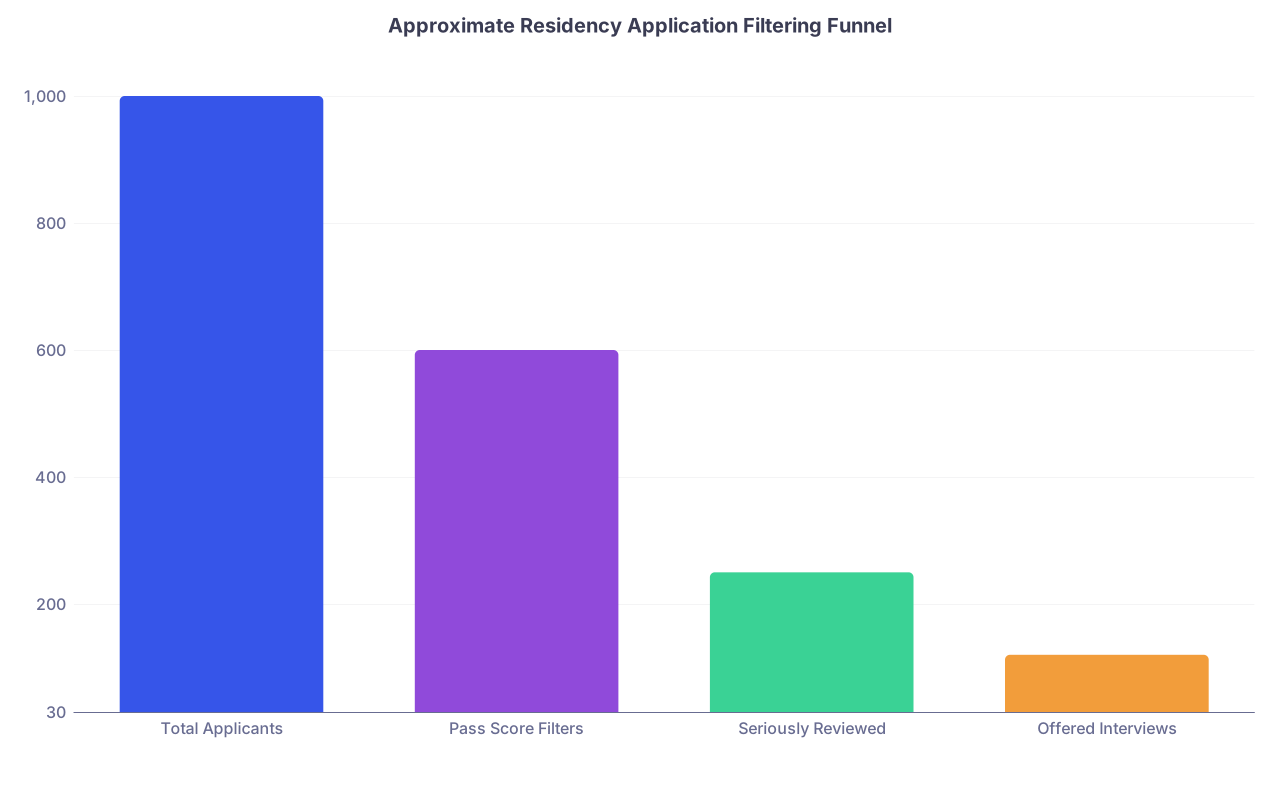
| Category | Value |
|---|---|
| Total Applicants | 1000 |
| Pass Score Filters | 600 |
| Seriously Reviewed | 250 |
| Offered Interviews | 120 |
So if you think applying to 60+ programs guarantees 60+ reasonable chances, you’re misunderstanding the funnel. You now have 60+ entry tickets to a filter, not 60 sets of human eyeballs on your application.
The Truth: Not All 60+ Programs Are Created Equal
When you blast applications to 60+ programs, you picture it like 60 independent coin flips.
That’s not how PDs see it. Behind the scenes, they’re asking:
- “Is this applicant really interested in us, or are we number 47 on their spam list?”
- “Does their profile fit what we usually match, or is this just random?”
- “Are they likely to rank us high enough to matter?”
I’ve watched PDs do this live. ERAS open on a giant monitor. Someone says, “Another one from [top med school], applied to 90 programs, including every top-40. We’re a safety to them.” And that colors how they read you.
If your strategy is “Apply to everything, sort it out later,” here’s whose pile you actually end up in.
| Applicant Type | Priority for Interview |
|---|---|
| Home or affiliate students | Very High |
| Rotators / Sub-I students | Very High |
| Strong local/regional candidates | High |
| “Perfect stat” but generic | Medium |
| Broad appliers (60–100+ apps) | Medium to Low |
| Clear mismatch with program profile | Very Low |
You’ll notice something: the person who applies to fewer, well-selected programs but signals real interest can easily get prioritized over the 80-application shotgun approach.
I’ve seen students with 28 apps get 16 interviews. And others with 85 apps scrambling with 6. The difference wasn’t luck. It was alignment and signal.
So Who Actually Gets Interviews Out of Those 60+?
Let’s slice this by general competitiveness / profile, because what 60+ programs means is radically different depending on who you are.
1. The “Solid but Not Stellar” U.S. MD in a Mainstream Specialty
Think: Internal Medicine, Pediatrics, Psych, FM, Anesthesia at non-elite programs.
Profile looks like:
- US MD, average to slightly below-average Step 2 for the specialty
- No red flags, decent LORs, some research or leadership
This is the group most likely to apply to 40–80 programs “just to be safe.”
Here’s what usually happens in the PD office with your 60+ applications:
- You get through basic filters at the majority of programs.
- At many places, you’re in the “could interview, not urgent” bucket.
- Whether you get an interview depends on:
- Geography (are you from their state/region?)
- Ties (did you mention them convincingly?)
- Specialty fit (e.g., psych with clear psych interest vs random last-minute pivot)
- How early you applied (early apps more likely to be actually reviewed, not lost in the avalanche)
If you’re moderately aligned with your list, 60+ apps in this group typically translates to something like:
- 10–20 serious looks
- 8–15 interview invites if your school is decent and no one hates your personal statement
- 5–8 if your school is unknown, letters are generic, and nothing stands out
Not because 40+ programs “rejected” you. Many never really gave you much of a chance. You were a backup option that they never needed to tap.
2. The Strong Applicant Who Panic-Spams 60+ Programs
You know the type:
- Step 2 well above average
- Honors on core rotations
- Maybe some meaningful research
- But they watched classmates panic and said, “Screw it, I’ll apply to 70 programs too.”
From the inside, these people are easy to recognize: high stat applicants with a scattershot application pattern. Michigan, Mayo, tiny community program in the middle of nowhere, random DO-heavy place, super academic, super rural, all on the same list.
Here’s the harsh reality:
You don’t get interviews from 60 programs. You get interviews from the 15–25 where your profile actually matches their historical “type.”
Academic heavy IM program? They notice your research and letters from known names.
Community-heavy program that prides itself on “we’re a family, we care about teaching more than research”? They glance at your CV, assume you want a more academic path, and quietly assume you’re ranking them low.
So despite 60+ apps, you typically land:
- 15–25 interview invites
- Mostly clustered in the same tier / culture of program that “fits” you on paper
The rest? You never had a real shot, not because you weren’t competitive, but because PDs can smell misalignment. And they do not want to waste an interview slot on someone who’s going to rank them 15th.
Where 60+ Actually Matters: Red Flags and Risk Profiles
There are people for whom 60+ is not optional; it’s survival. But again, the logic is different from what most students assume.
3. IMGs and DOs in Competitive or Semi-Competitive Fields
Here’s where behind-the-scenes behavior gets more ruthless than people admit publicly.
For IMGs/DOs in fields like radiology, anesthesia, EM, some IM programs, what actually happens:
Many academic programs use different score floors for IMGs vs AMGs.
No one advertises this. I’ve seen the spreadsheet.Visa requiring applicants get an additional layer of scrutiny: “Do we have funding / institutional appetite for more visas this year?”
Image matters. If the program touts “95% US MD/DO” on their website, their tolerance for non-US grads is often low.
So if you’re an IMG/DO in a more competitive or inconsistent specialty:
- 60+ applications is common. 80+ isn’t rare.
- From those 60–80, you might realistically:
- Pass filter at maybe 30–40
- Get truly read at 15–25
- Get 5–10 interviews if you’re solid and not delusional about tier
I’ve watched IMG applicants with 120+ applications end up with 4 interviews. Were the other 116 programs “wrong”? No. They never had the combination of visa bandwidth, PD attitude, and institutional politics to take that applicant seriously from the start.
4. Applicants With Red Flags (Fails, Gaps, Remediation)
This group absolutely should apply broadly. But again, let’s be precise about what that buys you.
- Step 1 fail
- Step 2 fail or very low score
- Extended time in med school, leaves of absence
- Unexplained gaps or professionalism issues hinted at in MSPE
What actually happens in PD rooms is blunt:
Many programs have a policy: “We do not interview anyone with a Step fail.” They won’t write that publicly. It’s often stated verbally in a faculty meeting and followed quietly.
Some programs will consider you if:
- You clearly improved (e.g., Step 1 fail, Step 2 > specialty average)
- You have a strong advocacy letter from someone the PD trusts
- Your story makes sense and does not scream ongoing risk
Where 60+ helps this group:
- It increases the chance that your application lands in one of the minority of programs willing to look past your issue.
- Out of 60–80:
- 30–50 might auto-filter you
- 10–20 might skim you and still say no
- 5–10 might genuinely consider you
- 3–8 might interview you if your narrative and rehabilitation are compelling
But here’s the inside trick:
Your odds with red flags depend much more on targeted outreach (emails, advisors calling PDs, faculty advocating for you) than on raw application count.
I’ve watched an applicant with a Step 1 fail get 7 interviews on 35 applications because two chairs picked up the phone for them. And another with 90+ apps and zero real advocates end up with 3 desperate interviews.
Why You’re Not Getting Interviews Even After Applying Everywhere
Let’s talk about the elephant in the inbox: the person who applied to 60+ programs and is sitting at 2–3 interviews in November.
Everyone around them is saying, “Just be patient, more invites are coming.” On the PD side? The reality is colder.
By mid- to late-October at most programs:
- 70–90% of interview slots are already offered.
- Waitlist exists, but it’s a thin second tier, not a real backup plan.
There are five common hidden reasons you’re not being pulled from your 60+ spread.
Your application reads as generic and unfocused.
PDs hate reading 500 applications that sound like ChatGPT wrote them. If your personal statement could be copy-pasted into any specialty or any region, you lose the “this person really fits us” advantage.Your geography story makes no sense.
PDs will say, “We are open to applicants from all over!” Behind closed doors, they still ask, “Is this person realistically going to move here and be happy?”
Midwest program, Californian applicant, no ties, no explanation. That hurts you.Your school’s reputation and letters are dragging you silently.
Not fair, but real. Some schools and letter writers are known quantities. Others are question marks. A bland letter from a known strong program > flowery letter from someone at a place the PD has never heard of.You’re competing directly with your own classmates.
In some years, one med school will flood a specialty, especially something like EM or Psych. PDs notice clusters. They will not interview five people from the same school unless they’re all stellar.You applied late or your Step 2 posted late.
Programs batch-review early. Late files end up in the “we’ll look later if we need more” stack. Often they never go back unless they’re scrambling to fill.

How Many Programs Should You Actually Apply To?
You came here looking for a number. I’m going to give you ranges, but I’ll also tell you the part everyone skips: the diminishing returns curve.
There’s a point where each additional application adds almost no additional realistic interview opportunity. For many of you, 60+ is already deep into diminishing returns.
Here’s the approximate truth for most mainstream specialties (IM, Peds, Psych, FM, Anesthesia, EM depending on year), assuming you’re reasonably realistic about tiers:
| Applicant Type | Apps Where Returns Plateau | Typical Interview Range |
|---|---|---|
| Strong US MD | ~30–40 | 15–25 |
| Average US MD | ~40–50 | 10–18 |
| US DO (no red flags) | ~50–60 | 8–15 |
| IMG (good scores, no fails) | ~60–80 | 5–12 |
| Any applicant with red flags | ~70–100 | 3–10 |
Those are rough numbers I’ve seen repeatedly across cycles. They change a bit by specialty and year, but the general pattern holds: beyond a certain point, extra applications mostly hit programs that were never meaningfully likely to interview you anyway.
The dangerous myth is: “If 40 is good, 80 is safer.”
Reality: Beyond your plateau range, that extra money and hope mostly buys you stress, silence, and more time hitting refresh.
What Actually Moves the Needle More Than Application Count
Here’s the part nobody likes because it involves work and discomfort, not just a credit card.
If you want more interviews out of your 60+ (or instead of 60+), this is where insiders focus:
Tightening your program list first
Remove places that obviously don’t fit you:- Hyper-academic if you have zero research and a community-leaning transcript
- Ultra-rural programs if your whole life screams big coastal city
- Programs that have historically taken almost no one with your background (e.g., IMG-unfriendly)
Showing clear, specific interest
A short, targeted email to a realistic program—referencing something concrete about them, not a copy-paste template—gets noticed more than your 61st blind application.Leveraging your network shamelessly (but respectfully)
A single call from:- Your department chair
- A faculty who knows the PD personally
- An advisor with a reputation for sending strong residents
can move you from “maybe later” to “offer them an interview.”
Fixing the obvious weaknesses in your file
- A rambling personal statement that never actually says why this specialty or type of program? That gets you quietly skipped.
- Generic letters from random faculty instead of strong letters from people who genuinely know your work? That kills borderline cases.
Step 2 timing
If you’re borderline, a strong Step 2 score available early in the cycle rescues more applications than 20 extra programs ever will.

| Step | Description |
|---|---|
| Step 1 | Submit ERAS to 60 programs |
| Step 2 | Auto screened out |
| Step 3 | Low priority review |
| Step 4 | Maybe or waitlist |
| Step 5 | Increased chance of interview |
| Step 6 | Interview Offered |
| Step 7 | Pass score filters |
| Step 8 | Program fit and geography |
| Step 9 | Any signal of interest |
The Quiet Reality: Who PDs Like to Interview
Program directors don’t just want “the best stats.” They want residents who will:
- Show up
- Not implode
- Not quit or transfer
- Make the program look good long term
So in that 60+ pool, the people they actually feel good about inviting look like this:
- The home or rotator student who was consistently solid and normal on the wards.
- The applicant whose story very clearly lines up with the program’s strengths: “I want underserved, continuity clinic heavy, long-term patient relationships” sent to a community-heavy FM program that prides itself on exactly that.
- The person with average scores but an application that’s coherent: their activities, statement, and letters all tell the same narrative.
- The applicant who took the time to show interest in that program, not “residency in general.”
If your application reads like you applied to 60+ because you’re scared, not because you understand where you fit, PDs feel that. And you quietly slide down the priority list.
So Who Actually Gets Interviewed When They Apply to 60+?
Let’s answer the title question cleanly.
When an applicant hits 60+ programs:
- A chunk of those programs auto-screen them out immediately for reasons they’ll never be told (scores, visa, IMG status, institutional politics).
- Another chunk technically passes the filter but never gets more than a 10-second skim and a soft “no.”
- A minority actually review them with real attention.
The ones who get pulled from that mess and offered interviews tend to be:
- Aligned with the program’s history and culture
- Geographically or personally plausible
- Showing at least some signal of interest or connection
- Backed by letters or institutions the PD trusts
- Or, in the case of red flags, supported by someone who is willing to vouch for them directly
Everyone else? They think they “applied to 60 programs.” From the PD’s perspective, they never truly existed as contenders at more than 15–25 of them.
Years from now, you won’t remember the exact number of programs on your ERAS invoice. You’ll remember whether you were deliberate or desperate. And that’s the difference between hitting submit on 60+ and actually turning those into interviews.