
You are sitting at your desk with a spreadsheet open, staring at a list of 160 residency programs. A different tab has Google Maps zoomed into three metro areas you actually care about. Your dean told you to “cast a wide net.” Your gut says that sending 120 applications to cities you would never move to is pointless. But you also really do not want to scramble (sorry, “SOAP”).
You are a highly geographic‑tied applicant. Partner with a fixed job. Kids in school. Visas dictating your options. Sick parents nearby. Or you are simply not someone who will move anywhere in the country for a job. The generic “apply to 60–80 programs” advice is useless for you.
Let me break this down specifically: how to fine‑tune your program volume safely when your geography is constrained, without self‑sabotage or going broke.
Step 1: Be Honest About How Tied You Really Are
Before we talk numbers, you need to classify your actual flexibility. People routinely mislabel this and wreck their strategy.
| Level | Description | Practical Flexibility |
|---|---|---|
| Hard‑locked | 1–2 metro areas only (family/visa/partner) | 10–20 programs total |
| Region‑locked | Several states or one broad region | 30–60 programs |
| Preference‑tied | Strong preferences but could move | 60–100+ programs |
A. Hard‑Locked
You are here if:
- Partner’s job is location‑fixed (e.g., military, tenure‑track, specialized industry).
- You share custody of children and cannot relocate.
- You must be close to a specific hospital or family member for medical reasons.
- You have a state‑specific visa or licensing constraint.
This is “I can only live in New York City or North Jersey” territory, not “I prefer the coasts.”
If this is you, you do not have a volume problem. You have a risk tolerance problem, and the ceiling on your program count is whatever exists in your locked geography. Sometimes that is 6–12 programs in a specialty. That is not “suboptimal.” That is simply the universe you are playing in.
B. Region‑Locked
You are here if:
- You can live anywhere in, say, the Midwest or the Southeast, but not coast to coast.
- You strongly need to be a flight‑drivable distance from home, but not necessarily in the same city.
- Your partner’s job market exists in multiple cities within one region.
This is the most common “highly geographic‑tied” profile I see. Here, your main levers are:
- How widely you define “your region.”
- How much you are willing to stretch that region in a worst‑case scenario.
C. Preference‑Tied (Not Truly Locked)
This is the “I really want to stay in California” crowd. Or “My family’s on the East Coast and I prefer cities.” You could actually move, but you really do not want to.
This is not the same as being hard‑locked. Students here often under‑apply and call it “geographic ties,” but what they really mean is “I do not want to leave.” Different problem. Different risk.
For this article, I am mostly talking to hard‑locked and region‑locked applicants. Preference‑tied folks should still read this, but you usually need to behave more like a standard applicant with a prioritized list of regions.
Step 2: Quantify Your Realistic Program Universe
Hand‑waving is how people get in trouble. You need hard numbers.
A. Build a Clean, Filtered List
Pull from FREIDA, program websites, and specialty-specific spreadsheets. Then filter aggressively:
- Geography filter:
- States and specific metro areas you can realistically live in.
- Eligibility filter:
- Citizenship/visa requirements.
- COMLEX‑only vs requiring USMLE.
- IMG‑friendly or not (if relevant).
- MD‑only vs MD/DO friendly.
- Specialty‑specific filters:
- Categorical vs prelim vs advanced.
- Minimum Step 2 scores (if clearly stated).
- Required home‑rotation or strong home‑school bias (for some surgical/competitive fields).
You should end with a real universe size: the number of programs that are both geographically acceptable and realistically possible based on your profile.
I will give you a rough sense of what I see in real applicants:
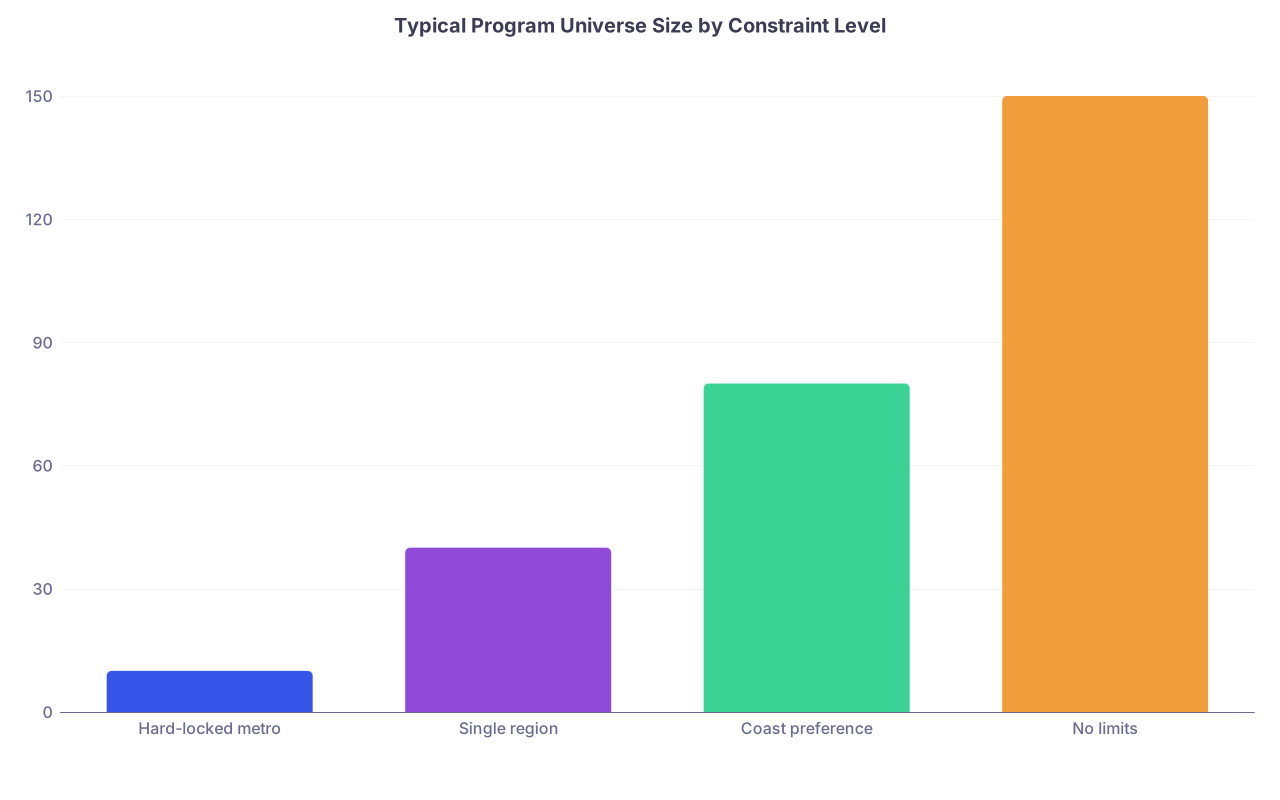
| Category | Value |
|---|---|
| Hard-locked metro | 10 |
| Single region | 40 |
| Coast preference | 80 |
| No limits | 150 |
Those are ballpark medians, not rules. But if your “I must be in Boston” list has 4 IM programs and you are aiming for a moderately competitive subspecialty later, you see the issue.
B. Classify Programs by “Realism Tier”
You cannot treat Mass General and a small community program in the same tier just because they are both in your city.
For your filtered universe only, label each program:
- Tier 1 – Reach: Your stats and story are below their usual lane, or they are top‑tier name brands with brutal competition.
- Tier 2 – Realistic: You are squarely in their typical range for scores, school type, research, etc.
- Tier 3 – Safety/Anchor: Historically interview your profile, less competitive, often community or newer programs.
Do this fast. Gut‑level is fine. You are not publishing this.
Now you can see something like:
- Total programs in acceptable geography: 32
- Tier 1: 8
- Tier 2: 14
- Tier 3: 10
That structure matters more than the raw count.
Step 3: Use Risk‑Based Targets, Not Generic Volume Advice
Most “how many programs” charts are written for national‑search, not geographic‑locked applicants. You cannot use those blindly.
What you need is a match‑safety framework that adjusts to your universe size and your competitiveness.
Let me lay out a practical structure.
A. Decide Your Target Interview Count
Do not obsess over application counts. Interview counts predict matching much better.
For most core specialties (IM, FM, peds, psych, neurology), I view:
- 8–10 interviews: Reasonable chance of matching, not guaranteed.
- 10–12 interviews: Good safety margin.
- 12–15 interviews: Strongly likely to match, barring extreme red flags.
For highly competitive specialties (derm, ortho, plastics, ENT, neurosurgery, integrated IR, etc.), the curve shifts. Even 10 interviews might not feel “safe.” For now I will assume you are dealing with a core or moderately competitive specialty; if not, your backup and dual‑apply strategy matters more than volume.
B. Translate That to a Program Target Range
Here is the reality for most applicants in the mid‑competitive range:
- Average invite rate per applied program across your real list might be 10–25% depending on your profile and specialty.
If you are geographically constrained, that invite rate often drops slightly, because you are forced to include programs above your ideal tier to fill your list.
So, rough math:
- If you have 30 realistic programs and you expect a 20% invite rate → ~6 interviews. Too low.
- If you have 50 realistic programs and you expect a 20% invite rate → ~10 interviews. More comfortable.
So what do you do if your universe is small? Three options:
- Max out your universe (apply to all geographically acceptable programs).
- Loosen your geography slightly until your universe is large enough.
- Adjust specialty strategy (dual apply, or include preliminary/TY years) if options are still inadequate.
Notice what is not on that list: “Throw 50 more applications at cities you refuse to live in.” That is performative. It calms your anxiety without improving your odds.
C. Practical Ranges by Constraint Level
Let me be specific. This is how I advise real students who are reasonably competitive (not top 1%, not bottom 5%) in core specialties.
| Constraint Level | Program Universe | Suggested Apps | Strategy Notes |
|---|---|---|---|
| Hard‑locked metro | ≤20 programs | Apply to all | Add prelim/TY if applicable |
| Hard‑locked multi‑city | 20–35 | Apply to all | Consider small stretch region |
| Region‑locked | 30–60 | 30–60 | Do not over‑prune safeties |
| Preference‑tied | 60–120 | 60–100 | Extra apps only if willing to move |
If your universe is smaller than the suggested lower bound, that is not a volume problem. That is a geography vs specialty conflict. You need to either:
- Expand geography (even minimally), or
- Adjust specialty strategy (second specialty, prelim plan, or true backup).
Step 4: Build a Tiered List That Matches Reality, Not Ego
The mistake I see constantly in geographic‑tied applicants: they pack a tight region with prestige‑heavy choices and call that a “broad list.” It is not.
Within your filtered geographic list, your goal is a healthy distribution across tiers.
As a rule of thumb for core specialties:
- Reach (Tier 1): 20–30% of applications.
- Realistic (Tier 2): 40–60%.
- Safety/Anchor (Tier 3): 20–40%.
Example. You are region‑locked to the Midwest, applying IM, with this filtered list:
- Total geographically acceptable programs: 46
- Tier 1: 10 (Chicago academic powerhouses, Cleveland Clinic, Mayo, etc.)
- Tier 2: 21
- Tier 3: 15
A sane distribution might be:
- Apply to all 15 Tier 3 (you need anchors).
- Apply to 18–20 of the Tier 2 (trim minimally for true no‑fit situations).
- Apply to 8 of the 10 Tier 1 (cut the most unrealistic).
That puts you in the 41–43 application range, which is absolutely fine for a geographic‑tied IM applicant.
If your distribution ends up like:
- 60% Tier 1
- 30% Tier 2
- 10% Tier 3
and you are not a stellar candidate, you are playing lottery, not strategy.
You cannot “volume” your way out of a bad tier mix.
Step 5: Decide Where (and Whether) to Add “Escape Hatch” Geography
Here is where the anxiety spikes. The classic fear:
“I want to stay near my family, but I am terrified of not matching. Should I apply to a handful of programs in Texas / Florida / random states as backup, even though I really do not want to move there?”
You have to be brutally clear with yourself about three separate things:
- Where are you willing to spend 3–7 years if you must?
- Where are you not willing to go under any circumstances?
- What is the realistic probability you will need that escape hatch?
A. The “Never Ever” List
If you and your partner swore you would not move to certain states for safety, family, political, or practical reasons, do not apply there. Full stop.
Applying to places you categorically refuse to rank is pointless. It does not add safety. It just adds cost and false comfort.
B. The “If I Absolutely Have To” Region
Most geographic‑tied applicants do have a few “emergency acceptable” cities or regions:
- “We could do 3 years in Phoenix or Denver if we had to.”
- “We do not want to leave the East Coast, but if I have to, I could do one Midwest city where my partner’s company has an office.”
This is where an extra 10–20 applications can be legitimately protective, especially if:
- Your core geographic region has <30 realistic programs.
- You are an average or below‑average applicant for your specialty.
C. How Many “Escape Hatch” Programs?
I am not a fan of “throw 50 more programs in random states.” That is lazy advice.
Instead, think:
- 10–15 programs in 1–2 additional cities/regions that you and your support system have actually discussed as realistic emergency options.
- Focus on safety/anchor and solid mid‑tier programs there, not more prestige reaches.
If you would truly rather SOAP locally than move away, then do not add these. But own that choice. Do not apply aspirationally to escape regions you secretly will not attend.
Step 6: Adjusting for Competitiveness, Specialty, and Red Flags
Geography is one dimension. You also have:
- Specialty competitiveness.
- Your objective metrics.
- Any red flags.
These modify volume targets.
A. For Strong Applicants
You are above average for your specialty. No Step failures, solid letters, decent research.
You can get away with:
- Slightly lower volume within a constrained geography.
- A bit higher proportion of Tier 1 programs.
Example: Regional tie to the West Coast, applying peds with strong Step 2 (260+) and honors in peds rotations. You have 30 realistic programs. Applying to all 30 is usually plenty, with a heavier weight toward academic centers.
Still, do not cut your anchors. Overconfidence is a real pathology in geographic‑tied strong applicants.
B. For Middle‑of‑the‑Pack Applicants
Average scores, decent but not glowing application. This is the majority.
You do not get to be cute with volume. You:
- Apply to essentially your entire realistic geographic universe.
- Keep a solid Tier 3 base.
- Consider small escape‑hatch geography if your core region is thin (under ~30–35 programs).
C. For Applicants With Red Flags
USMLE/COMLEX failure, leave of absence, major professionalism concern, or a significantly non‑traditional path.
You need to stop pretending geography is your only constraint. Your probability curve is different. Strategies:
- You may need dual application (e.g., IM + FM, or categorical + prelim/TY).
- You almost always need broader geography unless something truly immovable pins you to one city.
- Your Tier 3 volume needs to be heavy, with honest self‑assessment.
Applying to 80 programs in a single city with a Step 1 failure is not “safer” than applying to 40 programs across three states that might actually interview you.
Step 7: Timing and Signaling: How to Leverage Geographic Ties Without Spamming
Volume is not your only tool. How you present your ties matters just as much.
A. Make Your Ties Obvious, Early, and Specific
Programs are allergic to “I just really love your city” lines. You need:
- Concrete family connections (“Parents and two siblings live in X, I have spent every summer and holidays there for 15 years.”)
- Partner’s job details (“My spouse works for Company Y with an office in Z city, and they are already in discussions to transfer there.”)
- Prior residence or schooling.
- Clear explanation of constraints if appropriate (while still professional).
Use:
- ERAS geographic preference signals (if your specialty uses them).
- Secondary questions / supplemental ERAS essays.
- Personal statement tailoring for a few key programs or a city cluster.
B. Do Not Hide That You Are Tied
A lot of applicants are scared programs will see them as “I will leave after residency” or “inflexible.” Reality: programs worry far more that residents will leave during residency. Strong ties often reassure them.
If your reason is personal but legitimate (ill family, special needs child, etc.), you do not need a page of detail. You do need one to two clear sentences that make your non‑mobility understandable, not vague.
C. Signaling and Volume Interact
In specialties with explicit program signaling (like EM, ortho, some surgical subspecialties), you have another lever:
- With strong geographic ties, you can afford to allocate more signals to your key region, and fewer to far‑flung dream programs.
- Your signals effectively concentrate your “volume” where it actually matters.
I have watched applicants waste 3 of 5 signals on shiny programs in cities they would not attend if accepted. That is self‑sabotage.
Step 8: Cost, Sanity, and Diminishing Returns
You know ERAS is expensive. What most students underestimate is the diminishing return curve on geographic‑misaligned applications.
Over and over, I see this pattern when we back‑analyze:
- First 20–30 geographically‑aligned applications: Majority of interview invites.
- Next 20–30 still‑aligned applications: Some incremental adds, especially anchors.
- Last 30–40 random geography applications added out of fear: Virtually no interviews.
Here is a simplified visual of where most of your interviews will usually come from:
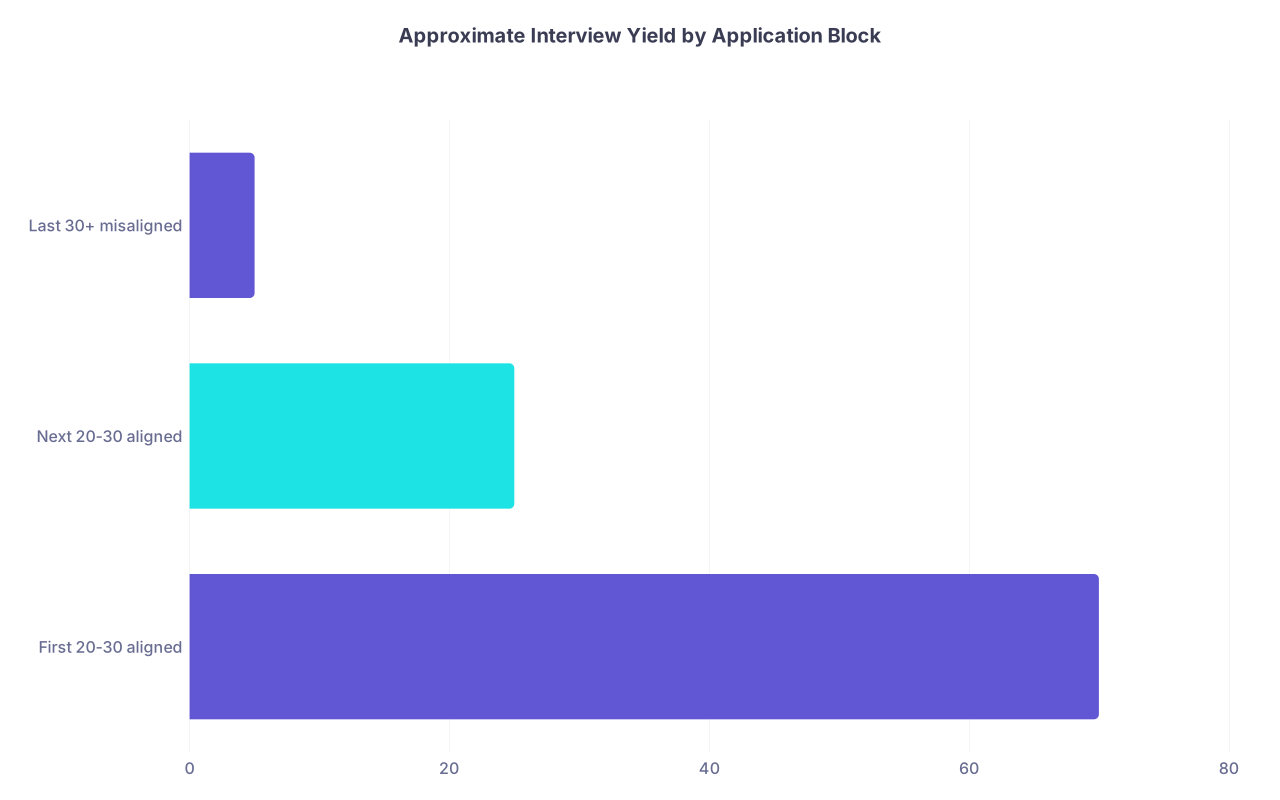
| Category | Value |
|---|---|
| First 20-30 aligned | 70 |
| Next 20-30 aligned | 25 |
| Last 30+ misaligned | 5 |
You will always find the anecdote of “I matched at the one random program in a state I added at 1 a.m. in October.” Fine. That is survivorship bias. For most people, geographic misalignment kills yield.
Calibration rule:
- If a program director looks at your file and says, “Wait, why would this person come here?”, your interview probability is already crippled.
- If the only reason you applied is “I am scared,” the return is usually terrible.
I am not saying never apply outside your main geography. I am saying: do it only where you can articulate a plausible reason for being there, to yourself and to them.
Step 9: Reality Checks With Scenarios
Let me run through three concrete scenarios to show you how I would fine‑tune volume.
Scenario 1: Hard‑Locked to One Metro, Core Specialty
- Specialty: Internal Medicine.
- Location: Hard locked to NYC metro (partner in residency there, shared childcare).
- Stats: Step 2 in the mid‑240s, no red flags, average research.
Filtered list, NYC + immediate suburbs:
- Total IM categorical: 18 programs.
- Tier 1: 6 (Columbia, Cornell, NYU, etc.)
- Tier 2: 7
- Tier 3: 5
Strategy:
- Apply to all 18 categorical programs.
- Apply to 4–6 local prelim/TY IM programs only if you have a credible prelim + reapply plan or EM/Anes/Neuro path.
- No “random” states. Geography is truly hard‑locked.
Your match risk is higher than a free‑to‑move applicant. That is reality. But adding 40 programs in places you refuse to move is fantasy. Instead, you squeeze every ounce out of:
- Letters, sub‑Is, and away rotations in that city.
- Demonstrating rock‑solid ties.
- A tight, polished application.
Scenario 2: Region‑Locked to Midwest, Psych
- Specialty: Psychiatry.
- Location: Must be in Midwest (partner law job opportunities limited to Chicago, Minneapolis, St. Louis, Milwaukee, Detroit, Cleveland).
- Stats: Step 2 in low‑230s, DO, decent clinical evals.
Filtered list (those metro areas only):
- Total psych programs: 39.
- Tier 1: 8.
- Tier 2: 19.
- Tier 3: 12.
Strategy:
- Apply to all 12 Tier 3 and all 19 Tier 2 = 31 programs.
- Add 5–7 of the 8 Tier 1 where your DO status is not a major barrier (based on past match lists, DO residents on their website).
- Optional: add 5–8 programs in one “escape hatch” metro with real partner prospects (say Denver), focusing on Tier 2/3.
Total: 36–43 applications. That is a very reasonable, safe volume for a geographic‑tied psych applicant.
Scenario 3: Preference‑Tied to California, IM, Average Applicant
- Specialty: IM.
- Location: Strong preference for California, but no absolute reason you cannot leave.
- Stats: Step 2 228, mid‑tier US MD, average application.
Filtered California IM programs:
- Total: 28.
- Tier 1: 7.
- Tier 2: 11.
- Tier 3: 10.
Strategy:
- Apply to all 28 in CA.
- Recognize this is preference‑tied, not hard‑locked.
- Add 20–25 programs in nearby Western states (OR, WA, NV, AZ, CO) where you could realistically see yourself for 3 years.
- Focus on Tier 2/3 out‑of‑state; pick only 3–5 big‑name reaches.
Total: ~50–55 applications, but with real willingness to attend any of them. If you honestly would not go to half of those states, cut them and accept increased risk.
The worst version of this scenario is: 30 California applications + 40 random East Coast applications “just in case,” with zero intent to move. That is not a plan. That is avoidance.
Step 10: Know When the Problem Is Not Volume
Sometimes the hard truth is this: your geography + your specialty + your competitiveness do not line up. No amount of optimizing program count fixes that.
Signals that this might be true:
- Your constrained region has <15–20 programs in your specialty, and you are not a standout.
- Multiple advisors independently tell you your target is unrealistic for your geography.
- Programs in your region are heavily prestigious/academic and you are substantially below their usual Lane.
Then you are not tweaking volume. You are choosing between:
- Broadening geography now.
- Switching or adding a less competitive specialty.
- Accepting a real risk of SOAP or no match.
I have seen people ignore this, apply to 80 programs in a tiny region in a competitive specialty, and then be shocked in March. That is not a volume failure; it is a strategy failure.
Key Takeaways
- Start by quantifying your real geographic universe and then tier those programs; your tier mix matters more than an arbitrary application count.
- Apply broadly within your true constraints, add only those “escape hatch” regions you would genuinely attend, and stop wasting money on places you would never rank.
- When geography, specialty, and competitiveness conflict, recognize it early—sometimes you need to adjust specialty or flexibility, not just push your ERAS cart to 100+.