
Brand‑new residency programs break every lazy rule of thumb about “how many programs to apply to.”
Most applicants either ignore them completely or treat them like free lottery tickets. Both approaches are wrong. New programs can absolutely change how many programs you should apply to, but only if you understand the math, the risk, and what “new” actually means in residency world.
Let me break this down specifically.
1. The Two Myths About New Programs That Mess Up Your List Size
There are two persistent myths I see every cycle:
- “New programs are easy matches, so I can apply to fewer places.”
- “New = risky, so I’ll ignore them and just apply to the usual number.”
Both are too simple. And simple gets you unmatched.
The reality is more nuanced:
- Some new programs are extremely applicant‑friendly and can function as “extra safety” that genuinely lets you keep your total application number reasonable.
- Some new programs are chaotic, under‑resourced, or geographically undesirable and will behave like black holes: tons of applications, few interviews, unpredictable ranking behavior.
- A “new” program in a large academic system with established fellowships is not the same species as a brand‑new standalone community program in a town nobody can locate on a map.
You cannot assign a blanket strategy like “add 5 new programs.” You have to categorize them, then adjust your targets (how many total programs to apply to) and mix (how many reaches / cores / safeties) accordingly.
2. First, Know Your Baseline Number Without New Programs
Before you think about brand‑new anything, you need a baseline: how many programs you’d apply to if every option was established.
This depends on:
- Specialty competitiveness
- Your competitiveness
- Whether you are US MD, US DO, or IMG
- Geographic constraints
Here is a rough baseline framework I use when advising students (before counting any new programs):
| Specialty Tier | Strong Applicant* | Average Applicant | At-Risk Applicant** |
|---|---|---|---|
| Less competitive (FM, psych, IM community) | 15–20 | 25–30 | 35–45 |
| Mid-tier (peds, OB/GYN, anesthesia) | 20–25 | 30–40 | 45–65 |
| Competitive (EM, gen surg, neuro) | 30–40 | 45–60 | 65–80 |
| Very competitive (ortho, derm, ENT, plastics, rad onc) | 45–60 | 65–80 | 80–120+ |
* Strong: solid scores, no red flags, appropriate experiences
** At-risk: below-average scores, attempts, gaps, visa needs, or major geographic restriction
Now keep that in your head. That is your “no‑new‑programs” number.
We’re going to modify that based on how many brand‑new programs you add, and what type.
3. Not All “New” Programs Are The Same: Know What You’re Adding
People say “new programs” like it is a single thing. It is not.
Here are the main “new” categories and how they behave from an application‑strategy standpoint.
3.1 True PGY‑1 New Program (Year 1 of Accreditation)
This is the classic ACME‑New‑County Hospital IM Residency, PGY‑1 class starting for the first time.
Signals:
- ACGME accreditation date in this or last cycle
- No historical residents
- No prior match data
- Often starting with small class sizes: 4–6 residents
These programs typically:
- Over‑interview initially (to make sure they fill)
- Are more open to “borderline” applicants if they sense genuine interest
- Have variable mentorship and infrastructure, depending on how serious the institution is
These can function as real “safety” additions—but only if they are not in the most desirable cities and if they are run by a reasonably stable institution (large health system, academic affiliate, etc.).
3.2 Recently Expanded or Split Programs (Functionally New Slots)
Not always labeled as “new program,” but your application strategy should treat the extra PGY‑1 positions like new capacity.
For example:
- A long‑standing IM program going from 12 → 18 interns
- A former prelim‑only site now offering categorical positions
- A program that split into tracks (rural, community, research tracks)
These “new” seats behave much more predictably. They inherit the reputation, faculty, and infrastructure of the parent program.
From a numbers standpoint:
- They are generally better value per application than a totally unknown startup
- Their interview behavior is closer to established programs, but often with slightly more flexibility
3.3 Rebranded or Reaccredited Programs
Looks new on ERAS. It is not.
Examples:
- Hospital system merge with new name
- Program that temporarily lost accreditation and is now reinstated
- Program moved institutions but same PD and core faculty
These should be treated like lower‑tier established programs with some instability. Do not count them as true “new” safeties.
4. How New Programs Distort Supply, Demand, and Your Risk
Think in terms of slots and attention.
When new programs open:
- Total number of PGY‑1 positions increases
- Applicant pool size stays roughly the same during a single cycle
- Applicant behavior changes: some people aggressively chase “easier” new spots, others ignore them
This matters for how many programs you need to hit your target number of interviews.
Here is the dynamic I have repeatedly seen:
Year 1–2 of a new program:
- Lots of curiosity, but many strong applicants prefer safer established names
- New program often interviews more broadly, including applicants who are “long shots” elsewhere
- They may over‑rank to avoid going unfilled
Year 3–5:
- Word gets out; either “this place is great” or “avoid this chaos”
- The program’s behavior normalizes toward the market
For your application strategy, early‑phase new programs can:
- Serve as extra interview sources (especially for at-risk applicants)
- Justify holding your total application number closer to baseline instead of panicking and doubling it
- Offer “signal” opportunities (if they accept preference signals or geographic signals) where you actually stand out
But they do not give you permission to under‑apply in competitive specialties. Anyone telling you “just add 3 new programs and you’ll be fine” is guessing.
5. Concrete: How New Programs Change Your Application Count
Let us talk numbers. You care about how many programs to apply to, not philosophy.
I will walk through typical scenarios and show you how new programs should actually change your targets.
5.1 Scenario A: Mid-Range Applicant in Less Competitive Specialty (FM/IM/Psych)
Profile:
- US MD
- No failures, no major red flags
- Average Step 2, average clinical performance
- Flexible on geography
Baseline (no new programs): 25–30 applications in IM or FM is reasonable.
Now, suppose:
- In your preferred geographic regions, you identify:
- 4 truly new programs (PGY‑1 year 1)
- 3 established programs that just added new tracks or expanded by ≥3 residents
How does this impact your number?
Here is how I would recalibrate:
- Keep your core of established programs: 20–22 applications
- Add the 4 true new programs
- Add 2 of the expanded programs (prioritizing those in less desirable locations / more IMG‑friendly or historically less competitive parts of your region)
Total: around 26–28 programs.
Notice what did not happen: you did not drop your total to 18 just because you added “easier” new programs. You used them to avoid creeping toward 35–40, not as an excuse to under‑apply.
5.2 Scenario B: Average Applicant in Mid-Competitive Specialty (Anesthesia/OB/Peds)
Profile:
- US DO with solid but not stellar Step 2
- Decent letters, some leadership
- Wants to stay mostly in the Midwest and South
Baseline: 30–40 anesthesia programs.
You find:
- 3 new anesthesia programs starting PGY‑1
- 2 programs with big expansions
- 1 rebranded program that looks new but clearly has prior grads
Adjustment:
- Do not count the rebranded program as “new safety.” Evaluate it as a lower‑tier established option.
- Keep baseline 30 established programs.
- Add 3 new PGY‑1 programs that look reasonably stable and not in hyper‑competitive cities.
- Add maybe 1 of the expanded programs if it fits your geography.
Total: ~34–35 programs.
If you are on the weaker side (borderline scores, no home program), you do not reduce your baseline. You let new programs push you toward the higher end (40+) without having to exclusively chase bottom‑tier established options.
5.3 Scenario C: At-Risk Applicant in Competitive Field (EM, gen surg, neuro)
Profile:
- US MD
- Step 2 just below average for the specialty
- No catastrophic red flags, but not a strong applicant
- Reasonable flexibility on geography
Baseline (no new programs): 55–70 applications, depending on how competitive the year looks.
You find:
- 4 new EM programs starting year 1
- 5 recently expanded EM programs adding 3+ positions
- 2 community programs that previously were very small, now doubling class size
Here is where many people make a mistake. They think, “Lots of new EM spots, I can just apply to 40–45.”
Bad idea.
What I would actually advise:
- Target 50–55 established programs (yes, really)
- Add all 4 new EM programs that seem remotely viable
- Add 3–4 of the expanded programs that fit your geography or appear more community‑oriented / IMG‑friendly / historically less competitive sites
Your new target is more like 60–65.
New programs here are not a reason to shrink your list. They are extra lottery tickets in a hyper‑competitive space where your baseline risk is already high.
6. How to Vet New Programs Before You Let Them Change Your Numbers
Before you let a “new” program justify a lower total application count, you need to interrogate it.
Here is the concrete checklist I use when looking at new programs with students.
6.1 Institutional Backing
Who owns the hospital?
- Major academic center or university system → higher floor, more stable
- Large regional health system (HCA, Ascension, etc.) → variable, but usually decent infrastructure
- Tiny independent hospital → proceed with caution
A brand‑new IM program at “Big State University Medical Center – Satellite Campus” is not the same risk as “Rural Valley Community Hospital IM Residency, PGY‑1 class of 4.”
6.2 Program Leadership
Look for:
- Experienced program director who has been PD, APD, or core faculty at another ACGME program
- Not just “enthusiastic hospitalist” with no prior graduate medical education leadership
If the PD has a history at a strong program, that new site often benefits from imported structure, policies, and connections.
6.3 Clinical Volume and Case Mix
Do they have:
- Enough admissions, operative volume, ICU exposure?
- Clear affiliated sites spelled out (VA, children’s hospital, main campus)?
For surgical fields, a new program without robust case numbers is dangerous. You do not want to be the experiment cohort discovering the volume is inadequate.
6.4 Residents Already on Site
Key distinction: are you the first residents in the hospital, or just first in that specialty?
- Hospital already hosting IM and FM residents → they know how to run GME
- You are literally the first residents → higher chaos potential
I have seen early cohorts in brand‑new “resident‑naive” hospitals get crushed with scut, vague supervision, and last‑minute schedule changes.
6.5 Geography and Applicant Demand
A new program in:
- Manhattan, Boston, LA, Seattle → will likely be flooded with applications despite being new
- Rural Midwest, deep South, remote West → may actually struggle to attract enough applicants at first
New programs in highly desirable cities do not function as “safeties.” They just add uncertainty.
7. Strategic Ways New Programs Let You Adjust Your Targets
Now that we have structure, here is how you actually use new programs to adjust your numbers in a rational way.
7.1 You Can Avoid Panicked Over-Application
Without new programs, anxious students often inflate from:
- A reasonable 35–40 → an absurd 70–80, “just in case.”
If you can identify:
- 3–6 credible new or newly expanded programs in your preferred region(s)
- With solid institutional backing and a sane PD
Then you can often:
- Sit at the upper end of the recommended baseline instead of doubling it
- Example: for average anesthesia applicant, staying at 35–40 instead of sprinting to 60+ just because everyone on Reddit is panicking
7.2 You Can Target Geographic Backups More Intelligently
If you are region‑locked (family, spouse, visa, etc.), new programs in “less shiny” parts of your region are gold.
Example:
- You want to stay in the Northeast, but Boston/NYC/Philly are long shots for your stats.
- Two new programs open in upstate New York and rural Pennsylvania, plus one expansion in western Massachusetts.
You use these to:
- Bolster your “safety” tier within your region
- Avoid having to dump 20+ applications into regions you do not actually want just to hit your interview count
7.3 You Can Add “High Variance” Options Without Wasting Slots
Some new programs are high variance: could be excellent, could be unstable. If your budget allows, they can be smart marginal additions.
For example:
- You are already applying to 60 gen surg programs.
- You see 3 new community surgery programs with decent institutional backing but unknown quality.
Adding these 3 on top of 60 is rational. Dropping 10 established programs so you can “swap them” for these 3 is not.
8. Using Data: Interviews per Application and New Programs
You do not match by applications. You match by interviews.
What new programs really do is change your expected interviews-per-application ratio.
Typical (very rough) patterns I see in many specialties:
Strong applicant in mid‑competitive field:
- Established programs: 20–30% II rate
- New programs: sometimes 30–40% (they are hungrier, cast wider nets)
Average applicant:
- Established: 10–20%
- New: 15–25%
At-risk applicant:
- Established: 5–10%
- New: 10–20% in friendly locations
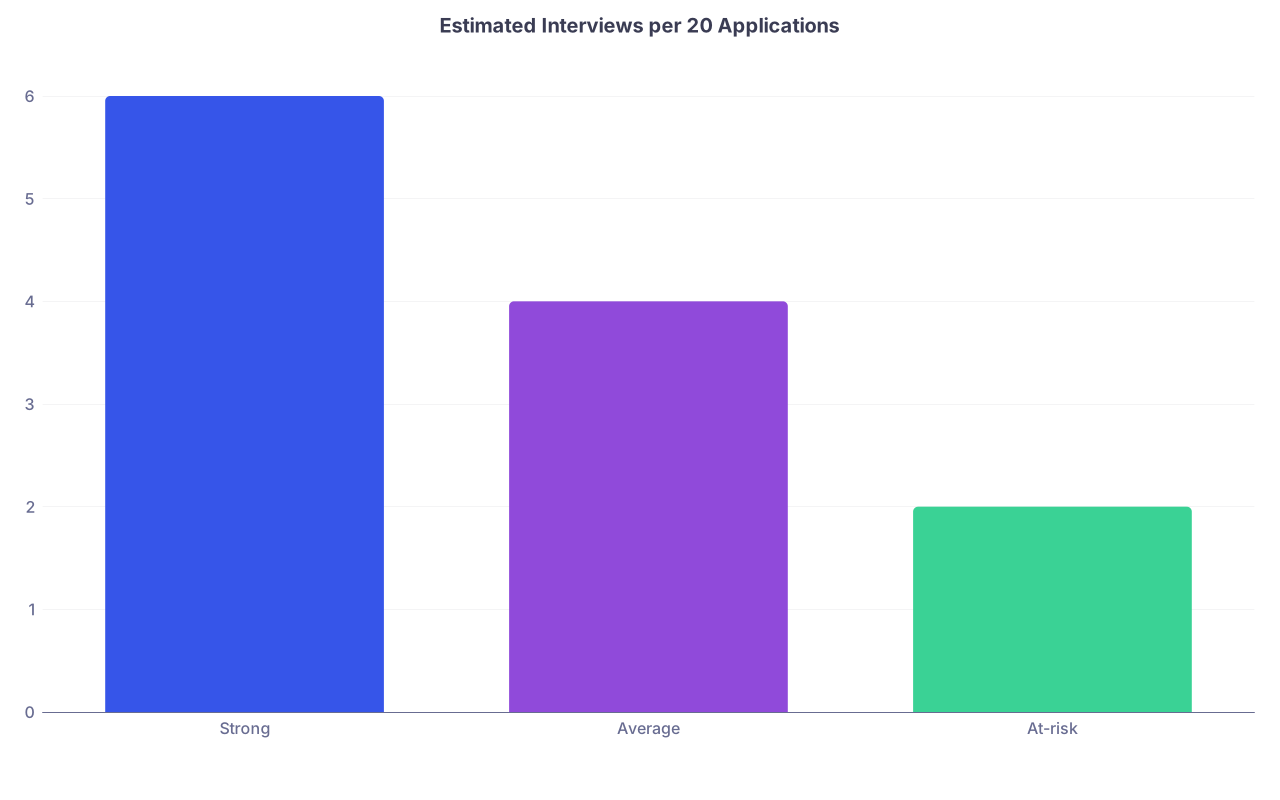
To visualize how adding new programs could change outcomes, think like this:
| Category | Value |
|---|---|
| Strong | 6 |
| Average | 4 |
| At-risk | 2 |
Imagine:
- 40 established programs only, average applicant: maybe 4–6 interviews.
- 30 established + 10 well‑chosen new programs: that might increase to 5–8 interviews instead of forcing you to go to 60+ established programs.
The exact numbers are not the point. The pattern is. New programs, if vetted correctly, can bump your effective II yield—especially if you are not at the top of the pool.
9. Common Dumb Mistakes With New Programs (Do Not Do These)
I have watched these play out in real time.
Counting every “new” listing as a safety
- Some “new” listings are just renamed, still‑competitive academic programs. Do your homework.
Slashing established choices to “make room” for new ones
- You add 6 new programs and drop 10 solid but less exciting established sites. Net risk goes up, not down.
Ignoring new programs in unglamorous locations
- The best safety programs are often in places your classmates wrinkle their noses at. This is your opportunity, not a punishment.
Trusting marketing alone
- Slick website, brand‑new logo, and the phrase “innovative curriculum” tell you nothing about call schedules, workload, or support.
Assuming new = malignant
- Some new programs are built by people who left malignant systems to do it right. They often overcompensate on wellness, mentoring, and teaching early on.
10. Practical Step-by-Step: How to Integrate New Programs Into Your List
Let me give you a concrete workflow, so you are not just theory‑rich but implementation‑poor.

| Step | Description |
|---|---|
| Step 1 | Set baseline target range |
| Step 2 | Build core list of established programs |
| Step 3 | Identify all new and expanded programs |
| Step 4 | Vet each new program |
| Step 5 | Add as supplements to list |
| Step 6 | Exclude or treat as low tier |
| Step 7 | Recheck total applications vs budget |
| Step 8 | Adjust within baseline range not below it |
| Step 9 | High quality and fits goals? |
Step 1: Determine your baseline range for your specialty and profile (without new programs).
Step 2: Build your core list of established programs first. Do not look at new ones yet.
Step 3: Identify all new / expanded programs in your specialty and regions.
Step 4: Vet them with the checklist: institution, leadership, volume, existing residents, geography.
Step 5: Add vetted new programs on top of your baseline core, especially in your “safety” and “backup geographic” bands.
Step 6: Adjust total count within your baseline range if budget is tight, but do not dip below a safe floor just because you added new sites.
11. Quick Specialty-Specific Nuances
Different specialties interact with new programs differently. A few targeted points.
11.1 Internal Medicine / Family Medicine
- New programs in community hospitals can legitimately be strong safety additions.
- Be careful with tiny hospitals with limited subspecialty support. Training may be narrow.
- For IMGs, new community programs in less desirable locations are often high‑yield interview sources, but check visa history and institutional visa policies.
11.2 Emergency Medicine
- Post‑2020, EM has gone through weird workforce shifts and variable applicant behavior.
- New EM programs at small hospitals concern me more; you need volume, trauma, and a variety of pathology.
- Use new programs to increase your total options, but not to shrink your baseline if your metrics are average or below.
11.3 General Surgery
- Volume and case mix are absolutely nonnegotiable. A shiny new surgery program with low volume is not a safety, it is a liability.
- Expanded spots at established surgical programs (added PGY‑1 positions) are often much safer bets than completely new standalone programs.
11.4 Psych, Neuro, Peds
- New psych and neuro programs at community sites can be very friendly to a wide range of applicants.
- Especially true in regions with growing mental health demands and underserved populations.
- Here, new programs can more safely justify staying at the lower half of your baseline range if the rest of your application is solid.
12. The Short Version: How New Programs Change Your Number Targets
I will end this without fluff.
Here are the core points you actually need to remember:
New programs rarely let you safely drop below your baseline target range.
They help you avoid escalating way above it.Treat new programs as supplemental interview generators, not magic safeties.
Vet them hard: institution, leadership, volume, hospital culture, and geography.Use them strategically to shore up your safety and regional backup tiers.
Especially in less glamorous locations, they can materially improve your odds without exploding your application count.
If you build your list like that—baseline first, new programs second—you will use new programs as tools, not talismans.