
Most applicants applying “community-only” still behave like they’re chasing Harvard. That is how people waste money, burn out, and still end up unmatched.
Let me break this down specifically.
If you genuinely want community programs, and you are not targeting the ultra-competitive coastal academic giants, you should not be applying to 80+ programs for most core specialties. That is fear, not strategy.
You are in a different game:
- Different geography.
- Different competitiveness.
- Different expectations.
- Different risk profile.
So the question is not “How many programs total?”
It is “How many programs, given my specialty, stats, and a community-only preference, in less competitive regions?”
That is a very different calculation.
1. What “Community-Only in Less Competitive Areas” Actually Means
First, let us define the lane you are claiming.
You are not:
- Trying to match at MGH, UCSF, Hopkins, Mayo, or similar
- Making “NYC/Boston/LA/SF only” your target
- Dependent on a research-heavy CV to get a big-name letter
You are usually:
- Open to medium or small cities, often in the Midwest, South, or non-coastal West
- Willing to train at non-university-affiliated or loosely affiliated hospitals
- Prioritizing:
- operative volume or hands-on experience
- family proximity
- lifestyle and cost of living
- or simply “I just want to be a solid clinician, not an NIH-funded PI”
This matters because community programs in these markets:
- Often receive fewer applications per spot than top urban academic centers
- Are more willing to look past imperfect scores, attempts, or “nontraditional” paths
- Care more about:
- geographic ties
- evidence you actually want them
- solid, safe clinician potential rather than research brilliance
But “less competitive” does not mean “guaranteed.”
You can still absolutely go unmatched if you under-apply or choose the wrong mix.
2. The Three Levers That Actually Drive “How Many Programs?”
Forget the vague advice you hear on Reddit. Your application volume in a community-only, less competitive strategy is driven by three levers:
- Specialty competitiveness
- Applicant risk category
- Geographic restrictiveness
Let us take them systematically.
2.1 Specialty Competitiveness (Reality Check, Not Vibes)
You are not applying to “residency.” You are applying to a specific specialty in specific regions with specific supply–demand dynamics.
For “community-focused, less competitive area” targeting, we break specialties into four tiers:
| Tier | Relative Competitiveness | Example Specialties |
|---|---|---|
| 1 | Very high | Derm, Ortho, Plastics, ENT, Urology |
| 2 | High | Gen Surg, EM (recently volatile), Anesthesia, OB/GYN |
| 3 | Moderate | IM categorical, Pediatrics, Psych, PM&R |
| 4 | Lower (but not zero) | FM, Pathology, Neurology (varies by region) |
If you’re trying to do “community-only” in Tier 1 (derm, ortho, etc.), you are still in a bloodbath. There is no “less competitive” magic button there; only “slightly less insane.”
If you’re in Tier 3–4 (IM, FM, peds, psych, many community neurology and path programs) in non-coastal regions, that is where “right-sizing” your application volume actually becomes rational and safe.
2.2 Applicant Risk Category
Do not skip this. Your self-assessment here determines whether “30 programs” is smart or suicidal.
I use three buckets:
- Low-risk applicant
- US MD or strong DO
- No exam failures
- Scores roughly within or above recent matched averages for that specialty
- Continuous training, no major red flags, decent letters
- Moderate-risk applicant
- Slightly below-average scores
- One or two weaker clerkships, or a gap year not clearly explained
- Average or light research for the specialty
- DO applying to a historically MD-heavy field, or older grad (3–5 years)
- High-risk applicant
- Step/COMLEX failure
- Significant time since graduation (>5 years)
- IMG without strong US-based backing
- Major professionalism or academic issues
- Applying into a specialty historically unreceptive to your profile (for example: IMG into derm)
You cannot choose your risk category by “positive mindset.” Programs see your file and put you in these mental buckets almost instantly.
2.3 Geographic Restrictiveness
Your words: “less competitive areas” and “community-only.”
Reality: Many applicants say that, then secretly apply to 20 NYC community programs and 5 in Ohio and call it “broad.”
No. That is not less competitive. That is just not academic.
You must be honest about three things:
- Are you OK with:
- Midwest (Ohio, Indiana, Iowa, Kansas, Missouri, etc.)
- Deep South (Alabama, Mississippi, Arkansas, Louisiana, rural Georgia)
- Plains and Mountain states (Nebraska, the Dakotas, Idaho, etc.)
- Can you live without a major coastal city:
- No New York, Boston, DC, LA, SF, Seattle as “must-haves”
- Are you willing to go where:
- Programs struggle to recruit
- Local med schools feed most residents
- Weather, politics, or culture may not match your ideal
If you are truly open to broad non-coastal community programs, your needed application count drops.
If you say you’re open, then quietly restrict 90% of those regions, your match risk goes up quickly.
3. Concrete Application Number Ranges – By Tier and Risk
This is what you came for. Let us make this brutally explicit.
These ranges assume:
- Community or community-heavy programs
- Midwestern / Southern / non-coastal preference or openness
- You are not chasing top-5 name brands as your primaries
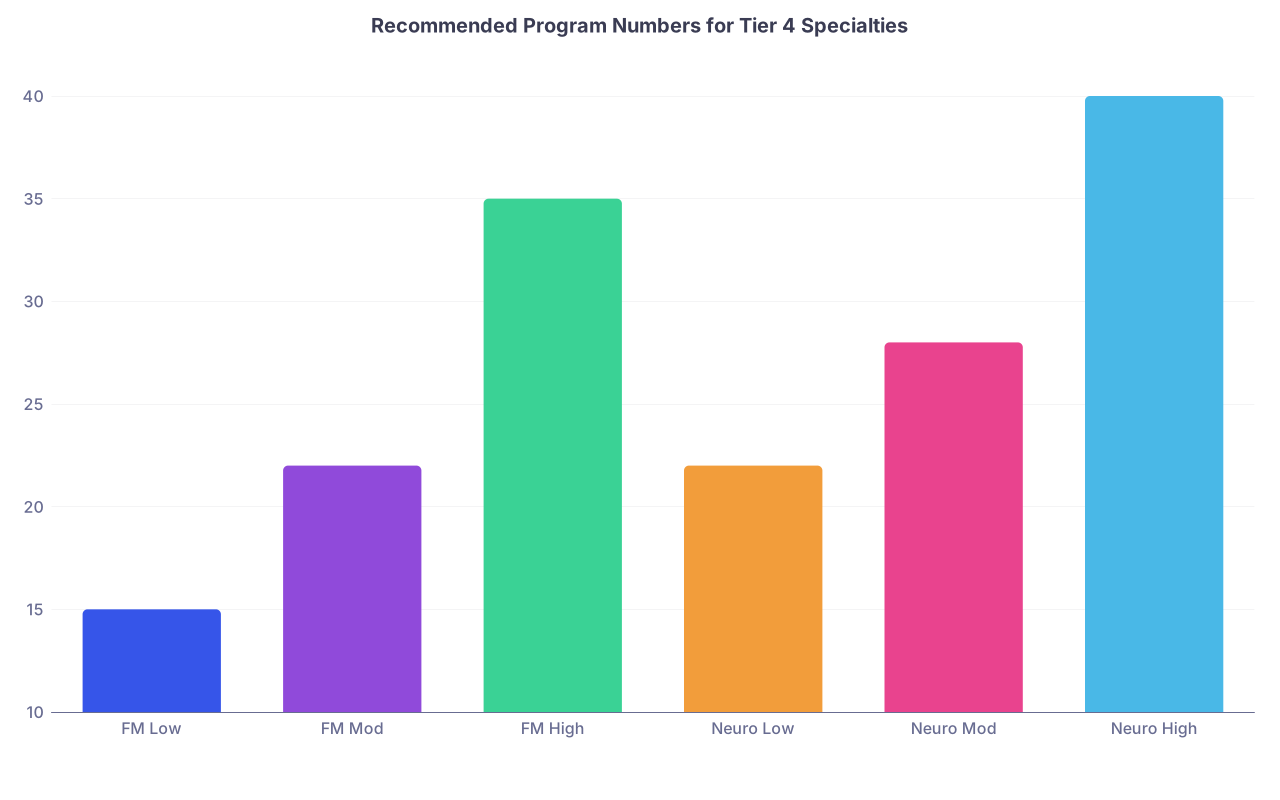
3.1 Tier 4: Family Medicine, Path, Many Community Neurology
For true “community-only, less competitive geography,” this is where right-sizing saves the most money.
Low-risk applicant (US MD/DO, no red flags)
- FM: ~12–18 programs
- Path: ~15–20
- Neurology (community-heavy): ~18–25
Moderate-risk applicant
- FM: ~18–25 programs
- Path: ~20–25
- Neurology: ~25–30
High-risk applicant (IMG, failures, older grad)
- FM: 30–40 programs
- Path: 30–40
- Neurology: 35–45
If you are low-risk and applying to 40+ FM programs exclusively in the Midwest and South, that is defensive overkill. I have watched strong FM applicants carry 60 applications and 30 interviews because they were terrified, then collapse under travel, miss interviews, and rank sloppily. Not necessary.
| Category | Value |
|---|---|
| FM Low | 15 |
| FM Mod | 22 |
| FM High | 35 |
| Neuro Low | 22 |
| Neuro Mod | 28 |
| Neuro High | 40 |
3.2 Tier 3: IM, Peds, Psych, PM&R (Community-Focused)
This is the “sweet spot” for your question. Many applicants here should strategically use community programs in less competitive regions.
Internal Medicine (categorical, community-heavy, non-coastal)
- Low-risk: 18–25 programs
- Moderate-risk: 25–35 programs
- High-risk: 35–50 programs
Pediatrics (community / smaller children’s hospitals)
- Low-risk: 15–22
- Moderate-risk: 22–30
- High-risk: 30–45
Psychiatry (community or mixed, non-coastal focus)
Psych has heated up, but non-coastal community slots still exist.
- Low-risk: 18–25
- Moderate-risk: 25–35
- High-risk: 35–50
PM&R (largely academic-associated but with community tracks)
- Low-risk: 18–25
- Moderate-risk: 25–35
- High-risk: 35–45
If you are a US MD with solid IM numbers, truly open to, say, Ohio, Indiana, Missouri, Kentucky, and the Carolinas, you should not need 60 applications. Applicants who do that usually:
- Did not research programs
- End up with bloated, random lists
- Exhaust themselves during interview season
3.3 Tier 2: Surgery, EM, Anesthesia, OB/GYN (Community, Non-Coastal)
Here, “community-only, less competitive area” does reduce your needed volume, but not to FM levels. These are still competitive enough that under-applying is dangerous.
General Surgery (community-focused, non-coastal)
- Low-risk: 35–45 programs
- Moderate-risk: 45–60
- High-risk: 60–80
Emergency Medicine
Recent EM market volatility complicates this, but for now:
- Low-risk (US MD, no failures, okay SLOEs): 25–35
- Moderate-risk: 35–45
- High-risk: 45–60
Anesthesiology
- Low-risk: 25–35
- Moderate-risk: 35–45
- High-risk: 45–60
OB/GYN
- Low-risk: 30–40
- Moderate-risk: 40–55
- High-risk: 55–70
Even here, if you’re a well-positioned US MD, truly targeting Midwest/South community surgery programs, sending 100+ applications is rarely rational. That is scarcity panic, not planning.
3.4 Tier 1: Derm, Ortho, ENT, Uro, Plastics
Let me be blunt:
If you are trying to “play the odds” by aiming community-only in less competitive regions for these specialties, you still live in a hyper-competitive jungle.
You will not get to apply “lightly.” Even in the middle of nowhere, they get flooded with apps.
For these, community-only helps a bit, but your floor is still high:
- Low-risk: 50–70 programs
- Moderate-risk: 70–90
- High-risk: >90 and seriously consider a parallel plan (FM, IM, prelim–categorical bridge)
If your question is specifically about “right-sizing” and saving money, this tier is not where you’ll get big savings without big risk.
4. How Community-Only Strategy Changes Your Risk Profile
The single biggest advantage you hold: signal. Most applicants do not genuinely want these smaller community programs. They just spray ERAS.
Programs feel that. They complain about it every year:
- “We interviewed them, and clearly they just want to get back to the coast.”
- “They have no ties here. They will be gone the second they graduate.”
You can stand out by leaning into your community-only preference.
4.1 What Community PDs Watch For
I have heard versions of this exact quote repeatedly:
“If you show me you actually want to be here and won’t bolt, I will take you over a higher score from someone who just needs a backup.”
They look for:
- Clear geographic ties:
- family in the region
- prior schooling or work in similar environments
- Longitudinal primary care or community rotations
- Evidence of stability and retention:
- “I want to settle in the Midwest” reads differently than “I need a spot somewhere.”
This allows:
- Slightly lower Step/COMLEX to still safely match with fewer applications
- Moderate-risk applicants to function like “low-risk” if their story and ties align with the program
4.2 How This Lets You Right-Size Application Numbers
If you:
- Have real geographic ties
- Communicate those ties well in your ERAS experiences and personal statement
- Reference specific programs and their region in your supplemental and emails
Then programs in those areas:
- Are more likely to interview you
- More likely to rank you high if the fit is clear
That is what justifies applying to, say, 20–25 internal medicine programs instead of 50–60.
Without that clarity, you are just another generic out-of-state applicant. And then yes, you need bulk volume to dilute the randomness.
5. Building a Rational, Community-Focused Program List
Let me show you how you actually construct a list that fits your risk tier and avoids overkill.
5.1 Start With a Geography–Specialty Grid
Do not start with “prestige.”
Start with a map.
Make a short list of states or regions you are truly willing to live in:
- Core region (most preferred, high density of applications)
- Secondary region (acceptable, but not ideal)
- Avoid region (only if absolutely necessary)
Then overlay your specialty’s program density.
| Region | Example States | Priority | Approx Program Targets |
|---|---|---|---|
| Midwest core | OH, IN, MI, WI, IL (non-Chi) | High | 10–12 |
| South secondary | KY, TN, AL, AR, MS | Medium | 6–8 |
| Plains backup | KS, MO, IA, NE, SD, ND | Medium | 4–6 |
Now you’re thinking like a strategist, not a panicked applicant.
5.2 Filter for Community or Community-Heavy Programs
Within these regions:
- Identify which programs are:
- pure community
- community with a loose university affiliation
- large regional medical centers
- De-emphasize or drop:
- big-name university flags that are incidental to your goals
Use:
- Program websites (look at call structure, research expectations, fellowship tracks)
- Resident lists (do many come from DO schools, Caribbean, regional schools?)
If a program is:
- 90% in-house med school grads
- Heavy research requirement
- Located in the one chic urban center in that region
It is not your target. Cross it off unless you have a compelling reason.
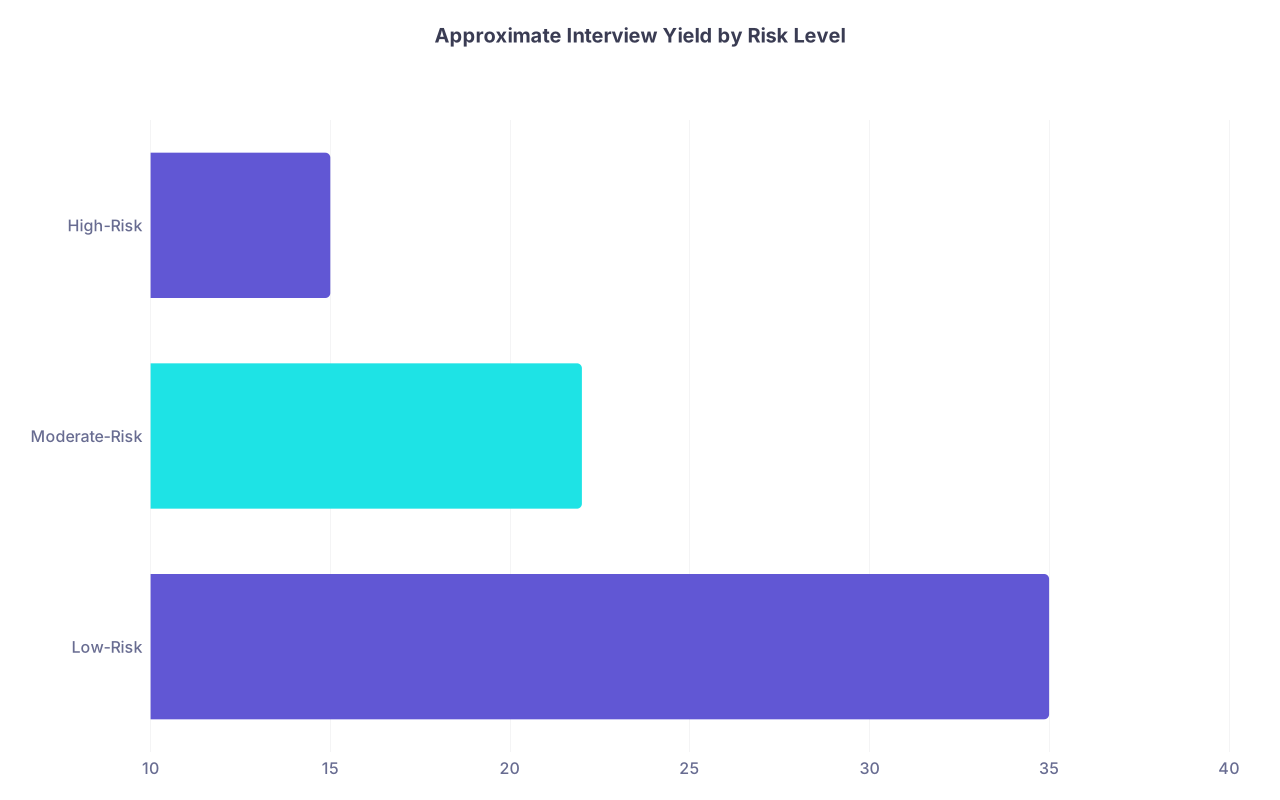
5.3 Align Your Volume With Expected Interview Yield
You do not match applications; you match interviews.
Use a working “yield” estimate:
For a community-focused, less competitive plan:
- Low-risk: expect 25–40% interview rate per application in your core regions
- Moderate-risk: 15–25%
- High-risk: 10–20%, sometimes lower for IMGs or with red flags
Now, reverse engineer.
Example:
US MD, low-risk, IM, open to Midwest/South, planning 22 applications.
- If you get a 30% interview rate → ~6–8 interviews
- For IM in this setting, 8–10 interviews typically gives a very high (>90%) match probability if you rank sensibly
You do not need 20+ interviews in IM community settings to match safely.
| Category | Value |
|---|---|
| Low-Risk | 35 |
| Moderate-Risk | 22 |
| High-Risk | 15 |
5.4 Parallel Planning Without Going Overboard
One subtlety:
If you are in a moderately competitive specialty and a moderate- to high-risk category, even in community settings, consider a parallel plan:
- Example:
- Primary: Anesthesiology community-only, 40 applications
- Parallel: IM community-only, 15–20 applications
You are still right-sizing by:
- Not sending 80 anesthesia applications blindly
- Using a modest, strategic parallel application to protect against a total miss
6. When “Right-Sizing” Becomes Dangerous
There are times when trying to be “efficient” is just gambling. Let’s call those out.
6.1 You Overestimate How “Non-Competitive” Your Target Programs Are
Common mistake:
“Program is in a small town, must be easy to get.”
No. Some small-town programs:
- Are the only major center in a multi-state radius
- Have exceptional training and quietly strong reputations
- Fill every year with applicants who intentionally want their high-volume experience
If you are applying “light” and anchoring on a few of these, that is a recipe for an ugly SOAP week.
6.2 You Are High-Risk But Behave Like Low-Risk
I have watched:
- IMGs with a Step failure apply to 25 IM programs “but all in the Midwest so it is fine” and go unmatched
- DOs with 2+ years since graduation apply lightly to psych, assuming community programs would “definitely want them”
Community and non-coastal does not erase:
- Gaps
- Failures
- Old graduation dates
- Weak letters
High risk still means you need volume and a broader backup plan.
6.3 You Have Fake Geographic Flexibility
If your real requirement is:
- Must be within 2 hours of a major airport
- Must be within 30–45 minutes of a major metro area
- Will be miserable in towns <100k population
Then your “less competitive” pool is smaller than you think.
Do not under-apply on the assumption that “Midwest” or “South” automatically means low-competition and high-yield.

| Step | Description |
|---|---|
| Step 1 | Assess Specialty and Risk |
| Step 2 | Increase Application Count |
| Step 3 | Right-size Applications 15-35 |
| Step 4 | Apply More 30-50 |
| Step 5 | High Risk? |
| Step 6 | Geographically Flexible? |
7. Practical Examples: What a Sane List Looks Like
Let me give you three concrete scenarios.
7.1 Example 1: US MD, Internal Medicine, Low-Risk
- US MD, Step 2 = 245, no failures
- Solid medicine letters, average research
- Wants community IM, ideally Midwest; fine with South if needed
Rational application plan:
- Midwest (OH, IN, WI, MI non-Detroit, IL non-Chicago): 12–14 programs
- South (KY, TN, AL, AR, MS, northern GA): 6–8
- Plains (MO, KS, IA, NE): 4–6
Total: ~22–26 programs.
Realistic interview yield: maybe 8–12 invites.
Match probability: Very high with a sensible rank list.
7.2 Example 2: DO, Psych, Moderate-Risk
- DO school, Step 2 = 225, no failure but below average for psych
- Good psych rotations, some regional ties to Missouri and Arkansas
- Wants non-coastal community psych
Plan:
- Core states (MO, AR, OK, KS): 10–12 programs
- Secondary (KY, TN, AL, MS, LA): 10–12
- Tertiary (IA, NE, SD, ND): 6–8
Total: 26–32 programs.
That is right-sized. Not 55. Not 15.
Interview target: 6–10. That should be achievable.
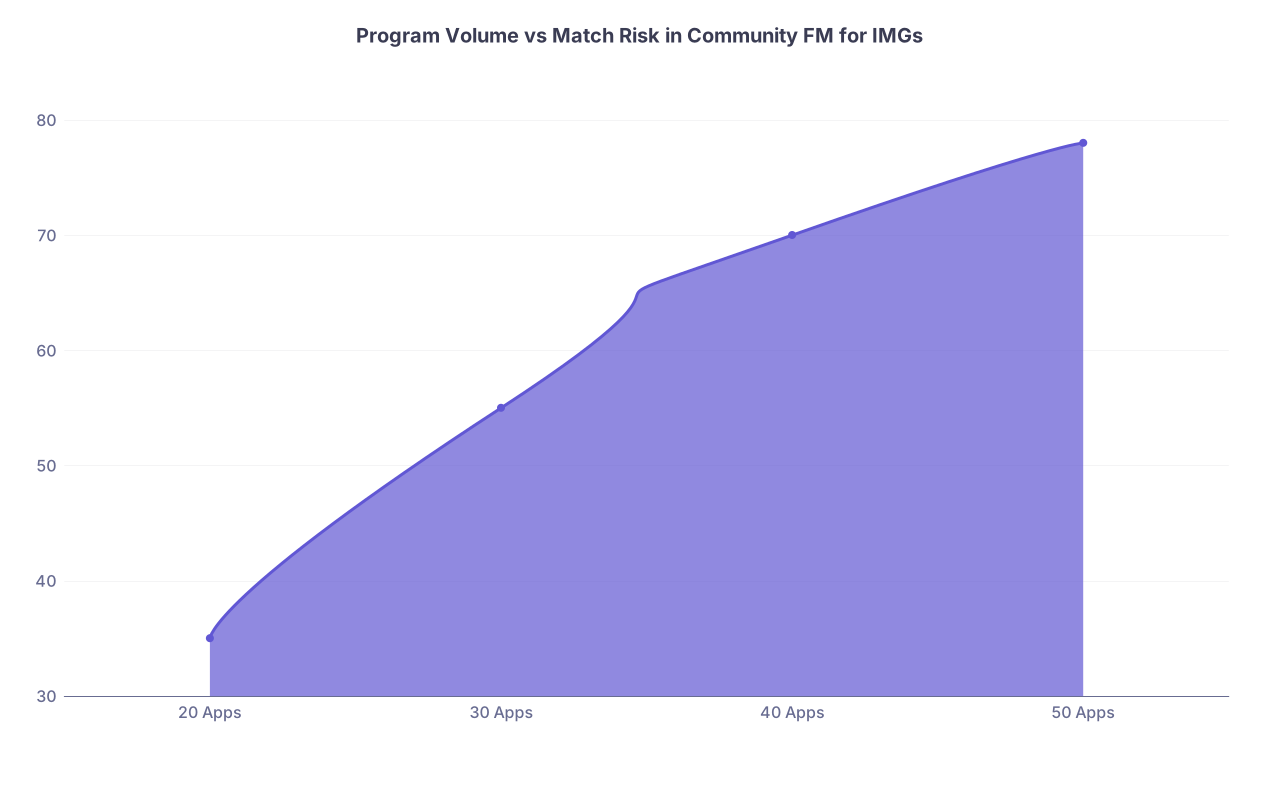
7.3 Example 3: IMG, Family Medicine, High-Risk
- IMG, passed on second attempt for Step 1, Step 2 = 220
- Multiple years since graduation
- Significant US clinical experience in community FM clinics
This is where “community-only, less competitive” helps, but does not allow minimalism.
Plan:
- Apply broadly to 35–45+ FM programs across:
- Midwest, South, Plains, interior West
- Prioritize:
- programs with history of IMGs
- smaller towns that struggle to recruit
- Strongly consider:
- emailing coordinators with concise, personalized interest letters
- clearly explaining ties, visa needs, and long-term goals in similar communities
Here, “right-sizing” might mean:
- 40 programs with intent
- Not 80 scattershot ERAS clicks
But below ~30 is playing with fire.
| Category | Value |
|---|---|
| 20 Apps | 35 |
| 30 Apps | 55 |
| 40 Apps | 70 |
| 50 Apps | 78 |
(The values above conceptually represent approximate chance of matching in this risk group; they are illustrative, not exact NRMP statistics.)
8. Actionable Checklist: How to Decide Your Number in 20 Minutes
You want a formula? Use this.
- Identify your specialty tier (1–4).
- Place yourself honestly in low / moderate / high risk.
- Decide how many true regions you are open to:
- Only 1–2 regions → aim upper end of the range
- 3+ regions → mid to lower end of the range
- Cross-match with the ranges above for your specialty and tier.
- Trim:
- vanity academic programs
- ultra-urban hot spots that do not match your stated strategy
- Add:
- programs with known IMG/DO friendliness if applicable
- programs in cities where you have real ties
- Sanity check:
- Do you have a plausible path to 8–12 interviews in moderate/low-competition fields like IM/FM/Peds/Psych?
- Or 10–14 in surgery/OB/Anesthesia/EM/community-heavy competitive fields?
If the honest answer is “no,” then:
- Increase the application volume within your tier range
- Or broaden geography
- Or consider a backup specialty
That is how you right-size. With structure, not vibes.
FAQ (Exactly 5 Questions)
1. If I only want community programs in my home state, can I safely apply to fewer programs?
Sometimes, but only if your home state has enough program density and you are low-risk. For example, a strong US MD applying to IM in a state with 8–10 programs and genuine local ties might be comfortable applying to 12–15 total (including a couple nearby states). If your home state has only 1–3 programs, restricting there and applying lightly is reckless, regardless of competitiveness.
2. Do community programs in less competitive areas care about research at all?
They care far less than academic powerhouses, but they still care about clinical performance and professionalism. A complete absence of research is not a problem in FM/IM/Peds/Psych community settings. Weak clinical evaluations, poor letters, or exam failures absolutely are. If you have research, great. If you do not, focus your ERAS on strong, concrete clinical experiences and evidence you are safe and reliable.
3. How many interviews do I need from community programs to feel safe?
For lower- and mid-tier competitiveness specialties (FM, IM, Peds, Psych) in community settings, 8–10 solid interviews is typically more than enough for a strong chance of matching, assuming you rank all sincerely. For more competitive community fields (Gen Surg, OB, Anesthesia, EM), you should aim more in the 10–14 range. Going beyond that rarely meaningfully improves odds but does increase burnout.
4. Should I send “love letters” or interest emails to community programs to improve my chances?
Yes—if they are targeted and specific. Community PDs are more likely to respond positively to short, concrete emails that mention real geographic ties, specific features of their program, and a sincere interest in staying in that region. Generic mass emails are useless. One or two strong, individualized messages per top-choice program can move you from “maybe” to “interview.”
5. If I am high-risk, is a community-only strategy enough to save my match, or do I still need a backup specialty?
High-risk status (failures, old graduation, weak scores, IMG in a competitive field) is not magically cured by choosing community or non-coastal programs. It helps, but it does not guarantee rescue. If you are high-risk in Tier 2 or higher specialties, a serious backup plan is wise—either a less competitive specialty (FM/IM) or a clear parallel application strategy with enough programs and realistic expectations.
Key takeaways:
- “Community-only in less competitive areas” lets low- and moderate-risk applicants safely apply to fewer programs—if they are honest about geography and risk.
- Your specialty tier, risk category, and real geographic flexibility determine your number; use them deliberately instead of guessing.
- You are not rewarded for panic-spamming 80+ programs when 25–40 targeted, community-focused applications would get you the same or better result with far less cost and burnout.