
It is late September. You are sitting in a call room between consults, ERAS is open on your laptop, and you have three tabs up: FREIDA, your school’s “rural track friendly” list, and a Google Map full of pins in counties no one in your class can pronounce.
You know you care about rural medicine. You know you want to end up in a place where you will actually learn obstetrics, scopes, emergency coverage, maybe even inpatient psych because there is no one else.
But the question gnawing at you is brutally practical:
“How many programs do I actually apply to if I am specifically rural-focused? And how many of those need to be true mission-fit, not just lip service?”
Let me answer that directly, then we will backfill the reasoning.
For most U.S. rural-focused applicants in core specialties (FM, IM, pediatrics, OB/GYN, general surgery, psychiatry), the usual pattern that works:
- Total applications: 25–40 programs
- Of those, true rural/mission-fit programs: 10–20
- General “safety net” programs (community or academic, not explicitly rural): 10–20
If you are non-US IMG or have significant red flags, scale that up. Think 50–80 total, with a similar or higher proportion being mission-fit.
That is the rough target. Now let me break down how to get to the right 25–80, not just a random ERAS shotgun blast.
1. Understand What “Rural-Focused” Actually Means (Not Just Marketing Copy)
Most applicants screw up at step one. They search “rural” on FREIDA, see the word once in the mission statement, and call it good. That is how you end up wasting fees on programs that have one rural elective 90 minutes away and no real community relationship.
You are looking for operationalized rural focus, not brochure-level.
Here is how I categorize programs in practice.
| Category | Key Characteristics |
|---|---|
| Dedicated Rural Track | Named rural program/track, longitudinal rural continuity site, structured rural curriculum |
| Rural-Based Program | Core hospital is in a rural area or small town; residents live and work rurally full-time |
| Hybrid Community-Academic with Rural Rotations | Base in small city; established out-rotations to rural critical access hospitals or clinics |
| Academic With Rural Lip Service | Mentions rural or underserved in mission; maybe 1 elective block; weak structural support |
The first two categories are your true “mission-fit” if you want to practice rural. The hybrid programs can be excellent if they are serious about rural partnerships. Academic-with-lip-service is usually where people get seduced by name recognition and then wonder why they never saw a patient more than 10 miles from downtown.
Concrete markers of real rural focus
You should be able to point to at least 3–4 of these:
- Named rural track or rural program (e.g., “Rural Family Medicine Track,” “Rural Internal Medicine Residency”).
- Longitudinal continuity clinic at a rural site, not just a single 4-week elective.
- Formal relationship with critical access hospitals or FQHCs in rural counties.
- Faculty bios that include rural practice background.
- Graduates listed on program website, with many practicing in small towns or Health Professional Shortage Areas.
- Clear language like “We train residents to practice full-spectrum in rural communities” versus vague “underserved” buzzwords.
If you do not see those, that program is not truly rural-focused, no matter what the mission slide says on interview day.
2. Your Competitiveness Dictates Your “How Many” Number
You cannot talk volume of applications without talking risk profile. Rural-focused programs care more about mission fit and less about Step flexing, but you cannot ignore basic competitiveness.
Let me make the logic explicit.
Step 1 (if scored) / Step 2 and class rank still matter
Rural programs are not magically uncompetitive. Many are community-based, but some are the only training pipeline for an entire state’s rural workforce. Those programs protect their match lists.
General guide, assuming core specialties like FM, IM, peds, psych, OB, gen surg:
Strong candidate:
- U.S. MD/DO, no failures, strong clinical evals.
- Step/COMLEX comfortably above national mean (or strong pass narrative if pass/fail).
- Demonstrated rural interest: longitudinal rural elective, rural background, specific projects.
- You can aim for the lower end of application ranges.
Average but aligned candidate:
- U.S. MD/DO, maybe one weaker rotation, Step around mean.
- Some rural connection (small town background OR some rural rotations), but not extensive.
- You need the mid-range application numbers.
Risk profile / IMG / red flags:
- Non-US IMG or significant gap, exam failure, remediation.
- Rural interest present but not perfectly documented.
- You must overshoot in number of applications. Volume is your hedge.
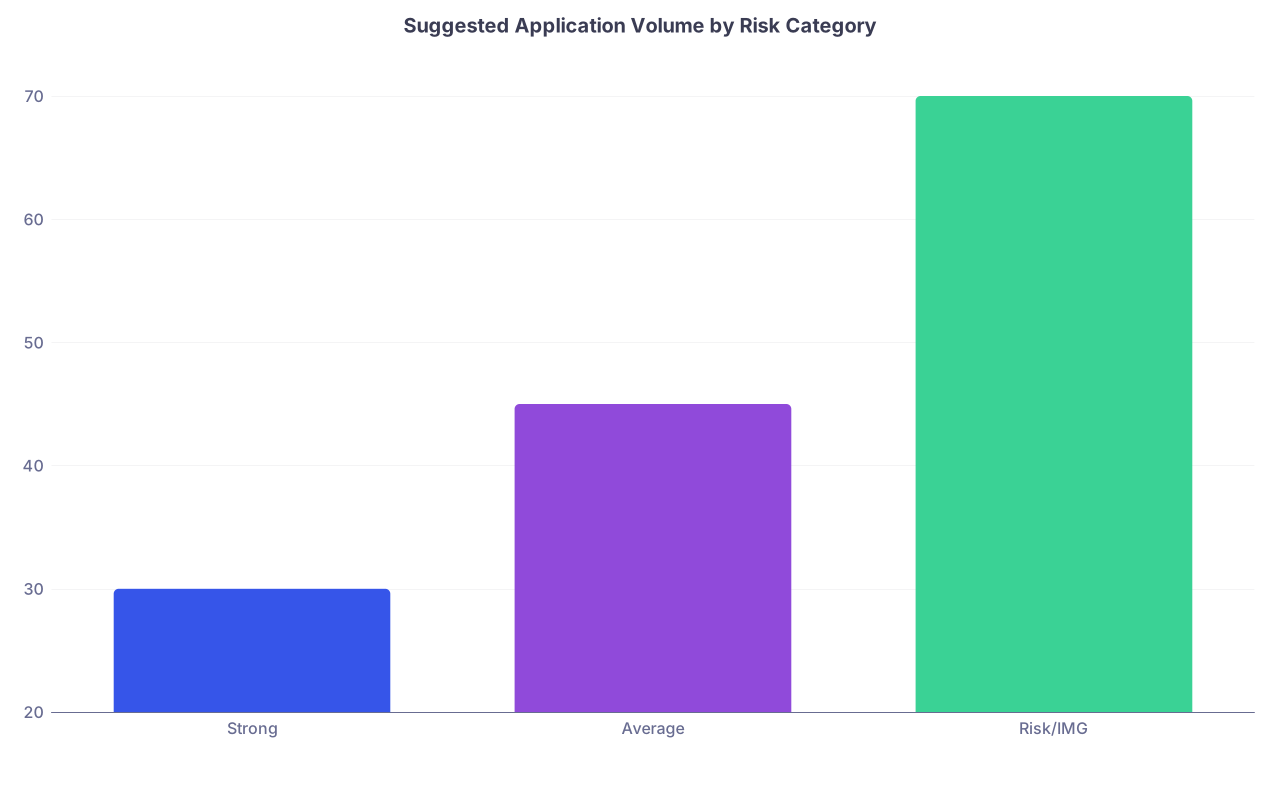
| Category | Value |
|---|---|
| Strong | 30 |
| Average | 45 |
| Risk/IMG | 70 |
Rural focus does not exempt you from these numbers. It just changes where you allocate them.
3. Build a Mission-Fit Core: 10–20 Programs You Actually Want
Here is the part most people skip because it takes work: building a curated list of programs where you could look a PD in the eyes and say, “I know exactly what your mission is and I chose you on purpose.”
For rural-focused applicants, the core should be:
- 10–20 programs depending on specialty and competitiveness, where rural focus is authentic and structural.
- At least 1–2 in geographic regions you have clear ties to (home state, med school region, family).
- At least 1–2 with explicit rural training pathways that match your desired scope (e.g., full-spectrum OB in FM, endoscopy in IM, C-section training in OB, broad operative experience in gen surg).
How to identify those 10–20 without losing your mind
Stop scrolling randomly. Use a structured pass:
Start with specialty society lists:
- AAFP / AFMRD for rural FM programs and tracks
- State academy rural committees
- HRSA-supported rural residency programs
- For surgery, OB, psych: state-level rural training initiatives and health system websites, not just FREIDA.
For each candidate, do a 5–7 minute deep dive:
- Where is the main hospital physically located? Population of the town?
- Do they show resident schedules that include rural blocks or sites?
- Do they show graduate destinations? Are people in towns under 25k?
- Any federal funding mentions: Rural Residency Planning and Development Program, THCGME, etc.
Tag each program into buckets:
- A: True rural-based or rural track, obvious mission fit.
- B: Strong community with rural rotations, good but not perfect.
- C: Urban-suburban with vague rural interest.
- D: No.
Your 10–20 mission-fit core is mostly A’s and some strong B’s.
This is time-consuming. It is also the part that actually moves your match odds because mission-fit programs are the ones that tend to love rural-focused applicants and rank them high.
4. Then Layer On Safety and Practicality: 10–40 Additional Programs
Once you build that mission-fit backbone, you do not stop. Unless you are a truly stellar candidate with geographic ties and a shortage speciality (rural FM in some states, for example), overconfidence is how you end up SOAPing into a program that has never seen a cornfield.
Think in tiers:
- Tier 1 (A-list): Rural-based and rural-track programs, 10–20.
- Tier 2 (B-list): Strong community programs with actual rural rotations, 10–20.
- Tier 3 (C-list): General community or academic programs that are not rural but will still give you solid training, 5–20 based on your risk profile.
For many rural-focused applicants in family medicine or internal medicine:
Well-positioned U.S. MD/DO:
- 10–15 Tier 1
- 10–15 Tier 2
- 5–10 Tier 3
- Total: 25–40
Average U.S. grad or DO with modest metrics:
- 10–15 Tier 1
- 15–20 Tier 2
- 10–15 Tier 3
- Total: 35–50
IMG or red flag:
- 10–20 Tier 1 (apply to all rural programs that accept IMGs and at least one of your exams is solid)
- 20–30 Tier 2
- 20–30 Tier 3
- Total: 50–80
You do not want a list that is “all or nothing rural.” You want a list where:
“If I match anywhere on this list, I will be reasonably happy. But if I match at my core 10–20, my training and career trajectory will be exactly on-mission.”
5. Geography, Lifestyle, and the Rural Reality Check
This part gets glossed over when people romanticize rural care.
You are not doing yourself any favors by applying broadly to “rural” programs in places you would hate living for 3–5 years. You will be miserable, and programs are surprisingly good at detecting that dissonance when you talk.
Be bluntly honest with yourself:
- Are you willing to live 2+ hours from a major airport?
- Are you and any partner/family realistic about employment and schooling in small towns?
- Do you actually like the kind of community this rural area is (Appalachia vs upper Midwest vs Southwest tribal vs Alaska)? They are not interchangeable.
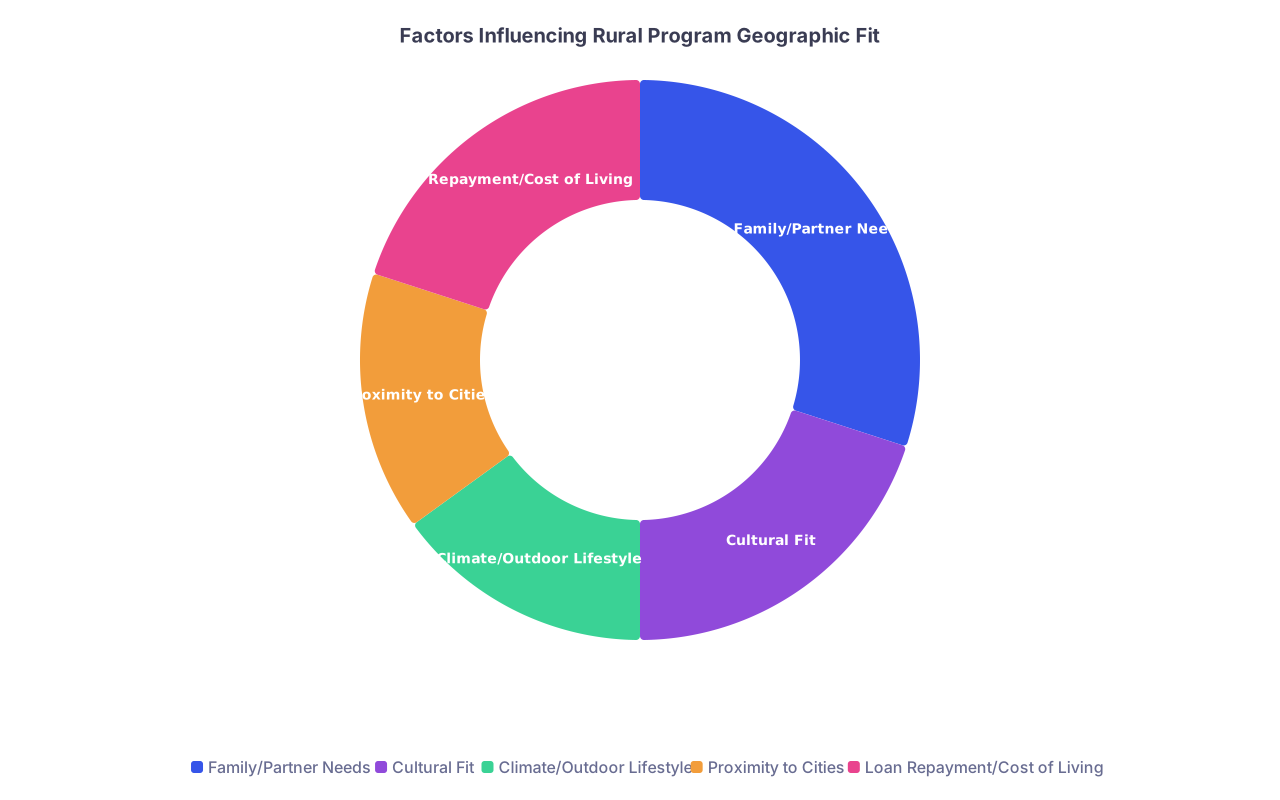
| Category | Value |
|---|---|
| Family/Partner Needs | 30 |
| Cultural Fit | 20 |
| Climate/Outdoor Lifestyle | 15 |
| Proximity to Cities | 15 |
| Loan Repayment/Cost of Living | 20 |
Smart rural-focused applicants narrow their geographic zones before building the list. Example: “I will target the upper Midwest, Pacific Northwest, and Appalachia. I will not apply to deep South or high desert programs because that is not our lifestyle fit.”
This protects you from padding your list with programs that are technically rural but practically nonstarter.
6. How Many Interviews Do You Actually Need? Back-Calculating the Application Number
The end goal is not “X applications.” The end goal is “enough interviews at mission-fit and reasonable backup programs to almost guarantee a match.”
Data from NRMP and actual experience converge on this:
- For core non-ultra-competitive specialties, most U.S. grads feel secure with ~10–12 total interviews.
- Strong rural-focused applicants, if their list is well-curated, often match with 8–10 interviews because they are self-selecting into programs that want them.
- IMGs and red-flag applicants often need higher numbers (12–15+) to feel reasonably paired.
For rural-focused applicants, I mentally split interviews into:
- 5–8 at truly rural or rural-track programs
- 3–8 at strong community or hybrid programs
If you get:
- Fewer than 4 rural-focused invites by late November → your rural signal is not landing or your list is mismatched; you will lean heavily on your community backups.
- 6–10 rural-focused invites → you are in good shape; you can be picky about ranking.
So how many applications to generate that?
Rough expectation for a reasonably aligned U.S. applicant:
- Rural-focused list that is well constructed: 20–30% interview yield.
- General community list: 10–25% interview yield depending on competitiveness of the region and your scores.
That is why the earlier numeric ranges sit where they do. You are playing for yield in two markets.
7. Signaling Rural Interest So Programs Actually Pick You Out of the Pile
Application number is useless without a clear signal. Rural programs wade through piles of generic “I care about underserved” personal statements just like everyone else.
Here is where rural-focused applicants either stand out sharply or blur into noise.
Make your rural signal unavoidable
You should have:
Personal statement that names rural explicitly
- Not “I am passionate about underserved care.”
- Say: “I plan to practice full-spectrum family medicine in a rural community similar to the one where I grew up in northern Wisconsin” or “My goal is to work as a rural general internist with hospital privileges in a critical access hospital.”
ERAS experiences that are clearly rural
- Rural free clinics, mobile health, critical access hospital rotations, FQHCs in non-metro counties.
- Label them cleanly so PDs scanning your app see “rural” without having to guess.
Geographic preference section that is coherent
- If you say you will go anywhere but only apply to coastal metros plus three rural sites, programs see the inconsistency.
- If you say “Midwest, Mountain West, Appalachia” and your list matches that, rural PDs perk up.
Letters that speak the language
- Ask rural preceptors to explicitly describe the context: small town, critical access, lack of subspecialty support, your comfort with that environment.
I have seen fairly average Step applicants absolutely clean up with interview invitations at rural programs simply because their rural story is undeniable and specific.
8. Special Cases: Specialty-Specific Nuances for Rural Applicants
Not all specialties behave the same way for rural-focused paths. Let me hit the patterns I keep seeing.
Family Medicine
- Rural FM is in high need. If you are a U.S. grad with a coherent story, you are in a strong position.
- 20–30 total applications is often enough for a solid candidate; 30–40 for average; 40–60 for DO/IMG/red flag.
- Heavily weight rural-track and rural-based programs. They are often your best educational and lifestyle fit.
Internal Medicine
- “Rural IM” often really means “training in a small city program that feeds docs into rural practice.” Full-on rural-based IM residencies exist but are fewer.
- Your rural goal may be primary care or hospitalist work in small towns, which many community IM programs prepare you for.
- Application numbers often need to be a bit higher than FM due to competitiveness in some regions: 30–45 for U.S. grads, 50–70 for IMGs.
Pediatrics
- True rural peds programs are fewer; a lot of rural pediatrics is done by med-peds or family medicine.
- If you are peds-only and rural-focused, you may need to treat “regional children’s hospital with strong community component” as your realistic training path, then choose rural in your job search.
- Application numbers similar to IM.
OB/GYN and General Surgery
- These are trickier. There is huge rural need, but rural tracks are fewer, and core specialties are more competitive.
- You may need to apply broadly, emphasizing your goal to practice in rural settings after standard training.
- 40–60 applications is not crazy for average applicants; IMGs go higher.
Psychiatry
- Rural psych need is massive. Many community psych programs love rural-focused applicants.
- You can often keep numbers in the 25–40 range if you are a U.S. grad with a decent application.
9. A Simple Framework to Decide Your Number in 30 Minutes
Let me pull this into a quick, ruthless exercise. Sit down with a spreadsheet and answer:
Specialty and competitiveness:
- Are you in FM or psych versus surg/OB/IM?
- Rough competitiveness: strong / average / risk.
Risk category → base application volume:
- Strong: 25–35
- Average: 35–50
- Risk/IMG: 50–80
Rural commitment level:
- “Non-negotiable” → at least half of applications should be rural or rural-track.
- “Strong preference but flexible” → 30–50% rural, rest strong community.
- “Interest but not make-or-break” → 20–30% rural, focus on solid overall training.
Geography constraints:
- If you restrict yourself to 1–2 regions, you must increase the total number on your list within those regions, especially for competitive specialties.
Plug that in. Your output should look something like:
- 10–15 rural-track/rural-based
- 10–20 community with rural rotations
- 10–20 general community/academic
You adjust the exact numbers for your risk profile and specialty, but the structure stays.
10. Interview Season Reality: When to Pivot vs. Double Down
Last piece. You submit your 35–55 applications; now what?
Timeline reality check:
- By late October: you should see the first wave of mission-fit interview offers if your signal landed.
- By Thanksgiving: you will know if your rural list “hit” or if your interviews are heavily skewed to generic community programs.
If by mid-November:
- You have 4–6+ rural-focused interviews → you are fine. Rank them high. Still attend your community interviews for backup.
- You have 0–2 rural-focused and 4–6 total interviews:
- You are at risk. Strengthen communication with programs (preference signals, targeted emails, updates).
- Be honest that you may end up in a less rural training environment and plan to chase rural in your job search or fellowship.
SOAP is not the time to chase rural dreams. SOAP is for getting a seat at a table. Your rural mission can still happen later, but the best time to stack the deck is in this original application cycle with a smart, balanced, and mission-focused list.
FAQ (Exactly 6 Questions)
1. If I am absolutely committed to rural, is it a mistake to apply to non-rural programs at all?
No, that is romantic but strategically naive. You still need to match. A strong community or regional program can send you into rural practice later, especially if you intentionally choose rural electives and jobs post-residency. Keep at least 25–40% of your list as “solid training but not rural” unless you have a very strong overall profile.
2. How do I tell if a “rural track” is real and not just a marketing gimmick?
Check for longitudinal structure and graduate outcomes. Real tracks have named rural continuity sites, multiple residents in the track each year, clear block schedules showing rural time, and alumni now working in small towns. If the website shows one elective block and no alumni stories, that track is weak.
3. I grew up in a city but discovered rural interest late. Will programs take my rural commitment seriously?
Yes, if you back it up with action. That means rural rotations, concrete experiences in small communities, and a narrative that connects the dots (e.g., telehealth projects, mobile clinics, critical access hospital exposure). “I like hiking” or “I like small towns” without experience reads hollow.
4. I am an IMG. Do rural programs like or avoid IMGs?
Mixed. Some rural-focused programs strongly prefer U.S. grads because they see themselves as pipelines from state schools. Others rely heavily on IMGs and are very IMG-friendly. You need to research each program’s historical IMG intake on FREIDA and through word-of-mouth. Do not assume either way.
5. If I am dual-interested in rural and academic medicine, how should I balance my list?
You will have to decide which priority wins in residency. The usual path: train in a strong community or hybrid program with real rural rotations, then pursue academic involvement through research or medical education. Apply to a few academic programs with rural or community tracks, but accept that pure big-city academic centers often do not provide true rural clinical experience.
6. Is it better to do a fully rural residency or a strong urban program with the plan to “learn rural later”?
If your goal is broad-scope, high-autonomy rural practice (especially in FM, OB, or surgery), a residency that actually puts you in resource-limited settings during training is a major advantage. Learning rural “later” is possible but harder. I would lean strongly toward a rural or rural-track program if you have viable options, then use CME and early-career mentorship to fine-tune skills.
Key takeaways:
- Most rural-focused applicants should target roughly 25–40 programs if U.S. grads, 50–80 if IMG/risk, with 10–20 being true rural or rural-track mission-fit.
- Your success hinges less on raw application count and more on building a curated rural core, backing it with a clear rural story, and then layering reasonable backup programs.
- Rural is a career path, not a single decision. A smart, balanced list now dramatically raises the odds that residency accelerates that path instead of delaying it.