
Most applicants get the single-city strategy completely backward. They start with the program list instead of starting with their leverage.
You say you want to stay in one metro area. Great. Programs do not care. They care about whether you help their service and match their risk tolerance. Your job is to translate “I must stay in City X” into a realistic program count that still gets you enough interviews to match.
Let me break this down in a way people rarely do: by hard numbers, tiers, and scenarios—not vibes.
1. The Real Question Is Not “How Many Programs?” It’s “How Many Chances?”
When you restrict yourself to a single metro area, you are doing two things:
- Cutting the number of available programs.
- Accepting that some of them will never rank you highly (no matter how much you “love” them).
So the operative variable is not “number of programs applied to” but “number of realistic interview chances” within that city.
We have decent consensus among PDs and NRMP data on this:
- For most core specialties (IM, peds, FM, psych, neuro),
about 10–12 solid interviews → high probability of matching. - Around 8–9 interviews → decent but not fail-proof.
- Below 6 → you are flirting with disaster unless you are an extreme superstar with very targeted programs.
You are trying to reverse-engineer:
“How many programs in this one metro do I need to apply to so that my expected interview count is high enough?”
That means three steps:
- Inventory the programs in your metro.
- Estimate base interview probability at each, given your profile.
- Decide how much risk you are willing to accept.
Then you back-calculate the number of applications.
2. Know Your City: How Many Shots Actually Exist?
You cannot do a serious single-city strategy if you do not know your local program ecosystem cold.
In a given metro (say Chicago, Houston, Philly, Atlanta, etc.), your options might look like this for Internal Medicine as an example:
- 2–3 university/university-affiliated academic IM programs
- 3–6 community-based ACGME IM programs
- 1–2 hybrid/large community with subspecialty presence
- Possibly a few “satellite” campuses counted as separate programs in ERAS
For Family Medicine:
- Often more total programs, but many smaller (6–12 residents/year).
- City + surrounding suburbs count. If you say “I must be in Philly,” you better decide whether southern NJ and Delaware count as “metro.”
For surgery, EM, radiology, ortho, derm, etc.:
- Much smaller absolute numbers per metro.
- Some metros have only 2–3 categorical general surgery programs, for example.
You need an actual list, not vibes. Go to FREIDA, program websites, and ERAS lists and make a simple spreadsheet:
- Program name
- Type (academic / hybrid / community)
- Annual PGY-1 spots
- Historical fill rate (NRMP data if available, or estimate based on reputation and website messaging)
- Your perceived competitiveness category there (more on this next)
Then you can see the obvious: some metros simply do not have enough slots to safely run a single-city-only strategy for certain specialties.
3. Build Your Profile Tier Before You Touch the List
This is where most applicants either lie to themselves or rely on bad Reddit anecdotes.
Your competitiveness tier sets how many programs you must apply to, even in a single city. I break it roughly like this (for core specialties like IM, FM, peds, psych, neurology):
Tier 1 – Strong / Above-average candidate
- US MD with:
- Step 2 CK ≥ 245, no failures, good clinical evaluations
- Some research or a clearly coherent story (leadership, advocacy, etc.)
- No major red flags (leaves, professionalism issues, etc.)
- Or US DO with:
- CK ≥ 240–245, strong letters, solid rotations in the region
These applicants are competitive at most programs in their specialty other than the truly elite.
Tier 2 – Solid / Middle-of-the-pack candidate
- US MD with CK roughly 230–244, average CV, maybe some modest research or leadership.
- US DO with CK around 230–240 and decent clinical record.
- No major red flags, maybe a slow preclinical period or one below-average clerkship grade.
These applicants are “fine” but not obviously high-yield to every program. PDs will interview many of them, but they are not chasing you.
Tier 3 – At-risk candidate
- Any of:
- Step failure
- CK < 230 in IM/FM/Peds/Psych/Neuro (specialty-specific cutoffs matter)
- Significant academic remediation
- Heavy geographic or visa constraint (IMGs especially)
- Unusual gap in training
- Or an IMG without strong US LORs and hospital-based rotations in the city you are targeting.
Tier 3 does not mean “doomed.” It means your interview yield per program is lower and more variable. In a constrained metro, that matters. A lot.
4. The Core Formula: Expected Interviews = Σ (Program probability × Programs applied)
You do not need exact statistics. You need ballpark ranges.
For single-city planning, I like to work in conservative estimates of “probability this program gives me an interview,” based on your tier.
Let me give you a realistic pattern for a core specialty (e.g., Internal Medicine) in a large metro with 8 programs:
- 2 academic flagships (university hospitals)
- 2 hybrid / academic-affiliated community
- 4 solid community programs
Now overlay your tier.
Example – Tier 1 candidate, mid-competitive specialty (IM, FM, Peds, Psych)
Conservative interview probability per program (assuming decent geographic fit):
- Top academic: 40–60%
- Hybrid: 60–75%
- Community: 70–90%
Expected interview count if you apply to all 8:
- 2 academic × 0.5 ≈ 1
- 2 hybrid × 0.7 ≈ 1.4
- 4 community × 0.8 ≈ 3.2
Total ≈ 5–6 interviews.
Which is borderline safe if you are truly Tier 1 and interview well. Many would want at least a couple more from prelims or nearby suburban programs.
Example – Tier 2 candidate
Now probabilities drop:
- Top academic: 15–30%
- Hybrid: 40–60%
- Community: 50–75%
Expected interviews from 8:
- 2 academic × 0.2 ≈ 0.4
- 2 hybrid × 0.5 ≈ 1
- 4 community × 0.6 ≈ 2.4
Total ≈ 3–4 interviews.
That is not enough. You need more programs, or you must expand your radius beyond the strict metro.
Example – Tier 3 candidate
Brutal but realistic:
- Top academic: 0–10%
- Hybrid: 10–25%
- Community: 20–40%
From same 8:
- 2 academic × 0.05 ≈ 0.1
- 2 hybrid × 0.2 ≈ 0.4
- 4 community × 0.3 ≈ 1.2
Total ≈ 1–2 interviews.
That is not a strategy. That is wishful thinking.
So when you ask “How many programs should I apply to in this metro?” the honest answer sometimes is:
“There are not enough programs in this metro for your risk profile. Even if you apply to all of them, it is not safe.”
And you must hear that before ERAS opens, not in January when the silence sets in.
5. Setting Program Counts by Metro Size and Specialty
Let us put some structure on this. I will give you general rules of thumb, then a table.
Definitions
- “Small metro”: 1–3 programs in your specialty within commutable distance.
- “Mid-sized metro”: 4–8 programs.
- “Large metro”: 9–15+ programs (city + real suburbs).
- “Mega cluster”: Rare cases like NYC (multiple boroughs), some regions of Texas or California where contiguous metro areas function as one giant cluster.
And we will separate “core” vs “highly competitive” specialties.
- Core: IM, FM, Peds, Psych, Neuro, OB/GYN (depending on region), Anesthesiology (borderline).
- Highly competitive: Derm, Ortho, Plastics, ENT, Neurosurgery, some rads/IR, EM in certain regions, integrated programs (e.g., IR, vascular).
Now combine this with your tier.
| Metro Size | Specialty Type | Tier 1 Candidate | Tier 2 Candidate | Tier 3 Candidate |
|---|---|---|---|---|
| Small (1-3) | Core | Apply to all; add nearby cities | Apply to all; must add nearby cities | Single-city not viable alone |
| Mid (4-8) | Core | Apply to all; consider 2-4 suburban/nearby | Apply to all; add 5-10 outside metro | Apply to all; add 15+ outside metro |
| Large (9-15) | Core | 8-12 in metro, plus 2-4 safety | 12-18 in metro (or all) | All in metro + 20+ elsewhere |
| Any | Highly competitive | All in metro + 20-40 elsewhere | All in metro + 40-60 elsewhere | Single-city-only is reckless |
Those are minimums, not flexed-out maximums. The point is: in a single-city strategy, you almost always apply to every reasonable program in that metro, then you decide how much you are willing to stretch beyond it.
6. Inside One Metro: How to Tier Programs and Set Your List
Assume you are committed to one metro. Now within that metro, you still need to stratify.
I use four internal buckets:
- Reach programs – Unlikely but not impossible.
- Match-range programs – Where your stats and profile line up well.
- Safety programs – Where you are clearly above average for recent classes.
- “Not worth it” – Poor fit, malignant reputation, unstable accreditation, or completely unrealistic reach.
You should not waste ERAS slots on the last group just to feel like your list is longer.
Within a single metro, an actually sane distribution looks like:
- 20–30% Reach
- 50–60% Match-range
- 20–30% Safety
The problem? Many metros are top-heavy (e.g., Boston, SF, NYC) with few true “safety” programs, especially in competitive specialties. You then have two options:
- Accept higher match risk to stay constrained to that city.
- Loosen geography to add real safeties in surrounding regions.
Concrete Example: Single-City IM Strategy in a Large Metro
Let us say you are Tier 2, applying Internal Medicine, targeting Chicago-like metro with:
- 4 university/hybrid IM programs
- 6 community IM programs
You want to stay in metro if possible, but you are not willing to go unmatched.
Rational structure:
- Apply to all 10 IM categorical programs in that metro.
- Categorize:
- 2 top university → Reach
- 2 academic-affiliated community → Match-range
- 4 stronger community → Match-range
- 2 smaller community → Safety (relatively)
- Add:
- 6–8 more IM programs within 2–4 hours driving radius
- Maybe 2–4 prelim IM spots in that same metro if you are open to the prelim + reapply route
So your “single-city nucleus” is 10 programs, but your total program count might be 18–22.
That is how serious people “do” a single-city strategy. You anchor to one metro but do not chain yourself blindly to it.
7. Tying Program Counts to Interview Targets
You must convert program counts into interview targets. Otherwise, you are just playing with spreadsheets.
I aim for these interview targets (core specialties):
- Tier 1: 10+ interviews (12–15 is comfortable).
- Tier 2: 12–15 interviews minimum.
- Tier 3: 15–20 interviews if at all possible.
Within a single metro, you usually cannot hit those numbers unless:
- The metro is very large and saturated with programs.
- Or your tier is high and your application is laser-aligned with that city (home school there, strong home LORs, away rotations there, regional ties).
To make this practical, do a simple calculation:
- List every program in the metro that is even plausibly targetable.
- Assign a conservative interview probability estimate:
- Reach: 5–25%
- Match-range: 35–65%
- Safety: 65–90%
- Add the expected values.
If that sum is less than 6–8 for core specialties, and you are not applying anywhere else, your single-city strategy is very high risk.
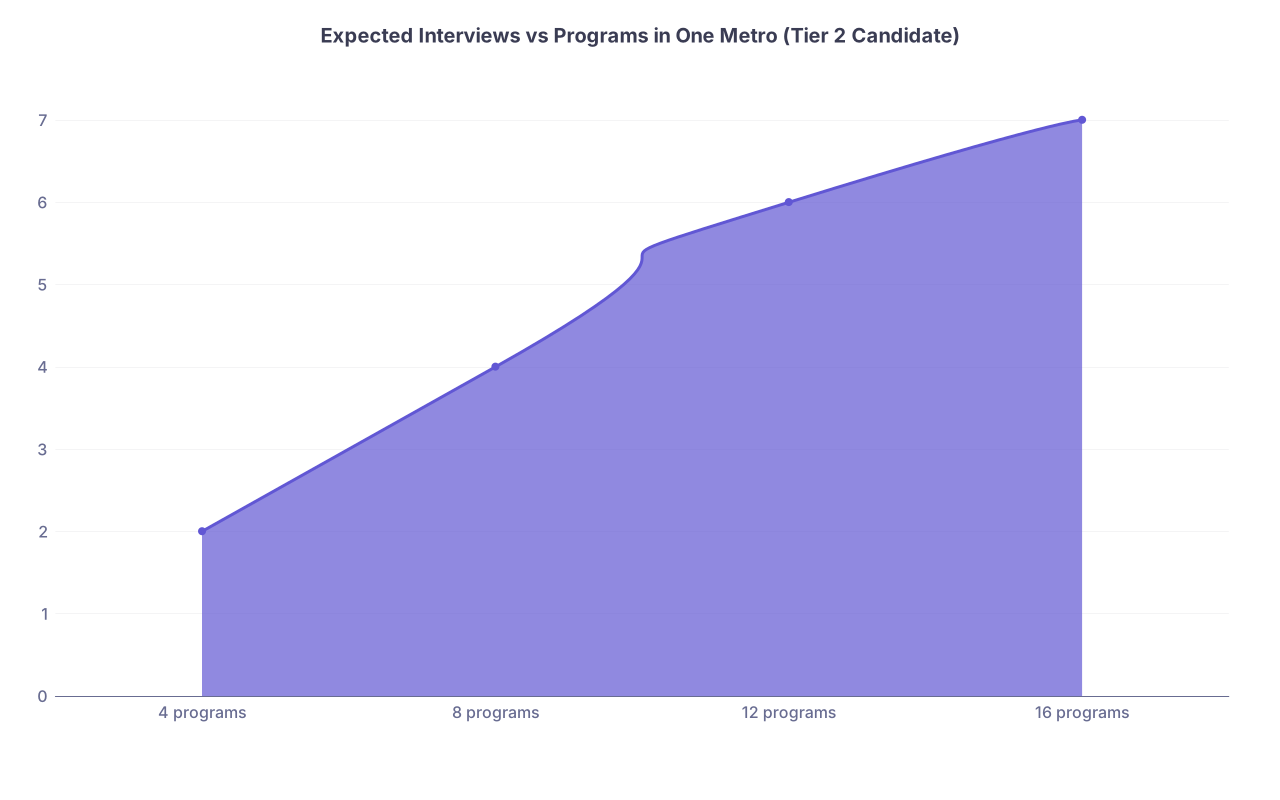
To visualize why overconfidence in “interview yield” gets people burned:
| Category | Value |
|---|---|
| 4 programs | 2 |
| 8 programs | 4 |
| 12 programs | 6 |
| 16 programs | 7 |
Notice how it flattens—doubling programs does not double interviews, because there are only so many realistic programs and many share similar selection behavior.
8. Subspecialty and Competitive Specialty: Why Single-City is Usually a Bad Idea
If you are applying to dermatology, ortho, ENT, plastics, IR, or neurosurgery and insisting on one metro, I am going to be blunt: you are not playing the same game.
- There may be 1–3 programs in your entire metro.
- Your interview probability at each is low even if you are excellent, because the applicant pool is insane.
- Programs in highly competitive specialties expect broad geographic flexibility. That is the culture.
In these fields, the only time a quasi single-city focus makes sense is if:
- You have extremely strong ties to that institution and city (home med school, extensive research with faculty, known quantities).
- You are applying broadly nationwide anyway and simply prioritizing that city in your preference.
Your program count for competitive specialties should be thought of as:
- “All programs in my metro that make any sense,” plus
- “A large national list that actually gets me enough total chances.”
For dermatology, for example, strong candidates often apply to 60–80+ programs nationally. The incremental cost of including every relevant program in your target metro is trivial; the cost of excluding the rest of the country is catastrophic.
9. Visa Status, Couples Match, and Other Constraint Multipliers
Single-city strategy gets harder with every extra constraint.
Visa-requiring IMG in One Metro
If you require a visa and you are restricting to one city, your “effective” program count shrinks fast:
- Some programs in that city simply do not sponsor visas → off the table.
- Some sponsor only J-1, and you want H-1B → off the table.
- Some quietly avoid interviewing IMGs regardless of stated policy.
A realistic approach:
- Identify visa-friendly programs first.
- In many cities, that reduces your true target list to 2–5 programs at most.
- For Tier 2–3 IMGs, a single-city-only approach becomes nearly indefensible unless that city is absolutely saturated (NYC, for example), and even then it is risky.
Couples Match, One-Metro Rule
Two people, one metro. Now you are not just asking “Can I get 10+ interviews?” but:
“Can we both get enough interviews in compatible specialties in this single metro?”
You must think in joint probability:
- If each of you has 6 interviews in that city, but only 3 programs overlap in terms of offering both of your specialties, your real joint opportunity set is 3, not 6.
Couples match in one city usually means:
- Both of you must apply broadly within that city (essentially to all reasonable programs).
- Both of you often still apply to some backup cities, even if they are second preference, because the joint match problem is much tougher.
Prelim + Advanced Combinations
Some fields (anesthesia, rads, some neuro, competitive advanced specialties) have advanced positions plus prelim years.
Single-city complication:
- There might be only 1–2 advanced programs and 1–3 prelim IM/surgery/TY programs in your ideal metro.
- Smart approach:
- Apply to every relevant prelim program in that metro.
- If you insist on a single-city life for the prelim, accept that you will widen for advanced spots, or vice versa.
The worst mistake I see: applicants applying to only 1 prelim in their city “because that is where my advanced program is.” Prelim spots are not guaranteed just because they share a campus with your desired advanced program.
10. What a Sane Single-City Strategy Actually Looks Like
Let us synthesize into something you can actually do in a week with your advisor.
Define your non-negotiable geography.
Decide whether “single city” includes:- Immediate suburbs
- Adjacent satellite cities within 1–2 hours If your partner’s job is downtown Chicago, does Evanston count? Joliet? Northwest Indiana? Spell this out.
List every single program in that real footprint.
For your specialty:- Categorical + prelims if relevant
- Academic + community Remove nothing at this stage.
Build your honest tier.
With someone who is not afraid to tell you no:- Where do your scores, CV, and red flags place you?
- For IM/FM/Peds/Psych, this is usually obvious to any seasoned advisor.
Classify each program into Reach / Match-range / Safety / Not worth it.
Use:- Past match lists from your med school.
- Websites, current residents’ schools, and step scores if published.
- Your home faculty’s opinions.
Estimate expected interview count inside the metro.
Use conservative probabilities:- Reach: 5–25%
- Match-range: 35–65%
- Safety: 65–90%
Check the sum against your interview target for your tier.
If:- Expected < 6–8 → You cannot rely on that city alone.
- Expected 8–10 → Borderline; strongly consider nearby cities or extra safeties.
- Expected 10–15 → Reasonable single-city core, still wise to have a few outside anchors.
- Expected > 15 → Unusual but possible in certain metros + strong profiles.
Set actual program counts.
For most core specialties:- Apply to all reasonable programs in your defined metro footprint.
- Add:
- Tier 1: 3–8 outside as buffer.
- Tier 2: 8–15 outside.
- Tier 3: 20+ outside.
Here is what that can look like visually for a realistic Tier 2 IM applicant:

| Step | Description |
|---|---|
| Step 1 | Define Metro Footprint |
| Step 2 | List All Programs |
| Step 3 | Assign Tier and Fit |
| Step 4 | Estimate Interviews In City |
| Step 5 | Expand Beyond City |
| Step 6 | Add Some External Safeties |
| Step 7 | City Focus With Minimal Outside |
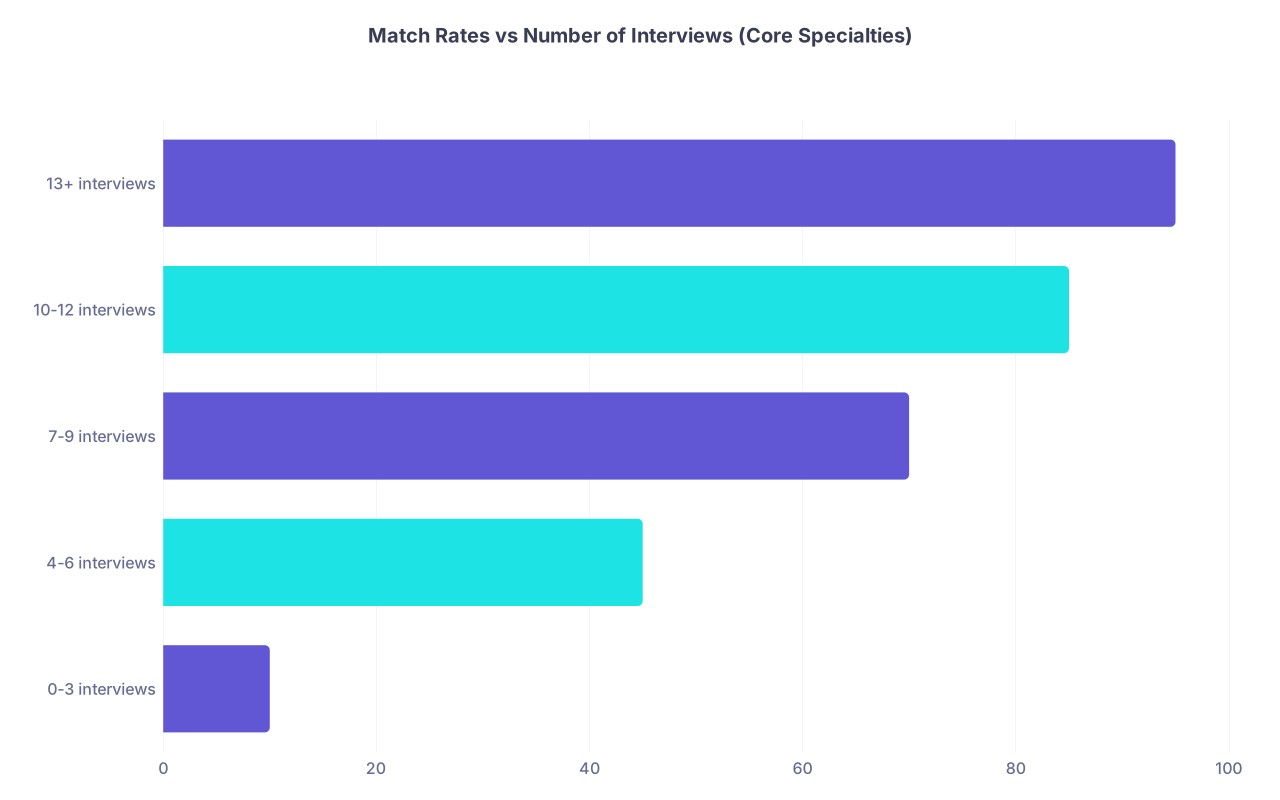
And just to underline why pure single-city applications blow up each year:
| Category | Value |
|---|---|
| 0-3 interviews | 10 |
| 4-6 interviews | 45 |
| 7-9 interviews | 70 |
| 10-12 interviews | 85 |
| 13+ interviews | 95 |
Those are approximate, but they reflect the NRMP patterns. You do not beat that curve by “really loving the city.”
11. When (and How) to Bend Your Single-City Rule
Sometimes life circumstances force a true single-city only rule (sick family member, custody arrangement, spouse whose job absolutely cannot move). Then the conversation changes.
In that case, you must:
- Apply to every single program in your specialty within any plausible definition of that metro (even if some are not your vibe).
- Consider allied specialties or slightly adjacent fields that still meet your career goals but have more spots in that city.
- Be willing to:
- Take a prelim year there and reapply.
- Do a transitional year in that metro and then pivot.
- Start in FM or IM and later pursue a fellowship closer to your target niche (for example, psych → consult-liaison, or IM → cards critically later).
If you are not willing to bend on geography at all, you must bend on specialty choice, program type, prestige expectations, or training path flexibility. There is no way around that trade-off.

12. Quick Scenario Snapshots
To cement this, let me give you three quick but realistic scenarios.
Scenario 1 – US MD, Tier 1, Internal Medicine, Large Metro
- CK 252, AOA, several publications, no red flags.
- Wants to stay in Boston, willing to commute up to 1 hour.
- Metro footprint IM programs: 12 categorical.
Plan:
- Apply to all 12 IM programs in that footprint.
- Expected interviews in-metro: ~9–12.
- Add:
- 3–5 high-academic IM programs in NYC/Philly as “lateral” choices.
- Maybe 2–3 mid-Atlantic or Northeast community/hybrid programs as absolute safety.
Program count: ~17–20 total, but core outcome almost entirely in Boston area.
Scenario 2 – US DO, Tier 2, Psychiatry, Mid-sized Metro
- CK 236, strong psych rotations, decent letters, no red flags.
- Needs to stay in Denver area if possible, willing to drive 90 minutes.
- Metro footprint psych programs: 5.
Plan:
- Apply to all 5 psych programs in that extended metro.
- Expected interviews locally: maybe 3–4.
- Add:
- 10–12 psych programs in nearby states (Colorado region, surrounding states with direct flights).
- Total program count: 15–18.
This is a metro-priority strategy, not a pure single-city lock.
Scenario 3 – IMG, Tier 3, Internal Medicine, NYC-only
- CK 228, one attempt on Step 1, strong US rotations in NYC, J-1 needed.
- Wants NYC because of family; says “I will only apply here.”
NYC IM programs that:
- Sponsor J-1
- Take IMGs with similar profiles
Let us say you find 10 reasonably possible IM programs.
Even if you apply to all 10, your expected interview count may be 1–3. That is simply not enough.
Realistic recommendation:
- Apply to all 10 NYC programs that meet criteria.
- Add 30–40 more IM programs in other East Coast cities that are IMG-friendly with similar metrics.
- Decide emotionally whether risking an unmatched year is worth refusing any out-of-NYC options.
Many ignore this advice. A depressing number end up unmatched.

13. The One Thing You Must Not Do
Do not pick a random number—“I’ll apply to 20 programs in my city”—without checking:
- How many programs even exist.
- Whether you have enough realistic interview probability to reach at least 8–10 invites.
ERAS makes it far too easy to spend money on a list that is mathematically hopeless.
Get your dean’s letter, draft your personal statement, ask your advisor, and then spend two hours with a spreadsheet applying the logic I laid out.
If, at the end of that, your calculated expected interview count in one metro is under 6 and you are still planning to apply nowhere else, you are not strategizing. You are gambling.

FAQ (Exactly 5 Questions)
1. If I only have 5 programs in my entire metro, can a single-city strategy ever be safe?
For core specialties, 5 total programs is rarely “safe” by itself. If you are a very strong Tier 1 candidate and those 5 include multiple community or hybrid programs where your profile is a clear fit, you might squeeze out 5–7 interviews if everything breaks your way. But if you are Tier 2 or Tier 3, or if several of those programs are highly competitive, relying only on those 5 is high risk. The usual answer: apply to all 5 locally, then add programs in nearby cities until your expected interview count is comfortably above 8–10.
2. How do I handle a single-city focus if my home medical school is not in that city?
You are at a disadvantage compared with local students, simple as that. To compensate, you need evidence of real geographic commitment: away rotations in that city, research or clinical work with faculty there, family in the area, or substantial time previously living there. You still apply to every plausible program in that metro, but you should assume a slightly lower interview probability than a local applicant and add more programs in surrounding regions. If you can, get one LOR from an attending at your target city; that moves the needle.
3. Should I include programs I have heard are “malignant” just to increase my program count within one city?
Generally no. A malignant program that burns residents out or has major cultural problems is not a true “safety.” Matching there can be worse than not matching, especially if the environment threatens your mental health or ability to train properly. The exception: if you have extreme geographic constraints and would rather train in a difficult program than risk being unmatched or moving, then it becomes a personal trade-off. But that is a conscious, eyes-open decision, not something you do just to pad your list.
4. How does a preliminary year fit into a single-city strategy?
A prelim year can be a tactical way to stay in your metro if you accept that you might reapply later. In single-city planning, you should treat prelim programs as their own mini-ecosystem: apply to all reasonable prelim IM, surgery, or TY programs in the city, because prelim slots are not guaranteed just because advanced programs exist there. If your advanced specialty is competitive, applying broadly to advanced spots nationally while keeping prelims anchored to your city is often smarter than keeping both prelim and advanced strictly in that city.
5. If my partner’s job locks us to one metro, how should we decide whether to expand beyond it anyway?
You start with brutal math. List every program in the metro for your specialty and, if your partner is also in medicine, for theirs. Estimate interview probabilities and see how many potential overlapping programs actually exist. If your joint expected interview count in that city is very low (for example, 2–3 overlapping programs), you have three choices: accept a significantly higher risk of going unmatched, change specialties or tiers of programs you are willing to consider (e.g., more community, less prestige), or allow at least one backup region as a contingency. Most couples who go in eyes open choose a “city-first, but not city-only” approach for exactly this reason.
Key points:
- A single-city strategy lives or dies on expected interview count, not the raw number of programs applied to.
- In almost every scenario, you apply to all reasonable programs in your defined metro footprint, then add outside programs to reach a safe interview target.
- If your honest math in one city yields fewer than ~8 realistic interviews and you refuse to expand your geography, you are not strategizing—you are gambling with your match.