
Targeting University vs Community: Tailoring Program Numbers Precisely
It is mid-September. Interview offers are trickling in for your classmates. Your phone is quiet. You are staring at your ERAS dashboard and that spreadsheet you made in July. Forty-two programs. Mostly university. Two “safeties” you do not really want.
Now you are asking the question you should have asked six months ago: did I target the right mix of university vs community programs, and did I apply to enough of each?
Let me walk you through how to answer that with precision, not vibes.
Step 1: Know Which Bucket You Are Really In
Before you can decide university vs community, you need a brutally honest assessment of your competitiveness. Not your friend’s opinion. Not Reddit fantasies. Real positioning.
I am going to use four broad tiers. You know where you fit if you are honest.
| Tier | Typical Profile | Target Strategy |
|---|---|---|
| 1 – Strong | High scores, solid to strong research, no red flags | Majority university, selective |
| 2 – Above-average | Slightly above mean scores, decent clinicals, maybe some research | Mixed, favoring mid-tier university + strong community |
| 3 – Average/Borderline | Around mean scores, limited extra strength, maybe minor issues | Heavier community emphasis, broad net |
| 4 – High-risk | Low scores, attempts, gap/red flags, late Step 2 | Mostly community, maximum spread |
Quick tiering rules of thumb (US MD / DO, non-IMG, moderately competitive specialty: IM, FM, peds, psych, etc.):
Rough guidelines—not absolutist, but directionally correct.
Tier 1 – Strong
- Step 2 CK: ≥ 250 (or ≥ 240 in slightly less competitive fields)
- Honors or mostly high passes on core rotations
- At least one strong letter from a well-known faculty
- Some research or meaningful leadership / impact
Tier 2 – Above-average
- Step 2 CK: ~240–249
- Mostly passes with some honors
- Solid clinical comments, no professionalism issues
- Maybe small research, maybe strong non-research story
Tier 3 – Average/Borderline
- Step 2 CK: ~225–239
- Mixed clinical evaluations, maybe a tough rotation comment or two
- Limited or no research
- Maybe late exam, weaker letters, or graduating from a newer / lesser-known school
Tier 4 – High-risk
- Step 2 CK < 225, or multiple low attempts
- Failures, remediation, professionalism concerns, LOA
- Older grad (YOG > 3–5 years), limited continuity in CV
- Minimal advocacy from home institution
If you are in a competitive specialty (ENT, derm, ortho, plastics, etc.), shift each tier up a notch. A “Tier 2” in IM is Tier 3 in ortho.
You do not get to choose your tier. Your numbers and narrative already did that. Your only decision now: are you going to build a program list that matches reality, or a fantasy?
Step 2: Understand What “University” and “Community” Really Mean
Most students misclassify this. I see it every year.
“University” vs “community” is not just who employs the residents. It is culture, expectations, and risk tolerance.
University Programs – Common Traits
Think of places like: University of Michigan, UCSD, Mayo, or even mid-tier academic centers like University of Kansas, UMass, MUSC (depending on specialty).
Patterns you see:
- Larger academic centers, often with:
- Multiple fellowships
- NIH funding
- Subspecialty services pervasive
- Heavier emphasis on:
- Research, scholarly output
- Standardized metrics (scores, grades)
- Leadership potential, academic careers
- Applicant pool:
- Higher average Step 2 CK
- More AOA / GHHS
- More home students they already know and trust
They are not “better humans”; they are just more risk-averse. They can be picky because they have a surplus of applicants.
Community Programs – Common Traits
Examples: St. Joseph’s, HCA-affiliated residencies, county-based non-university hospitals, smaller city programs without a med school attached.
Patterns:
- Often smaller or mid-sized hospitals
- Less research infrastructure
- More service-heavy, hands-on clinical work
- Faculty are often clinically excellent but not research-focused
- May be newer or in less desirable geographic areas
Applicant selection tends to be more holistic and pragmatic:
- Can you work hard?
- Can you communicate?
- Are you reliable?
- Will you stay?
Scores matter, but they are one piece, not the whole story.
Hybrid / “Community-University Affiliate” Programs
Do not ignore these. They can save borderline applicants.
These are programs that:
- Are community hospitals
- But:
- Have a university affiliation
- Or host med students from a big-name school
- Or have one or two fellowships
Examples in many states: university-affiliated community hospitals that are not the “main campus.”
These often:
- Have slightly lower score cutoffs than the main academic flagship
- Offer a path to fellowships and some research
- Are more open to diverse applicant profiles
For a Tier 2–3 applicant, this category should be your bread and butter.
Step 3: Calibrate Total Number of Programs by Risk
Before we split into university vs community, set the total volume.
I will break it down by competitiveness tier for non-ultra-competitive specialties. If you are doing derm, ENT, ophtho, etc., your baseline numbers will be higher and more program-type-skewed.
For IM, FM, peds, psych, anesthesia, EM (non-2020-chaos), etc.:
| Tier | Very Safe Total | More Typical Total | Aggressive Low-End |
|---|---|---|---|
| 1 – Strong | 30–40 | 20–30 | 15–20 (only if truly risk-tolerant) |
| 2 – Above-average | 40–60 | 35–45 | 30–35 |
| 3 – Average/Borderline | 70–100 | 60–80 | 50–60 |
| 4 – High-risk | 120+ | 100–140 | 80–100 (only with excellent advising) |
I have watched people in Tier 3 apply to 30 programs and then act surprised in January. That is not bad luck. That is bad strategy.
You can play “I don’t want to overapply” if you are Tier 1–2. You cannot afford that philosophy in Tier 3–4, especially as an IMG or in a semi-competitive specialty.
Step 4: University vs Community Split – Precise Ratios by Tier
This is where most people mess up.
They either:
- Apply almost only to university because “I want academics,” or
- Spray random community programs without understanding which ones are realistic
Let me give you practical ranges.
Tier 1 – Strong Applicant
Your problem is not “will I match?” Your problem is “am I boxing myself into one narrow program type?”
You can absolutely go heavy on university. But you should not ignore certain strong community or hybrid programs that might actually fit your life and goals better.
For a moderately competitive specialty:
Total programs: ~20–40
Suggested split:
- 60–80% university / academic
- Big name flagships
- Mid-tier state universities
- University-affiliated academic centers
- 20–40% strong community / hybrid
- Large, well-established community programs
- Community-university affiliates with fellowships
If you apply to 30 programs:
- ~18–22 university
- ~8–12 community / hybrid
You can push academic higher (up to 90%) if:
- You have very strong numbers for the specialty
- You have home institution support and research
- You already have some interviews early
You add more community programs if:
- Geography is narrow
- You have a mild red flag (like a poor clerkship grade or one weaker letter)
- You are switching specialties late
Tier 2 – Above-average Applicant
You are the bulk of the “normal” applicant pool. Enough strength to be respected. Not so strong that you can ignore risk.
Your biggest mistake: applying like you are Tier 1.
Total programs: ~35–60
Suggested split:
- 40–60% university / academic
- 40–60% community / hybrid
This is where nuance matters.
If you are:
- 245 Step 2 CK
- Solid clinicals
- And want IM in the Midwest
You might do:
- 50% university (including a few reach, mostly solid mid-tier)
- 50% community/hybrid (strong, established programs and some in less competitive locations)
If you are:
- 240 with weak research, no home department support
- Applying in a specialty that got slightly more competitive this cycle
You lean:
- ~40% university
- ~60% community/hybrid
Example: 45 total programs
- 18 university
- 27 community/hybrid
That is the kind of distribution that keeps you in the game.
Tier 3 – Average/Borderline Applicant
Here is where most people completely overestimate academic interest in their application.
If you are Tier 3 and your list is 80% university? You are not “shooting your shot.” You are wasting money.
Total programs: ~60–100
Suggested split:
- 10–30% university / academic
- 70–90% community / hybrid
University choices for you must be surgical:
- Mostly regional programs tied to your school or geography
- Places where your school historically matches people with similar stats
- Institutions where you have a real connection: away rotation, research mentor, known PD contact
Not “because their website looked nice” or “I always dreamed of living in Boston.”
If you are applying to 70 programs:
- Maybe 10–15 university (the right ones)
- 55–60 community / hybrid (well distributed across regions and competitiveness levels)
That ratio is what actually moves the needle.
Tier 4 – High-Risk Applicant
Harsh but real: traditional university academic programs are mostly not your lane, unless you have a very specific, very strong connection or backstory.
Total programs: 100–140+
Suggested split:
- 0–10% university / academic
- 90–100% community / hybrid
Those 0–10% should not be aspirational brand names. They should be:
- Your home program (if academic)
- A place where you rotated and absolutely crushed it and they explicitly encouraged you to apply
- Rare programs known to be IMG- and red-flag-friendly, with a history of taking on risk
Everyone else should be community / hybrid. Split them across:
- Multiple states / regions
- A mix of more and less desirable locations
- Programs that historically interview applicants with your profile (ask older students, look at match lists, talk to advisors)
Step 5: Geography vs Program Type – How Narrow Can You Be?
You cannot treat geography as independent of program type.
Geographically restricted and academically ambitious is where people get burned.
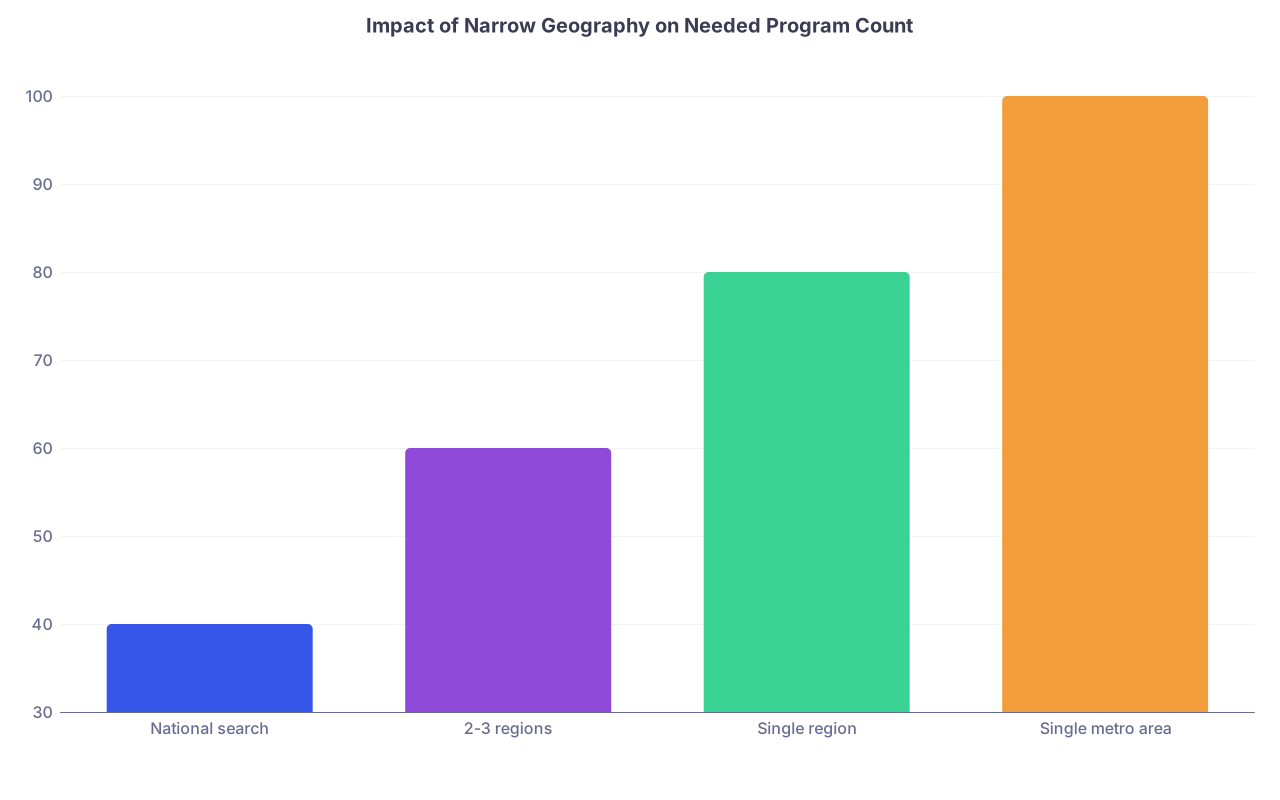
| Category | Value |
|---|---|
| National search | 40 |
| 2-3 regions | 60 |
| Single region | 80 |
| Single metro area | 100 |
That is a crude but accurate representation of what I have seen: the narrower your geography, the higher your total N must go.
If You Are Geography-Restricted
For example, “I must stay within 3 hours of Chicago” or “I have family obligations in Texas only.”
You adjust in two directions:
Increase total number of programs
- Tier 2 applicant restricted to one region? Push from 40–45 up to 60.
- Tier 3 applicant restricted to one region? You are looking at 80–100+ easily.
Shift toward more community In most markets:
- University spots are limited and heavily contested
- Community capacity is wider and slightly less competitive
So your local-region strategy if you are not Tier 1:
- Apply to almost every realistic community and hybrid program in that region
- Be selective with university programs, but still include:
- Your home institution if applicable
- Places where your school has established match relationships
- Programs known to value local ties
Having a “dream city” with 4–6 total programs and applying to all of them is not a strategy. It is a lottery ticket.
Step 6: Program List Tiers – Internal Risk Buckets
Within university and community, you need your own micro-tiers. Otherwise you end up with a list where 80% of programs are all “reaches” wearing different names.
Create three internal buckets within each program type:
- Reach
- Target
- Safer
Apply this separately to:
- University programs
- Community/hybrid programs
Example for a Tier 2 IM applicant, 50 total programs
Say you land on:
- 25 university
- 25 community/hybrid
For those 25 university:
- 5 reach (score medians well above yours, heavy research, big brands)
- 12 target (mid-range academic with stats similar to yours)
- 8 safer (mid- to lower-tier university, less competitive location, known to take similar applicants)
For the 25 community/hybrid:
- 5 reach (highly desired locations, “hidden gem” community programs)
- 12 target (solid, mid-competitive community/hybrid)
- 8 safer (newer programs, less desired geography, but ACGME-accredited and stable)
If you are Tier 3:
- Your “reach” bucket should be smaller, especially on the university side
- Your “safer” community bucket should be bigger
Step 7: Use Data and History, Not Vibes
Two people with identical Step 2 CK and similar grades can have very different odds at the same program. Why? Relationships and historical patterns.
You should be using:
Your school’s match lists for the past 3–5 years
- Where do people like you match?
- Which university programs actually took your graduates?
- Which community programs seem to preferentially like your school?
Advisor insight A real advisor who knows the field will say things like:
- “Program X says they are holistic, but they basically never rank DOs.”
- “Program Y in that midwestern city looks low-key, but they secretly want 245+.”
- “Program Z is very IMG-friendly; your profile actually fits.”
Program websites, carefully interpreted Most will not tell you cutoffs. But you can pick up:
- “We value research and academic careers” = more selective, more university-like in behavior
- “We are committed to serving our local community” + many DO/IMG grads = likely more open to varied metrics
Interview and invite patterns Once invites start:
- If you are getting almost exclusively community invites, your university bucket was probably too ambitious
- If you hear nothing from any category, your total N and risk tiers were off from the beginning
Step 8: EM, Surgical, and Highly Competitive Fields – Modified Ratios
Everything I said above is for “standard” competitiveness specialties. For fields like EM (post-2020 volatility), GS, ortho, ENT, derm, etc., the university/community dynamic shifts.
Two key realities:
- Many surgical and competitive specialties have fewer true community programs.
- The “community” programs that exist often still behave like academic ones in terms of score expectations and selectivity.
So for something like general surgery:
- A “community” program might still expect:
- High Step 2 CK
- Strong letters
- Aggressive work ethic
- University vs community ratio may matter less than:
- Big-name academic vs mid-tier vs lower-known or newer program
- Geographic desirability
- Presence or absence of fellows
Practically:
- Total N must be higher, especially for non-Tier 1 applicants
- Your “community” bucket, where it exists, is still not soft
- DOs and IMGs in these fields must go very high-volume, with emphasis on less-desired geography and newer programs
The deeper point: in highly competitive or surgically intense fields, “community” ≠ “easy.” Do not rely on that assumption.
Step 9: Common Bad Strategies (I Have Seen All of These Fail)
Let me be very explicit about patterns that crash and burn:
The “High-Ambition Academic Only” Strategy
- Applicant: Tier 2–3
- Applies to: 80% university, 20% random community
- Geography: mostly big coastal cities
- Outcome: a January with 0–3 interviews, often all community
The “Random Community Dump” Strategy
- Applicant: Tier 3–4
- Applies to: 100 programs, but chooses them by name/website only
- Does not check: IMG/DO friendliness, history, program stability
- Outcome: huge spend, weak returns because half the list was never going to touch their profile
The “I’ll Just Apply Broadly and See” Strategy
- No explicit ratio planning
- No tiering of reach/target/safe
- Ends up unintentionally heavy on one category (usually big-name university in nice cities)
- Outcome: illusions of “broad” with actual narrowness where it matters
The “Late Overcorrection”
- Submits initial list with 70% university
- No early invites
- In October, panic-applies to 30 extra community programs
- Problem: many of the more interview-generous places already sent their invites; late ERAS apps get less attention
Do it correctly the first time. Build the ratios logically.
Step 10: A Concrete Example – Turning Theory into a List
Let me walk a realistic scenario.
You:
- US MD, no red flags
- Step 2 CK: 236
- Mostly passes, one honors in IM
- No publications; one poster from a required project
- Want internal medicine
- Prefer Midwest but can stretch to some other regions
Tier? Solid Tier 2, maybe 2.5 leaning toward average. No major hook, no major liability.
Your advisor says: “You should be safe if you apply smartly, but do not underapply.”
You choose:
- Total programs: 55
Build the split:
- University / academic: 25
- Community / hybrid: 30
University 25:
- 5 reach: high-end Midwestern and a few coastal universities you like (Chicago, Michigan, etc.)
- 12 target: mid-tier state and regional universities, especially in the Midwest and neighboring regions
- 8 safer: university-affiliated community sites and smaller academic centers in less-desired locations
Community / hybrid 30:
- 6 reach: very desirable city community programs (Chicago suburbs, Twin Cities, etc.) with strong reputations
- 16 target: decent-sized community and hybrid programs in Midwest + some other states, not in the hottest metros
- 8 safer: newer programs and rural/less-competitive areas that have stable accreditation and faculty
You check:
- Your school’s match list: confirm that graduates with ~235–240 have matched to several of these target and safer programs.
- Program rosters: you see recent alumni from your school in some of them.
That is how you align university vs community—not by vibes, but by structured probability management.

| Step | Description |
|---|---|
| Step 1 | Assess Competitiveness Tier |
| Step 2 | Set Total Program Number Range |
| Step 3 | Decide University vs Community Split |
| Step 4 | Layer Geography Constraints |
| Step 5 | Create Reach Target Safe Buckets |
| Step 6 | Check School Match History |
| Step 7 | Refine Final Program List |

Key Takeaways
Your university vs community ratio is not a personality choice. It is a function of your competitiveness tier, specialty, and geographic flexibility. Stronger applicants can lean more academic; borderline or high-risk applicants must be community-heavy.
Total program count and program-type mix must be planned together. A Tier 3 applicant with 70% university programs and 40 total applications is not “testing their luck.” They are cutting their odds dramatically.
Use real data: your school’s match history, advisor input, and each program’s profile. Build explicit reach/target/safe buckets within both university and community lists, and anchor your strategy to where people like you have actually matched—not where you wish they would.