
Most applicants in niche specialties either apply to way too many programs—or disastrously too few. The middle ground is where people actually match.
Let me break that down specifically.
You are not an internal medicine applicant wondering whether 40 vs 60 programs is enough. You are looking at rheumatology, pediatric GI, sleep, palliative, complex general surgical oncology, or another small field where there might only be 50–150 programs total.
In a niche field, “How many programs should I apply to?” is not a vibes question. It is a math + risk tolerance + geography + credentials question. And the people who ignore the math are the ones emailing me in March asking what to do after they did not match.
We are going to walk through exactly how to calibrate your program count in small specialties so you are neither broke nor unmatched.
1. The Core Equation: Interviews → Rank Length → Match Probability
Forget program counts for a moment. The actual sequence is:
You apply to X programs → You get Y interview invites → You rank Z programs → Z determines your match odds.
NRMP data are clear: the probability of matching rises steeply with the number of programs you rank, then flattens hard.
For fellowship-like and niche specialties, rough numbers look like this (varies by field, but pattern holds):
- 1–3 ranks → scary territory
- 4–6 ranks → still risky
- 7–9 ranks → decent but not guaranteed
- 10–12 ranks → strong
- 13+ ranks → very high match probability unless you are in an ultra-competitive subspecialty
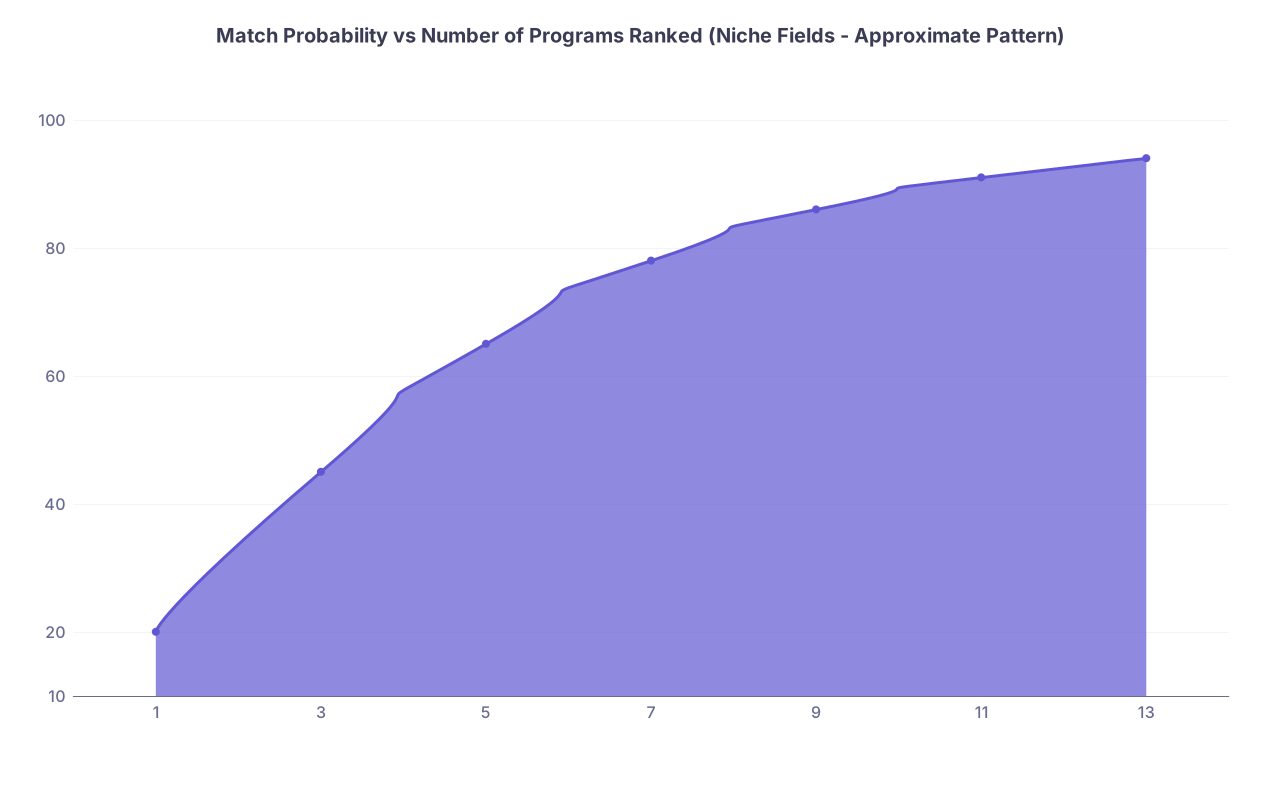
| Category | Value |
|---|---|
| 1 | 20 |
| 3 | 45 |
| 5 | 65 |
| 7 | 78 |
| 9 | 86 |
| 11 | 91 |
| 13 | 94 |
Takeaway: Instead of asking “How many programs should I apply to?”, the better question is:
“Given my profile, how many applications do I need to send to reliably generate 10–12 interview offers?”
In large specialties, you might need to overshoot a bit. In small specialties, there is a hard ceiling: there may only be 40–60 programs total. That is the twist.
2. Understand What “Niche” Actually Means
“Niche” is not just about small numbers. It usually means:
- Fewer total programs nationally
- Fewer total positions per program (often 1–4 per year)
- High variability in how programs screen (home bias, institutional pipelines)
- Very lumpy geography (heavy clusters in major academic centers, big gaps elsewhere)
Examples where this article applies well:
- IM subspecialties with limited spots at many programs: rheumatology, endocrinology, allergy/immunology, geriatrics, palliative, sleep, transplant hepatology
- Pediatric subspecialties: peds GI, peds pulm, peds rheum, peds endo, peds heme/onc
- Some surgical fellowships: complex general surgical oncology, pediatric surgery, surgical critical care (depending on year), vascular at certain times
- Combined or rare tracks: medicine-pediatrics subspecialty fellowships, niche pathology fellowships, certain neuro subspecialties
Where this article is less useful:
- Categorical IM, FM, psych, peds, general surgery residency. Different math. Much bigger denominators.
3. The Four Inputs That Set Your Program Count
You do not pick a number out of thin air. You calculate a range from four levers:
- Competitiveness of the specialty
- Your competitiveness as an applicant
- Geographic flexibility
- Structural constraints (how many programs exist, how many actually take your background)
Let’s go one by one and be blunt.
3.1 Specialty Competitiveness: Are You in “Rheum” or “Geriatrics”?
Some “niche” fields are quietly brutal. Others are begging for applicants.
Rheum, GI, heme/onc, pediatric GI, pediatric heme/onc: higher competition.
Geriatrics, endocrine (depending on cycle), palliative, some sleep and nephrology: more forgiving.
Program count should scale with this.
- Competitive niche → you aim to apply to 80–100% of programs you are geographically willing to attend.
- Less competitive niche → you can afford a selective approach if your application is solid.
If you have no idea where your field sits, look up:
- Fill rate (NRMP, specialty match reports)
- Average number of ranks for matched vs unmatched
- Trends over 3–5 years
If the field is consistently >95% filled and unmatched applicants have 5–7 ranks on average, that is a red flag specialty. You do not play cute with program counts there.
3.2 Your Competitiveness: Are You Above or Below the Median?
I use a crude but practical three-tier model.
Tier 1 – Strong applicants
- Top 1/4 of your residency / class
- Strong letters from known faculty in the field
- Solid research aligned with the subspecialty
- No exam failures; scores around or above “typical” for matched in that field
- Leadership or meaningful niche involvement
Tier 2 – Middle-of-the-road
- Middle 50% of your residency
- Decent but not famous letter writers
- Some scholarly activity, maybe one relevant poster or paper
- Clean transcript; scores in average range
- Nothing glaringly weak, nothing spectacular
Tier 3 – Risk profile / weaker on paper
- Exam failures, remediation, or significant leaves
- Few or no specialty-specific letters
- Little to no research / scholarship in the niche
- Coming from a program with limited reputation / pipeline in that field
- International grads without strong US-based anchors
Your tier drives how aggressive you need to be.
3.3 Geography: How Fussy Are You Really?
This is the part people lie to themselves about.
You cannot say “I will only live in coastal cities, no Midwest, no South, no rural, and I want to see my parents weekly” and then pretend that the field’s national program count still applies to you.
You do not have 80 programs. You might have 15.
- Nationally flexible: “I will go anywhere that trains me well and treats me decently.”
- Region-flexible: “I prefer East Coast or Midwest but could consider exceptions.”
- Region-rigid: “I must be within X hours of family / partner / kids’ school.”
- City-rigid: “New York, Boston, SF, LA, maybe DC. Nowhere else.”
The more rigid you are, the more applications you must send within that narrow band, and the more you must accept that your match probability is capped by simple math.
3.4 Structural Constraints: How Big Is the Universe?
Before assigning numbers, you need a reality check:
- Total number of programs in the specialty
- How many accept your prior training background
- How many would realistically consider your visa status (if relevant)
- How many explicitly or implicitly favor internal candidates or same-institution residents
I have seen people apply to 30 programs in a field that only has 35 total—but 10 of those are essentially locked for internal candidates. On paper that is 30/35. In reality it is closer to 20/25.
Do your homework. Talk to graduates, mentors, and recent fellows, not just websites.
4. Concrete Number Ranges: Strong vs Mid vs Risk Applicants
Here is what you came for: actual numbers.
These ranges assume:
- You are applying in a genuinely niche specialty (50–150 programs total)
- You want to end up with 10–12 interviews if possible
- You will rank every program where you can live and train without hating your life
I will break this into scenarios.
| Applicant Type | Geography Flexibility | Suggested % of Programs | Approx Count (if 80 programs exist) |
|---|---|---|---|
| Strong | National | 50–70% | 40–55 |
| Strong | Region-limited | 60–80% of that region | 25–40 |
| Mid-range | National | 70–90% | 55–70 |
| Mid-range | Region-limited | 80–100% of that region | 35–50 |
| Risk profile | National | 90–100% | 70–80+ |
Now I will translate this into actual examples.
4.1 Strong Applicant in a Competitive Niche (e.g., Rheum, GI)
Profile: Top IM resident, strong rheum/GI letters, specialty research, US grad at a known academic center.
- National geography: Applying to ~50–60 of 80–90 programs is reasonable
- You do not need to hit every single institution.
- You can cut clear “bad fits” and places you truly would not go.
- Region-limited (say, East + Midwest only):
- Identify all programs in your acceptable region
- Apply to roughly 60–80% of them, unless that ends up <30 programs, in which case you should think seriously about expanding geography.
If you are in this tier and apply to only 20 programs in rheum nationally because “my mentor said I am strong,” that is how you become the anecdote whispered about on rounds.
4.2 Middle Applicant in a Competitive Niche
Profile: Solid IM resident, a poster or two, decent letters but not from national names, no red flags.
You do not have the luxury of being picky early.
- National: Aim for 70–90% of all programs
- So if there are 85 programs, you send ~60–75 applications
- Region-limited: You need to apply to essentially all acceptable programs in your region
- If that is <40 programs total and you are not willing to expand, understand your risk is substantially higher.
4.3 Risk-Profile Applicant (Any Niche)
Profile: Exam failure, IMG without strong US anchors, weak research, generic letters, coming from a small community program with no pipeline in the field.
Blunt truth: your biggest enemy is not over-applying. It is underestimating how many screens you will fail silently.
- National, willing to live anywhere: Apply to 90–100% of programs that accept your background and visa status.
- If that ends up being 60 programs, I would seriously consider applying to all 60.
This is where cost and sanity collide. But if matching in this niche is non-negotiable for you, you cannot pretend you are in the same risk category as your co-resident with triple first-author papers.
5. Strategy in Ultra-Small Fields (≤40 Programs)
Some specialties or niches have very few total options: pediatric rheum, pediatric pulm (some years), certain micro-subspecialties.
Here the question “How many programs should I apply to?” is sometimes answered by: “Every single program I can remotely tolerate.”
If there are 35 programs and:
- 5 are essentially internal pipelines
- 5 do not take your prior training background or visa
- 5 are in locations you truly cannot move to for legitimate reasons
You are left with 20. If matching this cycle matters, applying to all 20 is not excessive. It is necessary.
In these ultra-small fields, the levers you adjust are not just program count. They are:
- Doing a focused away rotation / visiting rotation to be known
- Aggressively networking at national conferences
- Getting your PD and subspecialty faculty to advocate directly
- Being realistic about backing up with a more available subspecialty or generalist track
Program count cannot compensate for structural scarcity.
6. Common Mistakes in Niche Fields (And How to Avoid Them)
I see the same errors every single cycle.
Mistake 1: Underestimating Home Bias and Pipelines
Many small programs:
- Prefer their own residents
- Prefer residents from a small network of “feeder” institutions
- Have faculty who only really know how to evaluate residents from 10–15 familiar programs
Solution: Do not over-weight a handful of “dream” institutions with strong home pipelines. They may never seriously consider you. Pad your list with programs that historically take from a broader array of places.
Mistake 2: Over-Filtering on Prestige
You do not need to train only at top-10 name-brand programs to practice in a niche field. Especially true in:
- Endocrine
- Rheumatology
- Geriatrics
- Palliative
- Many pediatric subspecialties
I have seen perfectly capable residents apply only to “top 20” GI programs and end up short on interviews while their slightly less “prestige-obsessed” peers match into excellent mid-tier academic centers.
Mistake 3: Geography Fantasy
“I will apply broadly but realistically I only want NYC / Boston / San Diego.”
No. Decide up front:
- Are you actually willing to move to Iowa City, Birmingham, Rochester, Omaha, Columbus, or Kansas City if that is your only offer?
- If not, treat those as off your list from the start. Do not count them as “applied” for your risk calculations.
Mistake 4: Applying in Two Niche Fields Without a Plan
People sometimes do this: apply in, say, rheum and heme/onc or peds pulm and peds GI. They split their letters, their story, their signal, and then wonder why neither specialty was convinced.
If you are going to apply to two small fields:
- Be explicit with mentors and PD about your primary vs secondary choice
- Understand that each field will see you as less focused
- You may need to apply to near-maximum programs in both fields to compensate
It is usually more efficient to pick one niche and then have a robust backup plan in a broader field rather than spray into two small pools.
7. A Practical Stepwise Method to Set Your Number
Let me walk you through a concrete process you could do in an evening.

| Step | Description |
|---|---|
| Step 1 | List all programs in field |
| Step 2 | Remove structurally unavailable |
| Step 3 | Remove truly impossible locations |
| Step 4 | Estimate your tier strong mid risk |
| Step 5 | Check specialty competitiveness |
| Step 6 | Set target interview count 10 to 12 |
| Step 7 | Choose application percentage based on tier |
| Step 8 | Calculate actual program count |
| Step 9 | Reality check with mentor PD |
Step 1 – Build the universe
Export a list of all programs in your specialty from the match site / FREIDA / specialty society.
Step 2 – Remove structurally unavailable programs
Delete programs that:
- Do not accept your training background
- Cannot sponsor your visa type
- Explicitly state criteria you do not meet (like Step failures not considered)
Step 3 – Remove truly impossible locations
If there are locations that are absolutely off the table (for reasons beyond “I do not like snow”), remove them now. Be honest.
Step 4 – Classify yourself: strong, mid, or risk
Ask your PD and a faculty member in the niche where they would place you. Do not self-upgrade “mid” to “strong” because you feel you worked hard.
Step 5 – Look at specialty competitiveness
Is your field in a crunch year? Look at recent fill rates, match stats.
Step 6 – Set a target interview count (usually 10–12)
This is what you need to rank and feel reasonably safe.
Step 7 – Map tier → application percentage
Using the earlier table:
- Strong: 50–70% (national)
- Mid: 70–90%
- Risk: 90–100%
Adjust upward for more competitive specialties or if your geography is still somewhat limited.
Step 8 – Do the math
If your filtered list after steps 2–3 is 65 programs and you are a mid applicant in a competitive field, 70–90% is 45–60 applications. That is your working range.
Step 9 – Reality-check with a mentor
Show the list and the numbers to:
- Your PD
- At least one faculty member in that specialty
Ask explicitly: “Given my application, does this range seem too low, too high, or about right?”

If both of them think you are under-applying, listen. The downside of extra applications is money and fatigue. The downside of under-applying is redoing the entire year.
8. Special Considerations: IMG Status, Visas, and Non-Linear Paths
If you are an IMG or have any non-standard background, program counts in niche fields shift upward.
8.1 IMGs in Niche Specialties
You face three layers of filtering:
- Programs that simply will not interview IMGs
- Programs that will interview but rarely rank IMGs high
- Programs where an IMG with your specific profile has actually matched in the past
For many subspecialties, the realistic pool for IMGs is:
- 30–50% of total programs, sometimes less.
If your filtered list after accounting for IMG-friendliness ends up at, say, 30 programs, applying to 25–30 of them is not overkill. It is baseline.
8.2 Visa Requiring Applicants
Visa sponsorship shrinks your universe further. J-1 is common but not universal. H-1B is much more restrictive.
Your steps:
- Explicitly check visa policies program by program
- Talk to current fellows / residents as websites are often outdated
- Remove “technically sponsor but practically never do” programs from your mental count
Assume that for each barrier (IMG + H-1B, for example) you need to push your application percentage higher. You are not in the same universe as a US grad with no visa needs.
8.3 Non-Linear or Red-Flag Paths
If you have:
- A Step failure
- Remediation or professionalism issues
- A prior specialty switch
- A gap year with weak explanation
Your strategy must emphasize:
- Absolute maximum number of realistic programs
- Early, proactive honest communication in your personal statement and interviews
- Strong advocate letters that explicitly contextualize the red flag
Program count alone will not save this situation. But under-applying will absolutely sink it.
9. Cost, Sanity, and When to Stop Adding Programs
You are not a bottomless bank account. ERAS or specialty applications in niche fields are not cheap.
At some point you have to ask: “Is adding 5 more programs going to meaningfully change my interview odds, or am I just throwing money at my anxiety?”
Here is how I differentiate:
Add more programs if:
- You are in a high-risk tier or very competitive field
- Your filtered universe is still reasonably large (50–80 programs)
- You genuinely would go to additional programs you add
Do not add more if:
- You are already applying to >90% of realistic programs
- The remaining programs are places you really would not attend if they were your only option
- The main driver is fear, not math
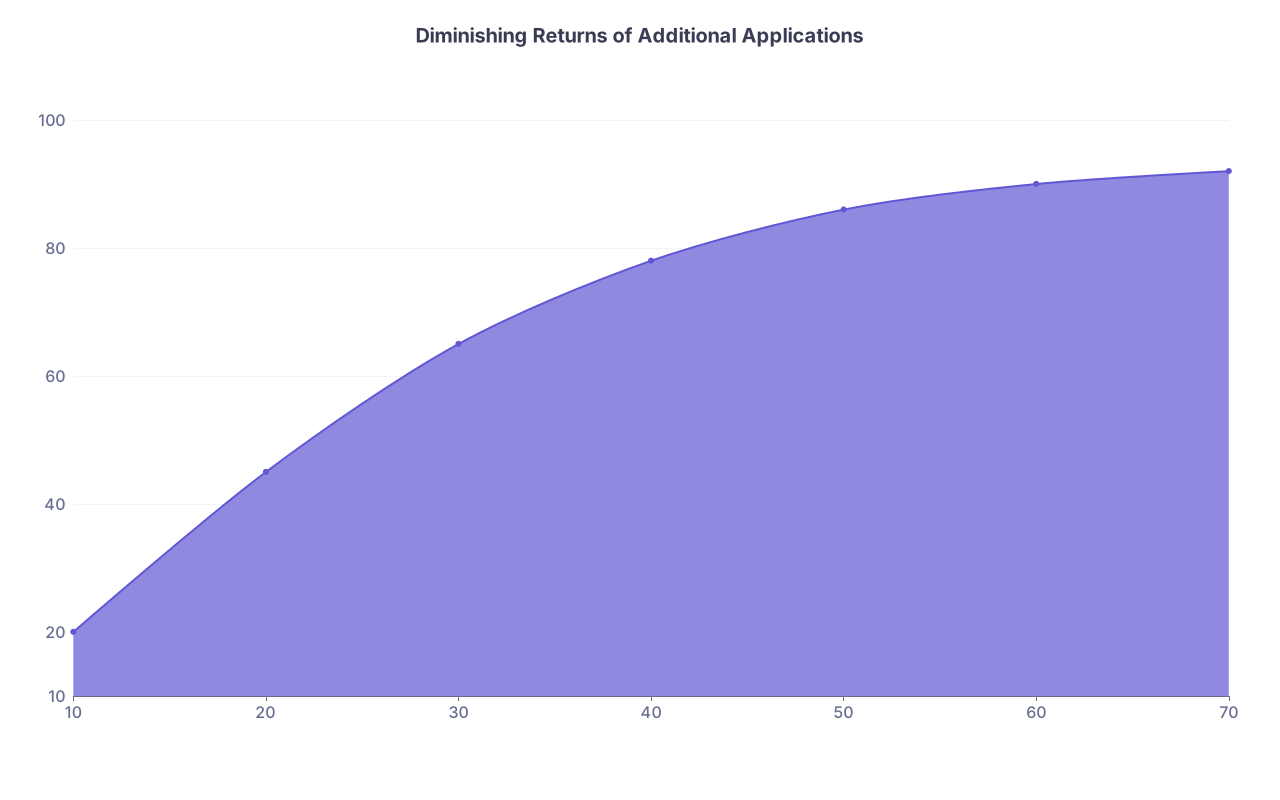
| Category | Value |
|---|---|
| 10 | 20 |
| 20 | 45 |
| 30 | 65 |
| 40 | 78 |
| 50 | 86 |
| 60 | 90 |
| 70 | 92 |
The curve is steep at first, then flattens. Going from 20 to 40 applications matters. Going from 60 to 70 often does not—unless those extra 10 are the only truly IMG-friendly or visa-sponsoring programs.
10. Quick Case Examples (So You See the Logic)
Case 1 – Rheumatology, US Grad, Solid Application
- Total rheum programs: ~120
- After visa / background filtering: 110 are realistic
- Applicant: mid-to-strong IM resident, no red flags, one rheum paper, good letters
- Geography: willing to go anywhere but pref Midwest / East
Recommendation:
Apply to 70–80 programs. Skip only the 30–40 you absolutely cannot stand or are true long-shots (ultra-elite, internal-heavy).
Case 2 – Pediatric Pulmonology, Very Few Programs
- Total peds pulm programs: ~40–45
- After filtering for prior training background: 35
- Applicant: middle-of-the-road peds resident, one subspecialty rotation, a poster
- Geography: wants to stay within a broad region but open to exceptions
Recommendation:
Apply to 25–30 programs (essentially every program in the preferred region plus several outside). Back up with a plan to stay an extra chief year or apply again if needed.
Case 3 – IMG, Endocrinology, On Visa
- Total endo programs: ~150 (example)
- Programs that both take IMGs and actually sponsor needed visa: maybe 50–60 once you filter
- Applicant: decent scores, 1 US letter in endo, several years of US clinical (non-resident) work
Recommendation:
Apply to all 50–60 that fit. You do not have the luxury to be picky. Your match hinges on maximizing interview chances.

FAQ: Small Specialty, Big Question
If my specialty only has 30–40 programs total, is it normal to apply to all of them?
Yes. In ultra-small fields, applying to all realistically available programs is often standard, especially if you have any risk factors. You then sort them later by preference when ranking. The real constraint is fit and eligibility, not elegance.Is there such a thing as applying to too many programs in a niche specialty?
The only “too many” is applying to places where you would absolutely refuse to go. From a match standpoint, more applications generally just cost money and time. The diminishing returns problem is real, but in niche fields the ceiling is low enough that you rarely hit pure absurdity if you are being honest about places you would attend.How many interviews should I aim for in a small or niche field?
For most fellowship-like and niche specialties, 10–12 interviews gives you a strong match probability, assuming you rank them all and interview reasonably well. Below 6–7, your risk of not matching rises significantly, especially in competitive subspecialties.Does coming from a big-name residency program mean I can apply to fewer programs?
Maybe a little fewer, but people overestimate this. A strong home program and strong mentors help open doors, but they do not replace volume in a competitive field. I have seen residents from elite IM programs under-apply in rheum or heme/onc and pay for it. I would not adjust down more than ~10–15% just for institutional name.How much should I let my partner / family needs narrow my geographic list?
As much as you are genuinely willing to accept the increased risk of not matching. If staying near a partner is non-negotiable, then commit to that and accept that your program count will be restricted. The mistake is pretending you are flexible when you are not; that breaks your risk calculation and leads to bad surprises.If I do not match in my niche specialty, should I just apply to more programs the next year?
Not by itself. If you went unmatched, simply resubmitting with 10 more programs will not fix the core problem. You need a deliberate gap-year strategy: improved letters, more targeted research, possibly a focused year in a related role (chief, hospitalist with niche involvement, research fellow), and then a smarter program list. Program volume helps only if your underlying application is being strengthened in parallel.
Key points to walk away with:
- In niche specialties, you do not pick a program count by vibe; you derive it from your competitiveness, specialty competitiveness, geography, and the true number of realistic programs.
- Aim for enough applications to reliably generate 10–12 interviews—usually 50–90% of realistic programs, depending on how strong or risky your application is.
- Under-applying is far more dangerous than over-applying in small fields; the applicants who get burned are almost always the ones who assumed they were the exception.