
Subspecialty Aspirations: Choosing Application Volume for Future Fellowships
Most people are asking the wrong question about application numbers.
If you care about fellowship, the real question is: “How many residency programs do I need to apply to so that I end up at a place that will not quietly kill my subspecialty chances?”
Let me break this down specifically.
If you want cards, GI, heme/onc, interventional radiology, complex ortho, peds subspecialties, etc., your application volume strategy is not the same as someone happy with general practice. Your risk tolerance is different. Your “safety” programs are different. The damage of landing at the wrong residency is different.
You are not just trying to match.
You are trying to match somewhere that keeps doors open.
Step 1: Understand How Fellowship Aspirations Change the Game
For fellowship-focused applicants, residency program choice is leverage. It shapes:
- Access to research in your field
- Letters from recognizable subspecialists
- Exposure to complex cases and procedures
- Reputation and connections of your department
That means “How many programs should I apply to?” is not a simple NRMP table look-up. You have to layer your future subspecialty on top of your current competitiveness.
Two brutally simple truths
Highly competitive fellowships are strongly influenced by program pedigree and faculty connections.
I have watched average residents from powerhouse institutions coast into cards or GI because their attendings picked up the phone.Residency is a weak time to “reinvent” yourself for ultra-competitive fellowships if you start from a low-residency baseline.
It is possible, but it is absolutely not the median outcome.
So application volume has to be calibrated to:
- Your baseline competitiveness for residency
- Your desired specialty
- The competitiveness of your target fellowship
- The tier of residency programs that realistically offer good odds at that fellowship
Let us get precise.
Step 2: Know Your “Fellowship-Relevant” Competitiveness Tier
You cannot decide application numbers without knowing which bucket you are in.
Core variables that matter for fellowship-focused applicants
For most core residencies that feed fellowships (Internal Medicine, Pediatrics, General Surgery, Radiology, Anesthesiology, OB/GYN, Neurology), these matter:
- USMLE Step 2 CK (since Step 1 is pass/fail)
- Class rank / AOA / school reputation
- Research output (especially in or near your future subspecialty)
- US vs IMG status
- Red flags (fails, gaps, professionalism issues)
- Letters and home program strength
For subspecialty: cardiology, GI, heme/onc, advanced pulm/crit, IR, some surgery fellowships etc., residency program prestige and structure become crucial.
I will use Internal Medicine as the example, because it is the main pipeline to multiple high-demand fellowships, but the logic generalizes.
Internal Medicine applicant “fellowship-relevant” tiers
Think about yourself honestly:
Tier 1 – Strong, fellowship-aiming, very competitive
- Step 2 CK: ~250+
- Solid school (especially US MD), maybe AOA
- Multiple publications, some in relevant fields
- Strong letters, no red flags
Tier 2 – Solid, realistic for good academics and strong community
- Step 2 CK: ~235–249
- Decent research exposure (1–3 publications, maybe not in your target field)
- Above-average clinical evals
- No red flags
Tier 3 – At-risk for academic programs, must be strategic
- Step 2 CK: ~220–234, or IMG with 230–240+
- Limited research
- Middle-of-the-pack MSPE
- Maybe some minor concerns (no fail, but no obvious strengths)
Tier 4 – Red flag or meaningful deficit
- Step 2 CK <220, US fail / repeat, big gap, significant professionalism comments
- Or IMG with weak scores / no US clinical experience
You know roughly which group you are in. Do not pretend otherwise—it only hurts your outcome.
Step 3: Translate Fellowship Goals into Residency “Target Tiers”
If you tell me your fellowship goal, I can tell you roughly what kind of residency environment you should be aiming for.
General rule
The more competitive the fellowship, the more you should favor:
- Strong academic centers
- Programs with in-house fellowships in your desired field
- Programs that regularly send grads to that fellowship
For Internal Medicine-based fellowships, a rough mapping:
| Residency Tier (Informal) | Typical Fellowship Outcomes for Strong Residents |
|---|---|
| Top academic (big 20–30 IM) | Cards/GI/Onc/Pulm at solid to elite programs |
| Mid academic / strong university | Mix of competitive and mid-tier fellowships |
| Strong community with fellows | Heme/onc, pulm/crit, cards at regional centers |
| Pure community, no fellows | Hospitalist, primary care, occasional fellowship |
Is this a bit oversimplified? Sure. But it is directionally accurate. You can absolutely match a good fellowship from a community program. I have seen it. But the probability is lower and the lift is heavier.
Why in-house fellowships matter
Programs with in-house fellowships in your target field offer:
- Specialists who know how to write fellowship-caliber letters
- Research projects already running in that area
- Visibility: they have a track record of “placing their own”
Programs without that infrastructure often have:
- Limited high-level research
- Fewer high-impact letters
- Less national visibility
So when you decide application volume, you are not just asking “Where can I match?” You are asking “Where can I match that has a decent fellowship pathway?”
Step 4: Concrete Application Number Ranges by Scenario
Let’s stop talking in generalities. Here are realistic application volume bands for a fellowship-minded applicant, stratified by core specialty and risk.
Internal Medicine with future cards/GI/heme-onc/pulm-crit
Assuming US MD or strong US DO. Add 10–20 programs if IMG.
If you are Tier 1 (very competitive):
- Target: Broad range of academic programs (top and mid), plus a smaller number of strong community programs with fellowships.
- Application volume: ~25–35 programs.
Why not 10–15? Because program preference signaling, geographic fit, and randomness still exist. A single bad personal statement line, one lukewarm letter, or a regional bias can knock you out. Thirty-ish is aggressive but safe.
Breakdown example:
- 10–15 high-to-upper mid academic IM programs
- 10–15 solid academic / hybrid community-university programs
- 3–5 strong community with in-house subspecialty fellows
If you are Tier 2 (solid, not superstar):
- Target: Mid-tier academics, some aspirational top programs, and a stronger “floor” of solid community programs with in-house fellows.
- Application volume: ~35–45 programs.
Breakdown example:
- 5–8 aspirational high-tier academic IM
- 15–20 mid academic university programs
- 10–15 strong community/hybrid programs with fellowship infrastructure
At this level, fellowship ambitions are very realistic if you land at a place with:
- Regular fellowship matches
- Real subspecialty faculty
- Some research activity
You are primarily defending against the risk of slipping into a low-volume, no-fellowship community shop.
If you are Tier 3 (borderline academic competitiveness):
- Target: Aggressive spread across mid-to-lower academic and strong community. Priority = get into somewhere that has your fellowship of interest.
- Application volume: ~45–60+ programs.
Breakdown example:
- 3–5 aspirational academic IM (for upside)
- 15–20 realistic academic / hybrid programs
- 20–30 community/university-affiliated with subspecialty fellows
Here, the danger is matching at a place where nobody knows how to send residents into your target fellowship. More applications buys you a better shot at at least one program with a track record.
If you are Tier 4 or IMG with significant deficits:
- Target: Any IM program that can train you decently and that has at least some track record of graduates going on to further training.
- Application volume: 60–80+ programs is common and rational.
You are prioritizing simply matching, but you can still bias toward programs that:
- Have affiliated or nearby subspecialists
- Mention fellowships in their alumni outcomes
- Have research or QI projects in your area of interest
Do not kid yourself: from here, cards/GI at top places is possible but rare. You would be grinding against the odds.
Other specialties with heavy fellowship pipelines
I will keep this concise but practical.
General Surgery → competitive fellowships (surg onc, HPB, CT, peds surg)
- Tier 1 applicants: ~25–35 surgery programs (emphasis on academic & high-volume centers)
- Tier 2: ~40–50
- Tier 3+: 60+
You need case volume and faculty in your niche. A small low-volume community program is a bad marriage for someone gunning for complex HPB or surgical oncology.
Diagnostic Radiology → IR, neuro IR, etc.
- Tier 1: ~20–30 (heavier on academic centers with IR)
- Tier 2: ~30–40
- Tier 3+: 45–60
Look hard at:
- How many IR faculty
- Presence of IR residency/fellowship
- Procedure volumes and resident IR exposure
Pediatrics → NICU, peds cards, heme/onc, PICU
- Tier 1: ~25–30
- Tier 2: ~30–40
- Tier 3+: 40–55
You want:
- Freestanding children’s hospitals or large children’s centers
- In-house fellowships in your area
- Documented fellowship placement lists
OB/GYN → MFM, Gyn Onc, REI
- Tier 1: ~25–30
- Tier 2: ~30–40
- Tier 3+: 40–55
Again: in-house MFM, gyn onc, REI fellowships are gold. Look for academic centers with strong surgical volume.
Where people go wrong on application counts
Three common failure patterns:
Underapplying because of ego or cost
Example: Tier 2 candidate aiming for cards applies to 18 IM programs, all aspirational. Ends up scrambling. I have literally heard, “I thought my 245 would carry me.” It did not.Overweighting geography for a competitive fellowship
“I only applied in California because my partner is there and I want cards.” Then they match into a small community program in a saturated region with almost no fellowship exposure. Long-term cost: enormous.Treating all IM (or surgery, or peds) programs as equivalent
They are not. If half the graduating class becomes hospitalists every year and nobody has gone to cards/GI in 5+ years, that is data.
Step 5: Use Data, Not Vibes, to Define Your “Safety Floor”
You should not be guessing which programs are decent for your fellowship aspirations. There are hard signals you can pull quickly.
Signals a program is “fellowship-friendly”
- Lists of recent graduates’ destinations (on program website or asked on interview)
- In-house fellowship in your area
- Multiple faculty in your subspecialty of interest
- Ongoing clinical research / QI projects in that area
- Program leadership who can name where their residents matched last cycle
If their answer to “Where have your residents gone for GI/cards/etc. recently?” is vague or ancient (“Uh, I think someone matched there… maybe 5–6 years ago”), that tells you something.
Quick program categorization strategy
Make a simple spreadsheet and tag each program:
- Has in-house fellowship in my field? (Y/N)
- Sends at least 1–2 people per year into any fellowship? (Y/N)
- Sends at least 1 into my fellowship every few years? (Y/N or ? if unknown)
- Research presence in my area? (None / Limited / Active)
Then label programs:
- Tier A: Strong path to your fellowship (in-house program, track record)
- Tier B: Possible path (some faculty, some history, not robust)
- Tier C: Weak path (no in-house fellowship, little history or infrastructure)
Your application list should not be weighted heavily toward Tier C if you are serious about subspecializing, unless your main priority is simply matching somewhere.
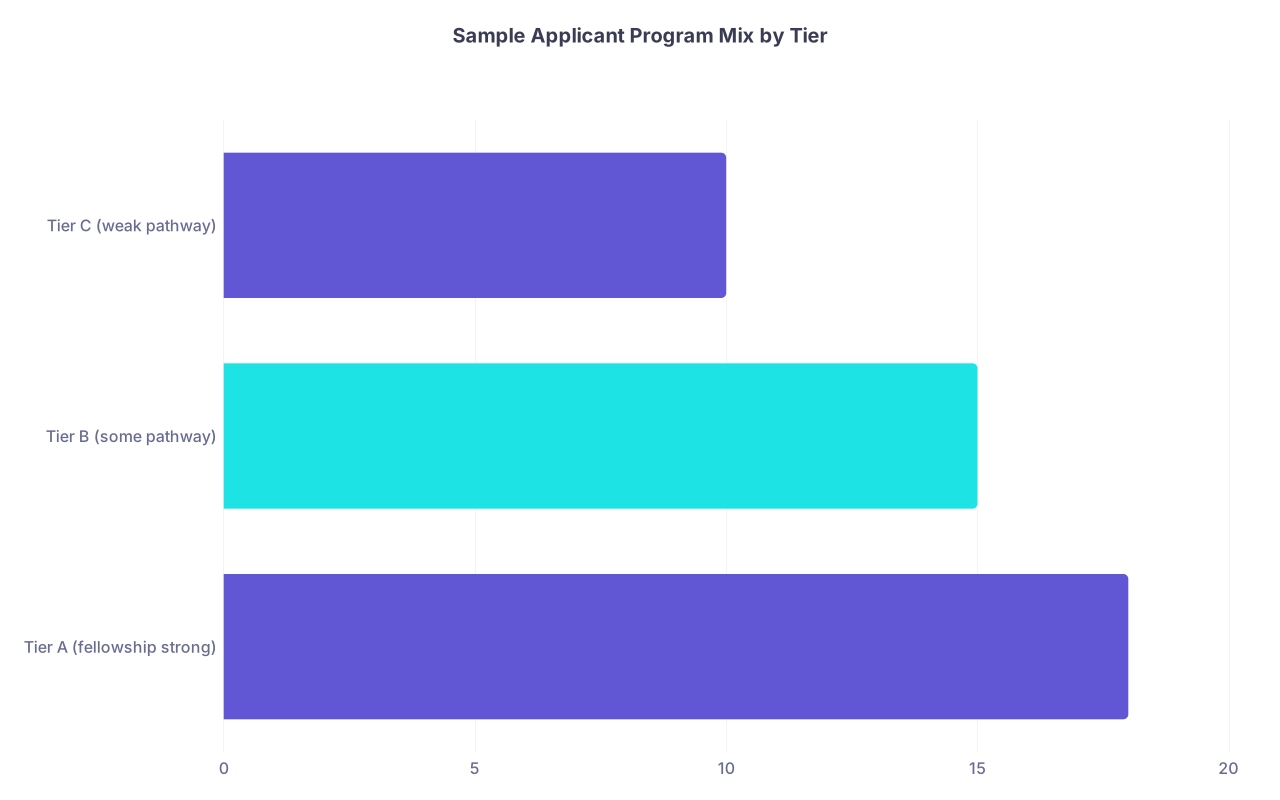
| Category | Value |
|---|---|
| Tier A (fellowship strong) | 18 |
| Tier B (some pathway) | 15 |
| Tier C (weak pathway) | 10 |
This is how a reasonably strong, fellowship-focused IM applicant’s distribution might look. If your Tier A number is 2, and Tier C is 30, you are not acting like someone who really wants subspecialty training.
Step 6: Adjusting Application Volume for Reality: Couples, IMGs, and Risk
There are modifiers that absolutely change your needed application count.
Couples Match
Couples Match is a chaos amplifier. You are no longer solving for “I match”; you are solving for “we both match in the same rough place.”
If you are both fellowship-minded, but one of you is significantly weaker on paper, your strategy shifts.
Rules of thumb:
- Add 10–15 programs over what you would apply to solo, and the same for your partner’s list.
- You will likely compromise on program tier or geography.
- If one of you needs an academic center for future fellowship, prioritize that person’s trajectory, then add more geographic spread to make pairing possible.
I have watched couples “play it close” with 20–25 programs each, both fellowship-aspiring, and they paid for that optimism during Match Week.
IMGs and subspecialty goals
If you are an IMG and dreaming of competitive fellowship:
- Application counts need to be aggressive. 60+ for most, 80+ for many.
- You aim at a broad range of academic and hybrid community-university programs that actually interview IMGs.
- Your floor: programs with at least some history of fellowship matches and faculty who will answer your emails.
IMGs who apply to 25–30 IM programs and hope for cards/GI later are usually misunderstanding the landscape.
Your personal risk tolerance
Some people are willing to repeat an application cycle. Most are not.
If you must match (visa, finances, family), you do not get to run a “tight” list. You buy probability with more applications.
If you see your future identity as tied strongly to a particular subspecialty (e.g., “I know I want advanced heart failure” or “I will do gyn onc or I will be miserable”), you should:
- Apply to more programs.
- Be less precious about geography.
- Heavily prioritize programs that make that subspecialty realistic.
Step 7: Timing, Signaling, and List Management
Application volume is not static. Smart applicants change their behavior based on feedback.
Use signals (where applicable) intelligently
Some specialties now have signaling or preference tokens. The point is not “spray them at your dream programs and pray.” The point is:
- Use signals on programs that are realistic and that materially improve your fellowship odds.
- Do not waste all signals on sheer dream reach programs where your odds are microscopic.
Think: “If I matched here, would this move the needle on my fellowship goal?” Then: “Am I plausible for them?”
Track interview yield and adjust
You are not locked into a number until ERAS opens. But you can adjust your expectations for future cycles (and you should).

| Step | Description |
|---|---|
| Step 1 | Submit ERAS |
| Step 2 | Track interview invites |
| Step 3 | Maintain current volume in future |
| Step 4 | Increase programs next cycle |
| Step 5 | Broaden tiers and geography |
| Step 6 | Invite rate adequate? |
During your current cycle, you obviously cannot add more programs after the deadline, but you can:
- Recognize if you under-applied far earlier than Match Week.
- Keep a record of response patterns for advisors or for any SOAP considerations.
- Learn for your fellowship application strategy later (how competitive you really look to programs).
Step 8: When You Have to Undershoot the “Ideal” Number
Sometimes money is tight. Or you have true geographic immobility. Or both.
You may simply not be able to afford 60–80 applications.
Here is how I would triage, if you are fellowship-minded but constrained:
Keep fewer programs, but insist on a higher fraction of fellowship-capable ones.
For example: Instead of 40 programs of mixed quality, 25–30 that almost all have in-house fellowships or a clear track record.Use targeted geography with density.
If you must be in the Midwest for family, hit every reasonable academic and hybrid program from Chicago to St. Louis to Minneapolis, rather than random scattershot coasts.Be extremely honest about your tier.
You cannot afford vanity applications. If your advisor says “You are not competitive for MGH or UCSF,” do not donate money for no reason.Lean harder on your home institution.
If you have a home program with your target fellowship, and you are well-liked, that single fact can offset some volume issues if you match there.
Step 9: Your Future Fellowship Application Starts With This List
Here is the part people do not want to hear. Even if you are “100% sure” you want a competitive fellowship now, you may change your mind. That is fine.
But the reverse is not true:
If you choose your residency list as if you will never care about fellowship, and then in PGY-2 you desperately want GI or IR, you are stuck with the environment you matched.
So your residency application volume should be built with a bias toward optionality.
Optionality comes from:
- Programs that open more doors than they close
- Faculty who know other people across the country
- Case mix that prepares you for higher-level training
- A reputation that does not need explanation at every interview
When you are sitting at your PGY-3 desk rewriting your fellowship personal statement at 2 a.m., you will not care that you saved a few hundred dollars by applying to 20 fewer programs three years earlier. You will care very much whether someone in your department can actually call the PD of the fellowship you want.
Key Takeaways
If you care about competitive fellowship, you are not just aiming to “match somewhere”; you are aiming to match at a program with proven fellowship pathways—this usually demands higher application volumes than your classmates who are happy with generalist careers.
Application numbers should be set by your true competitiveness tier, subspecialty goal, and risk modifiers (IMG status, Couples Match, geography). For many fellowship-minded applicants, realistic bands are:
- Strong: ~25–35
- Solid: ~35–45
- Borderline or IMG: ~45–80+
Design your list using data: prioritize programs with in-house fellowships, documented fellowship matches, and subspecialty faculty. If your application volume is high but heavily weighted toward places that never send residents into your target field, you are not actually behaving like someone serious about subspecialty training.