
Academic career goals do not excuse you from applying broadly. If anything, a research-heavy path usually demands a longer, smarter, and more stratified program list than a purely clinical trajectory.
Let me break this down specifically.
You are not just applying to “internal medicine” or “neurology” or “general surgery.” You are applying to:
- a training environment, and
- a research ecosystem, and
- a future network that will either launch your academic career or quietly suffocate it.
That has very concrete implications for how many programs you apply to—and what kind.
1. The Core Problem: You’re Applying to Two Markets at Once
A standard applicant is playing one game: match into a decent program that will not ruin their life.
A research-focused applicant is playing two games simultaneously:
- Match into a program where they will not be clinically miserable.
- Land in an institution where serious academic careers are actually built: grants, publications, mentorship, protected time, promotion tracks.
Those two sets do overlap—but not as much as people think.
The mistake I see constantly: strong research applicants dramatically shrink their list because they believe “I’m competitive for top academic programs.” Some are right. Many are slightly delusional. A non-trivial subset end up in SOAP or at a research-barren program, watching their academic goals evaporate over three years.
So the central question is not just “How many programs?” but:
- How many true academic powerhouses are realistic for you?
- How many mid-level but research-supportive programs belong as your safety net?
- How many clinical-heavy backup programs are you actually willing to attend if everything goes sideways?
You adjust total list length based on your competitiveness and how narrow your acceptable “academic ecosystem” is allowed to be.
2. First: Define Your Actual Academic Ambition (Not the Buzzword Version)
“Academic career” is one of the most abused phrases in residency applications. Everyone “loves teaching and research” until they are post-call, have not eaten, have five notes outstanding, and the PI wants revisions by tomorrow.
You need to be honest about what you actually want.
Level 1: Research-Adjacent Clinician-Educator
Profile:
- You enjoy teaching.
- You are willing to do some QI projects, a few case reports, maybe a small educational study.
- You do not need R01-level work or a K award.
What you need:
- Solid teaching culture.
- Reasonable support for scholarly projects.
- Maybe a fellowship that includes some research.
For this group, you do not need a hyper-elite list or a huge volume of “Ivies.” Your “research-heavy path” is moderate. Your list length looks closer to a standard applicant, with added filtration for basic scholarly infrastructure.
Level 2: Clinician-Scientist or Independent Investigator
Profile:
- You want serious research as a sustained part of your career.
- You can see yourself on a K-track (K08, K23) or similar.
- You care about methodology, mentorship, and protected time.
What you need:
- Real funding environment.
- Track record of residents getting K awards / T32 slots / significant fellowships.
- Known PIs in your area of interest.
Here, your list needs:
- A high density of real academic centers.
- Enough breadth that you are not dependent on matching at 3–5 ultra-elite places.
These applicants usually need a slightly longer list than their scores alone would predict, because the niche they are chasing (true academic ecosystem + good mentorship in their field) is rarer.
Level 3: Niche or Hyper-Specialized Research Path
Examples:
- Physician-scientist in a narrow subspecialty (e.g., neuroimmunology, pancreatic cancer genomics).
- Heavy computational / bench focus tied to one or two major labs nationally.
- Dual-degree trajectory (MD-PhD/PhD after residency, etc).
Here, the issue is not just “number of programs,” but “number of programs that make any sense for what I want to do.” That tends to be small.
Paradoxically:
- Your core target list may be short (the top 5–10 places with your niche).
- Your overall ERAS list needs to be padded with more general academic programs and some clinical backups. Because niche goals are fragile. One PI leaving can derail your perfect plan.
3. Baseline Numbers: Where Most People Start
These are starting points, not commandments. They assume a US MD applicant; adjust upward by 20–40% for DO and by 30–50% for IMGs in competitive fields.
| Specialty Type | Typical Range (US MD) |
|---|---|
| Less competitive (FM, Psych) | 15–25 programs |
| Moderate (IM, Peds, OB/GYN) | 20–35 programs |
| Competitive (EM, Anes, Neuro) | 25–40 programs |
| Very competitive (Derm, Ortho, ENT, Plastics, IR, Rad Onc) | 40–70+ programs |
Now layer research-heavy goals on top.
As a rough rule:
- Add 20–30% more programs if you’re targeting an academic/research-intensive path, unless your metrics are truly top tier and you are realistic about where you stand.
Why? Because you are not just matching—you are trying to match into a subset of places with actual research structure. Shrinking your list to 12 “top research powerhouses” is how you end up rethinking your life during SOAP.
4. How Your Academic Profile Changes the Math
Your Step scores, research output, and institutional pedigree dramatically shift the “right” number of applications. Let me be specific.
A. Objective Metrics: Steps, Grades, School
Quick shorthand:
Elite academic profile
- Step 2 CK ≥ 255
- Honors-heavy transcript / AOA / Gold Humanism
- T50 or better US MD school
- Strong narrative consistent with research
Solid academic profile
- Step 2 CK ~ 240–254
- Mostly passes with some honors
- US MD or strong DO with solid clinical comments
- Some research
Borderline for top academic centers
- Step 2 CK < 240, any fail, or big red flags
- Limited honors, mid-tier or lower-tier school, or DO/IMG without institutional cachet
The lower you are on that spectrum, the more programs you need, even if your research CV is solid.
B. Research Portfolio: Depth vs Noise
Having “research experience” on ERAS is not a binary. Programs see right through padded lists.
Here is how I mentally classify research strength:
Category 1: Heavyweight researcher for your level
- 10+ publications with 3–5 first-authors in relevant fields
- Mix of original research (basic, translational, clinical)
- Presentations at national meetings (e.g., ATS, AHA, AACR, AAN)
- Strong letters from known investigators
Category 2: Solid but not star-level
- 3–7 pubs, maybe 1–2 first-authors
- Some posters, maybe an oral presentation
- Projects are coherent but not spectacular
Category 3: Light or scattered research
- Case reports, one small retrospective study, local posters
- No strong narrative or major output
If you are Category 1 and your scores are strong, you can concentrate your list more in top academic programs—without getting reckless.
If you are Category 3 but want an academic career, you must accept that many elite programs will not take you seriously as a future investigator. You compensate with:
- A broader list
- More mid-tier programs with supportive mentors
- A realistic expectation that fellowship might be your real pivot point into serious research
5. Adjusting List Length by Specialty + Academic Ambition
Now let’s get concrete by specialty type.
Internal Medicine – Research-Heavy Track
IM has the broadest academic ecosystem, but the competitiveness at true research hubs (MGH, BWH, UCSF, Hopkins, Penn, Duke, etc.) is intense.
Rough ballpark for a US MD:
Elite profile + Category 1 research
- Total: ~18–25 programs
- Mix: 10–12 top academic “name” programs, 8–13 solid academic mid-tiers
- You do not need 40+ if you are reasonable about your self-assessment.
Solid profile + Category 2 research
- Total: ~25–35 programs
- Mix: 8–10 big-name academics, 10–15 mid-tier research-supportive, 5–10 strong clinical with some research
- You are right in the zone where small mis-calibration can hurt you; err slightly on the longer side.
Borderline profile or weak research
- Total: ~35–45+ programs
- Mix: 5–7 top-tier reaches (fine), 10–15 mid-tier academics, 15–20+ community/university-affiliated programs with some scholarship infrastructure
- Here, your academic “move” will likely come in fellowship.
Neurology, Pediatrics, OB/GYN – Academic Lean
These have well-known academic hubs but a long tail of programs with very limited research.
- Research-driven applicant should usually be around 25–40 programs, depending on competitiveness.
- Concentrate 8–12 programs at the top tier, then a wide base of mid-tier places that actually have NIH funding and a history of fellows going into academics.
Surgery, ENT, Ortho, Urology, Plastics
Hard truth: in many surgical fields, “I want to do research” is almost a cliché. Programs have heard it a thousand times.
If you truly mean academic surgery, you:
- Need to hit programs with established lab years, T32s, and a culture that does not treat research as a checkbox.
- Must respect how competitive this is.
A US MD with a strong research CV in, say, general surgery but no 260 Step score is still not a shoo-in at the “top 15.”
Numbers:
Strong applicant, research-heavy, competitive surgical field:
- 40–60 programs is completely normal.
- At least 15–20 major academic centers, then another 20–30 with real lab infrastructure.
If you are DO/IMG or have weaker scores:
- 60–80+ programs is not insane, if financially possible.
- But you also need to be honest that residency may not be your research-launch stage; that may come after a dedicated research fellowship.
Radiology, Radiation Oncology, Anesthesiology, EM
Academic paths exist, but the density of hardcore NIH-style labs is lower.
For a research-heavy plan here:
- Total often ~30–45 programs.
- You are prioritizing places that have robust departmental research plus non-token resident research time.
- You still need enough “normal” programs where you can do QI and limited projects without hating your life.
6. Tiering Your List: Academic vs Clinical Weight
An intelligent research-focused list is tiered, not just long.
At minimum, have three functional tiers:
Tier A – True research powerhouses (your dream scenario)
- NIH funding, real T32s, K-award success, famous names in your specific area
- Robust resident research tracks, documented protected time
- These are often your top 5–15 programs
Tier B – Solid academic programs with good mentorship but less name recognition
- University-affiliated, maybe not “Top 10” but good departmental culture
- Enough funding and faculty to support longitudinal projects
- Usually your largest tier numerically
Tier C – Clinically strong programs with decent scholarship but limited high-level infrastructure
- These may not launch you into R01-land, but they do not kill your academic prospects either
- Often where you match if big-name places pass
You then adjust counts in each tier depending on your risk tolerance.
Someone who “must” be in a K-award environment might do:
- Tier A: 10–15
- Tier B: 10–15
- Tier C: 5–10
Total: ~25–40 programs
Someone who is more flexible academically might do:
- Tier A: 5–8
- Tier B: 10–15
- Tier C: 10–15
Total: ~25–35 programs
7. Geography: The Academic Trap People Underestimate
Geographic restriction is deadly when combined with specific academic goals.
If you say:
- “I want a serious research environment”
and - “I must stay in California / New York / Boston”
You have just cut the viable program list to a fraction. In some specialties, that might mean:
- 5–8 truly appropriate programs in your region.
That is not a safe list, no matter how strong you are.
You then face a choice:
- Loosen geography, or
- Loosen your academic expectations.
Most people try to hold onto both and compensate by applying to the same 12–15 ultra-elite programs everyone else wants.
That is not strategy. That is wishful thinking.
If you are region-locked and research-focused:
- Add extra programs within your acceptable radius, even if they are weaker academically but still have some faculty doing work in your area.
- Then consider whether your real academic move will be in fellowship at a top center, rather than in residency.
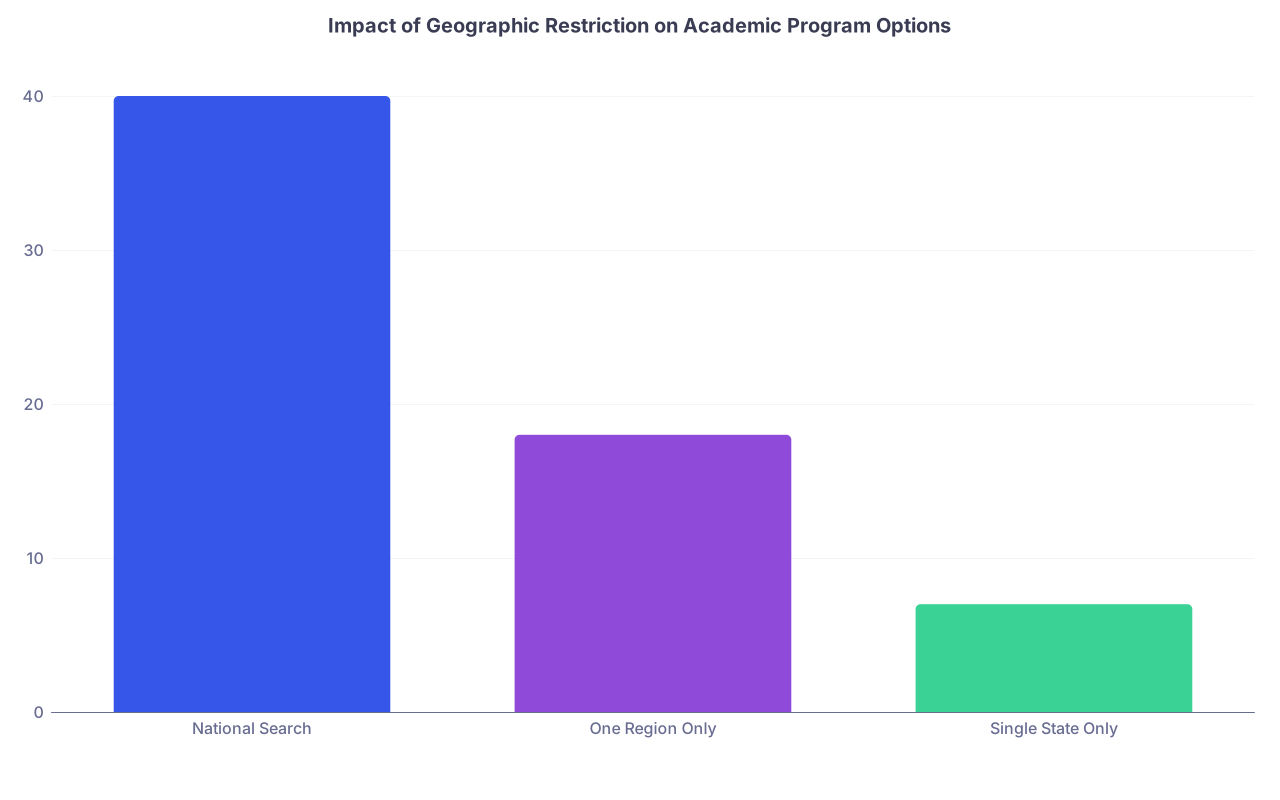
| Category | Value |
|---|---|
| National Search | 40 |
| One Region Only | 18 |
| Single State Only | 7 |
8. Cost, Sanity, and Diminishing Returns
People love to talk about “apply to 80 programs, it’s safer.” Financially and psychologically, that is not trivial.
There is a point of diminishing returns, especially in moderately competitive fields, where each extra program:
- Adds another potential interview you cannot attend
- Adds another set of letters and personalizations you will not truly tailor
- Adds noise without significantly changing match probability
But for research-heavy applicants, the calculus is slightly different:
- Extra mid-tier academic programs can meaningfully widen your safety net of research-compatible options.
Still, use some structure:
- Aim to stop when you have:
- A solid set of Tier A programs that realistically align with your profile.
- A numerically large Tier B that you would be fine matching at.
- An adequate Tier C that preserves at least some academic options while guaranteeing a match.
If, after that, your anxiety is still screaming for you to add another 15 bottom-tier places that have zero meaningful research, ask yourself: are you actually willing to go there and abandon your current academic goals? If yes, fine. If no, stop padding for the illusion of safety.
9. Concrete Scenarios: How Lists Actually Shift
Let me walk through three very typical profiles.
Scenario 1: The Strong IM Applicant Eyeing a K Award
- US MD, Step 2 CK 258
- 2 first-author clinical papers in oncology, 4 co-authors, ASCO poster
- Mentors at a mid-tier school, but strong letters
- Wants: serious onc research, maybe oncology fellowship, eventual K award
Reasonable list:
- 12–15 top academic IM programs with strong heme/onc research (MGH, BWH, UCSF, Penn, Duke, Stanford, FHCC/UW, etc.).
- 10–15 solid academic IM programs with strong cancer centers but less name recognition.
- 5–8 additional academic programs in cities they can tolerate.
Total: ~30–35.
Could they match with fewer? Yes. But 18–20 only is tighter than it needs to be for someone staking their future on a research career.
Scenario 2: The Mid-Range Neuro Applicant with Decent Research
- US MD, Step 2 CK 244
- 1 first-author epilepsy paper, 2 posters, regional neurology conference presentation
- Wants: academic neuro, probably epilepsy fellowship, mix of research and education
Reasonable list:
- 7–10 top neuro programs (UCSF, Penn, Columbia, Mayo, etc.)
- 12–18 mid-tier academics (university neurology departments with decent NIH presence)
- 8–12 additional programs that are more clinically heavy but have at least a few faculty publishing in epilepsy or clinical neurophys.
Total: ~27–40, depending on risk tolerance.
Scenario 3: DO Applicant Targeting Academic General Surgery
- DO, Step 2 CK 247
- 2 retrospective surgery papers, 1 QI project, several posters
- Wants: academic surgery, willing to take dedicated lab years, flexible geographically
Reasonable list:
- 15–20 academic surgery programs with established research years, known for taking DOs or at least not excluding them
- 20–30 university-affiliated general surgery programs with some research but less formal structure
- 15–20 more clinically heavy programs that still have at least a few faculty in outcomes research or QI
Total: ~50–70 programs.
Not cheap. But that is the price of being a research-minded DO in a hyper-competitive surgical field.
10. How to Vet “Research-Heavy” Programs Before You Waste Applications
Not every program that says “research opportunities available” is actually built for academic careers.
At minimum, look for:
- Number of faculty with R01 or equivalent funding in your area.
- Presence of T32 training grants or formal research tracks.
- Evidence that residents actually publish outside of token QI posters.
- Graduates going on to:
- top-tier fellowships
- K awards
- faculty positions at academic centers
Do a quick department-level sniff test:
- Check PubMed output with your target institution + key terms.
- See if your specific niche (e.g., pulmonary hypertension, movement disorders, etc.) has active faculty.
- Look at program websites—not for their self-praise, but for:
- resident publication lists
- structured research curricula
- protected time policy
Then categorize programs into Tier A/B/C. Only after that do you finalize how many to apply to.

11. Timing and Strategy: Do Not Wait to “See How Interviews Go”
One more trap: people think they can undershoot their list and “add more programs later if interviews look sparse.”
Reality:
- Programs often review in waves.
- Late applications to many academic programs are quietly deprioritized.
- The psychological hit of seeing no early invites often leads to panicked, poorly chosen add-ons.
For research-heavy paths, this is worse. The programs most aligned with your trajectory:
- Often screen carefully and early.
- Often fill most interview slots before you realize your list was too short.
Your initial application list should already reflect:
- A realistic assessment of your competitiveness
- A fully tiered academic/clinical strategy
- Enough depth that you are not dependent on adding “hail Mary” programs in November

| Step | Description |
|---|---|
| Step 1 | Define Academic Goals |
| Step 2 | Assess Competitiveness |
| Step 3 | Identify Tier A Programs |
| Step 4 | Identify Tier B Programs |
| Step 5 | Identify Tier C Programs |
| Step 6 | Set Target Program Counts |
| Step 7 | Finalize List Before Submission |
| Step 8 | Submit Applications Early |
12. Summary: How to Actually Adjust Your List Length for a Research-Heavy Path
Strip it down to the essentials.
You are playing a two-layer game: matching and landing in an ecosystem that can support your academic goals. That almost always means a slightly longer and much more carefully tiered list than a typical clinically focused applicant with the same scores.
Your metrics and research portfolio decide how concentrated you can be at the top. Elite scores + Category 1 research buys you the freedom to aim higher with fewer programs. Anything less → add 20–40% more, especially in mid-tier academic programs.
Do not let geography fantasies silently shrink your viable academic options to a dangerous level. Either expand your region or accept that residency will be a bridge, not the final launch point, for your research career.
If you build your list with those three realities in mind, you are miles ahead of the average “I love research” statement that collapses under pressure.