
The usual “just apply to 30–40 programs” advice falls apart the second you say: “I only want this one region.”
If you’re restricting your residency applications to a single region, you can’t use generic national numbers. You have to plan based on supply (how many realistic programs exist in that region for you) and risk tolerance (how devastated you’d be not to match there).
Let’s walk through exactly how many programs you need, how to calculate a safe range for your situation, and where people screw this up.
The Short Answer: Target Ranges By Risk Level
If you’re only applying in one region (Northeast, West Coast, Midwest, Texas, etc.), here’s the rough, honest breakdown assuming you’re applying in a moderately competitive specialty (IM, Peds, FM, Psych, OB/GYN). If your region actually has at least this many programs available to you:
| Applicant Type | Low Risk (very strong) | Moderate Risk (average) | High Risk (red flags) |
|---|---|---|---|
| US MD Senior | 20–25 | 25–35 | 35–45 |
| US DO Senior | 25–30 | 30–40 | 40–50 |
| IMG (US/non-US) | 35–45 | 45–60 | 60+ |
Those ranges assume:
- You’re applying to every realistic program in that region (not cherry-picking only “top” ones).
- Specialty is not ultra-competitive (Derm, Ortho, Plastics, ENT, NSG, Rad Onc). For those, regional-only is often simply unsafe unless you’re stellar and the region is dense with programs.
The real constraint usually isn’t “How many should I apply to?”
It’s “Does this region even have that many programs that will look at my type of application?”
Step 1: Define Your “Region” Like an Adult, Not a Realtor
“East Coast” is not a region. “Places my partner will tolerate” is.
You need a concrete definition:
- By states (e.g., NY + NJ + PA + CT)
- Or by metro + surrounding driving radius (e.g., within 3 hours of Chicago)
- Or by contract/personal constraint (e.g., I’m in the military, spouse job is fixed in Houston)
Once you define it clearly, count the supply.
How to Actually Count Programs
Do this on FREIDA, ACGME, or VSLO/ERAS search:
- Filter by:
- Specialty
- States / cities in your true region
- Then manually go through and mark:
- Programs that don’t take your background (e.g., many university IM programs don’t take IMGs)
- Programs that say no to your exam pattern (e.g., some require no Step failures)
- Programs that are categorical vs prelim (don’t count prelims if you want categorical)
You’ll usually end up with:
- “Total programs in region” (e.g., 42)
- “Realistic for me” (e.g., 28 after excluding those that clearly won’t consider your profile)
That “realistic” number is the ceiling of how many programs you can apply to in that region. If that ceiling is below your safe range from the table above, your plan is already risky.
Step 2: Match Your Profile to a Program Count
Now you tie who you are to how wide you need to go.
1. Assess Your Risk Level Honestly
You’re low risk if:
- US MD, no gaps, no failures, no major professionalism issues
- Step 1 pass on first attempt
- Step 2 in a reasonable range for your specialty (e.g., IM > 235–240, FM > 220–225)
- Decent letters and normal clinical experiences
You’re moderate risk if:
- Scores are around or slightly below national mean for your specialty
- You’re DO applying to a more academic region without strong research
- You’re an IMG with solid but not standout credentials
- You have minor “soft” weaknesses (limited home rotations, average letters, no home program)
You’re high risk if:
- Exam failure attempts
- Significant gap in training
- Big specialty switch with minimal experience
- Applying to a competitive specialty from a non-elite school with average scores
- IMG without US clinical experience or weak letters
Then pair your risk level with the table from above to get a target program count.
If you’re:
- US MD, IM, wants Midwest only, moderate profile → aim 25–35 Midwest IM programs, if they exist
- DO, Psych, wants only Northeast, moderate profile → 30–40
- Non-US IMG, IM, wants only NYC area → 60+ would be ideal, but NYC alone doesn’t have that many realistic IMG-friendly IM programs. That means the plan is structurally unsafe.
Step 3: Reality Check – Does Your Region Have Enough Programs?
This is where most people finally realize the math doesn’t work.
Let’s say:
- You’re a US DO, average application
- Specialty: Psychiatry
- Region: West Coast (California + Oregon + Washington)
- Realistic psych programs for DOs in that region: maybe 20–25 that would reasonably interview you
Your safe target range from earlier: 30–40.
You literally can’t hit that number without expanding beyond this region. So you’re choosing between:
- Accepting a higher risk of not matching to stay locked in that region, or
- Keeping your match probability safer by adding nearby regions (Mountain West, Southwest) as backups.
This is the core tradeoff:
Regional restriction always increases match risk unless your region is extremely dense in your specialty and friendly to your applicant type.
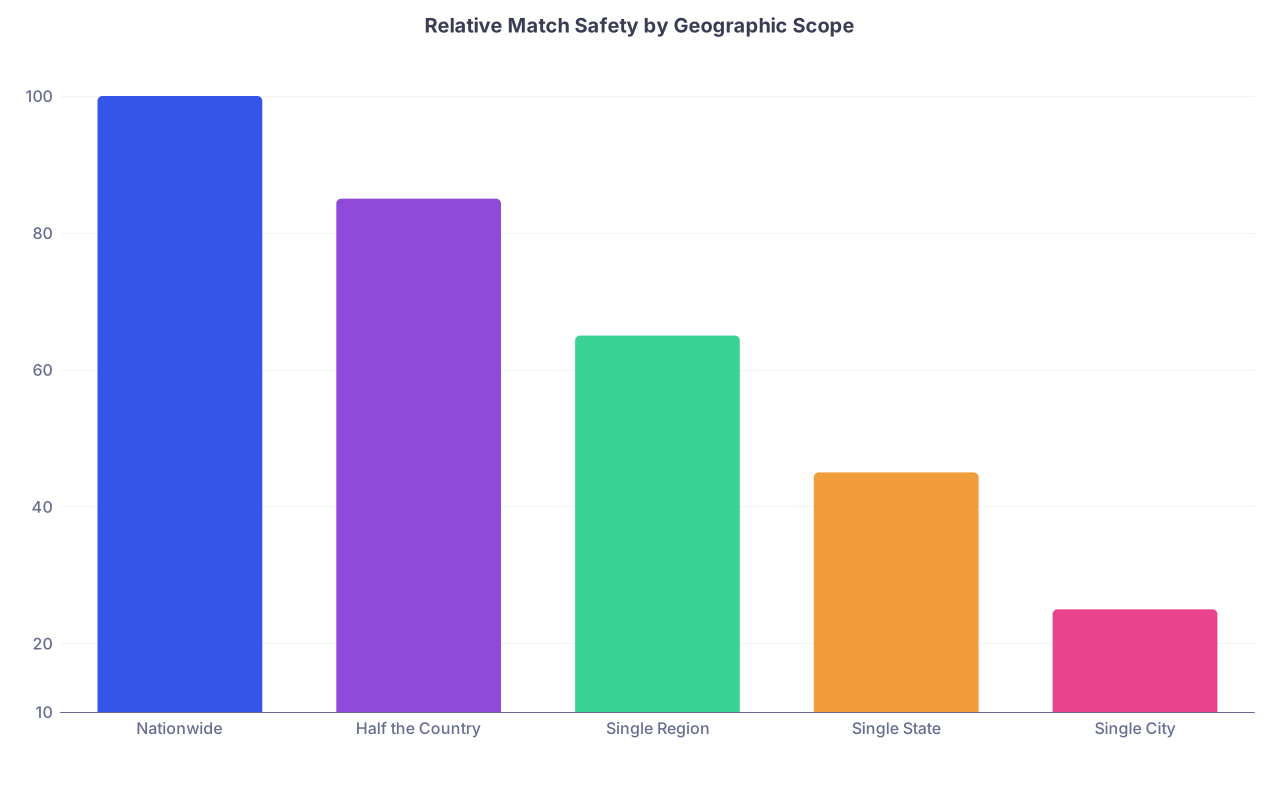
Visualizing the Drop in Safety When You Restrict Regions
Here’s the general trend of match “safety” as you shrink your geography. Not exact percentages, but directionally accurate:
| Category | Value |
|---|---|
| Nationwide | 100 |
| Half the Country | 85 |
| Single Region | 65 |
| Single State | 45 |
| Single City | 25 |
Once you hit “single state” or “single city,” you’re basically gambling unless:
- You’re a top-tier applicant, or
- You’re in a state with a huge cluster of programs in your specialty (e.g., IM in NY/TX/CA)
Step 4: How Many Interviews Do You Actually Need?
Programs are proxy. Interviews are what matter.
For most core specialties:
- 10–12 interviews → good chance to match
- 12–15 → high chance
- <8 → risk goes up quickly
If you’re limiting to one region, ask yourself:
- “Is this region capable of giving me 10–12 interviews on a realistic day for someone with my stats?”
If your region has:
- 30 programs that might interview you
- Typical invite rates are ~10–20%
You’re hoping for 3–6 invites from that set. That’s often not enough.
Step 5: Strategic Ways to Stay Mostly Regional Without Blowing Up Your Risk
You don’t have to choose between “only this city” and “national free-for-all.” There are smarter middle paths.
1. Use a Core + Safety-Ring Strategy
Define:
- Core: your true must-have region (e.g., New England)
- Safety ring: acceptable but less ideal areas (e.g., Mid-Atlantic, Upstate NY, parts of Midwest)
Then:
- Apply to every realistic program in your core region
- Add 10–20 programs from the safety ring that:
- Are a bit less competitive
- Are more likely to interview your profile (community, smaller cities, IMG/DO-friendly)
That way:
- Best-case: you match in your core region
- Worst-case: you still match somewhere you can tolerate, not in full panic mode on SOAP
2. Be Aggressive on Regional Networking
If you’re restricting to one region, you don’t have the volume advantage. You need the familiarity advantage.
Do things like:
- Audition rotations/Sub-I’s in that region
- Email coordinators and PDs after rotations
- Go to virtual open houses for programs specifically in that area
- Have letter writers who are known locally (former faculty, alumni at those programs)
Programs are more willing to spend one of their precious interview slots on a marginal candidate who:
- Has shown clear regional commitment
- Has done hard work in that region
- Has letters from people they actually know

| Step | Description |
|---|---|
| Step 1 | Define Region Clearly |
| Step 2 | Count Realistic Programs |
| Step 3 | Assess Applicant Risk |
| Step 4 | Apply to All in Region |
| Step 5 | Add Safety Ring Regions |
| Step 6 | Focus Networking in Region |
| Step 7 | Monitor Interview Count |
| Step 8 | Stay Course |
| Step 9 | Plan SOAP and Backup |
| Step 10 | Programs >= Target Range? |
| Step 11 | Enough Interviews 10+? |
Step 6: Specialty-Specific Reality Check
Some specialties can survive being regional-only. Some really can’t unless you’re exceptionally strong.
Here’s a quick sense:
| Specialty Type | Regional-Only Strategy |
|---|---|
| Internal Medicine, FM, Peds | Usually feasible |
| Psych, OB/GYN, Anesthesia | Feasible if region dense |
| EM, Gen Surg | Riskier, region matters |
| Radiology, Path, Neuro | Possible but variable |
| Derm, Ortho, ENT, Plastics etc | Often unsafe region-only |
If you’re aiming for a competitive specialty and only one region:
- You should be in the top slice of applicants (scores, research, letters)
- You should apply to every single program in that region that even remotely fits your profile
- And you still need a psychological backup plan if it doesn’t work
A Few Concrete Scenarios (So You Can See This in Practice)
Scenario 1: US MD, Internal Medicine, Wants Only Northeast
Profile:
- US MD, Step 1 pass, Step 2 = 238
- No fails, decent letters, no gaps
- Wants Northeast (ME → PA)
Northeast has a ton of IM programs. If:
- Realistic programs for them in that region = 60–70
Plan:
- Apply to 40–45 programs in the Northeast (prioritize mix of academic + community)
- No need to go national unless there’s a very narrow city preference
- Expect 10–14 interviews if application is otherwise normal → safe
Scenario 2: DO, Psychiatry, Wants Only Pacific Northwest
Profile:
- DO, Step 2 = 225
- Solid psych rotations at home
- Wants OR/WA only
Pacific Northwest has:
- Maybe 8–12 psych programs total
- Realistic DO-friendly options = maybe 6–8
Problem:
- Your safe target range = 30–40 programs
- Available = 6–8
Conclusion:
You either:
- Accept a very real non-match risk to stay in that micro-region, or
- Broaden out to CA/ID/UT/CO (safety ring) to get your program count up to ~30
If you absolutely refuse to expand geography, the honest advice:
You should mentally and logistically prepare to SOAP or reapply.
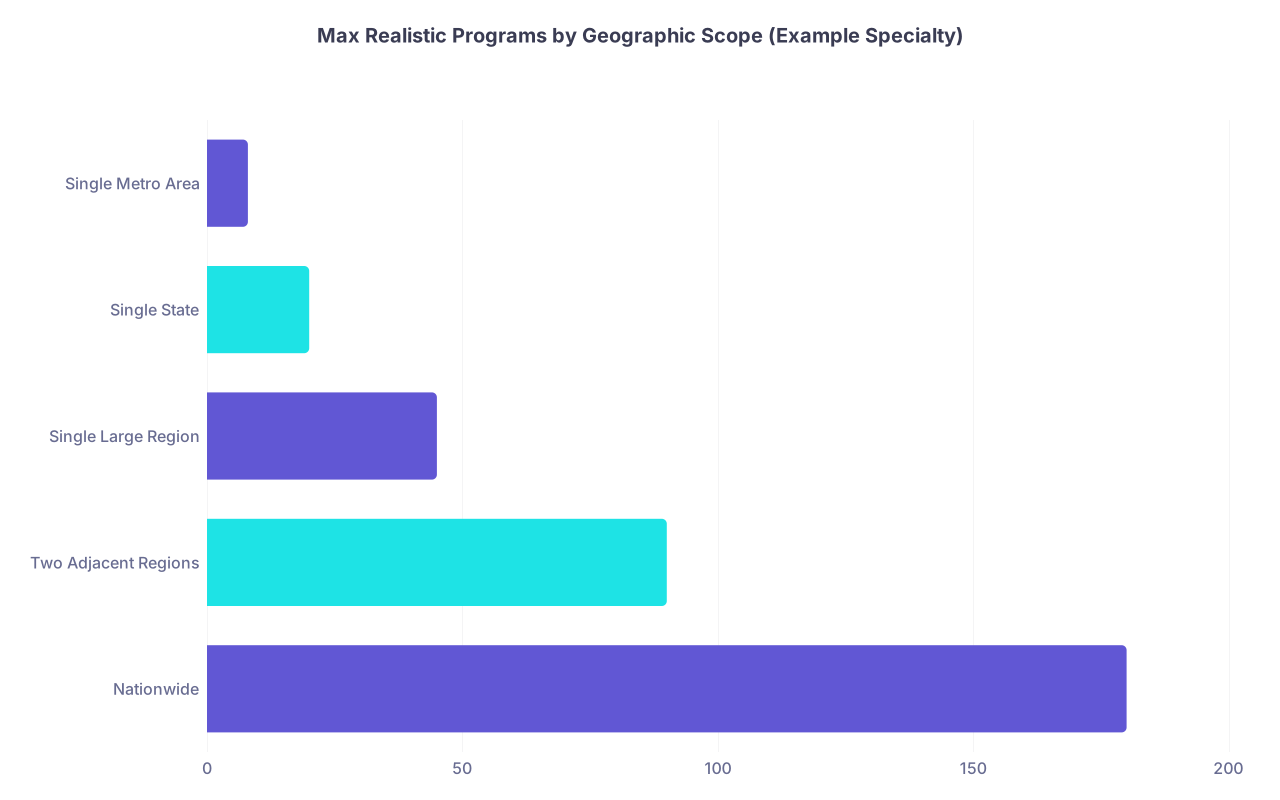
Visual: How Region Limits Your Max Program Count
| Category | Value |
|---|---|
| Nationwide | 180 |
| Two Adjacent Regions | 90 |
| Single Large Region | 45 |
| Single State | 20 |
| Single Metro Area | 8 |
Once your region caps your count below your recommended program range, you’re in high-risk territory, regardless of how “good” you are.
When Is It Actually Reasonable to Stay 100% Regional?
It’s reasonable to be strictly regional if:
- Your region has many programs in your specialty (e.g., IM in Northeast/Texas/California)
- Your profile is at least average for that specialty
- Your realistic program count in that region meets or exceeds:
- 25–35 for US MD/DO
- 45–60 for IMGs
It’s not reasonable (from a match-probability standpoint) if:
- Your region caps you under ~20 realistic programs and you’re not an absolutely top applicant
- You’re IMG in a region with low IMG friendliness
- You have red flags and are insisting on a small area
You can still choose to do it. Just don’t lie to yourself about the risk.
FAQ: Restricting to One Region
1. What’s the absolute minimum number of programs I can apply to if I stay in one region?
If you care about matching this cycle, I wouldn’t go below:
- 20–25 for a strong US MD
- 25–30 for a US DO
- 40–50 for an IMG
And that’s only if those numbers are actually available in that region for your profile. Less than that is gambling, not planning.
2. Can strong applicants get away with fewer programs if they stay regional?
Yes, but not as few as people think. A stellar US MD in IM might still apply to 20+ programs regionally. Interview slots are limited, programs are unpredictable, and “everyone loves me” is a story people tell before ERAS, not after.
3. I only want programs in one city because of family. Is that crazy?
It’s not crazy. It’s just high-risk. If that city has:
- 5–10 total programs in your specialty
- And only some are realistic for you
You need to be emotionally and logistically prepared for:
- Not matching
- SOAPing anywhere
- Or reapplying next year—maybe with expanded geography
4. How do I know if a program in my region is “realistic” for me?
Check:
- Their website or FREIDA for:
- US MD vs DO vs IMG match history
- Stated exam cutoffs
- Visa policies
- Current residents’ backgrounds (school types, scores if shared, research)
If everyone there is from Ivy/Top-20 with 260s and you’re a DO with 220, that’s not “realistic,” that’s “lottery ticket.”
5. If I’m region-limited, should I apply to prelim programs too?
Only if:
- Your specialty allows a prelim-to-categorical path (e.g., IM -> Neuro, Prelim Surg -> Anesthesia sometimes), and
- You’re honestly willing to do 1 year and reapply broadly next cycle.
Prelim spots are not a secure backup unless you understand and accept the two-step path.
6. What if my school advisor tells me 15 programs is enough in my region?
Ask them two things:
- “How many did people with my exact type of stats and background apply to in the last 2–3 years?”
- “How many interviews did they get?”
If they can’t answer with specific numbers, treat “15 is enough” as optimistic at best. Design your list based on real program counts, your risk level, and the ranges we went through—not on wishful thinking.
Key Points to Remember
- When you restrict to one region, the cap isn’t what you should apply to—it’s how many realistic programs exist there.
- For most applicants, you want 25–40+ programs in that region to keep match odds reasonable, more if you’re DO/IMG or have red flags.
- If your region can’t supply that many realistic options, you’re choosing higher match risk on purpose. Own that choice, and build a backup plan accordingly.