
The usual advice about “as many interviews as possible” is lazy and wrong.
If you’ve got 25 interview invites and you’re still panicking that it’s “not enough,” the problem isn’t your numbers. It’s that nobody ever sat you down and explained what’s actually safe for matching in your specific situation.
Let me fix that.
The Real Answer: How Many Interviews Is “Safe”?
Here’s the blunt version most advisors dance around:
- For a typical US MD applicant in a non-ultra-competitive specialty, about 10–12 ranked programs usually gives you a very high probability of matching.
- More is not linearly better after that. Going from 4 to 8 interviews is huge. Going from 16 to 22 is mostly stress and airfare.
- For DOs, IMGs, and competitive specialties, the “safe” number shifts upward.
But interviews only help if they turn into rankable programs. If you hate a place and would never go there, it doesn’t “count” for safety.
Let’s break this down properly.
What the Data Actually Shows (NRMP, not vibes)
The NRMP publishes a chart every few years: “Charting Outcomes in the Match” and “Results and Data.” That’s the closest thing you have to a residency match odds calculator.
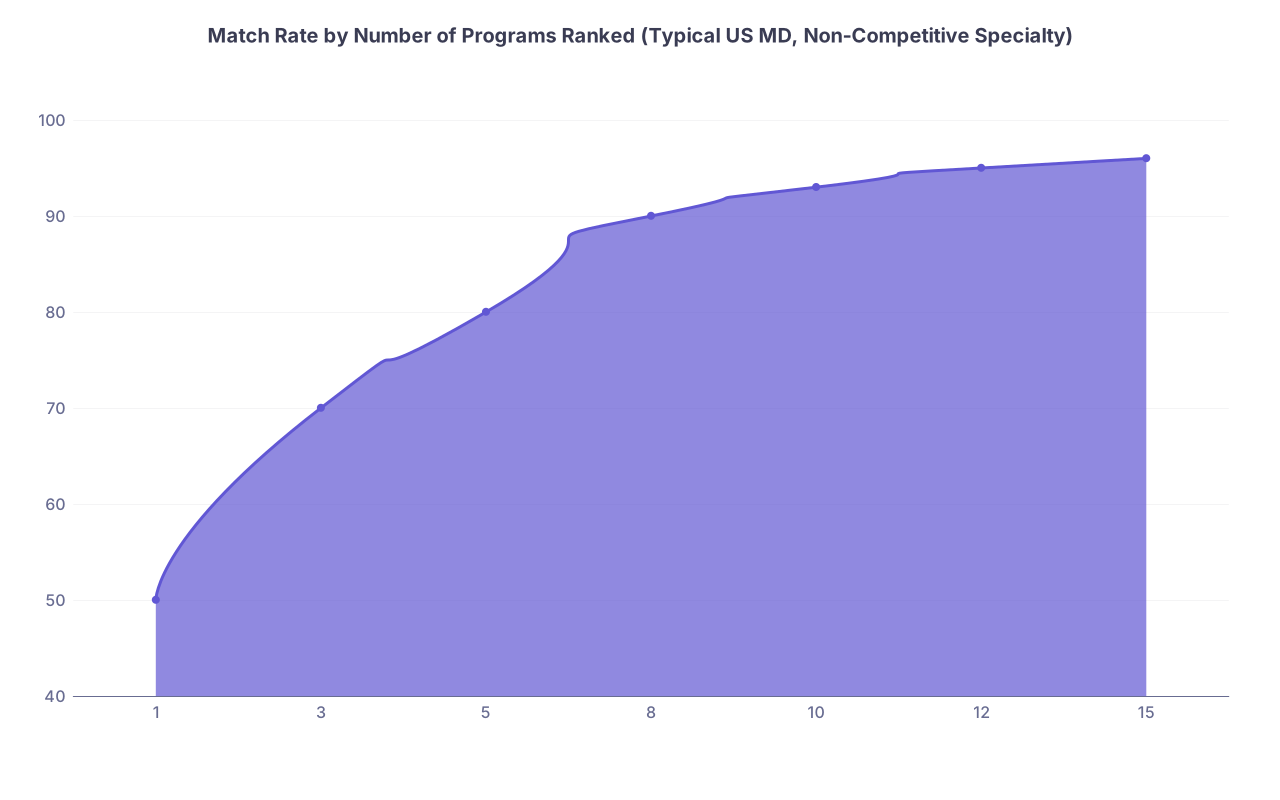
Here’s the core pattern I’ve seen again and again (and it holds up in the data):
| Category | Value |
|---|---|
| 1 | 50 |
| 3 | 70 |
| 5 | 80 |
| 8 | 90 |
| 10 | 93 |
| 12 | 95 |
| 15 | 96 |
Those numbers are approximate, but the shape is right:
- Huge jump from 1 → 5 programs ranked
- Still meaningful from 5 → 10
- Diminishing returns beyond 10–12
If your advisor ever told you “you need 20+ interviews to be safe” without qualifiers, that’s lazy advice. It might be true for a weak IMG applying dermatology. It is not universally true.
The Big Variables That Change Your “Safe” Number
You cannot copy someone else’s number blindly. Your safe zone depends on:
- Specialty competitiveness
- Applicant type (US MD, DO, IMG)
- How strong your application actually is
- Whether you’re couples matching
- Geographic inflexibility
Let’s walk through each.
1. Specialty Competitiveness
Rough breakdown:
- Less competitive specialties: Internal Medicine (categorical), Pediatrics, Family Medicine, Psychiatry, Neurology, Pathology.
- Moderate: General Surgery (categorical), OB/GYN, EM (post-chaos), Anesthesiology, PM&R, Radiology.
- Highly competitive: Dermatology, Plastic Surgery, Neurosurgery, Ortho, ENT, Ophthalmology, Urology, IR-independent, top-tier EM/Anes in saturated markets.
The more competitive the specialty, the higher your “comfort” number needs to be. I’ll give ranges below.
2. Applicant Type
Blunt truth:
- US MD: Best baseline odds at the same number of interviews.
- US DO: Pretty solid now in many fields but still somewhat disadvantaged in certain academic or historically MD-heavy specialties.
- IMG (US citizen or non-US): You need more interviews for the same level of match security, especially in competitive fields or academic programs.
If you’re an IMG aiming for IM, 12 interviews doesn’t mean what it does for a US MD in FM.
3. Application Strength
Forget labels like “above average.” Think concretely:
- Very strong: Honors-heavy, good board scores (for your field), strong letters, research if relevant, no red flags.
- Average: Mixed honors and passes, decent scores, okay letters.
- Below average / red flags: Low scores, repeated failures, professionalism issues, big gaps, weak clinical performance.
The weaker the portfolio, the more programs you need on your rank list to reach a similar certainty.
4. Couples Match
Couples matching multiplies the math. You’re not just trying to match; you’re trying to match in some paired combination of programs.
Translation: what would be “safe” as a solo applicant is not safe as a couple. You need:
- More interview invites
- Broader geographic spread
- More willingness to rank backup combinations
5. Geographic Inflexibility
If your spreadsheet has entire columns blacked out because you “refuse to live there,” that cuts your safety cushion.
Want to match psych only in one major coastal city, nowhere else? Then no, 10 interviews is not “super safe” for you.
Concrete Targets: How Many Interviews Is Enough?
These are rule-of-thumb ranges, not guarantees. Use them as a reality check.
| Scenario | "Comfort" Range (Rankable Programs) |
|---|---|
| US MD, low–moderate specialty | 10–12 |
| US DO, low–moderate specialty | 12–15 |
| US MD, moderately competitive specialty | 12–15 |
| US DO or IMG, moderately competitive | 14–18 |
| Highly competitive specialty (any type) | 15–20+ (plus a backup specialty) |
Key detail: I’m talking about rankable programs. If you know you’d never go somewhere, it doesn’t “count” for safety.
By Specialty Category
Here’s how I usually counsel students:
Internal Medicine, Family Med, Pediatrics, Psych, Neuro, Path, PM&R
US MD, reasonably competitive:
- 8–10 ranked programs: decent chance
- 10–12: quite safe for most
DO or IMG, or weaker application:
- 12–15+ ranked programs: safer zone
- For IMGs in IM/FM/Neuro: 15+ is ideal if you can get them
General Surgery, OB/GYN, EM, Anesthesiology, Radiology
US MD:
- 10–12: better start feeling okay
- 12–15: solidly safe for many
US DO / IMG:
- 14–18: more realistic comfort zone
Competitive Fields (Derm, Ortho, ENT, Neurosurgery, Plastics, Ophtho, Urology, IR)
Truth: even 15 interviews does not guarantee a match if your file is borderline.
General guidance:
- Aim for 15–20+ interviews in the target specialty
- Strongly consider:
- A backup specialty (with 10–12 interviews there)
- Or a transitional year / prelim track if that’s a known path in your field
Translating Interviews → Rank List: What Actually Matters
You don’t match from interviews; you match from your rank list.
A few practical rules I’ve given residents and students:
If you have fewer than ~8 programs you’d honestly be okay training at, your match risk is still real. I’ve watched people with 6 interviews go unmatched. Not rare.
If you have 10–12 programs you’d actually attend, and you’re:
- US MD
- Non-competitive specialty
- No major red flags
…you’re probably in a high-probability zone.
If you’re an IMG or DO, you want that number several notches higher in many fields.
And do not cross programs off your list because someone on Reddit called them “malignant” unless you have concrete, first-hand reasons. You don’t need your dream job. You need a training job.
When You Should Start to Worry (And What To Do)
Here’s the internal alarm bell I want you to have:
- Before interview season: No invites by late October (for typical cycles) → check with your advisor and program coordinator to review your application and see if anything’s off (letters missing, ERAS errors, etc.).
- Mid–late interview season: If you’re sitting at:
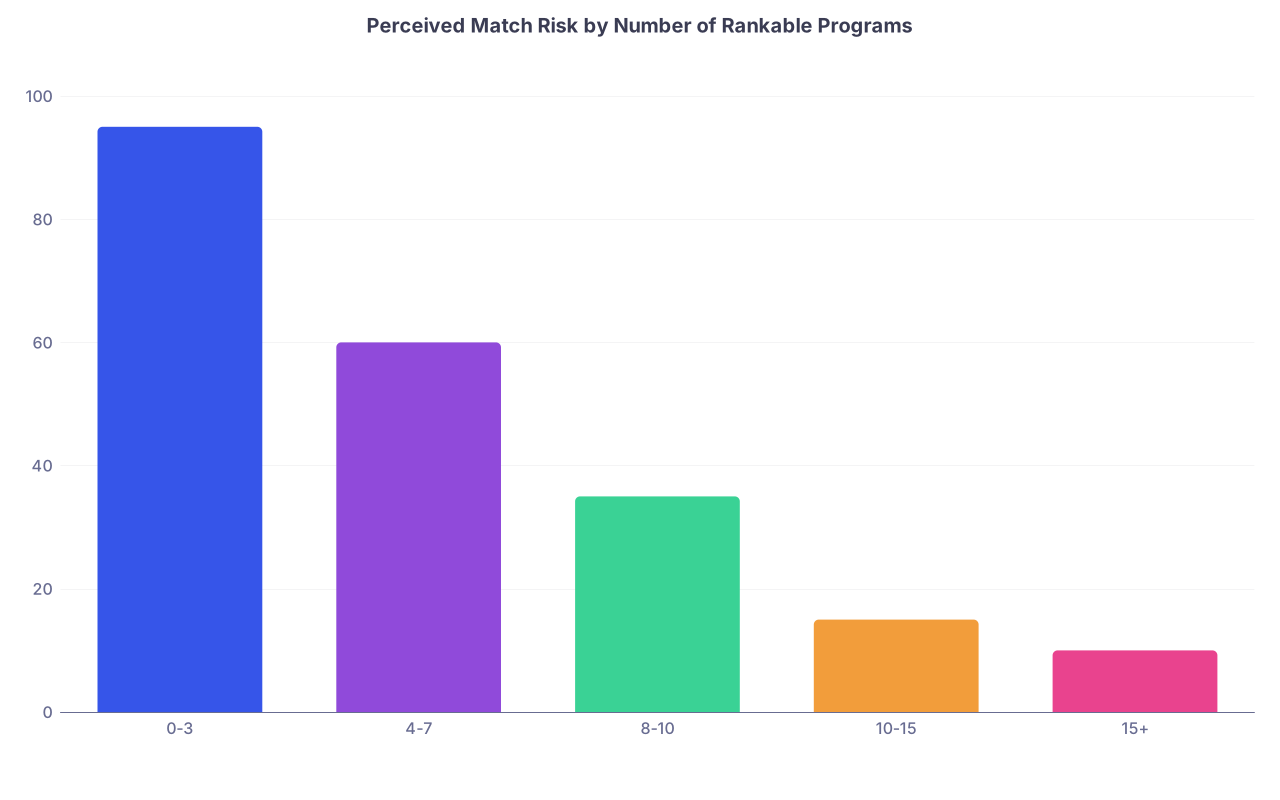
- 0–3 interviews: You are in a danger zone. Start exploring SOAP contingency, prelim options, or backup specialties.
- 4–7 interviews: Risk is very real, even in low-competition fields. You need to treat every interview like gold and widen geographic preferences if any late invites appear.
- 8–10 interviews: Borderline. Could be okay, especially for US MD in non-competitive specialties, but not what I’d call “relaxed” territory.
- 10–15 interviews: For most US MDs in mainstream specialties, this is an okay place to be.
- 15+: Past a certain point you’re just shredding your bank account and PTO.
| Category | Value |
|---|---|
| 0-3 | 95 |
| 4-7 | 60 |
| 8-10 | 35 |
| 10-15 | 15 |
| 15+ | 10 |
(Values = approximate “risk of not matching” in percent across mixed scenarios; point is the shape, not exact numbers.)
If you’re in the 0–7 range, talk to someone who actually understands your specialty. Not the dean who matched IM 20 years ago. A current PD or advisor in your field.
When To Start Cutting Interviews
This part nobody explains well. There’s a point where canceling is rational:
- If you already have 12–15+ solid programs you’d gladly attend, and
- New invites are in locations or programs you know you don’t want, and
- Attending them means skipping critical rotations, tons of travel, or burnout
Then yes, it’s reasonable to cut.
But don’t cut early in the season based on ego (“this is beneath me”). I’ve watched people do this with mid-tier IM programs, then cry in March.
A simple filter:
- Would I be okay spending 3–5 years here?
- Does this program meet my minimum training needs (procedure exposure, fellowship potential, lifestyle)?
- Can I honestly imagine signing a contract here if it was my only offer?
If all three are yes, it counts as a “real” interview. Keep it until you’re safely above your target number.
Strategy If You’re Under the Safe Zone
If you’re staring at 4–6 interviews by mid-season, stop panicking and start acting.
Here’s the sequence I usually recommend:

| Step | Description |
|---|---|
| Step 1 | Realize you have few interviews |
| Step 2 | Review application with advisor |
| Step 3 | Email programs with update letters |
| Step 4 | Expand geographic preferences |
| Step 5 | Consider prelim or TY programs |
| Step 6 | Prepare for SOAP as backup |
Concrete moves:
- Ask your home program director or advisor to make a few calls or send a few emails on your behalf.
- Update ERAS with:
- New publications
- New leadership roles
- Improved Step 2 score
- Politely email a small, targeted list of programs with an update/interest email.
- Add prelim/TY programs if that’s a viable path in your specialty.
- Start SOAP prep early: documents reviewed, letters updated, personal statement ready.
You cannot brute-force more interviews out of thin air in December, but you can slightly improve your odds and ensure you’re not caught flat-footed if you land in SOAP.
Visual Reality Check: Applying vs. Interviewing
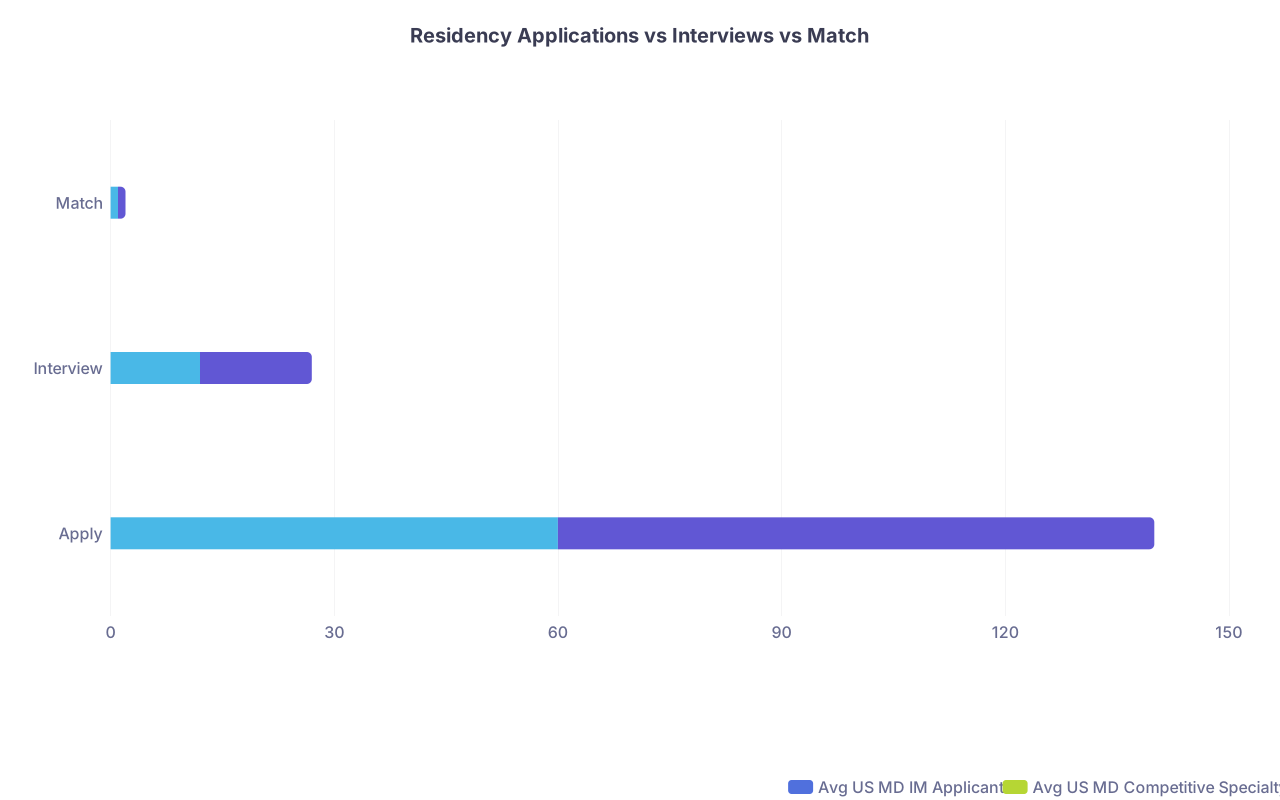
Most people wildly misunderstand this part.
| Category | Avg US MD IM Applicant | Avg US MD Competitive Specialty |
|---|---|---|
| Apply | 60 | 80 |
| Interview | 12 | 15 |
| Match | 1 | 1 |
You apply to dozens of programs. You interview at maybe a dozen+. You match at one.
The leverage you have is not in going from 80 to 95 applications. It’s in:
- Getting from 4 interviews to 8
- Getting from 8 rankable programs to 12
- Actually performing well during the interviews you already have
Quick Specialty-Specific Sanity Checks
I’ll keep this short, because every case is different, but as a gut check:
Internal Medicine (US MD):
10–12 categorical interviews you’d attend → pretty safe for most.Family Med / Psych / Peds (US MD):
8–10 okay, 10–12 better, 12+ very comfortable.General Surgery (US MD):
I don’t relax until you have 12+ solid categorical interviews. More if you’re below-average or DO/IMG.EM (US MD):
After the recent chaos with program closures and SLOE drama, I’m much happier if you’re in the 12–15 interview zone.Derm / Ortho / ENT / Plastics / Neurosurg / Ophtho / Urology:
If you have fewer than 10 interviews in the primary specialty, I’m pushing hard for:- A backup specialty with at least 10–12 interviews, or
- A very deliberate plan that includes prelim/TY and reapply.
FAQ: Residency Interview Numbers
1. What is the absolute minimum number of interviews where people still match?
People match with as few as 3–5 interviews, especially in low-competition specialties and as US MDs. But the risk is high. I would not call anything under 8 “safe” for most people.
2. I have 15+ interviews in a non-competitive specialty. Should I still go to all of them?
Probably not. Once you have 12–15 programs you’d truly be okay attending, it’s reasonable to cancel lower-interest ones to save money, time, and sanity. Just don’t cancel down to 6 because a Reddit thread said “you’re fine.”
3. Do prelim and TY interviews count toward my “safe” number?
Yes and no. They count for:
- Avoiding being completely unmatched
- Maintaining clinical continuity while you reapply
They do not count as much for being done with the process, because many fields require reapplication or a specific PGY-2 spot. Factor them separately from your categorical “safe” number.
4. If I’m couples matching, how many interviews do we need?
More. A rough target for many couples:
- Each partner: 12–15+ interviews in their field, with overlapping regions
- Broad rank list with many combinations
I’ve watched couples with solid applications not match together even with 10+ interviews each because their overlap and geographic flexibility were thin.
5. I’m an IMG with 8 interviews in Internal Medicine. Is that enough?
It might be, but I would not call it “safe.” For IMGs in IM, I’m a lot more comfortable when you’re in the 12–15+ rankable program range, assuming decent scores and no big red flags. With 8, you’re in “possible but risky” territory; every interview becomes crucial, and SOAP prep is smart.
Key takeaways:
- For most US MDs in non-competitive specialties, 10–12 rankable programs is where match odds become very strong.
- DOs, IMGs, competitive specialties, couples, and geographically rigid applicants all need higher numbers for similar safety.
- Focus less on raw application counts and more on converting enough interviews into real, rankable options—and have a backup plan if you fall short.