
The usual advice about how many residency programs to apply to is flat-out wrong once you’re Couples Matching.
If you’re Couples Matching and using solo applicant numbers as your guide, you’re underestimating the risk. By a lot.
Let me give you the direct answer first, then we’ll unpack the logic.
The Short Answer: Realistic Ranges for Couples
Here’s the no-nonsense baseline for “How many programs should we apply to if we’re Couples Matching?”
I’m assuming US MD/DO seniors without major red flags. Adjust up if you’re IMG, have exam failures, or are switching specialties.
Typical combined application ranges (per person)
These are per person, not total. If I say “60,” that means you apply to 60, your partner applies to 60 (not necessarily the exact same 60).
Both in moderately competitive specialties (IM, Peds, FM, Psych, Neuro, Anes, EM in a mid-competitive year):
- Aim for: 60–80 programs each
- If you’re more risk-averse or mid-tier applicants: 80–100 each
One competitive + one less competitive (e.g., Derm + IM, Ortho + FM, ENT + Peds):
- Competitive partner: 80–120 programs
- Less competitive partner: 40–80 programs
- You want at least 20–30 overlapping programs where both apply
Both in very competitive specialties (Derm, Ortho, ENT, Plastics, Ophtho, Urology, etc.):
- This is a high-risk path when coupled
- Think: 100–150+ programs each, plus a backup specialty strategy
- Honestly, not doing a backup is gambling
One or both with weaker applications (low Step 2, failed exam, few interviews expected):
- Stronger partner: 80–100+
- Weaker partner: 100–150+
- Overlap: try to get 30–40+ overlapping realistic shots
If you want one line to walk away with:
Most Couples Match pairs should target 60–100 programs per person, and more if either of you is in a highly competitive specialty or has red flags.
Now, let’s make that number actually make sense instead of just “someone on Reddit said so.”
Why Couples Need More Applications Than Solo Applicants
The problem is simple: as a couple, you’re not chasing interviews; you’re chasing overlapping interviews in the same city/area.
Two big realities you can’t ignore:
Your match odds drop when you behave like two solo applicants.
If you each apply like you’re solo, you’ll get solo-like interview numbers… but the overlap may be tiny.Every bit of non-overlap hurts your rank list.
Ten interviews each does not equal twenty usable options as a couple. It might be three. Or one. Or zero in the same region.
Think of it like this:
- Solo: “How many interviews do I need at any programs?”
- Couple: “How many overlapping interview pairs do we need in the same area?”
That’s the game. You’re not applying for yourself; you’re applying for a pairing probability.
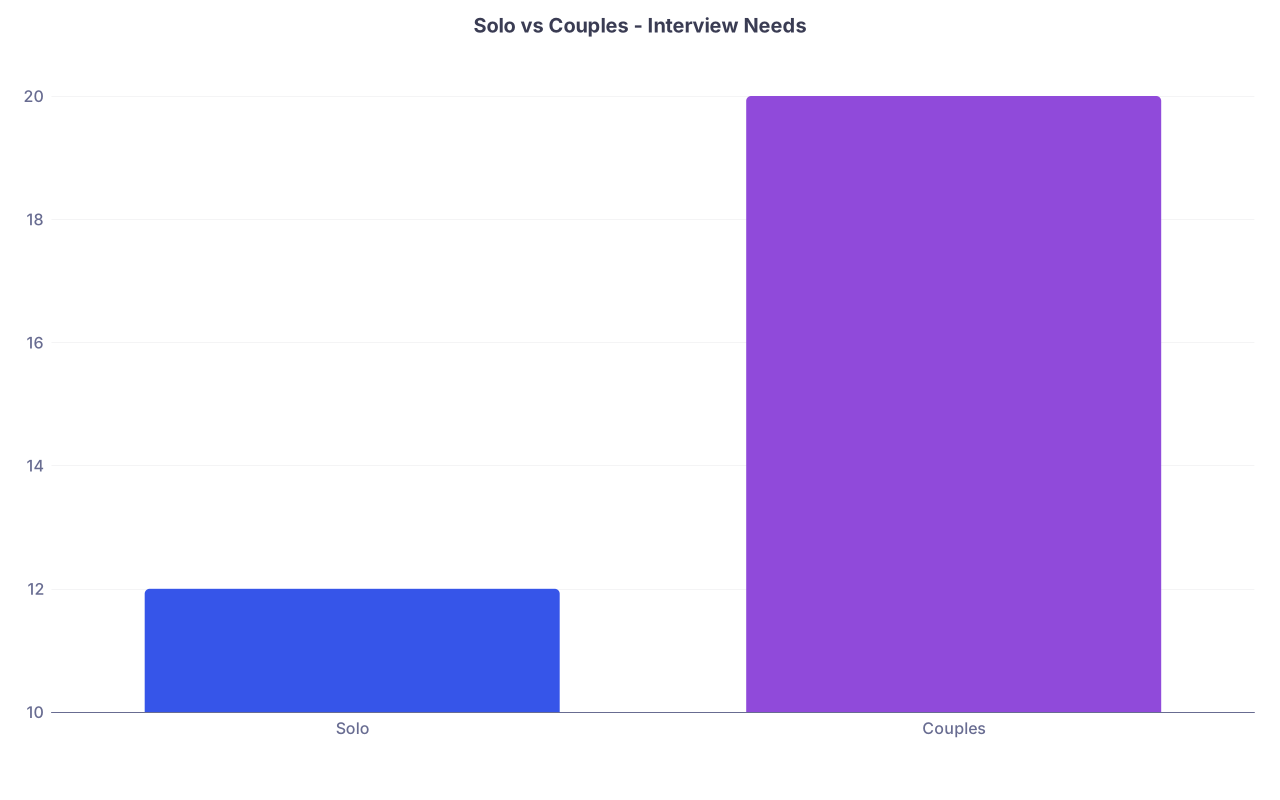
| Category | Value |
|---|---|
| Solo | 12 |
| Couples | 20 |
Quick rule of thumb:
- A solo US MD/DO in a non-competitive specialty can often match comfortably with 10–12 interviews.
- A Couples Match pair is safer with ~15–20 overlapping interview opportunities in the same region(s) or cities.
You usually need more applications to get there.
Step-by-Step: How To Decide Your Exact Number
Let’s build a real number for you instead of hand-wavy estimates.
Step 1: Classify both of you
Be brutally honest. Where do you each fall?
Specialty competitiveness
- Less competitive: FM, Peds, Psych (most years), Path, PM&R
- Mid: IM, Anes, Neuro, EM (varies), OB/GYN
- High: Derm, Ortho, ENT, Plastics, Urology, Ophtho, Rad Onc, sometimes Rads
Applicant strength
- Strong: Step 2 at/above national mean, no fails, solid letters, some research
- Average: Within ±5 points of mean, decent letters, standard profile
- Weak: Below mean by >5–10 points, exam failure, few/no honors, minimal or no specialty connection
If you’re both mid-competitive and average or better, 60–80 each is often reasonable.
If either of you is “weak” or “competitive specialty,” that number creeps up fast.
Step 2: Define your geographic flexibility
This is where couples quietly kill their match chances.
Ask yourselves, honestly:
- Are you willing to live anywhere in the country for residency?
- Or are you trying to stay in 1–3 specific cities or regions?
Here’s the harsh truth:
- Nationally flexible couples can get away with the lower end of ranges (e.g., 60–80 each).
- Highly location-restricted couples may need:
- More applications and
- Backup strategies (prelim years, backups, one partner targeting broader geography)
| Flexibility Level | Description | Application Strategy |
|---|---|---|
| High | Anywhere in US | Use mid-range numbers |
| Moderate | 2–3 broad regions | Add 20–30 programs each |
| Low | 1 city or single small region | Max out applications + backups |
If you’re saying “we have to be in Boston or NYC,” don’t pretend you’re playing the same game as a couple that’s fine with “anywhere east of the Mississippi.”
Step 3: Estimate your interview yield
Look at your school’s data, NRMP’s Charting Outcomes, and talk to advisors. But I’ll give rough, realistic assumptions:
- Strong candidate in non-competitive specialty:
May get interviews from 25–40% of programs they apply to. - Average candidate in non-competitive or mid-competitive:
Maybe 15–25%. - Weaker candidate or competitive specialty:
Sometimes 5–15%, occasionally lower.
Now, as a couple, assume:
- You need around 15–20 overlapping interviews in the same city/region for comfort.
- To get those, you probably need more like 30–40 total interviews per person, across many places, to create those overlaps.
You’ll rarely get 20 overlaps out of 20 interviews each. Reality is messy.
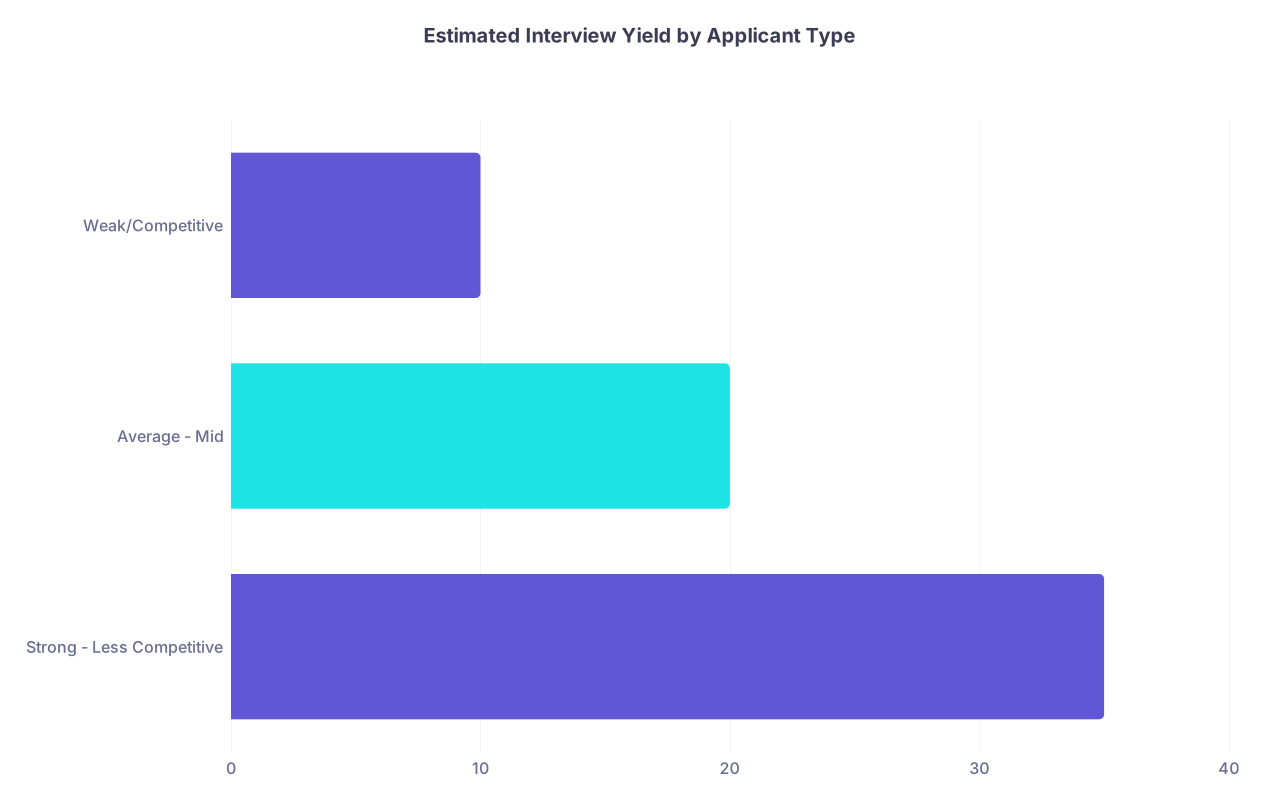
| Category | Value |
|---|---|
| Strong - Less Competitive | 35 |
| Average - Mid | 20 |
| Weak/Competitive | 10 |
Step 4: Convert yield to application numbers
Let’s do a concrete example.
Scenario:
- You: Average applicant, Internal Medicine
- Partner: Average applicant, Pediatrics
- You’re decently flexible geographically (2–3 regions okay)
Assume:
- You get interviews from ~20% of IM programs you apply to
- Partner gets ~20% of Peds programs
If you each apply to 70 programs:
- Expect maybe 14 interviews each (20% of 70)
But overlaps?
- Not all 14 are in the same cities or the same hospitals
- You might end up with 6–10 cities where both have interviews
That might be enough, but it’s not bulletproof. If you’d rather sleep at night, bump:
- 70 → 80–90 programs each, to hopefully push:
- ~16–18 interviews each
- ~10–12 overlapping options
That’s a more comfortable place to Couples Match.
Smart Couples Match Strategy: Not Just “Apply Everywhere”
You can’t just spam every program in ERAS and call it strategy. You’ll waste money and miss where it actually matters.
Here’s how to be intentional.
1. Build three tiers of overlap
You want a mix of:
Tier 1 – Dream overlap
Top-tier academic places, big cities you love, high-prestige programs
Apply? Yes. But don’t rely on them.Tier 2 – Realistic sweet-spot overlap
Solid university and strong community programs where your stats fit well
This tier should be the bulk of your overlap.Tier 3 – Safety overlap
Programs with historically lower fill rates, smaller cities, community-heavy
Not glamorous, but where you go if your dream tier doesn’t pan out.
Most couples underbuild Tier 3. Then panic in January.
2. Use “one-sided” applications strategically
You don’t have to both apply everywhere.
- Partner A can apply very broadly, including places Partner B doesn’t target.
- Partner B can have a focused list but heavily applies to regions where Partner A has many applications.
Why this works:
- It increases the chance that if one of you gets a great option somewhere, the other might still scrape together a prelim, transitional year, or slightly out-of-sync position there.
- This is especially relevant if one of you is way more competitive.
3. Decide how “coupled” you really are
Couples Match allows different strategies:
- Fully coupled: “We only care about pairs where we’re together.”
- Flexible coupled: “We strongly prefer to match together but will include some ‘one matches, one doesn’t’ combos far down the list.”
- Extremely flexible: “Worst-case, one of us does a prelim year nearby or in a different city with plans to re-apply.”
The more flexible you are, the slightly fewer programs you can get away with.
The less flexible you are, the wider you need to cast the net.

| Step | Description |
|---|---|
| Step 1 | Start Couples Match Planning |
| Step 2 | Apply 100 to 150+ each and plan backup |
| Step 3 | Apply at high end of ranges and add safety programs |
| Step 4 | Increase to 80 to 120+ for weaker partner |
| Step 5 | Target 60 to 80 programs each |
| Step 6 | Both in competitive specialties |
| Step 7 | Geography very limited |
| Step 8 | Any red flags or weak apps |
Special Situations That Change the Numbers
A few scenarios where your numbers should jump or your strategy must shift.
If one of you is an IMG or has red flags
Be blunt here. Programs are risk-averse.
- IMG or exam failure?
That partner should usually be in the 100–150+ zone for most specialties. - The stronger partner should still go broad (80–100+), especially where the weaker partner has a chance.
You’re trying to line up the Venn diagram of “programs that will interview both of you.” That shrinks fast with any red flags.
If you’re both going for very competitive specialties
Derm + Ortho. ENT + Plastics. Ophtho + Urology.
Couples Matching with two of these is not “ambitious.” It’s risky.
Reality:
- You both should probably be well over 100 applications each.
- You should have:
- Backup specialties (one or both of you)
- Or a plan where one applies to a more flexible specialty in overlapping cities
What I’ve seen work:
- Competitive partner A applies 100–150 programs in their field.
- Partner B picks a more flexible but still interesting specialty (IM, Anes, Peds) and applies 60–100 programs, heavily concentrated in cities where Partner A has many apps.
If you’re extremely location-restricted
“We have kids and can’t leave this metro area.”
“We’re locked to one city because of visas/family/health.”
Then your question isn’t “how many programs?” It’s “is this realistically possible?”
You still apply widely within that area, but your focus shifts to:
- Applying to every program in that city/region, across:
- University hospitals
- Community programs
- Prelim/Transitional years
- Using “uncoupled” or hybrid rank lists lower down:
- One matches, one scrambles/SOAPs/re-applies next year
- Being willing to delay training as a couple if needed
You’ll apply to fewer programs (because there just aren’t many), but your risk is higher than any other category.
A Visual Example: Typical Couple in Mid-Competitive Fields
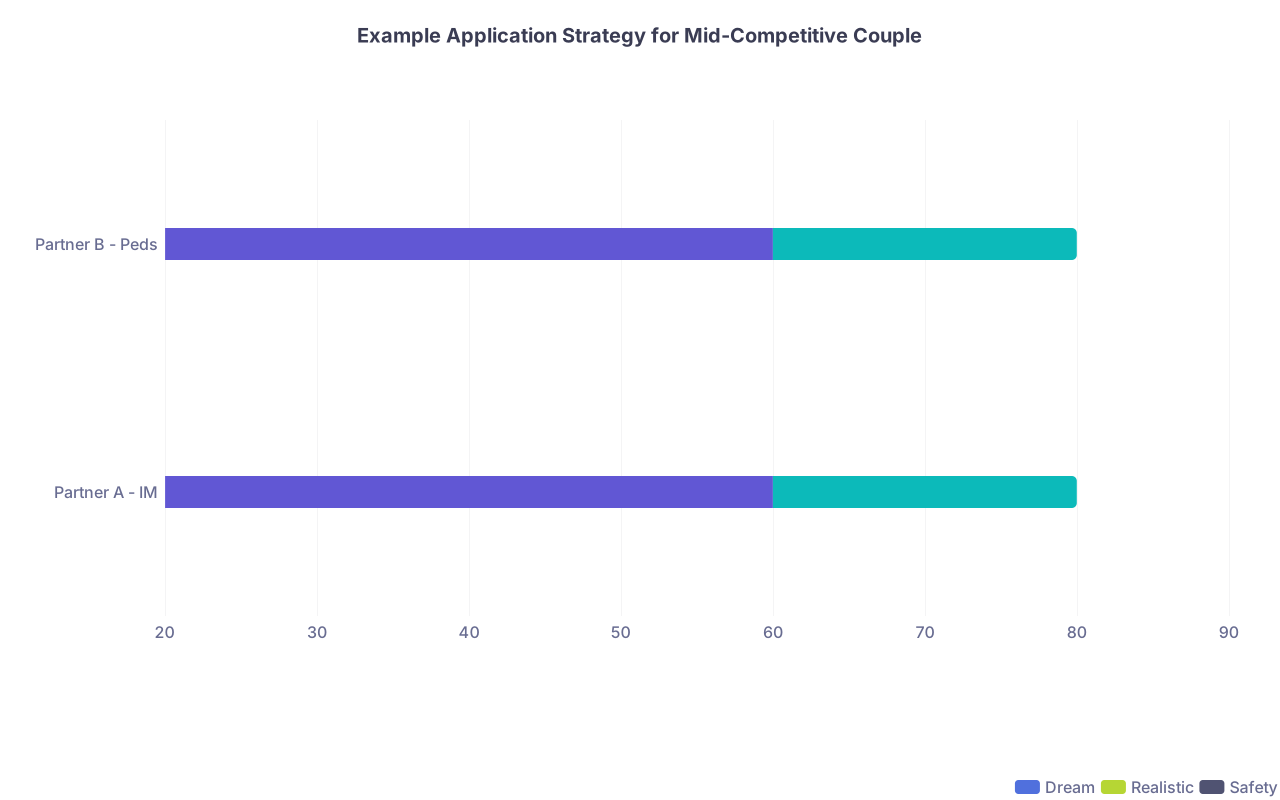
| Category | Dream | Realistic | Safety |
|---|---|---|---|
| Partner A - IM | 20 | 40 | 20 |
| Partner B - Peds | 20 | 40 | 20 |
Here:
- Both apply to:
- 20 “dream” programs (heavily overlapping)
- 40 realistic programs (max overlap)
- 20 safety programs (again, try to overlap, but okay if not perfect)
- Total: 80 each
This is a very standard, sane Couples Match strategy.
Common Mistakes Couples Make (That Cost Them a Match)
I’ve watched these play out every season:
Using solo applicant numbers.
“My advisor said 40 programs is plenty for IM.”
For you alone, maybe. For you as a couple? Often not.Too narrow geographically with no backup.
You can’t demand “Boston only” and apply to 25 programs each, then act surprised.No true safety list.
“Our lowest-tier option is a mid-level university program in a big city.”
That’s not a safety.Not coordinating lists for overlap.
If you’re not deliberately building shared target regions, you’re just two solo applicants with wishful thinking.Overestimating your competitiveness.
“I did fine, I’ll be okay.”
Meanwhile, your Step 2 is 10 points below mean and you have one home rotation in your specialty.
Apply more broadly. You’ll never regret that.
Quick Reality Check Tool
Ask yourselves, right now:
- Are we both in mid-to-low competitive specialties?
- Are we okay living in multiple regions of the country?
- Are we average or better applicants with no red flags?
If yes to all three, you’re probably safe in the 60–80 programs each range, assuming you build overlap intelligently and have a few “safety cities.”
If any answer is no, you should be thinking 80–100+ per person, plus more thought about backups.

FAQs About Couples Match Application Numbers
1. Is there such a thing as applying to too many programs as a couple?
Yes, but it’s rarely about numbers and more about strategy. If you apply to 120 programs each with zero thought about overlap, tiers, and geography, you’ve wasted money. If 80–120 each are deliberately chosen to maximize overlapping and backup options, that’s not “too many.” That’s smart insurance.
2. How many overlapping programs should we aim to have on our list?
For most couples, aiming for 20–30 overlapping programs where both of you apply is a good target. That usually yields 10–20 combined interview cities where you can actually rank realistic paired options. More is better. Less than 10 overlapping places and your rank list gets dangerously thin.
3. Can one of us apply broadly while the other applies more narrowly?
Yes, and sometimes that’s the best move. The more competitive or weaker partner should often apply much more broadly, while the stronger/more flexible partner focuses applications on regions and cities where the other has a lot of programs. The ERAS bill will be unbalanced, but your match odds will be better.
4. Should we consider uncoupling or not Couples Matching at all?
If one of you is in a very competitive specialty (e.g., Derm, Ortho, ENT) and the other is not, or if you’re extremely geographically restricted, it’s worth at least talking to your dean or advisor about applying separately. Many couples still rank “together” up high but allow some “solo” outcomes low on the list to avoid both not matching.
5. How do we handle backup specialties as a couple?
Pick one of you (usually the one in the more competitive specialty or with weaker stats) to apply to a backup specialty at programs and cities where the other has a strong list. That partner might apply to, say, 60–80 primary specialty programs plus 30–50 backup programs. You rank pairs where the backup option is acceptable for both of you below your primary-primary options.
6. Does being from a top med school or having strong Step scores change our numbers much?
It lets you live closer to the lower end of the recommended ranges, but it doesn’t change the basic math of needing overlapping interviews. A superstar couple might be fine with 50–70 programs each instead of 80–100, but I wouldn’t drop below that unless you’re extremely flexible geographically and your advisors specifically tell you you’re outliers.
7. What’s one concrete thing we should do this week to set our numbers?
Sit down together and create three lists: your dream, realistic, and safety cities/regions. Then, pull program lists and mark which specialties exist in each city for both of you. From there, count how many programs you’d apply to in each tier. If your total per person isn’t landing in the 60–100+ range (depending on your situation), expand your realistic and safety lists until it does.
Open a spreadsheet right now and list the programs you each plan to apply to. Highlight the overlapping ones in the same cities. If that highlighted list looks thin, your answer is clear: increase your application numbers before ERAS opens.