
The idea that “you can’t apply to too many programs” is wrong—and it’s costing people matches, money, and sanity.
Here’s the reality: more is not always better. There is such a thing as applying to too many residency programs. And once you cross that line, every extra application usually gives you almost no added chance of matching while burning time, cash, and energy you actually need for interviews and Step 2.
Let me walk through how to figure out where that line is for you.
The Core Truth: There’s a Sweet Spot, Not a Magic Number
Everyone wants a number. “How many programs should I apply to?” 20? 80? 120?
The honest answer: there’s no single correct number, but there is a rational range based on your:
- Specialty competitiveness
- Applicant type (US MD, US DO, IMG)
- Academic profile (scores, failures, red flags)
- Geography flexibility
- Application strength (letters, research, leadership, clinical narrative)
But here’s the key principle:
After a certain number of programs, your odds barely improve, and your costs and burnout shoot up.
Think of it this way:
- Your first 10–20 programs (if well chosen) matter a lot.
- The next 20–40 add some safety and breadth.
- The 70th vs 90th vs 110th program? Tiny marginal benefit, huge marginal hassle.
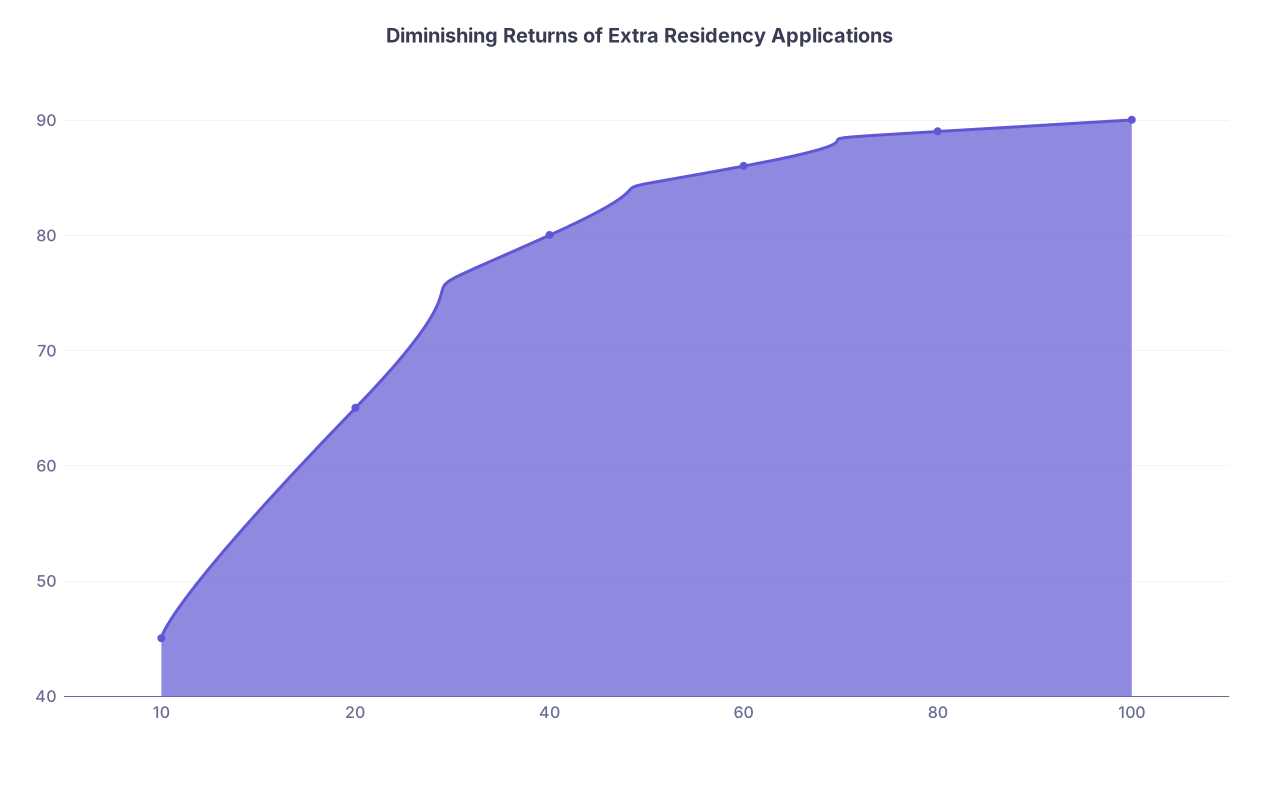
| Category | Value |
|---|---|
| 10 | 45 |
| 20 | 65 |
| 40 | 80 |
| 60 | 86 |
| 80 | 89 |
| 100 | 90 |
That chart is the basic pattern I’ve seen over and over. Your chance of getting enough interviews climbs fast at first, then flattens hard.
So the right question isn’t “Is 100 too many?” It’s: What’s the minimum number of strategically chosen programs that gives me a high likelihood of 10–15 solid interviews?
If you’re way above that number with no clear justification, you’re in “too many” territory.
When “More Programs” Helps vs When It Hurts
Let’s separate two scenarios.
When adding more programs does make sense
You’re justified in pushing numbers up (sometimes a lot) if:
You’re going into a very competitive specialty
Think: dermatology, plastic surgery, ENT, neurosurgery, ortho, some integrated programs (IR, vascular, CT).
It’s common to see 60–90+ applications here, sometimes more for IMGs or weaker applicants.You’re an IMG or DO applying to a historically MD-heavy specialty
You’ll probably need a larger net to find programs truly open to your profile.You have significant red flags and are aiming for a broad set of mid- to lower-tier programs
Examples: Step failures, long leaves, professionalism issues, big gaps.You’re geographically flexible and honestly would go almost anywhere
If you can tolerate a wide geographic spread, then extra applications can open doors.
In these cases, “more” can be strategy. But it still has to be targeted more, not blind more.
When more programs is just panic and self-sabotage
On the other hand, a lot of people crank their list up because they’re anxious, not strategic. That usually looks like:
- You’re applying to every program in the country without checking their typical applicant profile
- You’re throwing in programs in cities you’d clearly be miserable in (and would never rank highly)
- You’re duplicating subspecialty interests that don’t fit your story at all
- You’re sending generic, low-quality personal statements and letters because your volume is too big
This is how people end up with 90+ applications, 6 mediocre interviews, and a very tired brain. They thought they were “maximizing their chances.” In reality they diluted their application effort so much they looked average everywhere.
The Actual Risk of Applying to Too Many Programs
Let’s be blunt: ERAS won’t punish you for applying to 100 or 200 programs. There’s no cap.
But you will punish yourself in three ways:
1. Your application quality drops
You don’t have infinite energy. If you apply to 100+ programs, something gives:
- Personal statements become generic and forgettable
- You stop tailoring experiences to program type (academic vs community vs rural)
- You don’t research programs well, so interviews feel shallow and forced
- You miss chances to frame your narrative in a way that matches the program vibe
I’ve seen very strong applicants torpedo themselves with quantity. Their PS reads like: “I like internal medicine because I value continuity of care and teamwork.” That could be anyone. Programs skim it and move on.
If you’d cut your list by 30 and spent that time polishing and customizing, you’d often trade 30 low-yield apps for 3–5 extra actual invites.
2. You drown in administrative chaos
More programs = more emails, more surveys, more portal logins, more syllabi to skim before interviews.
That has a cost:
- It’s harder to remember which program is which
- You show up to interviews confusing Program A with Program B
- You rank programs sloppily because everything blurs together
- You burn out mid-interview season and underperform when it matters most
The whole point of applications is to perform well once you’re actually in front of a PD or faculty member. If you’re exhausted and disorganized, you’ve sabotaged the most important stage.
3. You waste money—often a painful amount
ERAS fees ramp up fast. For many specialties and applicant types, there’s a steep financial hit once you blow past a normal range.
| # of Programs | Fee Range (Single Specialty, Approx) |
|---|---|
| 20 | Low |
| 40 | Moderate |
| 60 | High |
| 80 | Very High |
| 100+ | Extremely High |
I’ve talked to applicants who spent an extra $1,000–$1,500 chasing a handful of low-yield interviews they didn’t even rank highly. That’s rent. That’s flights for interviews you actually care about.
The money argument alone is strong, but honestly, the bigger issue is cognitive overload.
A Practical Framework: How Many Programs You Should Apply To
Let’s get concrete. Here’s a simple decision framework that works better than advice from Reddit strangers.
Step 1: Know how many interviews you actually need
For most specialties:
- 10–12 interviews → reasonable shot of matching
- 12–15 interviews → strong chance, assuming you’re not ranking irrationally
- 15+ → diminishing returns but nice buffer
The goal of applications is not “apply to the maximum number.” It’s: get to 10–15 decent interviews. That’s it.
Step 2: Look at your risk category
Here’s a rough, opinionated guide. Adjust for your specific specialty:
| Applicant Profile | Target Range (Typical Specialty) |
|---|---|
| Strong US MD, average specialty | 25–40 |
| Average US MD, average specialty | 35–60 |
| US DO or strong IMG, average specialty | 50–80 |
| Weak US MD (red flags), average specialty | 60–90 |
| Any applicant, very competitive specialty | 70–120+ |
“Average specialty” here means IM, peds, FM, psych, neurology, anesthesia, etc. Not derm, ENT, plastics, neurosurg, integrated IR/vascular/CT.
If you’re way above these ranges without a sharp reason, you’re probably in “too many” land.
Step 3: Back-calculate from interview expectations
Start with a conservative estimate of your “invite rate” (what percent of programs you apply to might invite you):
- Strong/average US MD in average specialty: maybe 25–40%
- DO/IMG in average specialty: often 10–25%
- Any applicant in highly competitive specialty: sometimes 5–15%
Then do simple math. Example:
You’re a solid US MD applying IM, expect maybe 25% invite rate.
- Apply to 40 programs → ~10 invites (40 × 0.25)
- Apply to 60 programs → ~15 invites
- Apply to 90 programs → ~22 invites (but you’ll realistically only rank ~15 meaningfully)
So 60 is probably your sweet spot. 90 is mostly overkill.
You’re an IMG applying IM, expect maybe 10–15% invite rate.
- Apply to 60 → 6–9 invites (a bit light)
- Apply to 80 → 8–12 invites (better)
- Apply to 100 → 10–15 invites (buffer, but now we’re at burnout risk)
That’s where 80–100 might be justified—but only if your application is strong and targeted.
How to Avoid Blind Over-Application
Throwing your ERAS at every program with a pulse is the lazy approach. It’s also how you end up broke and overwhelmed.
A smarter way to cap your list:
1. Ruthlessly define where you won’t go
You’re allowed boundaries. Decide:
- Absolute no-go states or regions
- Cost-of-living extremes you can’t handle
- Program types you really don’t want (for example, ultra-small rural with zero subspecialty exposure, or massive malignant-feeling academic units)
If you know you won’t rank a program in, say, a tiny town 3 flights from your family, don’t apply there. You’re not magically going to fall in love with it on interview day.
2. Use filters intelligently
Most fields have resources (FREIDA, program websites, NRMP data, etc.) that show:
- Typical Step/COMLEX ranges
- % IMGs or DOs
- Program size
- Fellowship placement patterns
Use those to cut obviously unrealistic targets (if you’re an IMG and the last 20 years of their residents are all US MDs, that program is probably not your best bet).
3. Segment your list: reach, target, safety
Even for residency, this idea still works:
- Roughly 20–30% reach programs
- 50–60% target programs
- 10–20% safety or “I’d be solidly competitive here” programs
If your list is 90% reach and you’re trying to compensate by applying to 100+ programs, what you really have is a distribution problem, not a volume problem.
Special Cases Where “More” Might Actually Be Necessary
There are a few times where I won’t push back on big numbers.
Very competitive specialties
For derm, plastics, ENT, neurosurg, ortho, integrated IR, etc.:
- It’s common and often rational to apply widely: 60–120 programs
- But you still need strategy: strong home program ties, research alignment, networking, away rotations
Programs in these fields are hyper-selective. Volume alone won’t save a weak file, but a strong applicant needs volume to reach enough aligned programs.
Dual applying
If you’re dual applying (for example, EM + IM, or rad onc + IM), numbers climb almost automatically.
You’re essentially running two parallel strategies. But the rule still holds within each specialty—hit your rational 10–15 interview goal, then stop chasing marginal extra invites.
A Simple Sanity Check Before You Submit
Here’s the quick gut-check I use with people:

| Step | Description |
|---|---|
| Step 1 | Have I defined my target number of interviews? |
| Step 2 | Set goal of 10 to 15 interviews |
| Step 3 | Estimate realistic invite rate |
| Step 4 | Calculate needed number of programs |
| Step 5 | Filter out places I would not honestly attend |
| Step 6 | Cut obvious low fit and unreachable programs |
| Step 7 | Proceed with current list |
| Step 8 | Yes or No |
| Step 9 | Am I more than 20 to 30 percent above that number? |
If, after this, you’re still at 110+ programs for a non-hypercompetitive specialty and you’re not an IMG/DO with big red flags, you’re probably applying from fear, not strategy.
One More Point People Miss: Interviews > Applications
I’ve seen people brag: “I applied to 130 programs!” That’s not an achievement. Number of applications is vanity. Number of interviews is what actually correlates with matching.
Your finite resources:
- Time to customize personal statements and ERAS
- Energy to prepare for interviews
- Money for fees, travel, attire, etc.
- Emotional bandwidth to stay calm and presentable
Spend those on maximizing interview quality and number, not inflating your application count for psychological comfort.
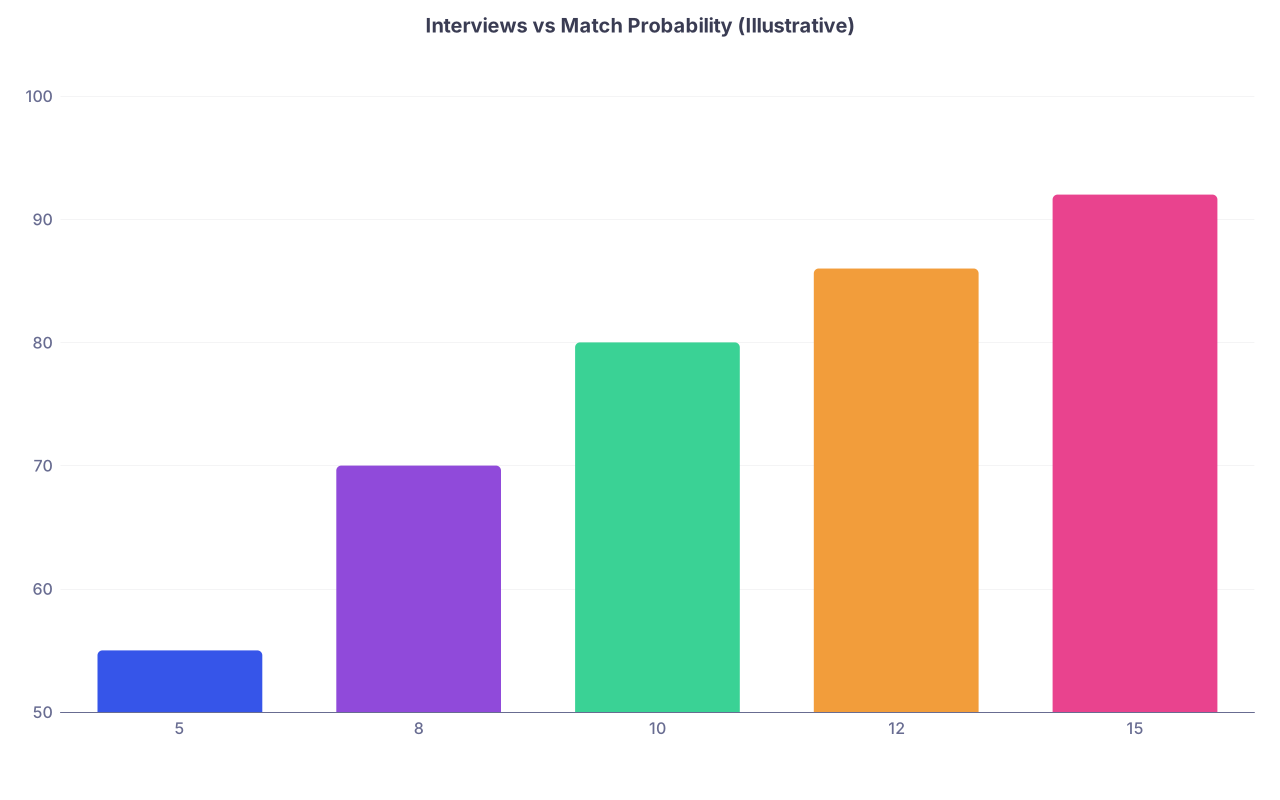
| Category | Value |
|---|---|
| 5 | 55 |
| 8 | 70 |
| 10 | 80 |
| 12 | 86 |
| 15 | 92 |
Notice what matters here: interviews, not raw applications.
Bottom Line: Can You Apply to Too Many Programs?
Yes. You absolutely can apply to too many programs. And a lot of people do.
More isn’t automatically better. Past a rational range for your specialty and risk category, extra applications mainly:
- Drain your wallet
- Dilute your application quality
- Overwhelm you during interview season
The smarter move:
- Aim for 10–15 interviews, not 100+ applications.
- Use your profile and specialty to pick a reasonable program range, then refine it.
- Cut the noise—only apply to places you’d genuinely consider ranking.
If you keep those three principles in front of you, you won’t need to shotgun 150 applications to feel safe—and your odds of actually matching where you’ll be happy will go up, not down.