
What do you actually do when it’s mid-October, you’ve got maybe 1–2 residency interviews, and everyone else in your group chat seems to be booking flights every week?
Let me be direct: if your early interview response is low, you probably should add more programs. But not blindly, not at 2 a.m. in a panic, and not in ways that waste money and hope.
Here’s the decision framework you actually need.
Step 1: Reality check — are your interview numbers truly “low”?
Before you start throwing more applications into ERAS like lottery tickets, you need to know if you’re actually behind or just anxious.
Rough ballpark (US MD/DO, average-ish application):
| Specialty Type | Competitive Example | Typical Interview Goal | “Low” by Mid-Season* |
|---|---|---|---|
| Very competitive | Derm, Ortho, ENT | 12–18+ | ≤ 4–5 |
| Moderately competitive | EM, Anesthesia, OB | 10–14 | ≤ 3–4 |
| Less competitive | IM, FM, Psych | 8–12 | ≤ 2–3 |
| Transitional/Prelim | TY, Prelim IM | 6–10 | ≤ 2–3 |
*“Mid-season” = around late October to mid-November, depending on specialty.
Now overlay that with your situation:
- How many interview invites do you have today?
- How many programs did you apply to?
- How many total rejections vs. silence?
Silent ≠ rejected. But if your classmates with similar stats are at 6–8 interviews and you’re sitting at one lonely invite and 30+ rejections in a competitive field, that’s a red flag.
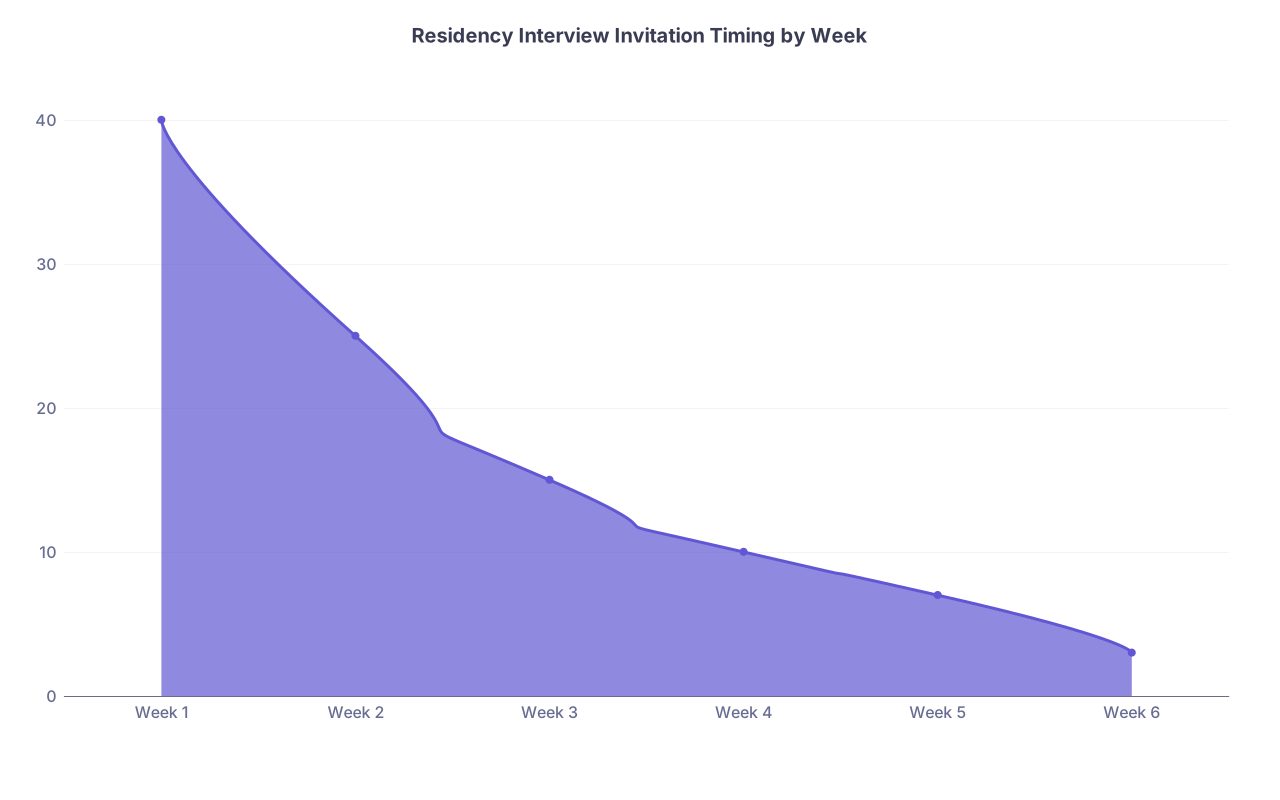
Here’s what interview timing often looks like:
| Category | Value |
|---|---|
| Week 1 | 40 |
| Week 2 | 25 |
| Week 3 | 15 |
| Week 4 | 10 |
| Week 5 | 7 |
| Week 6 | 3 |
Most invites come in the first few weeks after programs start sending. Does that mean you’re done if you’re low early? No. But it means you do not just sit and hope.
Step 2: Diagnose why your response is low
You don’t treat the symptom (low interviews) without diagnosing the cause. Otherwise you over-apply in the wrong way and still don’t match.
Common causes:
You under-applied for your competitiveness
- Example: Applying to 25 EM programs with a 225 Step 2 and no home EM.
- Or 40 categorical surgery programs with multiple red flags.
Your list was too top-heavy
- 80%+ “reach” programs.
- Almost no community or less competitive programs.
- Heavy on big-name academic centers with strong applicant pools.
You’re in a high-risk category
- International medical graduate (IMG)
- US citizen IMG (worse than non-US IMG in many fields)
- Previous failed exam (Step/COMLEX)
- Gap years without clear explanation
- Significant professionalism or academic remediation
Timing issues
- You submitted ERAS late (mid–late October).
- Letters weren’t uploaded for weeks.
- MSPE release timing hurt you because of weak comments.
Application quality
- Generic personal statement that doesn’t sound like a human.
- Awful experiences section (vague, cliché, no reflection).
- Sloppy CV, typos, missing context for red flags.
Adding programs helps a lot if:
- Your main issue is too few or mis-targeted programs.
- You’re in a less competitive specialty and just under-applied.
- You’re an IMG who only applied to a narrow set of hospitals.
Adding programs helps less if:
- You have multiple serious red flags and are applying to ultra-competitive fields.
- Your core application content is weak or confusing.
- You applied reasonably broadly already and have near-zero response.
That doesn’t mean “do nothing.” It means you may also need a plan B (SOAP, prelim, reapply) while you expand smartly.
Step 3: The core question — should you add more programs?
Here’s the blunt rule I use when advising:
If by late October you have:
- Fewer than 3–4 interviews in any specialty, and
- You’re getting a steady stream of rejections, and
- You applied to fewer than:
- 60–70 categorical IM / FM / Psych
- 40–50 OB / Anesthesia / EM (US MD/DO, average stats)
- 80–100+ for competitive specialties (or IMGs in almost anything)
…then yes, you should strongly consider adding more programs.
You’re not stuck. ERAS stays open. Many programs keep reviewing late applications, especially community and prelim programs.
But the way you add more programs is where people blow it.
Step 4: How to add programs strategically (not desperately)
Think of this like a mid-season course correction, not hitting the panic button.
1. Rebalance your list
Your new additions should not look like your original reach-heavy list. You want more “likely” and “safety-ish” (as much as that exists in residency).
You rebalance in three ways:
- More community programs
- More geographically flexible programs (places people overlook)
- More less competitive or parallel-plan specialties (if appropriate)

If your original 60 internal medicine programs were mostly big academic centers in coastal cities, your next 30 should be:
- Community IM programs in the Midwest, South, smaller cities.
- Programs known to interview broadly, not just 260+ Step scorers.
- Hospitals that take more IMG/DO applicants if that’s you.
2. Target programs that still have interview capacity
Some concrete tactics:
Check program websites and social media (X, Instagram, program pages):
- Look for posts saying they’re “still reviewing applications.”
- Some explicitly say they welcome late applications.
Talk to upperclassmen or residents:
- Ask which programs sent late-season invites last year.
- People remember the ones that emailed in December.
Use filters intelligently:
- Avoid “no visa sponsorship” if you need a visa.
- Avoid programs that explicitly state they don’t take IMGs/DOs if that’s you. Do not donate money to people who’ve already told you “no.”
3. Fix what you can in your application ecosystem
You can’t rewrite your ERAS personal statement after submission for existing applications, but you can fix issues going forward:
- Apply to a second specialty you’re genuinely okay matching into (e.g., adding FM or IM if you’re striking out in EM or anesthesia).
- Ask mentors to email PDs at a few key programs you’re adding, especially your home/regional ones.
- Fix your professionalism: tighten email communication, voicemail message, interview scheduling response times. Programs notice flakiness.
Step 5: How many more programs should you add?
Let’s be specific. A lot of people either under-correct (“I’ll just add 5 more”) or totally overdo it (“I applied to 180 IM programs and got 2 interviews”).
Here’s a simple adjustment framework:
| Situation | Current Apps | Interviews by Late Oct | Suggested Additional |
|---|---|---|---|
| Less competitive field, under-applied | 30–40 | 0–2 | +30–40 |
| Less competitive, already 60+ | 60–80 | 0–3 | +20–30 (more targeted) |
| Moderately competitive, under-applied | 20–30 | 0–2 | +30–50 |
| Competitive specialty (US MD/DO) | 40–60 | 0–3 | +30–60 (plus backup) |
| IMG in any core specialty | 60–80 | 0–2 | +40–80 (lean community) |
Step 8: Money, mental health, and what’s actually in your control
You’re probably stressed, maybe embarrassed, and watching other people book 12+ interviews while you spin your wheels. I’ve seen this every cycle.
Here’s what you can fix right now:
- Expand and rebalance your list: more community, more regions, realistic programs.
- Communicate with mentors: tell them your interview count and ask for targeted advocacy.
- Tighten your professional presence: email, voicemail, availability for interviews.
- Decide if you’ll add a backup specialty and do it in the next 48–72 hours, not “someday.”
And what you stop doing:
- Doom-scrolling Reddit/Discord comparing yourself to anonymous stats.
- Refreshing your email every 2 minutes.
- Pretending “it’ll all work out” without changing anything when the numbers say otherwise.
Quick checklist: Should you add more programs?
If you answer “yes” to most of these, add more:
- I have fewer than 3–4 interviews scheduled.
- It’s already mid/late October (or later).
- I applied to fewer programs than commonly recommended for my specialty/competitiveness.
- My list is heavy on big academic / coastal / brand-name programs.
- I’m an IMG or DO who focused too much on top centers.
- I can still identify at least 20–30 more realistic programs.
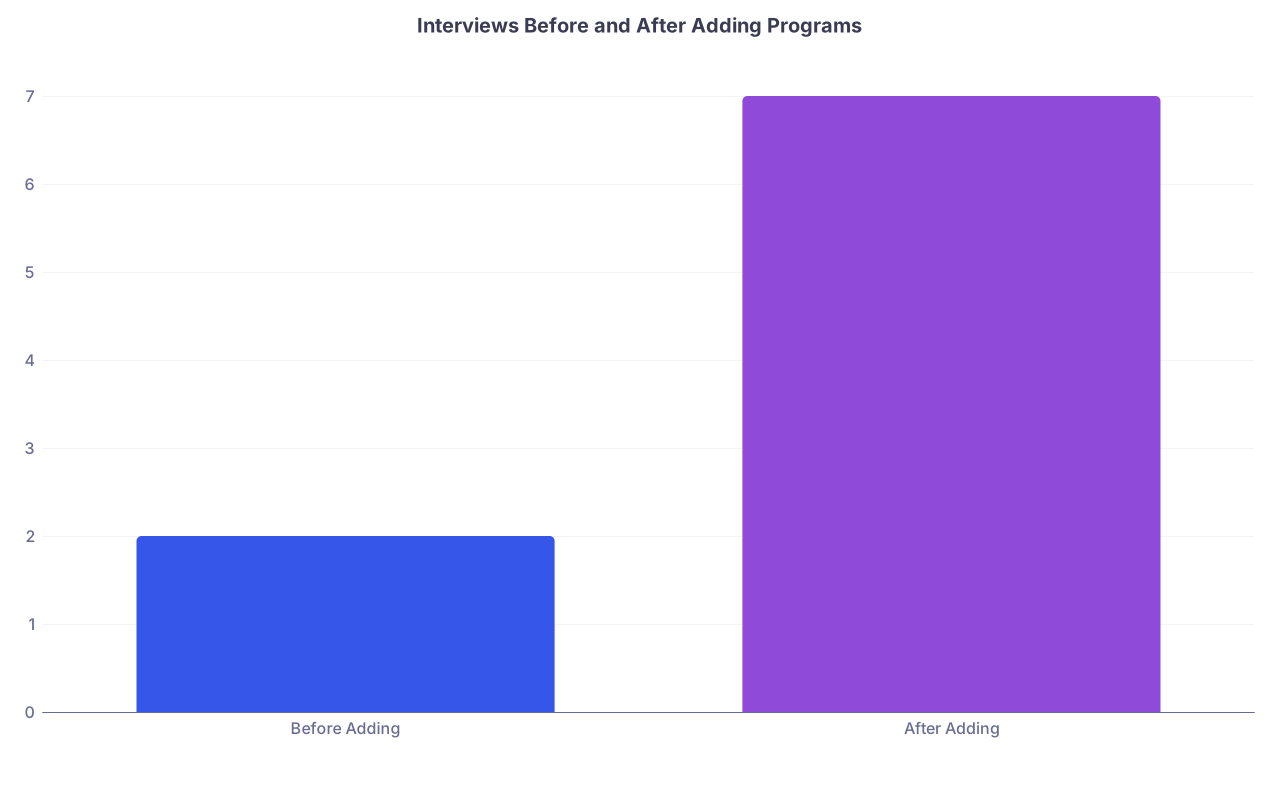
If you end up adding, track it:
| Category | Value |
|---|---|
| Before Adding | 2 |
| After Adding | 7 |
That’s a realistic scenario I’ve seen: someone goes from 2 → 6–8 interviews after a targeted mid-season expansion. That can be the difference between matching and scrambling.
FAQ: Adding More Programs After Low Early Interview Response
1. When is it “too late” to add more residency programs?
It’s “too late” when:
- Programs have already sent out almost all interview invites and have waitlists,
- You’re applying in December or January,
- And you’re in a competitive specialty with no signal that programs are still reviewing.
But practically, adding programs through late October and even early–mid November can still lead to interviews, especially:
- Community programs
- Less competitive specialties
- Programs in less popular regions
After that, any apps are very long shots. Focus shifts to SOAP prep and next-cycle planning.
2. Should I email programs before or after I add them?
If you’re clearly below their typical stats or an unusual applicant (IMG, gap year, etc.), you can:
- Apply first
- Then send a brief, professional interest email saying:
- Who you are
- One specific reason you’re interested in their program
- A concise mention of any major strength or tie (regional connection, prior rotation, research with their faculty)
Do not send a mass “please interview me” email blast. It has almost no effect and annoys people.
3. Is adding a new specialty mid-season a bad look?
No. Programs do not see what other specialties you applied to.
What is a bad look is:
- A personal statement that obviously wasn’t written for their field.
- No evidence in your experiences that you care about that specialty at all.
If you add a new specialty:
- Write a new, focused personal statement for it.
- Make sure at least one or two letters are believable for that field (medicine letter for IM/FM/Psych is usually fine; EM letter reused for derm will look weird).
4. I’m an IMG with no interviews yet. Does adding more programs actually help?
For IMGs, yes, program count matters a lot, but only if the programs:
- Actually accept IMGs historically,
- Sponsor the visa you need,
- And your scores/language/experience meet their minimums.
If you’re at 0–1 interviews and under 80–100 applications in IM/FM/Peds/Psych, you should seriously consider adding more, focused on:
- Community hospitals,
- IMG-friendly regions (NY, NJ, Midwest, parts of the South),
- Programs where past graduates from your school have matched.
If you’re already at 150+ applications with no interviews, the problem is more likely your profile, not application count alone. You still might add more, but you must also plan for SOAP or a reapplication year.
5. How many interviews do I actually need to feel “safe”?
It depends on specialty and your competitiveness, but rough targets:
- Less competitive fields (FM, IM, Psych, Peds):
8–10 solid interviews = reasonably safe for most US MD/DO applicants. - Moderately competitive (EM, Anesthesia, OB, some surgical prelims):
10–12+ is more comfortable. - Competitive specialties (Derm, Ortho, ENT, Urology, integrated plastics):
Even 8–10 isn’t guaranteed; more is better, and many applicants use parallel plans.
If you’re sitting at 2–3 interviews only, you’re in a risky zone and should strongly consider broadening.
6. What should I do today if I’m low on interviews?
Three concrete steps:
Pull up your ERAS list and mark:
- Academic vs. community
- Geographic regions
- Programs that historically take DO/IMG (if relevant)
Identify 20–40 realistic additional programs:
- Heavier on community and less popular locations
- Programs explicitly open to your degree/visa status
Message 2–3 trusted faculty mentors with:
- Your current interview count
- Your current specialty and stats
- A direct ask: “Can we talk about adding more programs or a backup specialty this week?”
Do that, and you’re actually acting strategically instead of just worrying.
Open your ERAS program list right now and sort it by “Program Type” and “Location.” If 70% of your programs are big-name academic centers in coastal cities and you have fewer than 4–5 interviews, it’s time to add more — starting today — and rebalance toward realistic options.