
What do you actually do if your Step 1 is pass, your Step 2 CK is a 228, and every Reddit thread is screaming: “Apply to 80+ programs or you won’t match”?
Let me be direct: your Step scores should absolutely influence how many residency programs you apply to—but not in the panic-driven, “spray and pray” way most people default to.
You need a strategy. Not a vibe.
Below is exactly how to use your Step scores to decide:
- How many programs to apply to
- What mix of reach / realistic / safety programs you need
- When a big application list is smart vs just expensive and pointless
1. The Core Rule: Scores Change Your Safety Margin, Not Your Whole Life
Your Step scores do three things in this process:
- Control if you pass initial filters (especially Step 2 CK now that Step 1 is pass/fail).
- Change how many interviews you need to “buffer” risk.
- Affect how much you can narrow your list.
They do not:
- Completely erase strong clinical performance, letters, or home program support.
- Guarantee a match, even with “great” scores.
- Automatically kill your chances, even with below-average scores (unless you combine low scores with poor strategy).
So the point is not “High score = apply to 20; low score = apply to 100.”
The point is: “Given my Step profile and specialty competitiveness, how big a net do I need?”
2. Start With Reality: Where Do Your Scores Fall?
Let’s anchor your Step profile to something objective.
Use this rough breakdown for Step 2 CK (post-Step 1 pass/fail era):
- 250+ – Strong for most specialties, competitive for many
- 240–249 – Solid, around or above average
- 230–239 – Slightly below average for competitive specialties, fine for many others
- 220–229 – Low for many competitive programs, workable for primary care, psych, peds with smart targeting
- <220 – Very risky for competitive fields; you need extreme targeting, backup plans, or a different specialty
Now combine that with specialty competitiveness.
| Step 2 CK Range | Competitive (Derm, Ortho, ENT, Plastics) | Mid (EM, Anesth, Radiology, OB) | Less Competitive (FM, IM, Peds, Psych) |
|---|---|---|---|
| 250+ | Apply broadly but can be selective | Moderate list | Smaller but still safe list |
| 240–249 | Very broad list, many safeties | Broad but targeted | Moderate list |
| 230–239 | Consider rethinking specialty or huge list | Broad list | Broad but rational list |
| 220–229 | Only with strong mentorship & backup plan | Very broad list | Broad list with many safeties |
| <220 | Usually not advised without special context | Extreme targeting, backup plan | Broad list, heavy on safety programs |
This is not gospel. But it’s honest.
3. Baseline Numbers: Rough Targets by Specialty and Score
Let’s talk actual numbers. This is what you came for.
Assuming you’re a US MD/DO without huge red flags (no multiple failures, no catastrophic professionalism issues) and an average application otherwise:
For Less Competitive Fields (FM, IM (non-elite), Psych, Peds)
Strong Step 2 (245+):
15–25 programs if you have a home program or strong geographic ties
25–35 if you don’tMid-range Step 2 (230–244):
25–35 programs, heavy on community and mid-tier university programsLow Step 2 (220–229):
35–50 programs, target: more community, more lower/mid-tier, multiple regions<220 or failed Step:
50+ programs, strong advising, possible transitional/prelim year targets, and serious backup thinking
For Moderately Competitive Fields (EM, Anesthesia, Radiology, OB-GYN, decent IM programs)
Strong Step 2 (250+):
30–40 programsMid-range Step 2 (240–249):
40–50 programs230–239:
50–70 programs, and you start needing more “safer” options in less popular regions220–229:
70+ programs and/or re-evaluating the specialty depending on other strengths (EM especially has gotten picky)
For Highly Competitive (Derm, Ortho, ENT, Plastics, Urology, Neurosurgery)
Here’s the truth: Step scores are only one piece here, but they absolutely set the floor.
250+ and strong app (research, mentors, signals, etc.):
40–60+ programs depending on specialty norms240–249:
60–80+ programs; many will still screen you out<240 in these specialties:
You’re in “long shot” territory unless you have exceptional connections, research, or are at a powerhouse institution. This is where most people need a dual-application strategy (e.g., ortho + prelim surgery or IM).
4. Step Scores Don’t Live Alone: Other Factors That Change Your Number
Your Step score is the start, not the full picture. Here’s what moves you up or down from those ranges.
You should apply to more programs if:
- You’re an international medical graduate (IMG) or non-US citizen
- You have a failed Step attempt
- Your school has weak name recognition in the region or country you’re applying
- You’re changing specialties late without targeted experience
- Your letters are generic or from non-academic faculty only
- You’re geographic–agnostic (willing to go anywhere) and need raw volume
You can apply to fewer programs (within reason) if:
- You have a strong home program in the specialty that likes its own students
- You rotated at and impressed several outside programs
- You’re okay limiting yourself to certain regions for personal reasons and are fine accepting that risk
- You have strong research and mentorship in that specialty
- Your school historically matches very well in this field with your score range
Bottom line: bad or risky context + borderline scores = large list.
Great context + strong scores = you can be choosier, but don’t get arrogant.
5. How Many Interviews Do You Actually Need?
You’re not applying for fun. You’re applying to get interviews.
The entire game is: “How many programs do I need to apply to in order to land a safe number of interviews?”
General (not perfect) rule:
Less competitive specialties (FM, IM, Psych, Peds):
8–10+ interviews → very high chance to match
12–15+ → extremely safeModerately competitive (Anesthesia, EM, OB, Radiology):
10–12+ interviews → good chance
14–18+ → saferHighly competitive (Derm, Ortho, etc.):
It varies, but 12–15+ is often considered a strong position. Many unmatched applicants in these fields have <8.
Where Step scores fit in:
- High scores mean more programs will actually read the rest of your app → more interview invites per application.
- Lower scores mean more automated rejections → you need more applications to net the same number of interviews.
So: if your classmates with 250s are applying to 35 and get 18 interviews, your 225 might need 60+ applications to get 12 interviews in the same field.
Unfair? Yes. Still real.
6. Specialty-Specific “Gotchas” With Step Scores
A few examples where people consistently misjudge:
Internal Medicine
- 250+ thinking they only need to apply to 10 elite academic places. Then they end up with 4 interviews and sweat all winter.
- If you’re gunning for top academic IM (Mayo, MGH, UCSF), high scores help, but fit, research, and letters dominate.
For IM with average scores: apply widely, but you don’t need 80 unless you have other red flags.
Emergency Medicine
The past few cycles have been weird. Oversupply → undersupply. Programs panic, students panic.
- Historically, mid-230s and decent SLOEs: 30–40 applications worked.
- In recent more competitive cycles, students with 230s–240s applied to 50–70 just to feel safe.
Your SLOEs (not just scores) heavily drive interview yield.
Psychiatry
Students often underestimate how much psych tightened up.
A 220–230 used to feel comfortable with 25–30 apps. Now I advise 35–45+ for those scores, especially for IMGs.
7. How to Build Your List: Reach, Realistic, Safety
Once you’ve picked an approximate total number (say 50 programs for Anesthesia with a 235), you’re not done. You need the right mix.
Rough ratio that works:
- 20–30% “Reach” – programs where your Step scores are below their typical matched average or they’re prestige-heavy
- 50–60% “Realistic” – programs where your scores and overall profile align with historical data
- 20–30% “Safety” – lower-tier or less desirable location programs that historically match applicants with your or lower scores
For a 50-program list, something like:
- 10–12 reach
- 25–30 realistic
- 10–12 safety
Your Step numbers primarily shift where you belong in each bucket, not whether you’re allowed to have any reach at all.
8. When Over-Applying Is Actually Dumb
There’s a limit where extra applications add almost no benefit:
- Adding the 80th program when your first 60 are already a solid realistic/safety mix often just burns money.
- If your Step 2 CK is 255 with a home IM program, applying to 80 community programs across the country “just in case” is fear, not strategy.
Places where over-applying makes sense:
- Lower scores in a moderately competitive specialty
- IMGs in anything but the least competitive specialties
- Applicants with a prior failure who are still applying in a reasonable specialty
But if your Step scores are strong and your CV isn’t full of red flags, you’re usually better off:
- Improving your personal statement
- Targeting emails to PDs at “priority” programs
- Preparing well for interviews
…than mindlessly adding more programs.
9. Simple Process to Decide Your Number in 20 Minutes
You want a clear action path. Here:

| Step | Description |
|---|---|
| Step 1 | Identify Specialty |
| Step 2 | Check Specialty Competitiveness |
| Step 3 | Locate Your Step 2 Range |
| Step 4 | Use Baseline Range for Your Specialty |
| Step 5 | Increase Range by 15 to 25 Programs |
| Step 6 | Decrease Range by 5 to 10 Programs |
| Step 7 | Keep Baseline |
| Step 8 | Build Reach Realistic Safety Mix |
| Step 9 | Any Major Red Flags? |
| Step 10 | Strong Home Program or Big Research? |
Then reality-check it:
- Look up NRMP Charting Outcomes for your specialty (or the most recent PD survey / score distributions).
- Talk to your dean’s office or specialty advisor:
“Here are my Steps. Here’s my specialty. I’m thinking about applying to X programs. Too high? Too low?” - Adjust by ±10 based on their real-world experience with your school’s match patterns.
10. One More Thing People Don’t Like to Hear
If your Step scores are significantly below the typical matched range in a very competitive specialty, no number of applications guarantees safety.
I’ve seen:
- Ortho applicants with 240s match at great places with smart strategy and mentorship.
- Ortho applicants with 260s go unmatched because they only applied to elite programs and ignored “safeties.”
- Psych applicants with 215s match after applying to 80+ programs and being geographically flexible.
- EM applicants with 240s unmatched after applying to only 25 programs in one region during a tight cycle.
Your Step scores should push you toward:
- The right number of programs
- The right type of programs
- And, in some cases, the right backup specialty
Not just more blind applications.
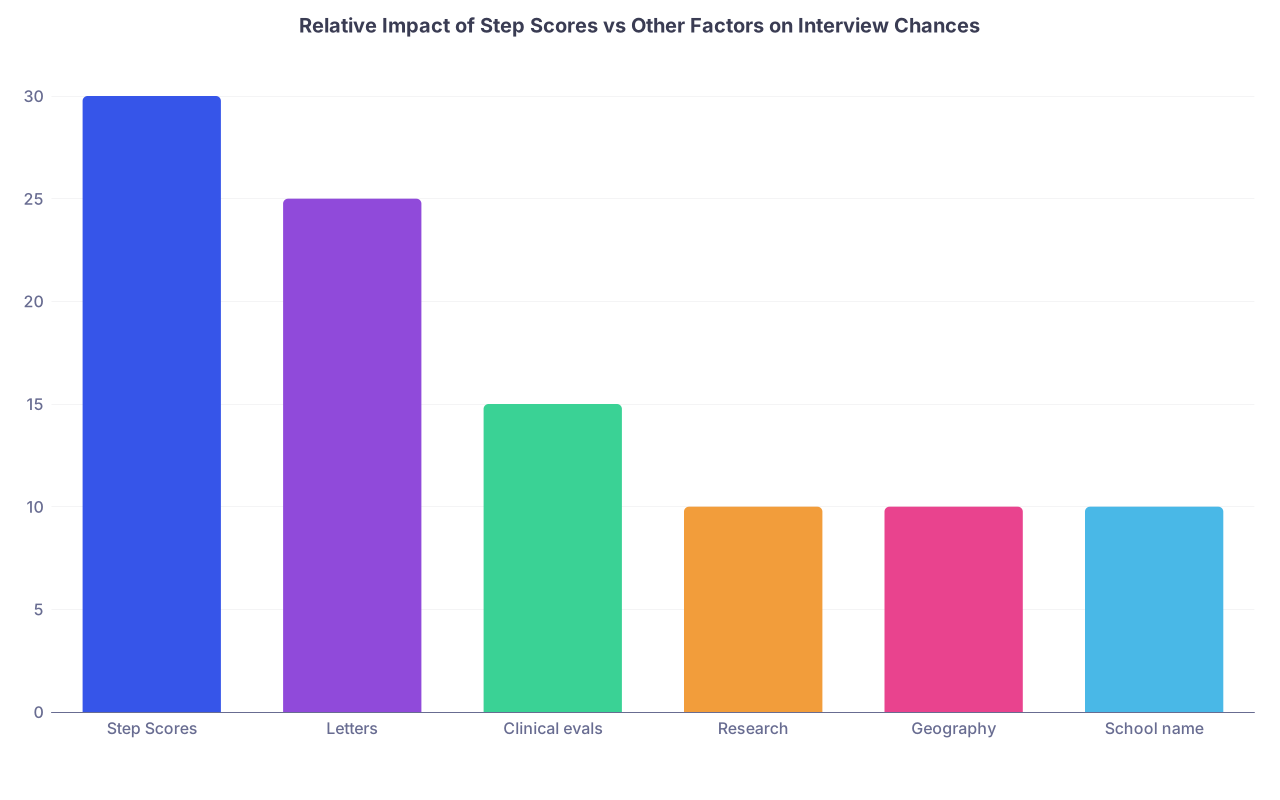
| Category | Value |
|---|---|
| Step Scores | 30 |
| Letters | 25 |
| Clinical evals | 15 |
| Research | 10 |
| Geography | 10 |
| School name | 10 |
This is roughly how PDs often describe it when they’re honest off the record. Step scores open the door. Your whole application decides whether they invite you in.
FAQ: Step Scores and How Many Programs to Apply To
If my Step 2 CK is below 220, should I still apply this year or wait?
If you’re in a less competitive field (FM, Psych, Peds), you can still apply—just heavily broaden your list (50+ programs), focus on community programs, and get strong advising. If you’re aiming for a competitive specialty, I’d seriously consider a pause year: improve your application, get research or strong clinical experiences, and reassess specialty choice. Throwing 100 apps into Ortho with a 215 is not strategy. It’s denial.I have a 250+ Step 2 CK. What’s the minimum number of programs I can safely apply to for IM?
If you’re US MD at a reasonably known school, with decent letters and no failures, you can probably target 20–25 IM programs (mix of academic and community) and be fine, especially with a home program. I still wouldn’t go below 20 unless you have insane home institution support and context. There’s no bonus prize for applying to the absolute minimum and then sweating the match.Do Step 1 and Step 2 matter differently for how many programs I apply to now that Step 1 is pass/fail?
Yes. Step 2 CK is now the key number. A failure on Step 1 plus a strong Step 2 (240+) can partially rehabilitate you, but PDs will still see the failure. That means: size up your list a bit from the usual for your specialty and score range. A weak Step 2 with a Step 1 pass is worse. That’s when you increase your program count substantially.Should IMGs always apply to more programs regardless of score?
Generally yes. Even with a 245+, an IMG typically needs more applications to secure the same number of interviews compared to a US MD. For IMGs:- Less competitive fields: 60–100 depending on scores and visa status.
- More competitive: often 80–120, plus ruthless targeting. High scores help, but not as much as people hope.
Is there any point in applying to “reach” programs if my Step scores are below their average?
Yes—but sparingly. If your Step 2 is 235 and top programs report matched averages around 245–250, having 5–10 reach programs is fine, especially where you have geography or research ties. Just don’t let reach programs eat up the majority of your list. You match based on where you interview, not where you dream.What if my school’s advisor says 30 programs is enough, but my gut says 50?
Go 50. Your advisor is guessing based on aggregate data and prior cycles. You’re the one who lives with the outcome. If you can afford the extra 20 and you’re in any category that increases risk (borderline scores, competitive specialty, IMG), I’d side with your gut—as long as the extra 20 are realistic or safety programs, not just more reaches.Is it ever smart to apply to two specialties because of borderline Step scores?
Yes, and more people should admit it. If your Step scores are mediocre for a highly competitive field (e.g., 235 for Ortho, 228 for ENT), a dual-application strategy with a more realistic specialty (IM, prelim surgery, anesthesia, etc.) can be the difference between matching something vs SOAP chaos. Just do it intentionally: two coherent applications, not a sloppy second-choice dumped together last minute.
Open your Step 2 CK score report right now and write down: your specialty, your score, and whether you’re US MD/DO or IMG. Then pick a target range for number of programs using the ranges above—and adjust it by ±10 after talking to a real advisor at your school this week.