

What’s the actual number of programs you need to rank so you can stop waking up at 3 a.m. convinced you’re going to go unmatched?
Because that’s the fear, right? Not “do I match somewhere good,” but “do I match at all… or do I become the cautionary tale people whisper about on rounds?”
Let’s talk about that number. The real one. Not the fantasy “if your application is strong, 12–15 is fine” line you see on Reddit that somehow never applies to you.
The Ugly Truth: There Is No Magic Safe Number (But There Are Real Ranges)
I’m just going to say it: there is no perfectly safe number. You can apply to 120 programs and still not match if the rest of your application is wildly misaligned.
But you’re not asking for a guarantee. You’re asking: “How many programs do I need to rank so that I’m not making a stupid, avoidable mistake?”
Here’s what the NRMP data actually shows, boiled down to what neurotic people like us care about: unmatched risk vs number of ranks.
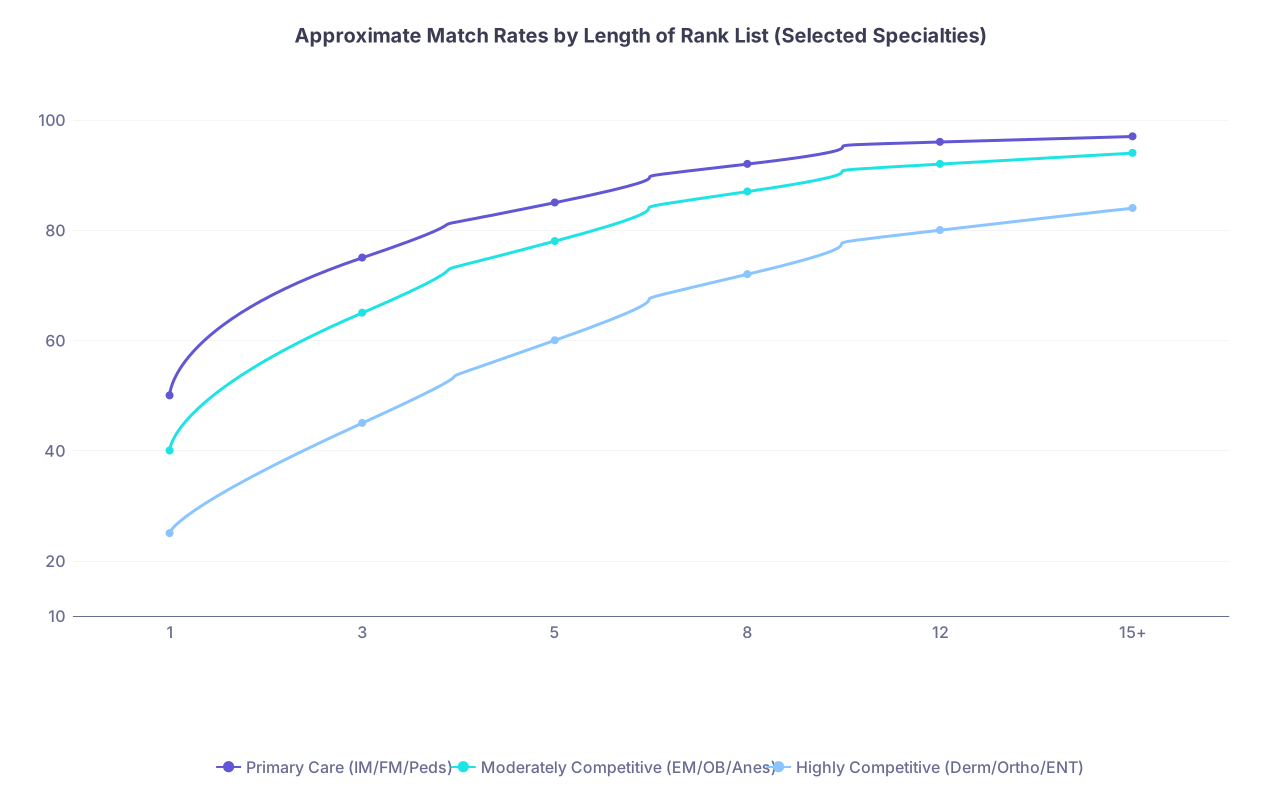
| Category | Primary Care (IM/FM/Peds) | Moderately Competitive (EM/OB/Anes) | Highly Competitive (Derm/Ortho/ENT) |
|---|---|---|---|
| 1 | 50 | 40 | 25 |
| 3 | 75 | 65 | 45 |
| 5 | 85 | 78 | 60 |
| 8 | 92 | 87 | 72 |
| 12 | 96 | 92 | 80 |
| 15+ | 97 | 94 | 84 |
That’s post-interview, but it’s useful for thinking about risk. Roughly:
- Very competitive specialties: you are never “safe,” you’re just “less doomed.”
- Medium specialties: longer rank lists really do protect you.
- Primary care: if you get enough interviews, your odds get pretty good with a decently long list.
But you’re probably not actually asking, “How many do I need to rank?” You’re asking:
“How many should I apply to so I don’t end up with 2 interviews and a prayer?”
So let’s go there.
Step 1: What Specialty Are We Even Talking About?
You cannot use the same number for family medicine and derm. That’s how people end up crying in March.
Here’s the uncomfortable but honest breakdown of how many programs to APPLY to, assuming you’re a US MD/DO with a reasonably okay application (not perfect, not a dumpster fire):
| Specialty Tier | Rough Number of Programs to Apply To |
|---|---|
| Ultra-competitive (Derm, Ortho, ENT, Plastics, NSG) | 70–100+ |
| Competitive (EM, Anes, Rad, Uro, Gas, Ophtho\*) | 40–70 |
| Mid (IM, OB, Peds, Psych – at avg competitiveness programs) | 25–50 |
| Less competitive / Primary care heavy (FM, some IM, Peds) | 20–35 |
*Yes, some of these are via separate matches or have weird processes, but the “spray wide” logic still holds.
Now the part you’re dreading:
When you need to increase those numbers
You’re in the “I should probably apply to more” camp if:
- You have a red flag (failed Step/COMLEX, professionalism issue, leave of absence)
- Scores are below the average for your specialty
- You’re switching specialties late
- You’re an older grad or an international grad
- Your application is lopsided (no research in a research-heavy field, zero home rotation in EM, etc.)
In that case, push yourself into the upper end or even beyond those ranges.
So yes, for a US MD applying to internal medicine with a 240s Step 2, solid letters, and no huge gaps, 25–30 apps may be enough.
But if you’re a DO with a 220-ish Step 2, no home program, and no research aiming at IM? I’d be living in the 40–50 range, easily.
Step 2: How Many Interviews Do I Actually Need to Not Freak Out?
This is where the “feeling safe” part lives.
NRMP has shown this repeatedly: the chance of matching climbs fast as you get more interviews, then flattens.
Here’s the short version for US MD/DOs in categorical programs:
| Interviews Ranked | Rough Match Chance |
|---|---|
| 1–2 | 20–40% |
| 3–4 | ~55–70% |
| 5–7 | ~80–90% |
| 8–10 | ~90–95% |
| 12+ | 95%+ (varies by field) |
So where’s the “I can sleep now” zone?
- Absolute panic zone: 0–2 interviews. You’re in SOAP-risk territory.
- Lightly sweating blood: 3–4.
- Cautiously hopeful but still checking emails every 3 minutes: 5–7.
- Reasonably safe for most non-ultra-competitive specialties: 8–10+.
If I’m being honest, my personal “I can at least function” mental threshold was 8 interviews. Below that I was planning SOAP strategies in my head. Above that I worried more about where I’d match than if I’d match.
Step 3: Connecting Applications → Interviews → Feeling Safe
You care about how many programs to apply to, which is just a proxy for: “How many interviews can I realistically get?”
The brutal formula in my head was something like:
Number of programs to apply to =
(Interviews you want / Realistic invite rate) × Panic multiplier
No one says it that way, but that’s what we’re all doing subconsciously.
For example:
- You’re targeting internal medicine
- You’re an average US MD (no huge red flags)
- Reasonably realistic invite rate once filtered: 10–20%
If you want 8–10 interviews to feel okay:
- At 15% invite rate:
- 10 interviews ÷ 0.15 ≈ 67 applications
- 8 interviews ÷ 0.15 ≈ 54 applications
But that’s the math if you’re throwing apps everywhere, including reaches and places that probably won’t touch your file.
In reality, most people:
- Get zero traction at their “reach” programs
- Get decent traction at good-fit places
- Over-apply because they can’t predict which is which
So here’s how I’d frame it mentally, specialty by specialty, as a Worried Applicant:
If you’re applying primary care heavy (FM, Peds, lower-tier IM)
- Target: 8+ interviews
- Assertive but not insane: 25–35 apps
- If you have BIG red flags or are IMG: 40–60
If you’re applying mid-range (IM with some academic interest, Psych, OB at average places)
- Target: 8–10+ interviews
- Solid range: 30–50 apps
- Red flags/IMG: 60–80
If you’re applying competitive (EM, Anes, Rad, etc.)
- Target: 10–12+ interviews
- Safer range for average US MD/DO: 40–70 apps
- Red flags/IMG or weaker stats: 70–100
If you’re applying ultra-competitive (Derm, Ortho, ENT, etc.)
- Target: 12+ interviews (and even that’s not “safe”)
- Many end up applying to 80–120+
- Also: dual apply if there’s any doubt. I would. Unapologetically.
And yeah, those numbers are horrifying. The system is bloated and ridiculous. But pretending you can be “efficient” while you’re lying awake catastrophizing doesn’t help either.
Step 4: Signs You’re Under-Applying vs Over-Applying
You’re probably bouncing between two terrors:
- Terror A: “I’m going to go unmatched because I was too conservative.”
- Terror B: “I’m going to waste thousands of dollars and still panic anyway.”
So let’s call out some honest signals.
You’re probably under-applying if:
- Your advisor says, “Given your scores and this specialty, I’d go broader than that,” and they’re not usually an alarmist.
- You have any of the following and are still using “average” ranges:
- Step/COMLEX below specialty mean
- No home program in your specialty
- Weak or generic letters
- No meaningful specialty exposure (no away rotations, no related research where it matters)
- Career switcher, gap years, older grad, etc.
- You’re relying on “I’ll just interview well” as your risk protection.
You’re probably over-applying (at least a bit) if:
- You have a very strong application in a less-competitive field and you’re at like 70+ applications.
- You’re applying to tons of places you know you wouldn’t actually rank unless everything else crashed.
- You’re adding programs mostly out of “everyone on Reddit is applying to 80+.”
Is over-applying irrational? Honestly… yes and no.
Financially, it sucks. Emotionally, if applying to 10–15 extra programs is the difference between sleeping or not, I’m not going to call that stupid. I’m just going to tell you to focus those extra apps on realistic, safety-ish programs, not dream reaches you know won’t look twice at you.
Step 5: What If I Don’t Get Enough Interview Invites?
This is the 2 a.m. scenario. Your ERAS is in, you did your part, and now… silence.
Here’s the mental game plan I wish more people actually walked through.

| Step | Description |
|---|---|
| Step 1 | Submitted Applications |
| Step 2 | High risk - Add programs |
| Step 3 | Moderate risk - Targeted add |
| Step 4 | Monitor - Likely OK |
| Step 5 | Talk to advisor ASAP |
| Step 6 | Apply to more lower tier programs |
| Step 7 | Consider dual apply or SOAP plan |
| Step 8 | Prepare for interviews |
| Step 9 | By mid Nov - Interviews? |
Real talk:
- 0–2 interviews by mid-November (for most specialties):
You’re in the danger zone. You should:- Talk to someone who’s seen a ton of applications (PD, advisor, dean’s office)
- Add more lower-tier, community, or less desirable geography programs
- Start mentally prepping SOAP strategies, not as self-punishment, but as a backup plan
- 3–5 interviews by mid-November:
Added risk, but not doomed. I’d personally add:- 10–20 more realistic programs, depending on specialty
- 6+ interviews by mid-November:
I’d be nervous (because that’s who I am), but reality says: you’re probably okay, especially in non-ultra-competitive fields.
Just remember: most of your match probability is baked in before interview season even starts. But you still have levers to pull if things look bad.
Step 6: How Many Programs Do I Need to RANK to Feel Safe?
Different question, but related.
I’ve seen people sabotage themselves by ranking like 4 programs “to send a message” to the universe. The universe does not care. The algorithm does not care. You just increased your chance of not matching.
Here’s what I’d tell my own catastrophizing brain:
- If you have 1–3 ranks:
You are absolutely still at high risk. I’d be scared. - 4–7 ranks:
Better, still uncomfortably risky in many fields. - 8–10 ranks:
For most non-ultra-competitive specialties? This is the “reasonable sleep” zone. - 12+ ranks:
Diminishing returns. Still helpful, but each extra rank gives only a small bump.
If you interviewed somewhere and could tolerate training there (not love it, just tolerate it):
Rank. Them. All.
There’s no “moral victory” in going unmatched because you didn’t deign to rank a program that actually would’ve trained you decently.
A Quick Reality Check on “Feeling Safe”
You will almost definitely not feel fully safe at any number. That’s kind of the curse of being an anxious applicant in a high-stakes, opaque system.
So here’s my blunt version of “safe enough”:
- You applied in the middle-to-upper range for your specialty + your risk factors.
- You end up with 8–10+ interviews (for non-ultra-competitive fields).
- You rank every program where you could realistically survive three or more years of training.
If those three are true, and you still don’t match? That’s not on you. That’s a system failure, not a personal one.
You can be cautious. You can be strategic. You can’t fully bully the match into guaranteeing an outcome, no matter how many programs you throw money at.

FAQs
1. Is there a point where applying to more programs doesn’t help?
Yes. If the quality and fit are off, more volume doesn’t fix that. Adding 30 more top-tier academic IM programs when your app is better suited to community programs doesn’t help much. Once you’re past a realistic range (say 60 vs 80 for many competitive fields), the gains get small unless you’re adding better-fit, lower-tier, or broader geographic options.
2. Should I dual apply if I’m scared of not matching?
If you’re going for an ultra-competitive specialty (derm, ortho, ENT, plastics, neurosurg) and you don’t have a truly stellar application or strong mentorship telling you you’re in great shape, dual applying is not cowardly. It’s survival. People regret overconfidence way more than they regret giving themselves a backup.
3. What if my advisor tells me I’m applying to too many programs?
Ask them to commit to a number in writing and to tell you, explicitly, what your risk profile is. A lot of advisors underestimate how terrified students are. If they say, “You’re strong for IM, 25–30 is fine,” and you know you won’t sleep unless you hit 40, apply to 40. You’re the one living with the 3 a.m. anxiety, not them.
4. Is it better to apply broadly or focus on places where I have geographic ties?
Both matter, but if we’re talking about fear of not matching, I’d lean slightly toward breadth with smart targeting. Prioritize:
- Your home region
- Places where your school has sent grads before
- Programs known to be IMG/DO friendly (if that’s you)
Then add extra programs beyond that for pure volume. Geographic ties help, but not as much as simply having enough places consider you in the first place.
Key points:
- There’s no magic “safe” number, but most US MD/DOs land in the 25–70 application range depending on specialty and risk factors.
- Aim for ~8–10+ interviews for most non-ultra-competitive fields, and rank every program you could tolerate.
- If you’re lying awake asking “Am I doing enough?”, slightly over-applying with realistic programs is usually better than betting on the optimistic minimum.


