

It’s 1:12 a.m. Your laptop brightness is way too high, your ERAS “Programs Applied To” tab is open, and you’re staring at that number in the corner. 37. You thought 37 was a lot. Then someone in your class Slack dropped, “With red flags you should really be doing 100+ apps, minimum.”
And now you’re here, debating whether to nuke your savings, apply to literally every program on earth, and just hope something sticks. While also low‑key panicking that if you don’t apply to 100+ you’re basically choosing to go unmatched.
I know this headspace. The mental loop is always the same:
- “My red flags are worse than everyone else’s.”
- “Programs will auto‑filter me out.”
- “I’ll be the one person who needed 120 apps and only sent 60.”
- “If I don’t apply everywhere, I’m basically giving up, right?”
Let’s actually untangle this. Not with the fake, “You’ll be fine!!” energy. With the real “okay, this might be rough, but here’s how to not burn your life down” version.
First: Are Your Red Flags Actually “Red” or Just “Yellow”?
Before you even talk numbers, you need to be honest about which category you’re in. Because “I got a pass in one pre‑clinical course” ≠ “I failed Step 1 twice and took a leave of absence.”
Here’s how I mentally sort it. Not what advisors say in vague language. What I’ve actually seen change people’s application behavior.
More like “yellow flags” (annoying, but not fatal alone)
- One failed pre‑clinical course, then remediation and passed
- One failed shelf exam
- One USMLE/COMLEX attempt with a pass on second try, otherwise decent record
- A leave of absence for something understandable (illness, family emergency) with clean story and clear return
- Below‑average Step 2 but still passing, no repeats
- No home program in your specialty, but solid rotations elsewhere
- Limited research in a research‑heavy specialty, but good clinical story
These things might push you a bit above “average” number of applications, but they don’t automatically shove you into “must apply to 100+ or die” land.
True “red flags” that do change the math
- Multiple USMLE/COMLEX failures (especially Step 2)
- Significant professionalism issues on record
- Dismissal/reinstatement from medical school
- Very low Step 2 score and weak clinical evals
- Large unexplained gaps in training
- IMG or DO candidate applying to an ultra‑competitive specialty plus one of the above
Those are the situations where application counts can legitimately climb. Not because higher is automatically smart, but because your “hit rate” per application probably drops.
So first reality check: which bucket are you actually in? Most people talking about 100+ apps are lumping all “I’m not perfect” into “I’m doomed.” And those are not the same.
The Ugly Truth: More Apps ≠ More Interviews After a Point
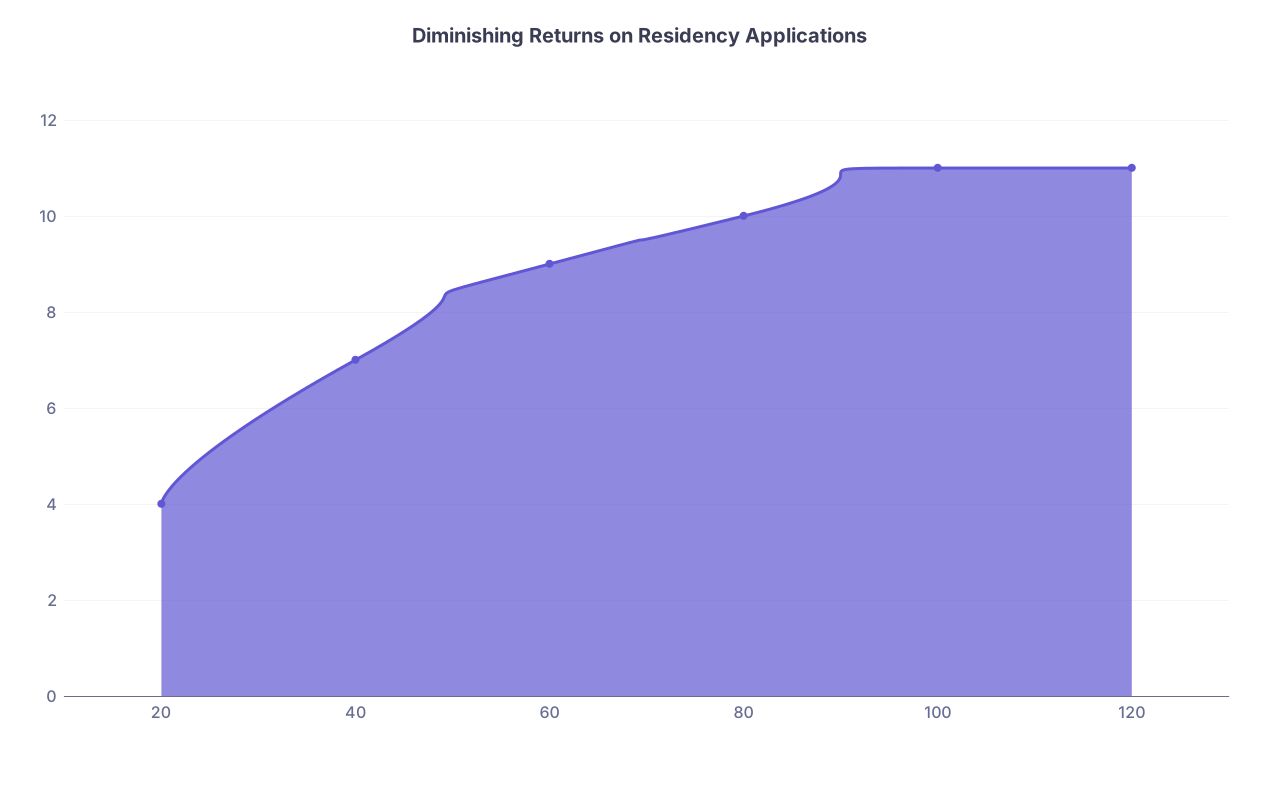
Here’s the part nobody believes at 1 a.m. but is still true: there’s a point where throwing more apps at the wall doesn’t really move the needle.
| Category | Value |
|---|---|
| 20 | 4 |
| 40 | 7 |
| 60 | 9 |
| 80 | 10 |
| 100 | 11 |
| 120 | 11 |
That’s pretty close to what I’ve seen with real people:
- The first 30–40 apps (if they’re well‑chosen) usually yield the most interviews.
- From 40–80, you still gain, but more slowly.
- After 80–100, for most mainstream specialties, the line starts to flatten. You’re applying to programs that are worse fits, more competitive, or simply not realistically interested in your profile.
But when you’re scared, you don’t care about diminishing returns. You just think, “Even if app #103 gets me one more interview, that could be the one that matches me.”
I get that logic. The problem is:
- Every extra app costs money you might need for rent or flights
- Every extra app dilutes your attention (researching programs, tailoring emails, etc.)
- If the extra apps are to programs that will filter you out anyway, you’re just lighting cash on fire
So no, needing 100+ apps is not universally true, even with red flags. It can be rational in some scenarios, but “I have any red flag at all” is not one of them.
The Real Question: What Kind of Applicant Are You With Your Red Flags?
Program directors don’t just look at “red flag: yes/no.” They look at your whole package. And that drastically changes how many programs you should realistically target.
Let me break this down with a rough spectrum. Not scientific, but frankly more useful than the generic NRMP graphs.
| Profile Type | Specialty Type | Typical App Range |
|---|---|---|
| Strong, no flags | Moderately competitive (IM, Peds, Psych, FM at US MD) | 25–40 |
| Average with yellow flags | Same specialties | 40–60 |
| Clear red flags, but strong narrative | Same specialties | 60–80 |
| Red flags + IMG/DO | Same specialties | 80–120 |
| Red flags + highly competitive specialty | Derm, Ortho, ENT, etc. | Reassess specialty or do backup, not just add apps |
This is the part that stings: if you’re a US MD applying Internal Medicine with one failed shelf and Step 2 = 224, you are not in the same situation as an IMG with two Step failures applying Ortho.
But social media collapses all of that into: “I had any problem ever, so I need 100+ apps.” Which is just false.
Situations Where 100+ Apps Might Actually Make Sense
To be fair, there are scenarios where crazy‑high application numbers actually line up with reality. I’ve seen people do 100–150+ and still barely scrape 5–7 interviews. So I won’t sugarcoat this part.
Here’s where the 100+ panic has some basis:
- You’re an IMG (especially non‑US) in a competitive or mid‑competitive specialty
- You have multiple exam failures or a very low Step 2
- Your school is new, unestablished, or you have weak letters, limited US clinical experience
- You’re couples matching and both have issues, or you’re geographically extremely restricted
- DO/IMG trying to match certain very academic programs that historically take almost none from your background
In those cases, yeah. You might genuinely be in the “cast a ridiculously wide net” camp.
But even then, 100+ has to be targeted, not random:
- Focus on programs with a track record of taking IMGs/DOs
- Prioritize community hospitals over big name academic centers
- Look for places that explicitly consider multiple attempts
- Avoid spending money on programs that literally list criteria you don’t meet
Spraying 150 applications at programs that auto‑screen your Step score or never take IMGs is not strategy. It’s fear.
Situations Where 100+ Apps Is Just Fear (Not Logic)
Here’s where I see people burning money out of panic, not need.
You probably don’t need 100+ if:
- You’re a US MD applying IM, FM, Psych, Peds, OB/GYN, or even Gen Surg in many regions
- You have one main issue (like a single exam failure) but upward trend afterward
- You have good clinical evaluations and at least a few solid letters
- You’re flexible on geography (not insisting on one city or one coast)
- Your red flag is well‑explained and not professionalism‑related
Example that comes up a lot:
“US MD, one Step 1 fail, passed Step 2 with 230s, honored some rotations, applying IM. Should I apply to 120 programs?”
My blunt answer? Probably not. For many people in that exact situation, 60–80 smartly chosen programs is already aggressive and more than enough.
Is there a universe where that same person applies to 120 and gets 1–2 more interviews? Maybe. But the extra 40 apps might cost $800+ and cause more stress than benefit.
The Part Everyone Skips: Program Selection Matters More Than Raw Number
This is the part that never fits in a TikTok: who you apply to is more important than hitting some magic “safe” number.
If you have red flags, the lazy approach of “sort by name, check every box” is the worst thing you can do. You need to be weirdly picky and weirdly broad at the same time.
Here’s how I’d actually attack it if I were terrified (and I usually am):
Start with programs that historically take applicants like you
Ask: do they take IMGs? DOs? People with exam failures? Have they taken grads from your school?Look at geography realistically
Big coastal cities = higher competition. Midwestern and Southern community programs often = more open, more forgiving.De‑prioritize programs with ultra high Step averages or heavy research focus if your red flag is scores or lack of research.
Intentionally include “safety” and “stretch” programs
Not every program should be out of your league. Not every one should be somewhere you’d be miserable either.
If you pick 60 programs like this, it will beat 100 random “I just checked them all” apps every time.
The Money and Sanity Part No One Talks About
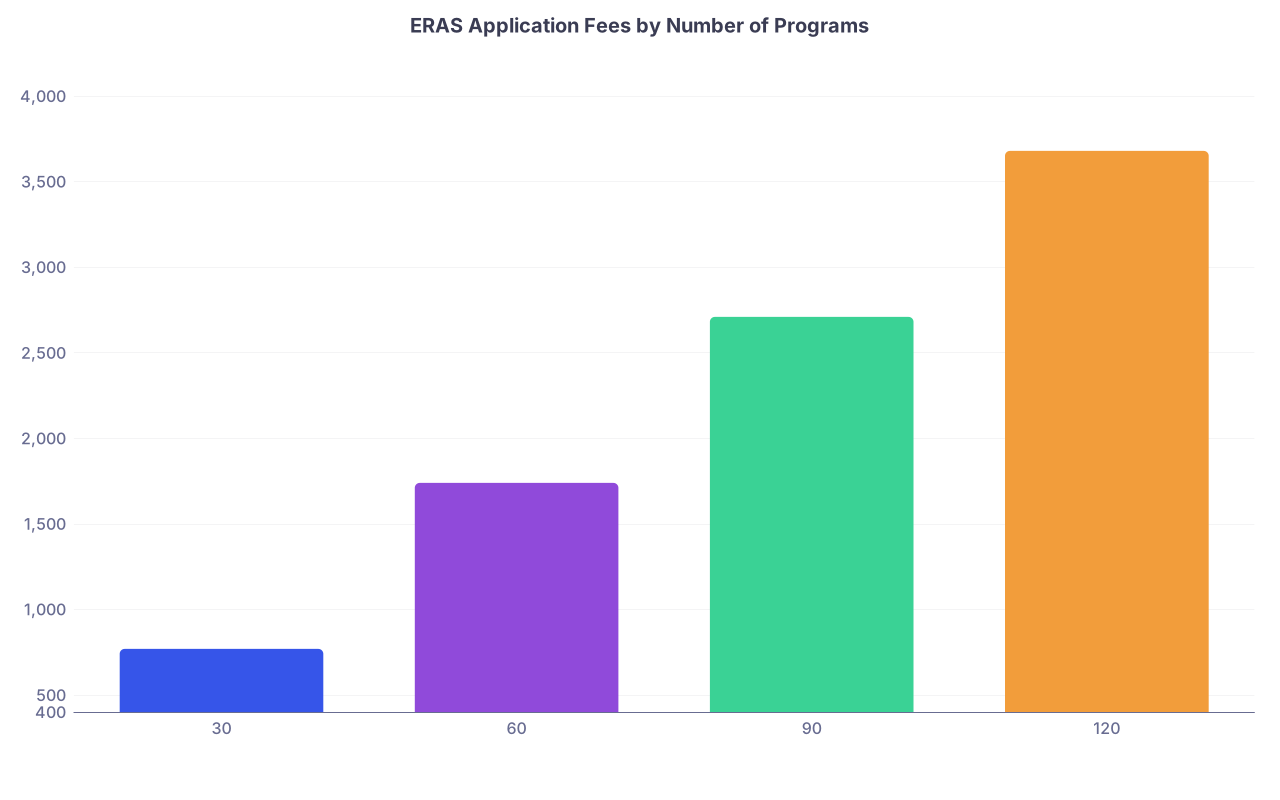
You know what 100+ apps actually costs? Not in feelings, in real numbers.
| Category | Value |
|---|---|
| 30 | 769 |
| 60 | 1739 |
| 90 | 2709 |
| 120 | 3679 |
Those numbers are in the ballpark for one specialty. That doesn’t include:
- Travel/lodging if you do in‑person interviews
- Extra specialty (if you’re running a backup)
- Time and emotional bandwidth for interview prep
So when your brain screams, “Just add 20 more to be safe,” it’s not free. You’re trading financial and mental health hits for a small chance of maybe one extra interview.
Sometimes that trade is worth it. Sometimes it’s just self‑punishment disguised as “being thorough.”
What You Should Actually Do Before Deciding Your Number
Instead of sitting alone doom‑scrolling and convincing yourself 100 is the minimum, do this in a more controlled way.
1. Brutally categorize your red flags
Write them out. Literally. Then next to each, ask:
- Is this a one‑time issue or a pattern?
- Is there a clean story? (illness, crisis, remediation)
- Is it academic (scores), professionalism, or life‑event related?
Programs respond much more harshly to professionalism and repeated patterns than to a single academic slip.
2. Look at real data, not vibes
Pull up:
- NRMP Charting Outcomes (for your category—US MD, DO, IMG)
- Program websites: do they state cutoffs? IMG policies?
- Your school’s match list and see where people like you matched
A US MD with one Step failure going into IM isn’t in the “must apply to 120” crowd, no matter how loud Reddit is.
3. Talk to an actual human who’s seen many cycles
Not just a generic dean talk. Ideally:
- A specialty advisor in your department
- A resident who recently matched who had similar issues
- An advisor at your school who knows your entire record
Ask them directly:
“If you were me, what range of applications would you target, assuming I’m okay being flexible geographically?”
If three different people who know you say “60–70 seems reasonable,” that holds more weight than one rando on Student Doctor Network saying “everyone needs 100+ now.”
Real Talk: The Fear Will Not Go Away Completely
Even if logically your number is fine—say 55, well‑selected—you will still have the “What if I under‑applied?” voice in your head. Because you can always imagine one more program that might have said yes.
That’s just part of this whole process. There is no number that fully cures anxiety.
Someone who applies to 120 will still lie awake wondering if they should’ve done 140.
The only way to stay sane is to:
- Make a reasoned range based on your actual profile
- Get at least 1–2 grounded human opinions
- Commit to it and stop re‑calculating every day
You’re not trying to find the perfect number. You’re trying to pick a defensible, non‑self‑destructive one.
So… Do Your Red Flags Mean You Need 100+?
Probably not automatically. Here’s my blunt summary:
You’re more likely to need 80–120+ apps if:
- You’re an IMG/DO in a mid‑competitive specialty
- You have multiple exam failures or very low scores
- You have serious professionalism issues in your history
- You have almost no geographic flexibility
- Your school/program background is weak and you have red flags
You’re probably fine in the 50–80 range (if chosen well) if:
- You’re US MD applying to IM/FM/Peds/Psych/OB/GYN/Gen Surg
- You have one main academic red flag with clear improvement
- You have decent clinical evals and some solid letters
- You’re willing to be geographically open, especially to community programs
And a calm truth I hate but also trust:
If a program has decided they will not touch exam failures, no amount of extra applications to that type of program will fix that. That’s not on you, that’s on their policy.
Your Next Step (Do This Today, Not “Later”)
Open a blank document and make three lists:
My actual red flags
Write them honestly. No sugarcoating, but no catastrophizing either.My strengths that counterbalance them
Honors, strong rotations, great letters, leadership, life experience, anything.My realistic application range based on what I just read
Put a floor and a ceiling (for example: “60–80 programs”).
Then, email one advisor or resident you trust and send them those three lists with this exact question:
“Given everything here, does 60–80 applications seem reasonable for me, or would you strongly push me higher or lower?”
Don’t tweak your ERAS list again until you get that answer.
You’re not going to erase all the risk. But you can stop letting fear alone drive you to 100+ apps when your actual situation might not demand it.


