

It’s 11:47 PM. You’re on your couch with your laptop open to ERAS, staring at your program list. Your credit card is already smoking from the fees. You have, what, 45 programs? 60? 22? And your brain is running through every horror story you’ve ever heard:
“Yeah, my friend only applied to 40 and went unmatched.”
“That girl from the class above us had a 250 and still didn’t match derm.”
“PD told me this was the most competitive year ever.”
And now you’re stuck on the same question:
Do I add more programs… or do I stop and just hope I didn’t screw this up?
Let’s go through this like two anxious people trying to be rational for once.
The Real Question: Are You Under-Applying or Over-Panicking?
There’s really only one thing you want to know:
“Am I actually at risk… or am I just catastrophizing because everyone around me is also panicking?”
Here’s the uncomfortably honest answer: sometimes it is just anxiety. And sometimes people really do under-apply and regret it. I’ve seen both.
The trick is figuring out which one you are before it’s October and your only emails are from Indeed, not ERAS.
So, step one: stop thinking in vibes (“I feel like I’m okay”) and start thinking in risk categories. Not perfect, but better than doom-scrolling Reddit.
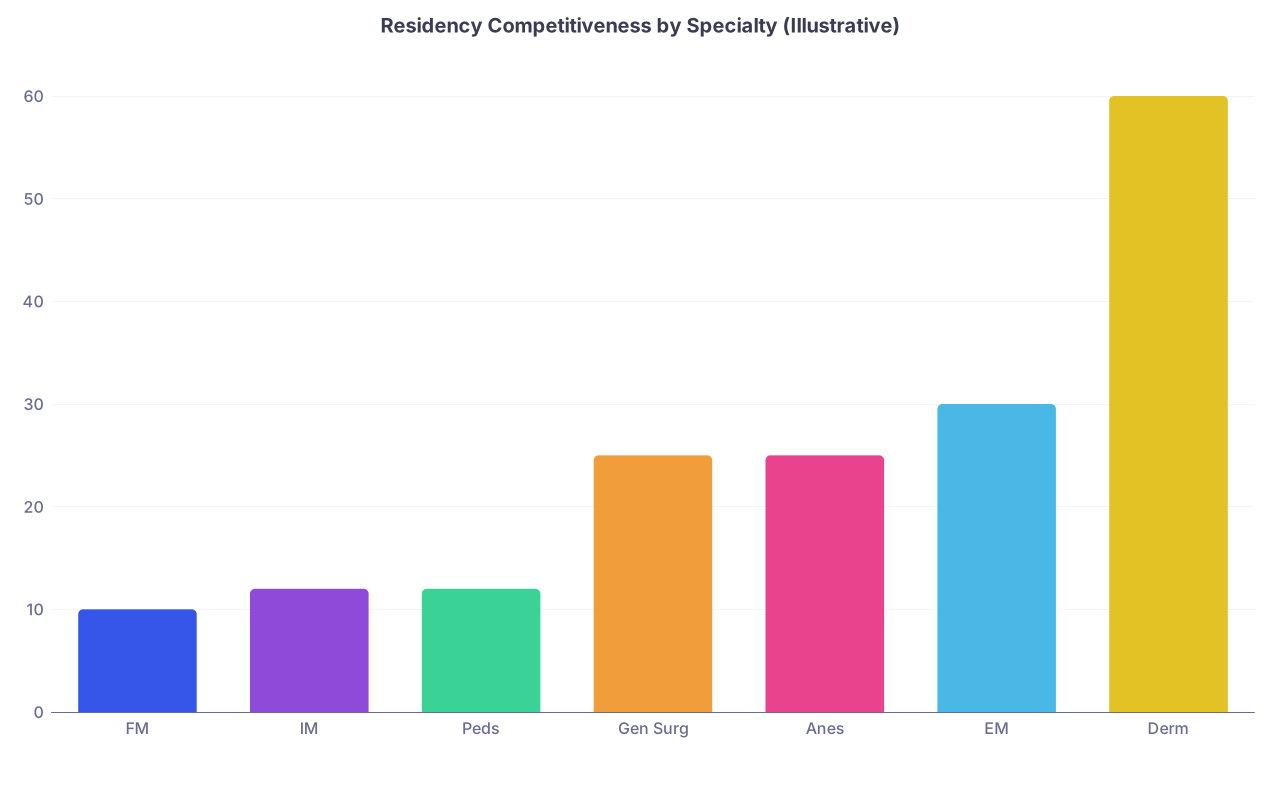
| Category | Value |
|---|---|
| FM | 10 |
| IM | 12 |
| Peds | 12 |
| Gen Surg | 25 |
| Anes | 25 |
| EM | 30 |
| Derm | 60 |
Rough mental framework (not gospel, just a sanity check):
- Lower-risk specialties: FM, psych, IM (categorical), peds – especially if you’re at or above average stats
- Middle: anesthesia, EM (yes, market is weird lately), OB/GYN, gen surg prelim, neurology
- Higher-risk: radiology, ortho, derm, ENT, plastics, neurosurg, urology, ophtho, competitive fellowships, or if you have red flags (low scores, gap years, no LORs, etc.)
If you’re in a higher-risk bucket and your program list is “short because I’m picky”… that’s not strategy. That’s denial disguised as standards.
If you’re in a lower-risk bucket, reasonably strong, and already at or above normal application numbers… you might just be paying extra not to feel anxious for 48 hours.
How Many Programs Is “Enough” – Without the Panic Tax?
Let’s do some numbers, because anxiety needs concrete things to hold onto.
These aren’t official caps. They’re “I’ve actually seen people match with this” ranges, for a typical applicant with no major red flags.
| Specialty Type | Rough Range That’s Usually Reasonable |
|---|---|
| Family Med / Psych | 15–25 |
| Pediatrics / IM | 20–35 |
| Neurology / PM&R | 25–40 |
| OB/GYN / Anesthesia | 35–55 |
| EM (currently weird) | 35–60 |
| Gen Surg Categorical | 45–70 |
Competitive fields (ortho, derm, ENT, plastics, etc.) are their own beast. Those can easily be 60–80+ with a strong app and still feel scary. That’s just the reality.
So if you’re applying to:
- Psych with 60 programs and decent stats – that’s probably overkill
- IM with 12 as an average applicant – that’s playing with fire
- Gen surg with 25 as a mid applicant – that’s… optimistic, to put it gently
Now, here’s the part nobody wants to admit: there is a point where adding programs isn’t “smart,” it’s just fear spending. You’re buying the illusion of safety, not actual odds.
But before we talk about when to stop, we’ve got to be blunt about when you probably do need to add more.
Red Flags That Mean You Probably Should Add More Programs
If any of this sounds like you, it’s not just anxiety. You’re actually in higher-risk territory, and adding more programs can be an actual strategy, not just a coping mechanism.
- You’re below average for your specialty on scores or clinical performance
- You failed a major exam (especially Step 1/2 or COMLEX)
- You’re an older grad (2+ years since graduation) without a strong, recent story to explain it
- You have limited or no home program in the specialty you’re applying to
- You’re switching specialties late without strong letters in the new field
- You’re an IMG/DO applying to very competitive specialties or mostly academic places
If that’s you and your current program count looks “moderate,” you’re not overthinking it. You’re probably under-applying.
This is where a lot of people fool themselves. They say:
“I don’t want to end up somewhere I’ll be miserable, so I’m being selective.”
Totally get it. But unmatched + SOAP + repeating the whole miserable process next year is way worse than matching somewhere you didn’t have as your dream city.
You can still prioritize your list and rank accordingly later. Right now, your goal is to actually get interviews.
Checkpoint: Are You Getting Enough Interviews?
Here’s the question that matters more than raw program count:
“Am I getting enough interview invitations to realistically match?”

| Step | Description |
|---|---|
| Step 1 | Applications Sent |
| Step 2 | Count Interview Invites |
| Step 3 | Reasonable Chance |
| Step 4 | Add More If Possible |
| Step 5 | Competitive Specialty? |
| Step 6 | At least 12 interviews? |
| Step 7 | At least 8 interviews? |
Ballpark (again, not perfect, but real):
- Less competitive specialties: around 8–10 solid interviews = usually enough
- More competitive specialties: want more like 12–15+
- Ultra-competitive or weak app: basically, more is safer
Problem: you don’t know this in September. You only see it once the interview season plays out. So you’re forced to set your list without that feedback.
That’s why you have to be honest with yourself before submission: will my stats + experiences likely pull enough interviews from the number of programs I chose?
If deep down you know you’re below the median applicant and you’re applying like a top-quartile applicant in terms of selectivity, that’s where bad stories usually start.
When Adding More Programs Is Mostly Just Anxiety Talking
Now for the other side. Because yes, there’s definitely a point where hitting “Add to Cart” is just you trying to numb the fear.
You’re probably in that zone if:
- You’re already at or above the typical range for your specialty
- You’re around or above average stats for that field
- Your advisor / PD / dean looked at your list and didn’t flinch
- The extra programs you’re considering are totally random “I would never actually go there” places
- You’re thinking, “Everyone else is applying to 70, so maybe my 45 is irresponsible”
That last one is huge. Other people’s panic is contagious. People lie. Or they’re compensating for issues they never told you about. Or they’re chasing different tiers of programs.
Remember this: people love to flex the quantity of their applications, not the quality of their actual fit. “I applied to 92 programs” sounds intense and hardcore, like they’re “serious.”
It doesn’t mean it was smart.

If your only argument for adding more programs is, “I’m scared,” not “My risk profile actually suggests I’m under-covered,” you’re probably just paying for short-term relief.
And the worst part: even after you pay, you’ll still worry.
The Money Question: Are These Extra Programs Actually Worth It?
Let’s not ignore this: ERAS fees add up fast, especially once you cross certain thresholds.
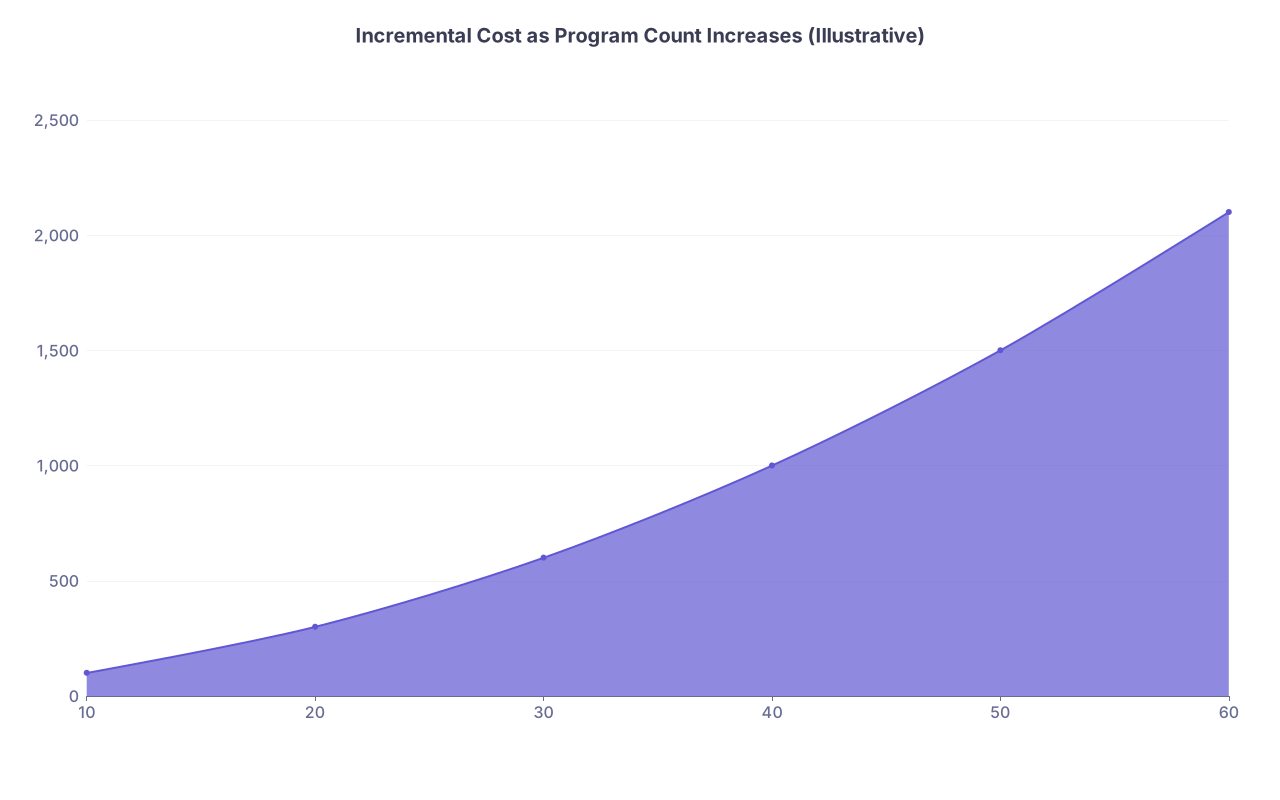
| Category | Value |
|---|---|
| 10 | 100 |
| 20 | 300 |
| 30 | 600 |
| 40 | 1000 |
| 50 | 1500 |
| 60 | 2100 |
Every 5–10 programs you tack on “just in case” could be:
- Another flight or hotel for an in-person interview (if those still happen)
- Extra rent cushion if you have to wait for match results
- Actual peace of mind later when you’re not broke and matched somewhere decent
I’ve watched people spend an extra $500–$1000 adding 20–30 last-minute programs that were never a reasonable fit for them, and they got zero interviews from that entire batch. It wasn’t strategy. It was panic.
Ask yourself, bluntly:
“If I add 10 more random programs I don’t really want, is that money more likely to buy me an interview… or just help me feel like I ‘did everything I could’?”
Sometimes that second one is psychologically worth it. But be honest that it’s therapy by credit card, not odds-boosting.
How to Sanity-Check Your List Without Losing Your Mind
Here’s a simple way to check whether you should add more or stand down, without spiraling for three hours.
Sit down and answer, in writing (yes, really):
- What specialty am I applying to, and is it low / medium / high risk overall?
- Am I above, at, or below the median applicant for this specialty? (Scores, class rank, research, etc.)
- How many programs am I applying to right now?
- What do typical ranges for my specialty look like for someone like me?
- Can I show my list to a faculty advisor / PD / mentor and ask, “If I were your kid, would you be nervous about this number?”
If you’re too embarrassed to show your list to someone objective, that’s a sign something’s off. Usually either:
- You already know it’s too optimistic and don’t want to hear it
- Or you already know it’s overkill and don’t want to admit you’re driven by fear, not logic
Either way, hiding it doesn’t make your odds better.

Trusting Your Strategy: What That Actually Looks Like
“Trust your strategy” sounds like Instagram nonsense if you don’t even feel sure you have a strategy.
Here’s what a real, grounded strategy looks like:
- Your program list isn’t just random; it’s intentionally mixed: some stronger programs, a solid middle, and real safeties you’d still actually attend.
- The number of programs you picked lines up with what people with similar stats and backgrounds successfully used in the last few years.
- A real human who knows you and your application has seen your list and didn’t say, “Uh, that’s… risky.”
- You can explain, in one paragraph, why you’re not applying to more: not “I didn’t feel like it,” but something like, “For my stats and this specialty, 35–40 is appropriate, and my list includes a good spread of places.”
Once those pieces are in place, the rest really is uncertainty. There’s no magic number where you force the match to go your way.
At some point, you stop tinkering with the list and start focusing on what actually moves the needle now:
- Writing strong, tailored personal statements (or at least not terrible ones)
- Making sure your letters go out on time
- Being responsive and normal in your communications
- Preparing for interviews so you don’t blow the chances you do get
If you’ve done the work, gotten feedback, built a rational list, and your only remaining urge to add programs comes from that pit-in-your-stomach anxiety? That’s the moment to stop.
You’re not “trusting the universe.” You’re trusting that you planned like an adult and can’t brute-force away uncertainty with your credit card.
FAQ – 5 Questions You’re Probably Still Panicking About
1. I already submitted ERAS. Can I still add more programs later if I freak out?
Yes, you can add programs after submission, and a lot of people do. But earlier is always better, because later in the season some programs are basically done sending most invites. If you’re truly under-applied, add more sooner rather than waiting for “proof” in November that things are going badly.
2. I’m applying to two specialties. Does that mean I need double the programs?
Not necessarily double, but you need enough in each specialty for it to stand alone. If either specialty is so under-applied that you’d be screwed if the other one doesn’t pan out, that’s a problem. Multi-specialty applicants often under-apply to at least one of them because they keep telling themselves, “Well, the other one will probably work out.”
3. My friend with worse stats is applying to fewer programs than I am. Does that mean I’m overdoing it?
Your friend might be under-applying. People under-apply all the time. Or they might have a home program, connections, or other strengths you don’t see. Comparing numbers without context is useless. Base your decision on your own risk profile, not on hallway flexes.
4. Is there such a thing as applying to too many programs?
Yes. Not like “ERAS will punish you,” but functionally yes. If you’re applying to so many places that you can’t realistically research them, write coherent preferences, or keep them straight on interview day, that’s not strategy. It also costs a ton and tends to add anxiety, not reduce it. There’s no prize for “most applications sent.”
5. I’m still terrified of going unmatched even with a reasonable list. How do I live with that?
You don’t completely get rid of that fear. Nobody does. What you can do is make your list rational, get real feedback, cover your downside with some safer programs, and then consciously decide, “I did everything that actually makes sense.” Beyond that, the uncertainty is just part of this awful process. Being scared doesn’t mean you did it wrong.
Key takeaways:
You add more programs when your risk profile and current program count don’t match, not just because everyone else is panicking. Once your numbers, mix of programs, and advisor feedback all line up, throwing more money at ERAS is usually just anxiety, not strategy. At some point, the bravest thing you can do is stop editing the list and start trusting the work you already put in.


