

The fear that you didn’t apply to enough programs ruins more nights of sleep than Step 1 ever did.
Let me be blunt: people underestimate this and then spend months refreshing their inbox in quiet panic. If you’re already asking “Did I apply to enough?” there’s a decent chance something in your gut is picking up on a red flag.
Let’s pull that anxiety into the light and actually test it.
The Ugly Truth About “Enough Programs”
Here’s the part nobody says out loud: “Apply broadly” is useless advice when you’re the one trying to decide if 25, 45, or 85 programs is “broad.”
Programs don’t care how many places you applied to. They care if you meet their filters. But your future happiness kind of hinges on this number, and you picked it based on:
- What your classmates said they were doing
- Some Reddit post written by a total stranger with Step 260
- An advisor who told you “You’ll be fine” after glancing at your CV for 90 seconds
So now you’re weeks into the season, sitting with your one or two interviews (or zero), and your brain is going:
- “Did I completely misjudge this?”
- “Is it already over and I just don’t know it yet?”
- “If I don’t match, was this the moment I ruined it?”
You’re not crazy. Those are valid questions. Let’s get specific.
Hard Numbers: Where You Actually Stand
You can’t feel your way out of this. You have to look at numbers. Not vibes.
Here’s the basic reality: the competitive level of the specialty + your stats + how many you applied to = your risk level.
| Specialty Type | Example Fields | Safe-ish Interview Goal* |
|---|---|---|
| Less competitive | FM, Psych, Peds, IM (categorical) | 8–10+ interviews |
| Moderately competitive | EM, OB/GYN, Anesthesia | 10–12+ interviews |
| Very competitive | Derm, Ortho, ENT, Plastics, NSGY | 12–15+ (often more) |
| Super location-limited | Any specialty but all in 1 region | Add 3–5 more interviews |
*Not guarantees. Just what I’ve seen as “I slept at least a little before Match Day.”
Now, if you’re mid–late season and you’re nowhere near those numbers, you have to consider that you might not have applied widely enough.
Let’s break down signs you’re underapplied vs just early.
Early Warning Signs You Didn’t Apply to Enough
1. Your invite count vs your peers is way off
If people in your specialty group chat with similar stats are sitting on 6–8 interviews and you have 0–1, something’s off.
Not “you’re doomed” off. But off enough that you should not just “wait and see” without a backup plan.
Timeline reality for most specialties:
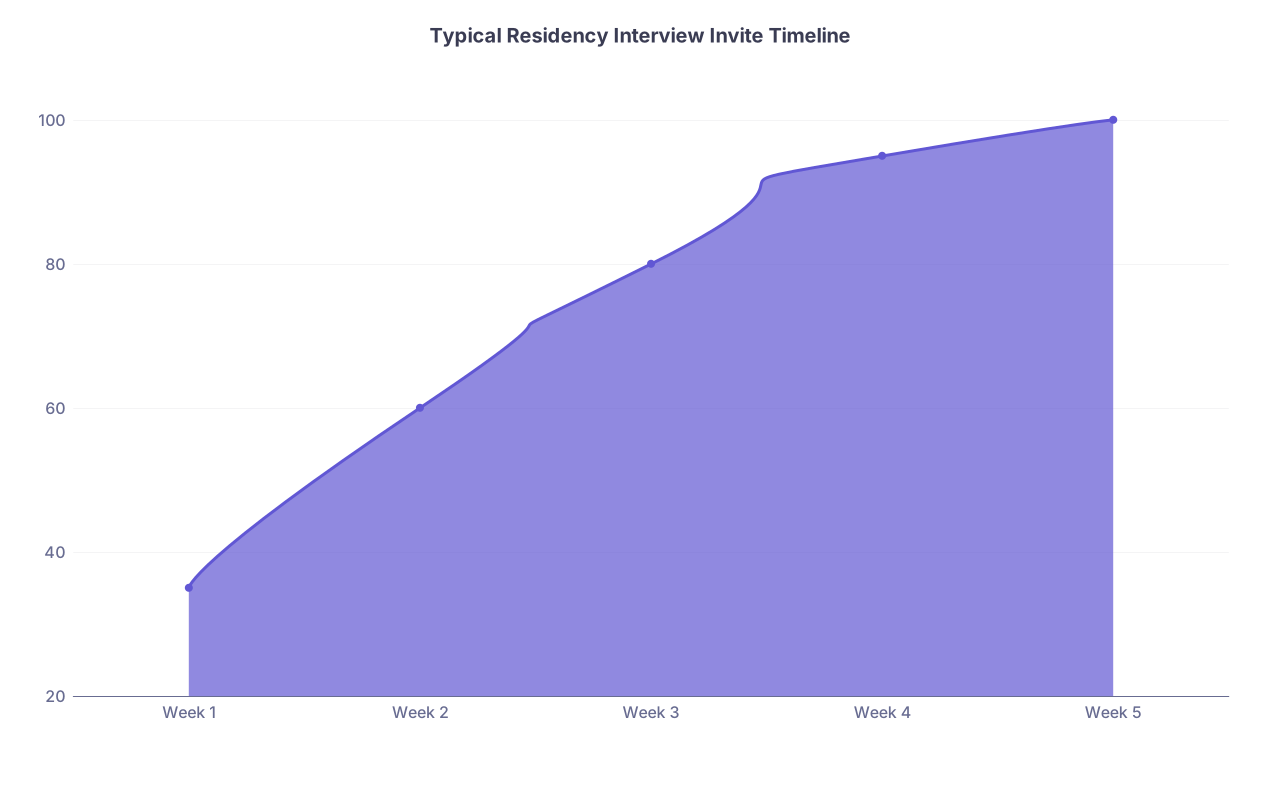
| Category | Value |
|---|---|
| Week 1 | 35 |
| Week 2 | 60 |
| Week 3 | 80 |
| Week 4 | 95 |
| Week 5 | 100 |
Roughly:
- First 2–3 weeks after ERAS release: 50–70% of invites
- Weeks 3–5: another 20–30% trickle in
- After that: mostly waitlist/last-minute/“someone canceled”
So if:
- You’re in week 3–4
- Your classmates (similar Step, similar school, same specialty) are getting invited
- You’re not
…it’s not definite that you underapplied, but the probability just went up.
2. You aimed mostly “up” with not enough safeties
If your list looks like:
- 70% reach programs (“we usually take >250, heavy research, top 20s, big-name places”)
- Very few true “lower-tier” or community programs
- And you’re not a 260 + AOA + research monster
You didn’t apply to enough programs. Or more accurately: not enough realistic programs.
I’ve seen people with:
- Step 240–245
- Mid class rank
- Minimal research
…apply to 35 anesthesiology programs that are all very academic and walk away shocked they got 1–2 invites. The problem wasn’t the number 35. It was what those 35 were.
If your “safety” programs are just slightly-lower versions of your dream programs, you don’t actually have safeties.
3. You were geographically stubborn
If you told yourself:
- “I only want the East Coast”
- Or “I’m applying to one big city because my partner’s there”
- Or “I refuse to leave California / NYC / Chicago”
…and you didn’t massively increase your total number of programs to compensate, yeah, you might have underapplied.
Highly location-limited + average-ish stats = you need to apply to more than the standard ranges, not fewer.
4. Your specialty is more competitive than you admitted
People lie to themselves about this constantly.
Emergency medicine, anesthesia, OB/GYN, radiology — these aren’t “super easy safe” fields anymore. They’re not derm, but they’re not FM either.
If you used “family medicine numbers” to decide how many EM programs to apply to, that’s a problem.
| Specialty Type | Approx Range Often Seen* |
|---|---|
| Less competitive | 15–30 programs |
| Moderately competitive | 40–60 programs |
| Highly competitive | 60–80+ programs |
*And yes, IMGs, DOs, red-flag applicants often need higher numbers. It’s unfair. It’s real.
If you’re going for a competitive field and you’re at the bottom of those ranges (or below), and you’re not a superstar, that’s a red flag.
5. You have “red flags” and didn’t account for them
Red flags make “enough programs” different for you than your squeaky-clean classmates.
Stuff like:
- Failed Step/COMLEX attempt
- LOA for non-obvious reasons
- Multiple Cs or repeats in key clerkships
- Prior attempt at the Match that failed
If any of that applies and you just “copied” how many programs your friends applied to, you probably underapplied. Programs are more risk-averse than they admit. You offset that with volume.
The Gut-Check Questions (You Probably Already Know the Answers)
Ask yourself these and don’t sugarcoat it:
If I got zero more invites from today forward, would my current number/quality of programs feel safe?
If the honest answer is “absolutely not,” that’s your sign.Did I choose programs mostly based on name / prestige / big cities?
Be honest. If you did, you left a lot of realistic places off the list.Would I truly be willing to train at every program I applied to?
If some are “I only applied because I panicked but I’d never actually go,” those don’t count as real safety spots.Did advisors actually say ‘You’re overshooting’ and I ignored them?
If more than one person said that, they were probably right.
Your anxiety is often picking up on something real — you just haven’t put language or numbers to it yet.
Okay, I Think I Underapplied. Now What?
Here’s the part your brain keeps skipping to: “Is it too late to fix this?”
Not necessarily. But you have to be strategic and a little ruthless with your pride.
1. Look at what you actually have right now
Before you panic-apply blindly to 40 more programs at 2 a.m., assess:
- How many interviews right now?
- In what range of programs (reach vs mid vs safety)?
- What week of the season is it?
If you’re:
- Week 2: It’s still early-ish. Some programs are slow.
- Week 4–5: You’re in the “this is the main picture” zone for most specialties.
Match your response to reality, not pure fear.
2. Add more programs — but not randomly
If it’s still relatively early or you’re clearly underapplied, adding more can help. But they need to be different from what you already chose.
Think: more community, more non-name-brand, more outside your favorite cities, more places that actually take people with your profile.
This is where a very non-fun exercise helps:
- Download your specialty’s NRMP Charting Outcomes
- Look at average Step, research, etc. for matched vs unmatched
- Compare that to yourself
- Target places where your stats fit their historical pattern (not your fantasy version)
Don’t just “add more famous programs” and expect anything to change.
3. Use your school’s connections shamelessly
Do the annoying thing:
- Email your dean’s office / advising
- Ask: “Do we have alumni / relationships at X, Y, Z programs?”
- See if someone is willing to send a “this is a solid student, please review their app” nudge
Is it gross that this matters? Yes. Is it real? Also yes.
Even one or two extra looks at your file can turn into an invite you wouldn’t have gotten otherwise.
4. Send targeted interest emails (not spam blasts)
If you’re mid-season, you can send brief, non-desperate emails to:
- Programs that fit you really well
- Places where you have ties (family, grew up there, partner lives there, etc.)
Keep it short:
- Who you are
- Real connection to the area/program
- One sentence about why you’d be a good fit
- That you’d love to train there and would be excited for an interview
Will this magically fix an underapplied list? No. But it can help at the margins, and margins matter.
Worst-Case Thinking: What If I Really Did Blow It?
Let’s go fully into the nightmare your brain is replaying at 3 a.m:
- You underapplied.
- You didn’t get enough interviews.
- You go through the season, rank what you have, and you don’t match.
What then?
First: that scenario is still statistically less likely than your anxiety is telling you, especially in less-competitive fields. But if it happens, your life is not over. It just gets more complicated and more expensive and more humbling for a bit.
Typical “didn’t match and underapplied” next steps I’ve seen:
- Scramble (SOAP) into something — prelim year, TY, or another specialty
- Do a research year while reapplying more broadly
- Reapply with: more programs, more realistic distribution, stronger application, and a much better sense of what went wrong
Is it awful? Yes. Does it mean you completely destroyed your dream forever? No.
The real damage usually comes from not learning anything and repeating the same too-short, too-ambitious list the second time.
How to Survive the Waiting Without Imploding
Even if you did underapply a bit, obsessing over it every 15 minutes isn’t going to generate a single extra invite.
A few things that help people stay functional:
- Decide set times you’ll check your email (e.g., top of each hour, or 3 times a day). Not every 90 seconds.
- Stop comparing yourself to the one classmate with 18 interviews at top-10 programs. That person is not your benchmark.
- Make a Plan B list on paper (SOAP options, research ideas, backup specialties) so your brain stops spinning it in circles at night.
And yes, talk to someone actually familiar with your situation — advisor, trusted resident, PD you rotated with. Random strangers on Reddit don’t know you, your school, your exact strengths and weaknesses. Their “I applied to 40 and got 25 interviews” story is not your story.

Quick Reality Checks by Scenario
Here’s the part everyone secretly wants: “Just tell me if I’m screwed.”
I can’t do that from here, but I can give you rough patterns I’ve seen.
| Scenario (US MD/DO) | Mid-Season Status | My Honest Read |
|---|---|---|
| Less competitive field, 2–3 invites | Mild concern, not panic | Add programs, ask for help |
| Less competitive, 0–1 invites | Concerning | You likely underapplied |
| Moderate field, 4–5 invites | Borderline but workable | Be proactive, not passive |
| Moderate field, 0–2 invites | High concern | Strongly consider more apps |
| Very competitive, 5–7 invites | Actually decent | Focus on doing well in interviews |
| Very competitive, 0–3 invites | High risk | Backup plans essential |
This isn’t gospel. But if you’re in those bottom rows and your list was short or top-heavy, it’s pretty likely the number and type of programs are part of the problem.

| Step | Description |
|---|---|
| Step 1 | Submitted Apps |
| Step 2 | Focus on Prep |
| Step 3 | Add More Realistic Programs |
| Step 4 | Identify Plan B Options |
| Step 5 | Email Advisors and Programs |
| Step 6 | Execute Plan and Monitor Invites |
| Step 7 | Enough Interviews? |
| Step 8 | Early or Late Season |
FAQ (Exactly 6 Questions)
1. Is there a magic number of programs that guarantees I’ll match?
No. I’ve seen people apply to 80 and still not match because their list was unrealistic or full of reaches. I’ve also seen people match with 20 applications because they were strong candidates who chose wisely. Numbers matter, but fit and realistic targeting matter just as much. Volume is a safety net, not a guarantee.
2. I’m at 0 interviews right now. Is it already over?
Not necessarily, but you can’t just passively hope. Look at the calendar: if you’re only 1–2 weeks past ERAS release, there’s still time. If you’re 4–5 weeks in and at zero for a non-super-competitive specialty, that’s concerning. At that point, adding realistic programs, asking for advocacy from your school, and seriously thinking about SOAP/backup options is smart, not dramatic.
3. Can I fix an underapplied season by adding a bunch of programs late?
Sometimes you can partially fix it, especially if: it’s still mid-season, the programs you’re adding are community/non-elite, and your stats are reasonably within their range. But adding 25 top-tier academic places in November “just in case” usually doesn’t do much. Late applications are often screened after earlier ones. Aim for realistically aligned programs, not famous ones.
4. How do I know if a program is a “reach” vs “target” vs “safety”?
Look at: typical Step/COMLEX scores, how many US grads vs IMGs they take, how academic vs community they are, and whether people with your profile from your school have matched there before. If you’re under their usual stats and they mostly take AOA/research-heavy people, that’s a reach. If your stats match their typical residents and your school has a history there, that’s closer to target/safety.
5. I limited myself to one region for family reasons. Did I ruin my chances?
Not automatically, but you did make it harder. If you’re region-locked, you should usually increase the number of programs you apply to in that region. If you didn’t do that (e.g., you applied to 20 in a dense, competitive area), then yes, there’s a higher risk you underapplied. That doesn’t mean you’ll definitely not match, but it does mean you’re playing on a harder mode than your classmates.
6. If I end up not matching, does that prove I didn’t apply to enough programs?
Not always. You can apply to a lot and still be filtered out for scores, red flags, or poor letters. But if you matched below the typical interview thresholds (e.g., 2–3 interviews in a field where most successful applicants had 8–10+), then yeah — in hindsight, you probably should’ve applied more broadly and more realistically. The key if that happens: use that data ruthlessly when you reapply, change your list, and don’t repeat the same pattern.
Key points:
- “Did I apply to enough?” isn’t about a single magic number — it’s about your stats, specialty, program types, and geography.
- If your interview count is clearly lagging behind similar peers by mid-season, treat it as a signal and act, not just a feeling to ignore.
- Even if you underapplied, this isn’t the end of your career — but it is a reason to be strategic, ask for help, and build a real backup plan instead of just hoping.


