

What if you pick the wrong number of programs and ruin your Match?
That’s the thought, right? Not “how many programs is reasonable?” but “what if I miscalculate this number by 5–10 and I never match and my career is over?”
You’re not alone. I’ve sat with friends at midnight while they agonized over whether 45 vs 60 IM programs was “safe” and watched them tweak their list for the 27th time. I’ve seen people add 15 more programs because of one panicked Reddit thread. I’ve also seen people under-apply and eat it in March.
Let’s talk about that obsession with list size. The numbers. The “should I add 5 more?” loop. And how to stop second-guessing it forever.
Why list size makes you spiral so hard
You know logically this isn’t a perfect math problem. But your brain wants it to be. Because if it were just “apply to X programs and you’ll match,” you could relax.
Instead you’re stuck between:
- “Everyone says apply broadly”
- “But my advisor said not to over-apply”
- “Reddit says 80+ is the new normal”
- “ERAS fees are insane”
- “What if this is the ONE decision that destroys my chances?”
Here’s the nasty combo that makes you obsess:
- Uncertainty: There’s no guaranteed “right” number.
- High stakes: Not matching feels catastrophic.
- Comparison: Everyone is posting wild numbers and “just in case” strategies.
- Money + time: Every extra program costs cash and brain cells.
So your brain tries to control the only thing it can: the list size. And you end up refreshing spreadsheets, reading NRMP data at 2 a.m., and redoing your “projected interview count” formula like some deranged actuary.
Been there.
The only data that actually matters
Let me be blunt: a lot of what people obsess over is noise.
You don’t need to solve the whole NRMP Charting Outcomes book. You need a sane baseline. Something better than vibes and fear.
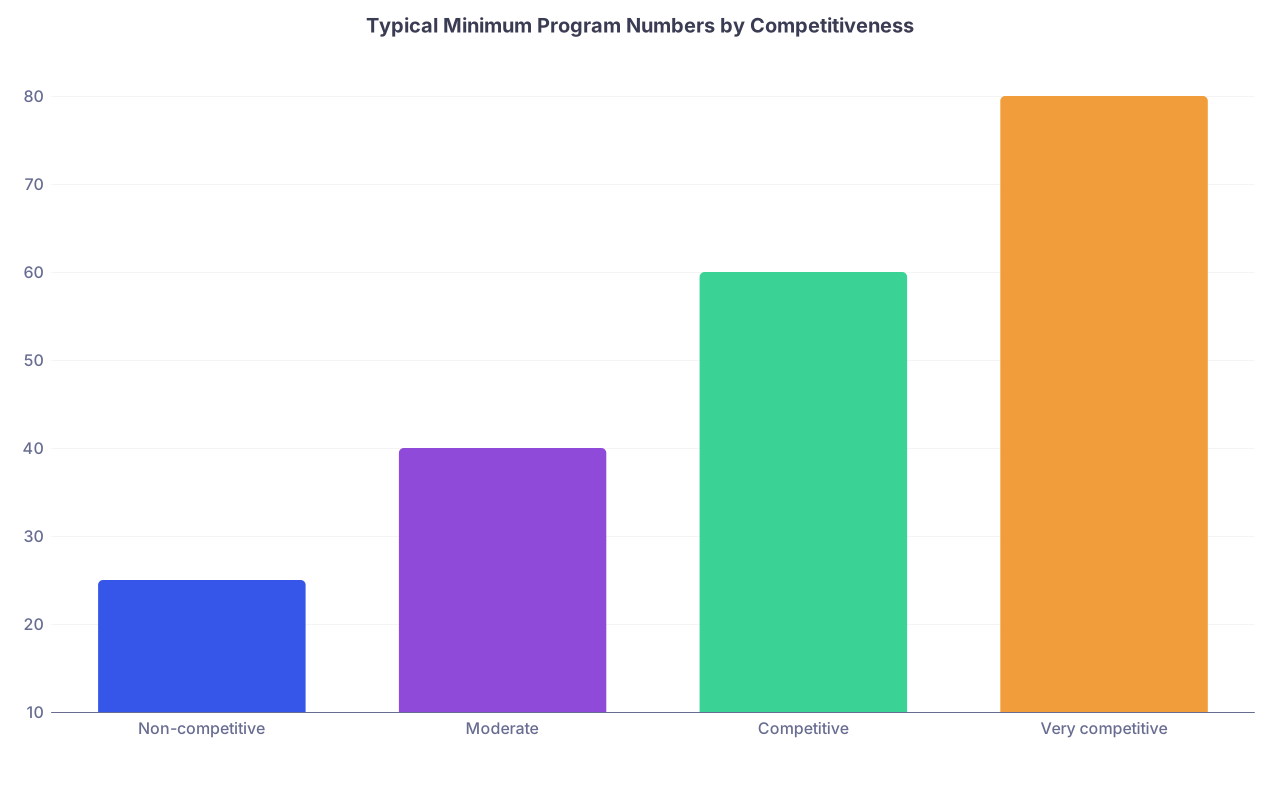
| Category | Value |
|---|---|
| Non-competitive | 25 |
| Moderate | 40 |
| Competitive | 60 |
| Very competitive | 80 |
Very rough buckets people actually use (not the fantasy numbers on forums):
| Specialty Type | Example Fields | Rough Target Range |
|---|---|---|
| Less competitive | FM, Psych, Peds, Pathology | 20–35 |
| Moderate | IM, Neuro, Anesthesia, EM* | 35–60 |
| Competitive | OB-GYN, Gen Surg, Rad, Derm* | 50–80 |
| Hyper-competitive / SOAP-risk | Ortho, PRS, ENT, NSG, Derm (weak apps) | 70–100+ |
*EM and Derm are their own chaos given recent trends; these are ballparks, not guarantees.
Now, here’s the part people skip and then panic later: you have to adjust those ranges based on your actual profile:
- US MD vs DO vs IMG
- Step scores / pass-fail + Step 2
- Red flags (attempts, LOA, etc.)
- Research for research-heavy fields
- Home program / connections
I’ve watched US MDs with solid apps apply to 80+ FM programs “just in case.” Overkill. I’ve also seen DOs with multiple fails apply to 25 IM programs and be surprised when interviews don’t come.
So no, there isn’t one magic number. But there is a process that makes this less like fortune-telling and more like a controlled risk.
A 4-step way to pick a number and stop obsessing
The goal isn’t to find the perfect number. The goal is to find a defensible number — something that, if you explained it to a reasonable advisor, they’d say, “Yeah, that makes sense for you.”
Step 1: Be brutally honest about your risk level
Not “how I wish programs saw me.” How they actually will.
Ask yourself:
- Are my scores/grades above, around, or below the average for my specialty?
- Am I US MD, DO, or IMG?
- Any red flags? Step failure, remediation, leave, professionalism issue?
- Do I have a home program in this specialty?
- Do I have meaningful research if the field expects it?
Quick mental stratification:
- Low-risk: US MD, decent scores, no big red flags, home program, specialty not hyper-competitive → you can sit closer to the lower end of the range.
- Moderate-risk: DO or IMG with decent scores, or US MD with weaker scores / no home program → middle-to-upper end of the range.
- High-risk: low scores, red flags, no home program, competitive specialty, or IMG in a tough field → upper end or above.
This is where people lie to themselves. “Yeah I’m going for ortho with one ortho rotation and a 228 Step 2 but I really connect well with people.” No. Not for this calculation. Be cold about it.
Step 2: Translate that risk into an actual number
Now pick an actual target using that earlier table.
Examples:
- US MD, applying IM, average-ish: 40–45 programs is often plenty.
- DO, applying IM, mid-range scores, no big red flags: 55–65.
- US MD, OB-GYN, slightly below average: 60–70.
- IMG, internal medicine, decent scores but no US research: 80+ is very common.
It’s uglier when you see it written out, I know. But pretending your situation is the same as the top-of-class US MD going into FM just sets you up for panic.
Now here’s the key: once you pick that range, you commit to a firm final number inside it. Not “40–60 and I’ll decide later.” That’s how you stay stuck.
You say: “Given my profile, I’m applying to 52 programs.” Not 52–ish. Fifty. Two.
Your brain will scream. That’s fine. Let it scream.
The over-application trap (and how it backfires)
This is the part people don’t want to hear: applying to more programs is not infinitely protective. It’s protective up to a point. Then it gets dumb.
There are three big ways over-applying screws you:
Your secondaries and signals get weaker.
You physically can’t write 90 thoughtful program-specific responses while on rotations or sub-I. So what happens? You copy-paste garbage. Programs can smell it. “I’m thrilled by the opportunity to learn from your diverse patient population” x 70 is not a strategy.You waste money on applications that never had a shot.
There are programs that simply don’t take DOs, or IMGs, or people from outside their region, or below certain test score cutoffs. Mass applying to those “just in case” doesn’t make you brave. It makes you broke.You fry your mental health.
Tracking 100+ programs, letters, MSPE status, interview scheduling, emails — it becomes a part-time job. And every “Application under review” or silent program becomes another source of panic.
You know that person who says, “I applied to 120 programs and still only got 7 interviews”? That’s not proof that you should apply to 140. It’s proof that:
- The list was poorly targeted, or
- Their application had real issues, or
- The specialty/program type was brutal for their profile.
More isn’t automatically safer. Smarter is safer.
The under-application nightmare (and how to avoid it)
Now, the fear on the other side: what if you’re too conservative and end up with 0–2 interviews?
That happens. I’ve seen:
- A DO who applied to 25 EM programs because “my advisor said I was fine” → 1 interview, unmatched.
- An IMG applying to 30 IM programs, all in major cities, because they “didn’t want to live in the Midwest” → didn’t match, had to SOAP pathology.
Pattern? They:
- Ignored their true risk level
- Only applied to “desirable” programs/locations
- Trusted vibes over data
The way out is not to add 50 random programs in February. The way out is to build your list right from the start.
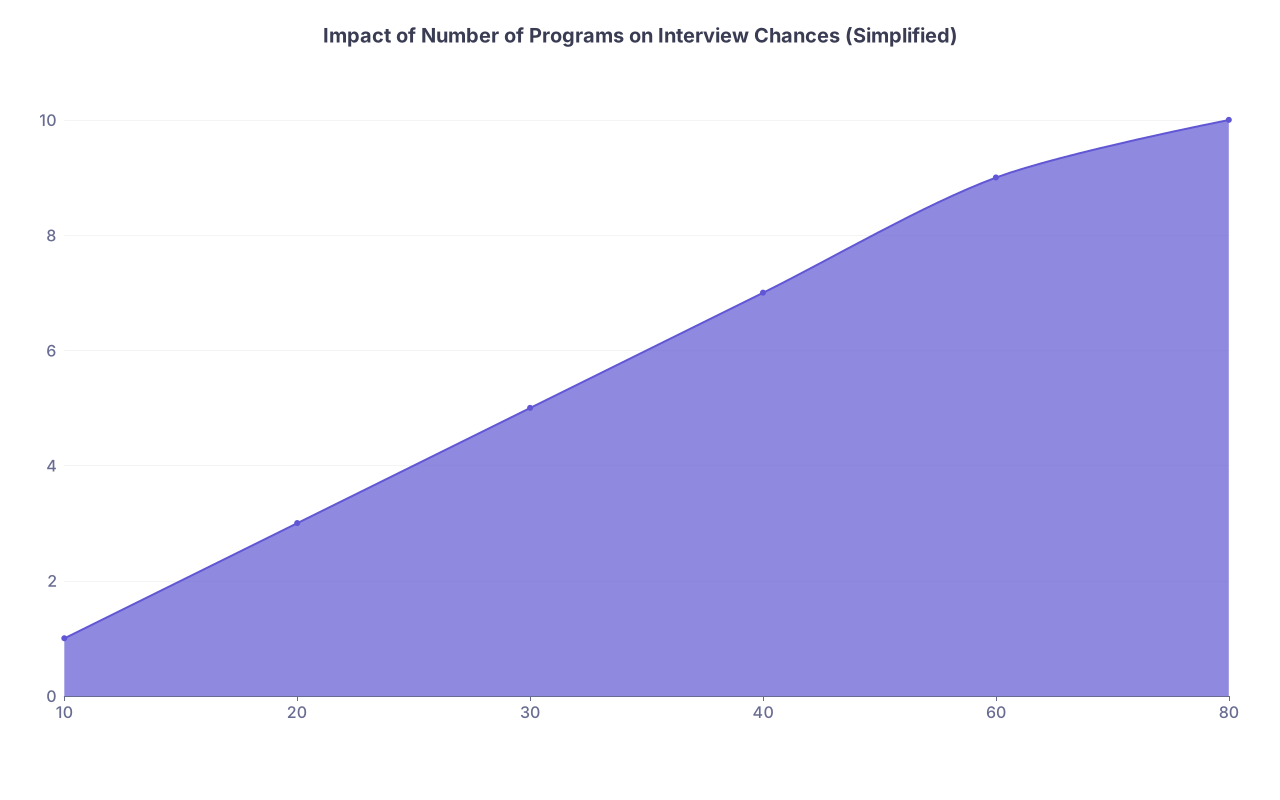
| Category | Value |
|---|---|
| 10 | 1 |
| 20 | 3 |
| 30 | 5 |
| 40 | 7 |
| 60 | 9 |
| 80 | 10 |
Notice the shape: big gains early, then flattening. Going from 20 → 40 can be huge. 60 → 80? Much less so, especially if those extra 20 are long shots.
The part nobody tells you: list quality > list size
If your list is just “every program on ERAS filtered by specialty,” you’re not being broad. You’re being lazy and scared.
Better way to think about it: your list should have tiers.
Rough breakdown for a sane list:
- ~20–30% “reach” programs (above your stats / dream locations)
- ~40–60% “realistic” programs (you fit their usual profile)
- ~10–30% “safer” programs (places that historically interview/match people like you)
For example, IM, US MD, average app, planning 45 programs:
- 10 “reach” (big-name academic, super competitive locations)
- 25 “realistic” (mid-tier academic, strong community)
- 10 “safer” (less desirable locations, smaller communities, newer programs)
You do NOT want a list that’s 90% reach and 10% realistic because “I can’t see myself living in [insert region].” That’s how you end up in SOAP begging those regions to take you.
Signals, interviews, and the “but what if I’m different” spiral
You might be thinking, “But with preference signals, doesn’t that change everything?” Or, “But Step 1 is pass/fail now, so does data even matter?”
It does change some dynamics. It does not change the basic truth: you still need enough programs on your list to generate a decent number of interviews.
You can’t signal 4–5 places and magically bypass the fact that you only applied to 18 total programs in OB-GYN.
What signals do change:
- You should definitely apply to all places you signal.
- Signals let you be slightly braver about including a few high-reach programs.
- But they don’t give you permission to shrink your list to something reckless.
The “but what if I’m different” thing is your anxiety trying to convince you that you’re the exception — in a good or bad way. You’re probably not. You’re probably somewhere in the middle, like everyone else.
How to stop the endless “Should I add 5 more?” loop
Here’s the real problem: even once you pick a number, your brain keeps whispering:
- “But what if the season is extra competitive this year…”
- “What if everyone else is applying to more…”
- “What if this one extra region would’ve loved me…”
You need rules before you spiral.
Try this:
Set a hard final number with a small emergency buffer.
Example: “My number is 60. I allow myself a buffer of +5 only if a truly new, good-fit program shows up.”Write down your rationale somewhere you can see it.
Literally type: “I am applying to 60 IM programs because I am a DO with X scores, no red flags, and this fits NRMP data + advisor recs.”
That’s your anchor when panic hits.Decide your “no more changes after” date.
Example: “Once I submit ERAS and send signals, I will not add more programs after October 10 unless a brand-new program appears or my advisor strongly recommends a specific one.”Ban yourself from last-minute Reddit-driven additions.
No more: “I saw a post that XYZ program is IMG-friendly, I should add it at 11:47 p.m.” If it wasn’t on your original research radar, it’s probably not mission-critical.
Is this easy? No. Your anxiety will try to bargain. But this is how you stop the “what if 5 more?” madness.
Cost vs. fear: are you buying safety or buying anxiety?
Let’s be honest: some of this isn’t “I want to be safe,” it’s “I’m so scared I’ll pay any amount not to sit with this feeling.”
The question you actually need to ask isn’t “Can I afford 10 more programs?” It’s:
- “Will these extra programs realistically increase my interview chances?”
- “Or am I just buying the illusion of control?”
If those 10 are carefully chosen, realistic, and fill genuine gaps in your list’s geography/tiers? Worth considering.
If they’re 10 random big-name places you know in your gut won’t look twice at your app? That’s not strategy. That’s fear swiping your credit card.
The uncomfortable truth: there is no zero-risk number
This is the part I hate too: you can do everything right — pick a reasonable number, target appropriately, get solid letters — and still not match in your dream field.
There is no list size that guarantees safety.
But there is a list size where you can say, with a straight face: “Given my situation, I did what a rational, well-informed applicant should do.”
That’s the best you get in this process. Not certainty. Just a defensible, grown-up decision.
And honestly? That’s what most attendings, PDs, and advisors did when they were in your shoes. They didn’t magically know. They picked a reasonable number, swallowed the fear, and hit submit.
One thing you can do today to get out of your head
Open whatever you’re using to plan your programs — spreadsheet, Notion, notebook, chaos doc, whatever.
Now:
- Based on everything above, write down:
- Your specialty
- Your risk level (low / moderate / high)
- A target range appropriate for that combo
- Pick one exact number inside that range.
- Type it at the top of the document:
“My final target number: __ programs.” - Start assigning programs into tiers (reach / realistic / safer) until you hit that number.
Don’t hunt for more data first. Don’t open Reddit. Don’t ask five more group chats.
Just pick the number.
Then, if you really want external validation, show that number and your reasoning to one actual human advisor who knows you. Not 20 anonymous strangers. One.
Let the fear sit in the background. It’ll be there either way. But at least now it won’t be driving while you’re frantically adding program #97 “just in case.”


