

The idea that “programs will be offended you applied broadly” is wildly overblown.
They’re not sitting there counting how many places you applied to and judging your loyalty. They’re drowning in hundreds of ERAS files, trying to figure out who is competent, not who is “exclusive.”
But if you’re like me, that doesn’t stop the 3 a.m. thought spiral: “I applied to 80 programs. They’re going to think I’m desperate. Or flaky. Or not actually interested in them.” Let’s walk through this like nervous humans, not abstract statistics.
The Big Fear: Does Overapplying Make Me Look Less Serious?
Short answer: no, not the way you think it does.
Programs cannot see the full list of where else you applied. There is no magical ERAS dashboard that tells them:
“This applicant applied to 84 internal medicine programs, including 19 community, 11 university-affiliated, and 7 stretch reaches. Strike them for being needy.”
They see their application. That’s it.
What they might infer about seriousness comes from what’s in front of them:
- Your personal statement
- Your program-specific signals (if your specialty uses them)
- Your geographic story (address, med school, rotations, family ties)
- Whether you respond to them like a real human (emails, interview day engagement, thank yous / updates if appropriate)
Not from “total applications sent.”
I’ve literally heard PDs say on interview days:
- “We assume everyone is applying broadly. The match is stressful.”
- “We don’t know where else you applied, and we don’t really care. We care what you’d do if you matched here.”
So if the fear in your head is, “I clicked ‘submit’ too many times; I blew my shot,” that’s just not how the system is built.
Is overapplying a problem? Yes—but not because programs are offended. It’s a problem for you:
, Interview Travel/Time, Burnout, Scheduling Headaches](https://cdn.residencyadvisor.com/images/articles_svg/chart-impact-of-overapplying-on-applicants-5874.svg "Impact of Overapplying on Applicants")
| Category | Value |
|---|---|
| [ERAS Fees](https://residencyadvisor.com/resources/how-many-programs-to-apply/terrified-of-wasting-money-how-few-programs-is-too-few-for-me) | 85 |
| Interview Travel/Time | 70 |
| Burnout | 90 |
| Scheduling Headaches | 75 |
That chart is exactly what it feels like: expensive, exhausting, and logistically stupid after a certain point. But “programs thinking you’re not serious”? That’s fantasy.
Reality Check: What Programs Actually Notice
Here’s what they do pick up on, and where “overapplying” might show up indirectly.
First, the obvious stuff:
- A generic personal statement that reads like you ctrl+F’d the word “dynamic” and just left it there
- No mention of any connection to the region or program type
- You clearly didn’t look at their website (or you say things they don’t even offer)
That signals “spray and pray.” But again, that’s not about how many you applied to. It’s about how little you customized the ones you picked.
Where it really starts to bite you is once interviews roll in.
If you apply to 70 programs and get 25 interviews in a non-ultra-competitive specialty, you’re in danger of looking scattered—not because of your list, but because:
- You start declining interviews late
- You cancel on short notice
- You double-book yourself and make programs rearrange
- You show up visibly burned out and flat on Zoom number 14 that week
That’s where seriousness gets questioned. “Not serious about us” doesn’t mean “they applied to too many places.” It means:
- “They no-showed.”
- “They seemed disinterested.”
- “They clearly hadn’t read anything about us.”
Not the same thing.
So what actually matters to them?
| Category | What Programs Actually See | What You’re Afraid They See |
|---|---|---|
| # of applications | Only that you applied *to them* | Full list of everywhere you applied |
| Your interest level | Signals, emails, interview behavior | Your total ERAS bill |
| Fit | Your experiences, geography, goals | How panicked you were when you clicked submit |
| Professionalism | Timing of replies, cancellations, demeanor | Whether you’re “desperate” |
Notice how none of the actual data they get is “overapplied = unserious.” That’s a narrative you’re feeding yourself.
Okay But… How Many Programs Should I Have Applied To?
Here’s the part that causes ulcers: Did I undershoot and ruin my career? Overshoot and look chaotic? Both?
Different specialties have different “normal” ranges. Ballpark, assuming average-ish applicant (no huge red flags, no insane superstar):
| Specialty Type | Rough Range That’s Common |
|---|---|
| Less competitive IM/FM/Peds | 20–40 programs |
| Mid-competitive (Neuro, Psych, OB) | 30–60 programs |
| Competitive (EM, Anes, Radiology) | 40–70 programs |
| Very competitive (Derm, Ortho, Plastics, ENT, Urology) | 60+ and highly strategic |
These are not moral judgments. They’re survival numbers.
So if you applied to:
- 35 IM programs? Totally fine.
- 50 Psych programs? Aggressive but fine.
- 90 EM programs? Expensive, intense, but not insane if you had worries (low Step, no home program, visa, etc.).
Programs understand that you don’t have perfect information. You don’t know exactly who will interview you. They know you’re playing defense against a system that can be unfair and opaque.
Do some people over-apply compared to what they needed? Absolutely.
Does that retroactively make their existing applications worse? No.
There’s no hidden meter that says, “Once this person crosses 50, lower them in the rank list.”
The only smart question now is: Given the number I applied to, what do I do next so I don’t look scattered and insincere when interviews start?
How To Look Serious Even If You Applied Everywhere
Let me be brutally honest: every program assumes you applied elsewhere. They are not expecting monogamy. They just want to know they’re not a throwaway backup.
Here’s how you show that, without lying and without needing to have applied to fewer places.
Tighten your story. If your map looks like someone threw darts at the US, you need a narrative you can repeat calmly:
- “I cast a wide net because I don’t have a home program and I really want to ensure I match in internal medicine.”
- “I’m applying broadly geographically because my partner’s job is flexible and I’m open to training in multiple regions.” The key: you don’t sound apologetic; you sound practical.
Know 3–4 reasons you’d be happy at each program that interviews you. Not fluffy “I love your commitment to diversity” copy-paste. I mean:
- Specific rotation sites
- Tracks or pathways
- Fellowship placement pattern
- Location things that matter to you (family, cost of living, specific city features) Before each interview, actually look them up. Fifteen minutes of real research makes you sound like you applied intentionally.
Use interest signals properly (if your specialty has them). Don’t blow all your signals on random places. And once you’ve sent a signal, try to:
- Respond quickly to invites
- Avoid canceling there unless absolutely necessary
- Be ready with very specific “why us” answers This doesn’t erase how many other places you applied. It just makes it very obvious that this program is not an afterthought.
Stop apologizing in your emails. Do not say:
- “I know I applied to a lot of programs, but…” They don’t need the confession. Answer their questions clearly. Schedule interviews promptly. Be normal. That’s it.
Worst-Case Scenarios You’re Imagining (and What Actually Happens)
Let’s drag the monsters out from under the bed.
Fear #1: “A PD will somehow see I applied to 80 places and blacklist me.”
There is no ERAS screen that lists your total applications.
They also don’t have a secret PD group chat like, “Hey, did you see Alex applied to literally 73 IM programs? What a joke.” I’ve sat in on meetings. They don’t have time for that. They’re trying to sort through people with failed Steps, visa issues, weird professionalism flags.
You applying to many places is boring to them.
Fear #2: “They’ll think I’m just doing this specialty as a backup.”
If anything triggers that suspicion, it’s usually:
- Different specialty on your MSPE or CV emphasis
- Letters all in another field
- A personal statement that screams “orthopedics forever” while you’re applying to anesthesia
Not your application count.
If you switched paths or dual-applied, you handle that by having a coherent explanation, not by hiding your application volume.
Fear #3: “If I don’t interview at every place that invites me, I’ll look flaky.”
Declining an interview is not an insult.
What looks bad:
- Accepting and then canceling the day before
- No-showing
- Taking 2+ weeks to respond when everyone knows invites go fast
You can absolutely send a short, polite decline:
“Thank you very much for the interview invitation. After careful consideration of my interview schedule and geographic priorities, I will not be able to attend. I appreciate your time and consideration.”
No one is sitting there psychoanalyzing that email for how much you “really” like them.
A Quick Sanity Check: Are You Actually Overapplied?
There’s “overapplied” the emotional way (I’m embarrassed by my number) and “overapplied” the statistical way (this is clearly beyond what most people at my risk level need).
If you want a rough gut-check:
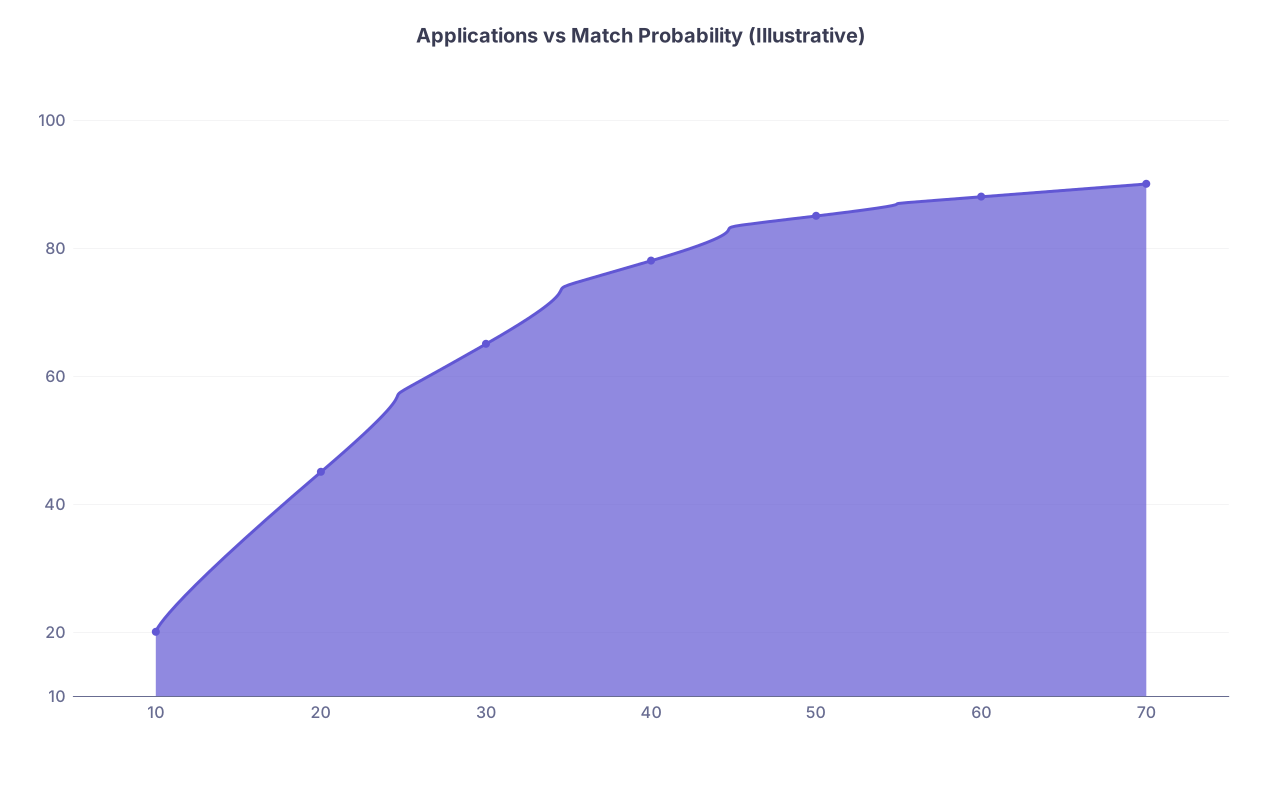
| Category | Value |
|---|---|
| 10 | 20 |
| 20 | 45 |
| 30 | 65 |
| 40 | 78 |
| 50 | 85 |
| 60 | 88 |
| 70 | 90 |
This is not literal data; it’s the general idea from NRMP reports: the curve of benefit flattens. Going from 20 → 40 applications helps a lot. Going from 40 → 70? Smaller gain.
So if you’re sitting at 55 applications in a mid-competitive specialty with decent stats, were you aggressive? Yes. Catastrophically overapplied? Probably not.
And again—too many applications does not equal “programs think you’re not serious.” It equals:
- You spent more money
- You may end up juggling more interview offers than you can handle
- You feel gross and panicked looking at your ERAS receipt
But your file at each program stands on its own.
If You Haven’t Submitted Yet: A Simple Way To Avoid True Overkill
If you’re still pre-submit and spiraling, build a tiered list instead of a chaos list.
Think in three buckets:
- “Risk but I’d be thrilled”
- “Reasonable fit”
- “Safety but I’d still actually go”
Then ask for reality checks:
- A faculty advisor
- A recent grad who matched in your specialty
- Your school’s match data for your Step/GPA range
Don’t mechanically add 10 more programs every time you feel scared. I’ve seen people go from “I think 35 is okay?” to “Maybe 50 just in case” to “Well, 70 doesn’t sound that bad” in one anxious evening.
You don’t need to be heroic and underapply. But you also don’t need to punish your future self with 100 applications when the data (and people who’ve been through this) tell you 40–50 is enough for your profile.
FAQ (5 Questions)
1. Can programs see how many total residency programs I applied to?
No. They only see that you applied to their program and what’s in your file. There’s no universal counter displayed anywhere that says “Applied to 82 programs.”
2. Will applying to a lot of programs hurt my chances at my top choices?
Not directly. Your chances at any given program depend on your stats, letters, experiences, and how well you connect with them. The only way overapplying hurts you is indirectly—if it leads to burnout, sloppy interviews, or unprofessional cancelations.
3. Should I tell programs I applied broadly if they ask about it?
If it comes up (rare), you can be honest and frame it as a rational choice: uncertainty about competitiveness, no home program, geographic flexibility, etc. You don’t need to volunteer this information unprompted, and you definitely don’t need to apologize for it.
4. Is it okay to decline an interview if I’m overbooked or not that interested?
Yes. It’s far better to decline politely and early than to hold a spot you don’t plan to use or cancel last minute. Declining an interview is normal and does not brand you as “unserious” across programs.
5. I already applied to way more programs than everyone around me. Did I ruin anything?
No. The damage is mainly personal (money, stress), not reputational. Focus now on doing high-quality prep for the interviews you do get, showing genuine interest in each place, and behaving professionally. Programs are not punishing you for clicking “submit” too many times.
Key points, without the anxiety filter:
- Programs cannot see your total application count; they judge you on what’s in front of them.
- Overapplying mostly hurts your wallet and energy, not your perceived seriousness.
- You fix the “scatter” problem with clear communication, thoughtful interview prep, and professional behavior—not by wishing you’d applied to fewer places.


