
The worst ERAS mistake is waiting until September to “figure out” your program list. By then, you’re not planning—you’re panic-clicking.
June and July are where serious applicants quietly win the Match. Not by writing some poetic personal statement. By building a disciplined, first-draft program list that actually fits their odds and their life.
Here’s how your June–July should run—week by week, with specific targets and numbers—so you end up with a realistic, strategic program list, not a random pile of applications.
Big Picture: Your June–July Targets
By the end of July of your ERAS year, you should have:
A first-draft program list:
- Categorized into:
- Reach
- Target
- Safer (“likely” is too cocky; call them safer)
- With ballpark counts that make sense for your specialty and risk level.
- Categorized into:
A clear application volume plan:
- How many programs you’ll apply to on Day 1.
- A small “expansion list” if interviews run low.
A basic tracking system:
- Spreadsheet or Notion/Obsidian table with columns that actually matter:
- Location
- Program type
- Visa status (if relevant)
- Step scores / COMLEX stance
- Required letters / preferences
- Contact info
- Notes (real ones, not “seems nice”)
- Spreadsheet or Notion/Obsidian table with columns that actually matter:
If you get those done, you’re already ahead of a lot of your classmates who will “sort it out later.”
Week 1 of June: Know Your Numbers Before You Touch ERAS
At this point you should not be browsing program websites yet. You should be brutally honest about your stats and risk level first.
Step 1: Define Your Applicant Profile (On Paper)
Sit down for 30–45 minutes and write this out, not just “know it in your head”:
- US MD / US DO / IMG (US citizen vs non-US)
- Step 1: Pass/Fail only, but:
- Did you pass on first attempt?
- Step 2 CK score (or target if you haven’t taken it yet)
- COMLEX scores (for DOs)
- Red flags:
- Fails
- Leave of absence
- Big career gap
- Strengths:
- AOA / GHHS
- Honors on core rotations
- Home program with strong letter support
- Research—yes or no, and how much (1 case report is not “strong research”)
You need this written, because your program list size will come straight from this profile, not from what your friends are doing.
Step 2: Choose Your “Risk Tier”
Be honest. I’ll be blunt about it:
Low-Risk Applicant
- US MD, no red flags
- Solid Step 2 (e.g., ≥240) for less competitive specialties OR very strong for competitive ones
- Good clinical evaluations, at least one strong home letter
- No major professionalism issues
Moderate-Risk Applicant
- US DO with average scores OR
- US MD with one mild concern (slightly below-average score, no home program, weaker clinical grades)
- Strong non-clinical strengths (research, leadership) can offset some risk
High-Risk Applicant
- IMG (even strong ones, just by the numbers)
- Any exam fail or large gap
- Significantly below-average Step 2 for your specialty
- No home program in your chosen specialty, plus limited networking
Pick one and own it. This will determine how many programs you should apply to, not how many you wish you could get away with.
Week 2 of June: Set a Rough Target Number of Programs
At this point you should pick a target range of programs before you start shopping.
Use this as a starting framework for the most common scenario (Internal Medicine, FM, Peds, Psych, etc.). Adjust upward for more competitive specialties (Derm, Ortho, ENT, etc.) and downward slightly for the least competitive if you’re very strong.
| Risk Tier | US MD/DO Typical | Strong IMG | Other IMG / Red Flags |
|---|---|---|---|
| Low-Risk | 25–40 | 45–60 | — |
| Moderate-Risk | 40–60 | 60–80 | — |
| High-Risk | 60–80 | 80–120 | 100–150 |
If you’re going into something like Dermatology, Ortho, Plastics, ENT, Rad Onc, or integrated IR, you’re often looking at:
- US MD (strong): 40–60+
- US DO or IMG: as many as exist that you’re eligible for, realistically 60–80+
Now layer in your budget and sanity. Every program costs money and time (secondaries, emails, interview days you can’t attend simultaneously).
Step 3: Sanity Check With Time and Money
Rough math:
- Application fees ramp up fast after 30–40 programs.
- Interviews:
- You realistically can’t attend 30+ interviews without burning out or blowing rotations up.
- Aim for:
- Primary care / less competitive: ~10–12 interviews often adequate
- Medium competitive: ~12–15
- More competitive: 15–20+
Your number of applications should map to how many interviews you need, considering your risk tier. Not everyone needs 100 programs.
Week 3 of June: Build Your Spreadsheet and Filters
Now you start building infrastructure. Not browsing casually. System first, research second.
At this point you should create one central running list, even if it starts messy.
Step 4: Create Your Tracking Sheet
Minimum columns I recommend:
- Program Name
- City / State
- Program Type (university, community, hybrid, university-affiliated)
- Preliminary vs Categorical (for surgery, radiology, etc.)
- Accepts DO? (if you’re DO)
- Accepts IMGs / Visa type (if relevant)
- Step 2 CK expectations / COMLEX policy
- Number of Residents per Year
- Known Red Flags (scut-heavy, malignant, frequent program director turnover)
- Personal Priority (1–3 or 1–5)
- Category (Reach / Target / Safer)
- Notes
You can build this in Excel, Google Sheets, Notion—whatever you will actually open regularly.
Step 5: Pull a Raw List From Official Sources
Now start filling the sheet:
- Use:
- ACGME public program list
- FREIDA
- Program websites
- Your school’s historical match lists
- Dump in:
- Every program that:
- Offers your specialty
- Is in a geographic area you could tolerate
- Does not clearly exclude your profile (e.g., “no IMGs” and you’re IMG)
- Every program that:
Don’t overthink at this stage. You’re building the big universe first.
Week 4 of June: Apply Hard Filters (Deal Breakers Only)
At this point you should start cutting obvious no’s, not agonizing over maybes.
Step 6: Remove Programs That Truly Don’t Fit
Run through your list once, quickly, with hard filters like:
- Location is an absolute no (you and your partner agreed: not going there)
- Clearly does not consider:
- IMGs (if you are one)
- DOs (if you are one)
- Requires Step 2 CK by interview time and you won’t have it
- Visa type mismatch (needs H-1B, only offers J-1, etc.)
You’ll drop 10–30% of your initial dump just with that.
Step 7: Add Essential Context Columns
Now that your list is cleaner, add:
- Geographic region tag:
- Northeast, Midwest, South, West, etc.
- Lifestyle note:
- Big city / smaller city / rural
- Proximity to support system:
- Near family, partner, or none
You’re not ranking yet. You’re building a picture.
Early July (Week 1–2): Start Categorizing Reach / Target / Safer
Now you’ve entered July. At this point you should have a cleaned master list. Time to layer in realism.
Step 8: Define What Counts as Reach / Target / Safer—for You
You’re not copying someone else’s thresholds. Use your own stats vs program patterns.
Use FREIDA, program websites, and your school’s advisors to get a sense of:
- Average Step 2 CK for matched residents
- US MD vs DO vs IMG percentages
- Research-heavy academic vs more community-focused
As a rough guide:
Reach:
- Programs whose residents typically have:
- Higher scores than you
- Much stronger research background than yours
- Somewhat less accepting of your applicant type (fewer IMGs, few DOs, etc.)
- Programs whose residents typically have:
Target:
- Programs where:
- Your stats are around their usual level
- They regularly take people with your background (US MD, DO, IMG)
- Programs where:
Safer:
- Programs whose usual numbers are a bit below yours
- Programs that regularly interview and match many applicants with your profile
Don’t overinflate your targets into reaches just because the name sounds fancy.
Step 9: Actually Label Every Program
Yes. Every single one.
- Go down your sheet and:
- Assign Reach / Target / Safer in the Category column.
- Then count:
- How many total?
- How many in each bucket?
Now compare to your planned application volume.
Mid-July: Balance Your Buckets and Your Total Count
At this point you should already see where you’re skewed. Most people are way too heavy on reach programs. It’s predictable.
Step 10: Use a Simple Distribution Formula
As a starting point, for common specialties:
Low-Risk Applicant (e.g., US MD with solid stats) aiming for 30–40 programs:
- ~20% Reach
- ~50–60% Target
- ~20–30% Safer
Moderate-Risk Applicant aiming for 40–60 programs:
- ~15–20% Reach
- ~45–55% Target
- ~30–40% Safer
High-Risk Applicant aiming for 60–100+ programs:
- ~10–15% Reach
- ~35–45% Target
- ~40–55% Safer
If your sheet shows:
- 60% Reach
- 30% Target
- 10% Safer
You’re not being “ambitious.” You’re setting yourself up for a stressful November.
Step 11: Trim and Add Strategically
Start editing:
Cut some reaches that:
- Have never or almost never taken your applicant type
- Openly say they do not sponsor your visa
- Are insanely research-heavy and you have none
Add more safer and true target programs by:
- Broadening geography slightly
- Including more community or hybrid programs
- Looking at medium-sized cities, not just huge metros
Your goal by late July: a balanced, realistic first-draft list that hits your total target range and your category ratios.
Late July: Lock Your First Draft and Create an Expansion List
By the last week of July, you should stop tinkering with the core list every day. Endless adjusting is just anxiety in spreadsheet form.
Step 12: Freeze a “Core Application List”
Decide:
- These are the programs I am definitely applying to on Day 1 of ERAS.
Sort them roughly by:
- Personal preference
- Geography
- Category (Reach / Target / Safer)
You are not ranking yet. But you should be honest with yourself about which programs are “if they interview me, I’m very interested” vs “backup that I’d still attend if necessary.”
Step 13: Build a Small, Realistic Expansion List
Create a separate tab or section:
- 10–30 additional programs you could add if:
- You’re not getting interviews by late October
- Or your advisor suggests broadening
These should be:
- Mostly Target/Safer
- Not total long-shot reaches
- Programs you could live with geographically and lifestyle-wise
Don’t apply to the expansion list yet. Just have it ready.
Visual: How Your Program Count Should Build Across June–July
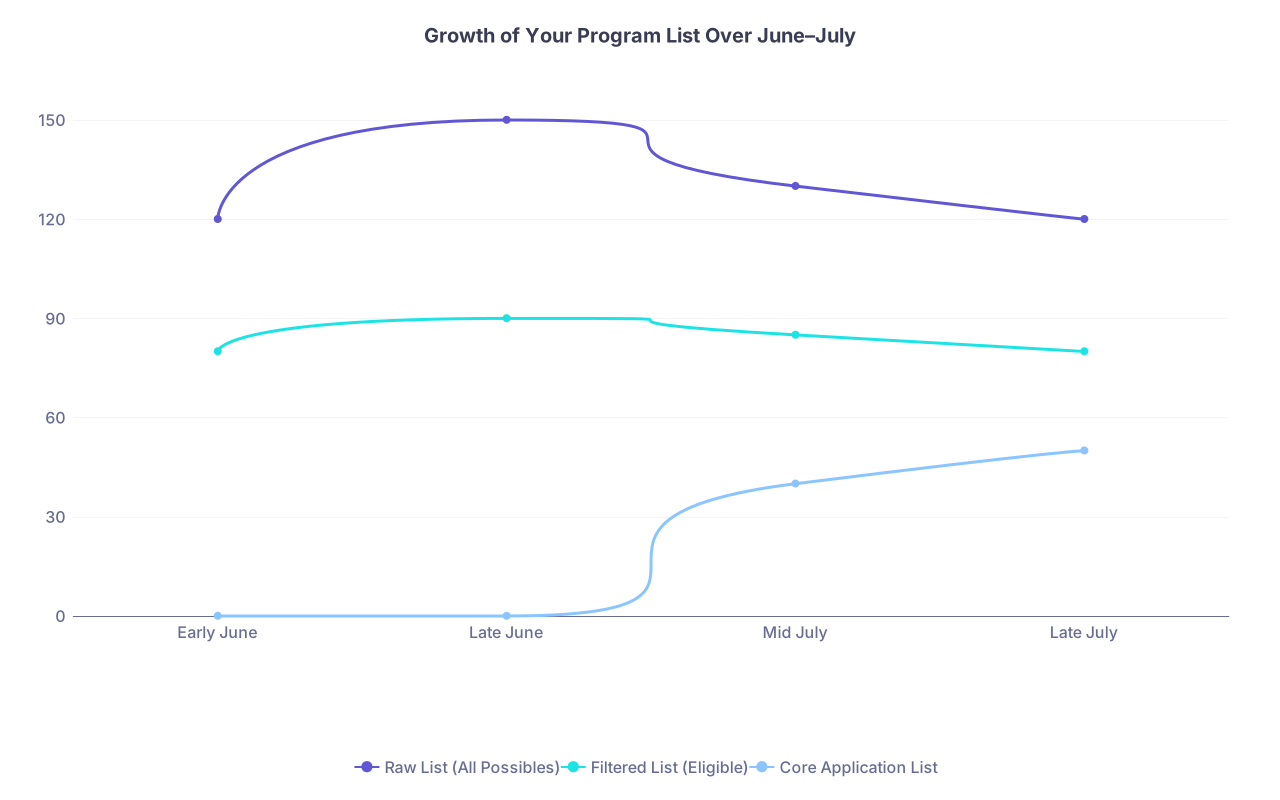
| Category | Raw List (All Possibles) | Filtered List (Eligible) | Core Application List |
|---|---|---|---|
| Early June | 120 | 80 | 0 |
| Late June | 150 | 90 | 0 |
| Mid July | 130 | 85 | 40 |
| Late July | 120 | 80 | 50 |
The raw list peaks early, then gets trimmed as you apply filters. The core list doesn’t get locked in until mid-to-late July.
A Concrete Example: Mid-Risk US MD Aiming for Internal Medicine
To make this less abstract, here’s what I’ve seen work.
Profile:
- US MD, Step 2 CK = 232
- No fails, average clinical evals
- 1 poster, no major research
- Wants Internal Medicine, open to most regions, prefers East/Midwest
Timeline:
Early June:
- Sets target: 45–55 programs
- Risk = moderate
Late June:
- Builds raw list: 100 IM programs that:
- Take US MDs
- In acceptable regions
- Builds raw list: 100 IM programs that:
Hard filters:
- Drops 20 for absolute location no’s and weird requirements
- 80 left
Early July:
- Categorizes:
- 20 Reach (big-name university, high average scores)
- 35 Target
- 25 Safer
- Categorizes:
Distribution check:
- Too many reaches for 50 total apps
Late July:
- Cuts 8 of the most unrealistic reaches
- Adds 8 more community / hybrid programs to Target/Safer
Final first-draft:
- 50 total:
- 8 Reach
- 27 Target
- 15 Safer
- Plus 15-program expansion list (all Target/Safer in geographically broader areas)
That’s how you go from chaos to a controlled plan in 6–8 weeks.
Don’t Ignore Geography and Reality
At this point (late July) you should be honest about your geographic flexibility. People lie to themselves here constantly.
Ask yourself:
- Am I truly willing to go where the interviews are?
- Or am I secretly “Northeast or bust”?
If you’re:
- Geographically rigid + not low-risk → you must increase total program count and accept more community programs in your chosen area.
- Geographically flexible + moderate/high risk → your willingness to go broader is one of your strongest assets. Use it.

How June vs July Should Feel (Reality Check)
To keep you honest, here’s what your stress should look like over these two months.
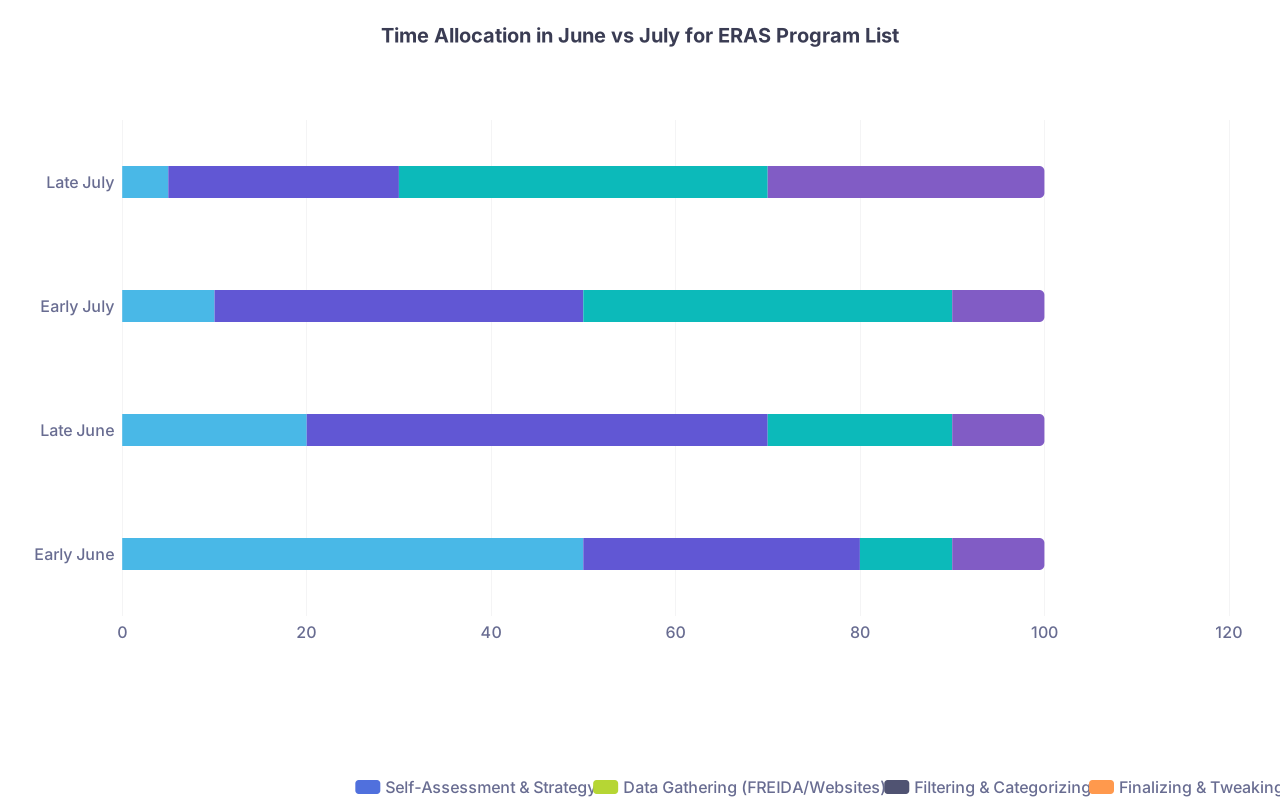
| Category | Self-Assessment & Strategy | Data Gathering (FREIDA/Websites) | Filtering & Categorizing | Finalizing & Tweaking |
|---|---|---|---|---|
| Early June | 50 | 30 | 10 | 10 |
| Late June | 20 | 50 | 20 | 10 |
| Early July | 10 | 40 | 40 | 10 |
| Late July | 5 | 25 | 40 | 30 |
If you’re still doing “self-assessment” in late July and haven’t categorized anything, you’re late. Catch up aggressively.
Quick Week-by-Week Checklist
Use this as your punch list.
Week 1–2 of June
- Write out full applicant profile and risk tier
- Set initial target application range
- Clear 1–2 dedicated blocks of time for program research
Week 3–4 of June
- Build your tracking sheet with core columns
- Pull a wide raw list from FREIDA/ACGME
- Apply hard filters (eligibility, absolute location no’s)
- Add geography and basic notes
Week 1–2 of July
- Define your personal Reach/Target/Safer thresholds
- Categorize every program
- Run counts for each bucket vs your total target
- Identify obvious imbalances (too many reaches, too few safer)
Week 3–4 of July
- Trim unrealistic reaches
- Add more Target/Safer in broader regions if needed
- Freeze a core list to apply to on Day 1
- Build a separate expansion list for later use
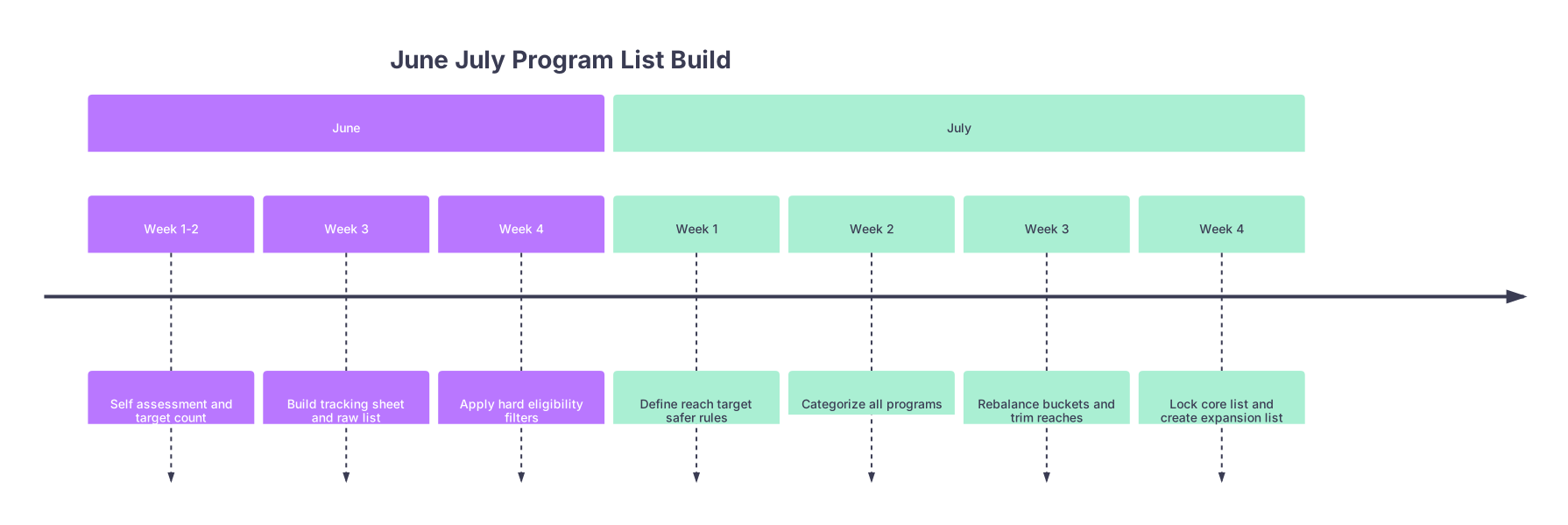
| Period | Event |
|---|---|
| June - Week 1-2 | Self assessment and target count |
| June - Week 3 | Build tracking sheet and raw list |
| June - Week 4 | Apply hard eligibility filters |
| July - Week 1 | Define reach target safer rules |
| July - Week 2 | Categorize all programs |
| July - Week 3 | Rebalance buckets and trim reaches |
| July - Week 4 | Lock core list and create expansion list |
Final Thoughts: What Actually Matters in June–July
Three core points:
- Your program count should be driven by risk, not vibes. Decide your risk tier, then set your range. Stop copying your friend in a different situation.
- Build the list systematically, then lock it. Raw dump → hard filters → categorize → rebalance → freeze a core and park an expansion list.
- Use June and July to think clearly, so September you can execute. If you do the heavy lifting now, ERAS opening won’t be chaos—it’ll just be data entry.