
The worst ERAS mistake is not a bad personal statement. It is sending your application to the wrong number of programs.
By August, you’re not “still deciding” how many programs to apply to. You’re either sharpening a smart list—or quietly setting yourself up for an avoidable disaster.
This month is about one thing: finalizing program counts before ERAS submission day. Not vibes. Not hope. Numbers.
Below is your August playbook: week-by-week, then down to the last 7 days, to lock in a rational, specialty-specific program count you can defend with data.
Week 1 of August: Confront Reality, Not Rumors
At this point you should stop hand-waving and write down three numbers:
- Your Step 2 CK score (or practice NBME equivalent if still pending)
- Your actual, honest class rank/percentile or MSPE wording reality
- How many interviews you realistically need
You are not doing “self-reflection.” You are doing a risk assessment.
Step 1: Benchmark Yourself Against Your Specialty
Pull up recent NRMP Charting Outcomes and your specialty’s professional society data (e.g., AAMC, AAIM, AAFP, APGO).
You need to know where you sit:
- Above typical matched applicant metrics
- Around the median
- Below / at risk
Now, map your situation into risk categories. This is the skeleton you’ll use for program counts:
| Risk Level | Typical Applicant Profile | Match Strategy |
|---|---|---|
| Low | Strong scores, no red flags, home program, good LORs | Fewer programs, more selective |
| Moderate | Average metrics, mild weaknesses, no major red flags | Broad list, mix of program tiers |
| High | Below-average metrics, red flags, IMG/DO in competitive field | High volume, maximal geographic spread |
If you’re telling yourself “I’m probably fine,” you’re already behind. Label yourself. Low, moderate, or high risk. In writing.
Step 2: Translate Risk Into a Rough Target Range
At this point you should draft a first-pass program count based on your risk level and specialty competitiveness.
For a single categorical specialty (U.S. MD/DO, no big red flags), typical starting ranges:
Internal Medicine:
- Low risk: 25–35
- Moderate: 40–60
- High: 70–100+
Family Med / Peds / Psych:
- Low: 20–30
- Moderate: 35–50
- High: 60–80+
General Surgery / OB-GYN / EM:
- Low: 30–40
- Moderate: 45–65
- High: 70–100+
Very competitive (Derm, Ortho, ENT, PRS, Urology*):
- Low: 40–60+
- Moderate: 60–80+
- High: 80–120+ (and a real backup plan)
*Some use a separate match but the logic is similar.
IMGs and DOs in competitive fields are almost always in the high-risk bucket by default.
Lock a provisional range this week. Not perfect. Just a box: “I’m likely applying to 45–60 IM programs,” etc.
Step 3: Look at Your Budget vs Program Counts
By this point you should have stopped pretending money is infinite.
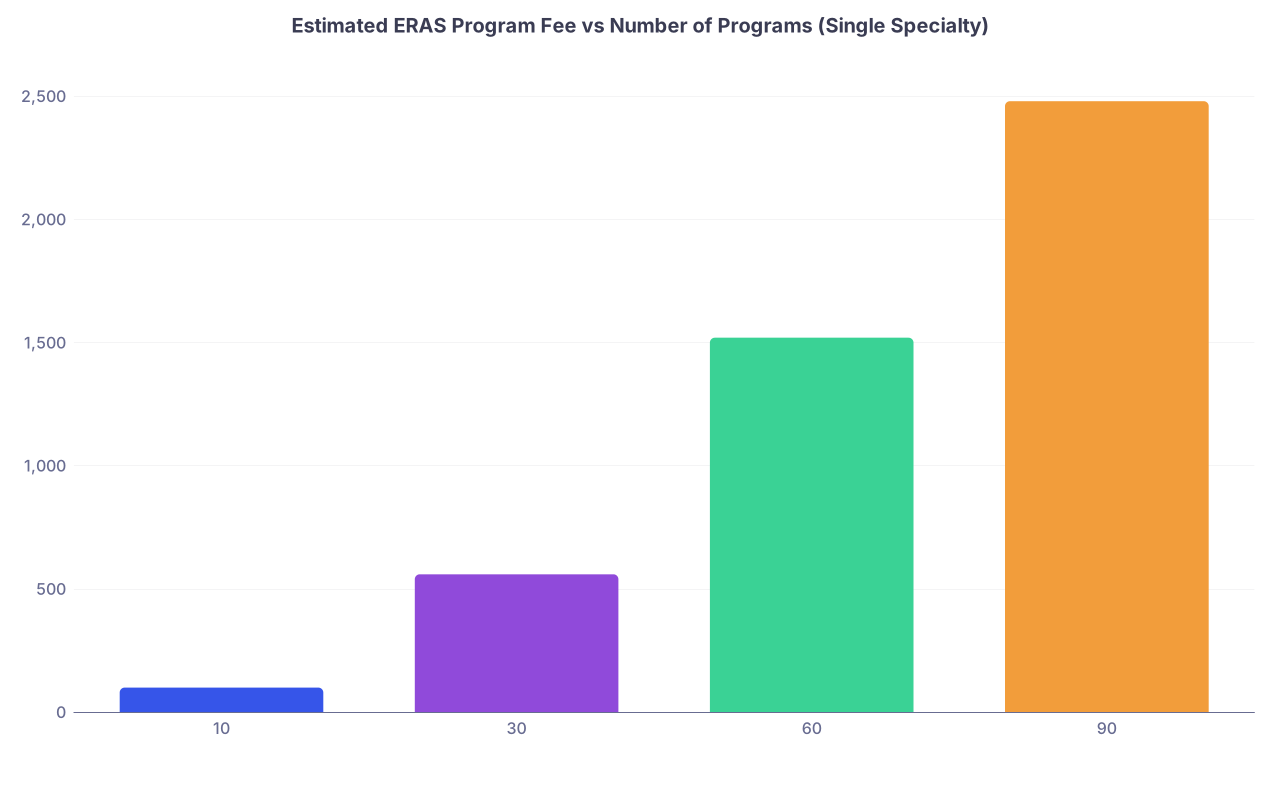
Calculate what you can actually afford. Right now.
| Category | Value |
|---|---|
| 10 | 99 |
| 30 | 559 |
| 60 | 1519 |
| 90 | 2479 |
(Those are ballpark numbers; ERAS tweaks fees, but the shape is the same: costs explode after ~30.)
Week 1 Checklist:
- Assign yourself a risk category (low / moderate / high)
- Set a provisional program count range based on specialty + risk
- Calculate real-world ERAS budget limits
- Get honest feedback from at least one advisor who’s matched people in your specialty
Do not finalize anything this week. You’re framing the box you’ll work inside.
Week 2 of August: Build the Long List, Then Cut Ruthlessly
At this point you should stop scrolling Reddit for “how many programs did you apply to” threads. Your classmates’ numbers are meaningless without their context.
This week is about building a long list of possible programs, then shrinking it intelligently.
Step 1: Generate a Maximal List (No Filters Yet)
Use:
- FREIDA
- Residency Explorer
- Specialty-specific spreadsheets your classmates pass around
- Your school’s match list from the last 3–5 years
Create one master spreadsheet with:
- Program name
- City/state
- Program type (community, university, county, hybrid)
- Size (number of positions)
- Historical friendliness to your profile (DO/IMG-friendly, Step 2-only friendly, etc.)
- Any automatic dealbreakers (visa, Step 1 fail policies, etc.)
Do not cut yet except for hard incompatibilities:
- Doesn’t sponsor your visa type
- Explicitly excludes your degree type (e.g., DO / IMG)
- Has required Step scores you will not have
This is your “everything that could possibly work” universe.
Step 2: Apply Hard Filters
Now you start cutting.
By mid-Week 2 you should:
- Remove programs with explicit “no DO” or “no IMGs” policies if they apply to you
- Remove locations you truly will not live in under any circumstance (not “meh,” but “absolutely not”)
- Remove ultra-competitive programs where your metrics are non-viable (e.g., 205 CK at MGH IM—do not waste the $)
Move those to a separate sheet (“Not applying – why”) so you do not keep re-adding them at 1 a.m. panic.
Step 3: Sort Into Priority Tiers
You’re aiming for tiers like this:
- Tier 1 – Dream but realistic
- Tier 2 – Solid fit / realistic target
- Tier 3 – Safety/backup but tolerable
You should have, for a single specialty:
- Tier 1: ~10–25 programs
- Tier 2: ~20–40 programs
- Tier 3: enough to reach the upper end of your previously defined target range
If your long list cannot get you to the upper end of your range, that’s a problem you want to discover now, not the night before ERAS submission.
Week 2 Checklist:
- Master spreadsheet with all plausible programs
- All hard exclusions removed
- Every remaining program assigned a tier
- Total count compared to your target range (still provisional)
Week 3 of August: Stress-Test Your Numbers Against Outcomes
By Week 3, you should stop thinking about “how many programs” and start thinking “how many interviews.”
Interviews get you matched. Programs just give you chances to get interviews.
Step 1: Map Programs → Expected Interviews
Use a blunt, realistic assumption model. For most mid-range applicants:
- Tier 1: 30–50% interview rate
- Tier 2: 20–35%
- Tier 3: 10–25%
High-risk applicants: cut those probabilities down. Low-risk: you can nudge them up a bit.
Do a back-of-the-envelope calculation:
Example (moderate-risk IM applicant):
- 15 Tier 1 programs × 0.4 = ~6 interviews
- 25 Tier 2 programs × 0.25 = ~6 interviews
- 20 Tier 3 programs × 0.15 = ~3 interviews
Total expected: ~15 interviews → good cushion (10–12 often sufficient in IM).
If your math is giving you 6–8 interviews total in a competitive field, that’s a red flag. You either:
- Need to increase total program counts
- Need to add more Tier 3 / safety regions
- Or you’re underestimating your risk and overrating your appeal
Step 2: Reality Check with Historical Data
At this point you should talk to:
- Recent grads from your school with similar stats in your specialty
- A PD or APD you trust
- Residents at a couple of your mid-tier targets
Ask specific questions:
- “I have X score, Y ranks, Z red flag. How many programs did you apply to and how many interviews did you get?”
- “If you were me now, would you push your program count higher or lower?”
Do not accept vague reassurance. Ask them for actual numbers.
Step 3: Adjust Counts by Specialty Competitiveness
Here’s the harsh truth: the same applicant may need 30 programs in FM and 90 in Ortho. Pretending otherwise is how people scramble.
If you’re dual applying (e.g., EM + IM, Derm + IM, Ortho + TY/prelim), you should:
- Assign separate target counts for each
- Decide your primary match goal (which specialty you actually want most)
- Make sure your backup specialty isn’t token (e.g., “I’ll apply to 10 IM programs just in case” rarely works)
By the end of Week 3, your total numbers should be narrowing. Maybe:
- “I’m down to 45–55 IM programs”
- “I’m between 65–80 total for EM + IM”
Good. Now you refine.
Week 4 of August: Lock the Final List Before ERAS Opens
By this point you should not be making massive changes. You should be doing surgical edits.
Step 1: Final Count Decision by Day
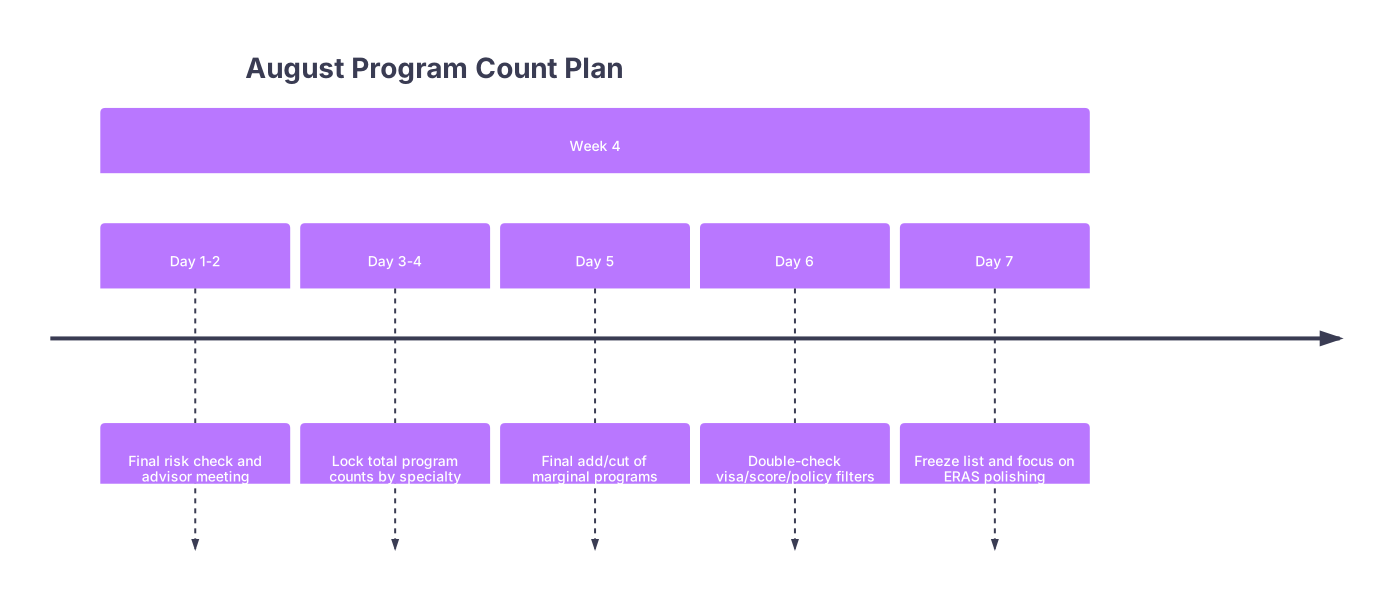
Use this 5–7 day micro-timeline leading into ERAS opening and submission.
| Period | Event |
|---|---|
| Week 4 - Day 1-2 | Final risk check and advisor meeting |
| Week 4 - Day 3-4 | Lock total program counts by specialty |
| Week 4 - Day 5 | Final add/cut of marginal programs |
| Week 4 - Day 6 | Double-check visa/score/policy filters |
| Week 4 - Day 7 | Freeze list and focus on ERAS polishing |
Day 1–2: Final Risk & Advisor Check
At this point you should:
- Reconfirm Step 2 status (score back? trends on practice NBMEs?)
- Ask one advisor directly: “Given this spreadsheet and my profile, is this number reasonable or risky?”
- Decide whether you’re err on the high side or accept moderate risk type
If two experienced people tell you “that’s too few,” they’re usually right.
Day 3–4: Lock Total Counts by Specialty
You need hard numbers now. None of this “maybe 50–70” nonsense.
Examples:
- “Internal Medicine: 55 programs”
- “Emergency Medicine: 45, Internal Medicine (backup): 30”
- “OB-GYN: 75, with 15 clear safety programs”
Write them down and commit. Put them in your calendar. This is your official target.
Day 5: Cut or Add at the Margins
Now you handle the gray zone programs sitting on the fence.
You keep programs that:
- Are in regions where you actually know you can be happy
- Have at least some history of taking applicants like you
- Don’t blow your budget
You cut programs that:
- You’re only adding out of panic, with no real fit
- Are long-shot prestige choices not aligned with your profile
- Duplicate “types” you already have plenty of (e.g., your 12th anonymous mid-size Midwest IM program when you’re already at 60+)
Day 6: Policy and Logistics Double-Check
This is quietly where people blow interviews.
At this point you should re-check for every program on your list:
- Visa requirements (if applicable)
- Step 2 by ranking/interview deadlines
- COMLEX vs USMLE requirements for DOs
- Specific letter requirements (e.g., SLOEs in EM, OB-GYN departmental letter)
Any program that demands something you absolutely will not have → remove or consciously accept as a lottery ticket.
Day 7: Freeze the List
Last week of August, you freeze.
- No more changes unless new, hard information arrives (e.g., surprise Step 2 score 30 points lower than expectations)
- No late-night Reddit-fueled expansions to 120 programs “just in case”
- You redirect energy to polishing ERAS itself: experiences, personal statement, LoRs, photo
Week 4 Checklist:
- Hard numeric targets per specialty finalized
- Spreadsheet filtered and cleaned (only programs you’re actually applying to)
- All program requirements verified
- You’ve consciously decided your risk tolerance (conservative vs aggressive)
Special Situations: When You Should Break Your Own Numbers
Not everyone fits the clean model. At this point in August, you should already know if you’re in one of these camps:
1. Major Red Flags (Fail, LOA, Probation)
If you have a Step failure, professionalism issue, or LOA:
- Your interview rate will be lower than peers with the same scores
- Your Tier 3 pool becomes much more important
- You should be biased toward the upper end of your count ranges, often +15–30 programs
2. Couples Match
Couples match math is brutal.
- You need overlap in geography, not just raw program counts
- Many couples underestimate how many joint interview pairs they’ll realistically get
In August, your job as a couple:
- Map out overlapping regions (e.g., Northeast corridor, Texas triangle, California coastal)
- Ensure both partners have enough programs in those overlapping regions, not scattered randomly across the map
For most couples, each partner ends up applying to more programs than they would solo. Plan for that now, not in September.
3. Dual Apply into Strong Backup
If you’re applying to a highly competitive field plus a true backup:
- Your backup program count should look like you’re serious about matching in it
- “Backup” doesn’t mean “12 programs, hope someone bites”
- For the backup, still hit realistic numbers: usually 30–50+ depending on risk
What You Should Be Doing Each Day in the Final 7–10 Days Before Submission
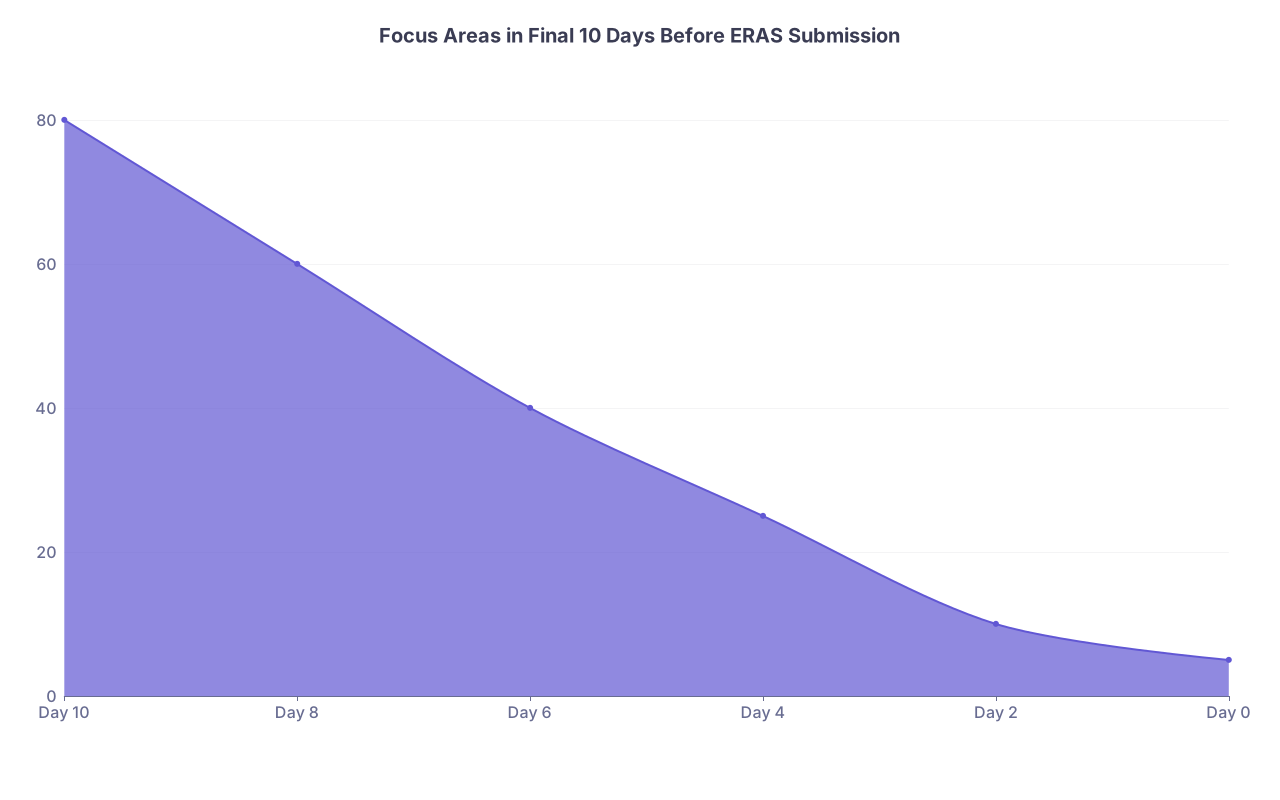
Here’s how I’d structure the final stretch, focused specifically on program counts and list sanity.
| Category | Value |
|---|---|
| Day 10 | 80 |
| Day 8 | 60 |
| Day 6 | 40 |
| Day 4 | 25 |
| Day 2 | 10 |
| Day 0 | 5 |
(Think of that as “percentage of your time spent tweaking program lists.” It should decrease as you approach submission, not spike.)
Day 10–8:
- Review tiers, confirm counts per tier
- Check for obvious gaps (e.g., no geographic diversity, too few mid-tier programs)
Day 7–5:
- Do one last pass: any program you literally would not attend if it was your only option? Cut it.
- Verify all your “backup” programs are actually on the list and not just in your head
Day 4–3:
- Stop touching the count. Finish ERAS content, proofread, finalize LOR assignments
Day 2–1:
- Quick spot check of 5–10 random programs for requirement mismatches
- Confirm your budget vs actual number of programs matches what ERAS is charging
Submission Day:
- Do not add 15 extra programs out of panic
- Submit what you’ve planned, intentionally
The Bottom Line for August
By the end of August, you should not be “figuring out” how many programs to apply to. You should have:
- A documented risk category and realistic expectations
- A frozen, intentional program list with hard numeric targets
- A clear sense of how many interviews you’re aiming for—and how your program count supports that
The dangerous applicants are the ones who improvise in September.
Do this today: open a spreadsheet and write three numbers at the top—your risk level (low/moderate/high), your primary specialty, and a specific target program count. Then list 10 programs you’re 100% sure about. That’s the spine of your application. Build the rest of August around it.