
The most dangerous thing about late letters and late scores is not that they are late. It is that they quietly force you to change how many programs you should apply to… and most applicants never adjust.
You will not be one of those applicants.
Below is a stepwise, time‑anchored guide to how late LORs, MSPEs, and exam scores should change your program volume strategy from June through rank list certification. Month by month. Then week by week when it gets tight. I will tell you exactly when to expand, when to hold, and when to stop throwing money into the ERAS furnace.
June–July: Before ERAS Opens – Build Two Program Volume Plans
At this point you are in fantasy land. Nothing is submitted yet. Perfect time to build contingency plans.
Your job in late June / July (pre‑ERAS opening):
List your risk factors for “late” items:
- Step 2 CK / COMLEX 2 date after:
- August 15 (mildly late)
- September 1 (late for many competitive programs)
- LORs requested from:
- Busy chair who “always runs behind”
- Away rotation faculty who will not finish until late August
- Significant MSPE concern:
- Known professionalism issue
- Remediation that will be visible on October 1
- Step 2 CK / COMLEX 2 date after:
Define three target program volumes now, before you panic later:
Baseline volume (if everything is on time)
- Competitive specialties (Derm, Ortho, ENT, Plastics, Neurosurg):
60–80+ programs - Upper‑mid competitiveness (EM, Anesth, OB/GYN, Gen Surg categorical):
40–60 programs - Mid‑range (IM categorical, Peds, Psych, FM in most regions):
25–40 programs
- Competitive specialties (Derm, Ortho, ENT, Plastics, Neurosurg):
“Late document” volume (if crucial things are delayed but you are otherwise solid)
- Add ~25–50% more programs than baseline
“Red flag / late plus” volume (late score + prior failure / big MSPE issue)
- Often double your baseline for competitive or mid‑competitive fields
- Or seriously consider a parallel / backup specialty
Put it in a simple table or spreadsheet now. You do not want to be doing this math on September 28 at midnight.
| Specialty Tier | Baseline Volume | Late Documents Volume | Red Flag / Late Plus |
|---|---|---|---|
| Very Competitive | 60–80 | 80–100 | 100–120+ |
| Upper‑Mid Competitive | 40–60 | 60–80 | 80–100 |
| Mid / Less Competitive | 25–40 | 40–55 | 55–70 |
- Schedule your exams with volume in mind.
- If your Step 1 is average or pass/fail only and you need Step 2 CK to carry your application, testing after early September is a problem.
- If you are applying to a very competitive specialty and your Step 2 is after September 1, you should already be leaning toward your “late document” volume.
August: 4–6 Weeks Before Application Submission – Decide Your Default Volume
By August, the fantasy is over. You have real test dates, real letter writer behavior, real risk.
Early August (about 4–6 weeks pre‑ERAS submission):
At this point you should:
Lock in your default volume based on what you know, not what you ‘hope’:
- You have a scheduled Step 2 / COMLEX 2 date.
- You have asked for letters.
- You know whether you will have a home department letter in time.
Use this simple rule:
- If Step 2 is scheduled on or before Aug 15 and:
- You expect a solid score and no prior fails → stick to baseline volume.
- If Step 2 is scheduled Aug 16–31 or critical letters are shaky:
- Move to “late document” volume for competitive or uncertain fields.
- If Step 2 is scheduled Sept 1 or later or you have any prior fail:
- Treat yourself as “late plus” until proven otherwise.
Segment your program list by selectivity.
- Create tiers in your spreadsheet (Tier 1 dream, Tier 2 realistic, Tier 3 safety).
- When something arrives late, you will adjust numbers per tier, not by random deletion at 2 a.m.
Clarify specialty‑specific culture on late scores:
- EM, Anesthesia, OB/GYN, Surgery (many programs):
They want Step 2 by the time they build interview invites (late September–October). - IM, Peds, Psych, FM:
More tolerant, especially community programs. Step 1 + strong MSPE can carry you for early invites.
- EM, Anesthesia, OB/GYN, Surgery (many programs):
If you do this in August, you are not guessing in October.
September 1–14: ERAS Opens – You Submit With Imperfect Information
When ERAS opens (early September), you can start sending applications, but many documents are still in motion.
At this point (first 2 weeks of September) you should:
Submit your primaries assuming your “late document” plan.
- If you know your Step 2 score will be available by Oct 1 → you can be a little closer to baseline.
- If your exam date is in early/mid‑September → assume you will not help your September invites; lean higher volume.
Prioritize which programs see an incomplete app first.
- Community and lower‑tier academic programs are more tolerant of:
- 2 letters instead of 3.
- Pending Step 2 score.
- Top‑tier programs often batch review later and prefer more complete files.
Meaning:
- Send your earliest, slightly incomplete applications to safer programs.
- Hold a few top stretches for after a key letter or score posts—but not for too long.
- Community and lower‑tier academic programs are more tolerant of:
Set two hard calendar dates now:
- “No new specialties” date: Usually September 15–20. After this you are not adding a brand‑new field because you panicked.
- “Last wave of new programs” date: Usually October 15. After that, adding more programs rarely changes your match odds significantly unless you are severely under‑applied.
September 15–30: Pre‑MSPE, Pre‑Most Scores – Make Your First Volume Adjustment
This is the anxiety window. Files are submitted, but:
- MSPE not released yet (comes Oct 1).
- Many Step 2 / COMLEX 2 scores not posted yet.
- Letters trickling in.
In the second half of September you should:
Assess the actual state of your file:
- Count how many programs have:
- Required number of LORs.
- Chair letter (if needed in your specialty).
- At least Step 2 score or a clearly strong Step 1.
- Count how many programs have:
Use a simple threshold rule:
If ≥80% of your applied programs have:
- Required letters in, and
- At least one strong board score visible
→ stay at current volume. Do not add just to feel busy.
If 50–79% are complete:
- Consider adding ~10–20% more programs, focused on:
- Community sites
- Newer programs
- Geographically flexible areas
- Consider adding ~10–20% more programs, focused on:
If <50% of your applications are truly complete:
- You under‑applied for your risk profile.
Move from baseline to “late document” volume immediately and add programs.
- You under‑applied for your risk profile.
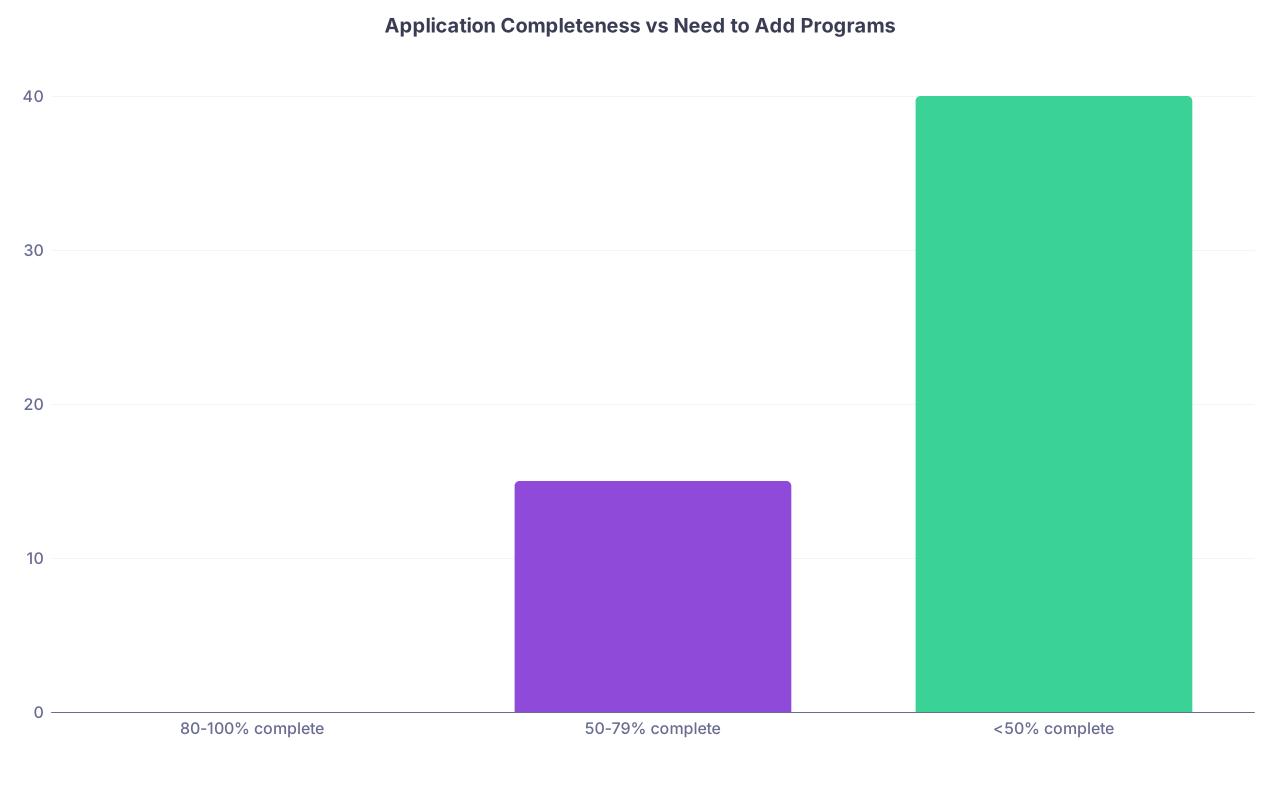
| Category | Value |
|---|---|
| 80-100% complete | 0 |
| 50-79% complete | 15 |
| <50% complete | 40 |
(Values above indicate approximate number of additional programs many applicants end up adding. I have watched people add 40–60 programs in a panic from the <50% group.)
- Do not wait for the MSPE to “save” you.
Unless your school specifically told you there is a major positive revision, the MSPE rarely rescues an otherwise late or weak application. Volume decisions belong to scores and LORs, not MSPE fantasies.
October 1–15: MSPE Release, First Wave of Invites – The Critical Recalibration Window
October 1, MSPEs drop. Around this time a large number of Step 2 and COMLEX scores also post. Some programs start sending early invites.
In the first half of October you should:
Recalculate your risk category immediately when scores post:
You move up a category (stronger than expected) if:
- Step 2 CK ≥ 10–15 points above your Step 1.
- And at or above your specialty’s usual match range.
You move down a category (weaker than hoped) if:
- Step 2 is not an improvement, or
- You failed / scored clearly below your specialty norms.
Adjust program volume that same week:
If you upgraded (better score than expected):
- Do not rush to add more programs.
- Instead:
- Update personal statements if needed.
- Send score update emails to a select list of top programs, not all 80.
If you downgraded (late or weak score, or fail):
- Increase program volume toward your “late plus” plan within 3–5 days.
- And seriously revisit:
- Parallel specialty (e.g., adding IM to your EM list).
- Prelim/TY year if aiming at a surgical field.
Track interview invites by October 15.
At this point you should have an early signal:
- For most specialties:
- If you have 0–1 invites by mid‑October after applying broadly, that is a warning sign.
- If you have 2–4 invites with a late score in play, you may be okay but should stop adding new programs by end of month rather than waiting until November.
- For most specialties:
October 16–31: Late Scores / Letters Hit – Use a Targeted Expansion, Not a Panic Blast
Late October is where people waste the most money. A Step 2 score posts October 20, and by October 21 they have added 30 completely random programs at 1 a.m.
You will be more surgical.
In late October you should:
Decide whether your new information changes your competitiveness tier.
Ask three blunt questions:
- Does this new score/letter move me from “possibly filtered out” to “clearly above cutoff”?
- Does it fix a red flag (previous fail, very low Step 1, no SLOEs, etc.)?
- Would I seriously work at more community or geographically distant programs if they offered?
If the answer to the third question is “no,” then adding those programs is theater, not strategy.
Add programs only in three situations:
Situation A: Late but strong score.
- You took Step 2 late and crushed it (e.g., 260+ in a competitive field).
- You previously limited your reach due to fear.
→ Add select higher‑tier or academic programs where:- They explicitly say they review October scores.
- Or your mentors have connections.
Situation B: Late but adequate score and few interviews.
- You are sitting on 0–2 invites.
- Step 2 is acceptable but not spectacular.
→ Add safety‑leaning programs only:
- Community
- Newer
- Less desirable geographic locations
Situation C: Newly clarified red flag.
- A fail posts, or a much‑lower‑than‑expected score.
→ Decide quickly:
- Increase program count in same field and add a backup specialty.
- Or fully pivot to a more available specialty and apply broadly there.
- A fail posts, or a much‑lower‑than‑expected score.
→ Decide quickly:
Avoid these common mistakes at this stage:
- Adding 20 ultra‑competitive academic programs in late October after a marginal score. They already picked their favorite files.
- Sending update emails to every program insisting they reconsider you because your score improved “a little.”
Focus on where late information actually changes your chances of being seen.
November: Interview Season in Full Swing – Stop Expanding Blindly
By November, interview invites are flowing. Your program volume decision is mostly done. Late items only matter now if they are very late or truly game‑changing.
In November you should:
Track interviews per 10 programs applied.
Simple metric:
- ≥2–3 interviews per 10 programs applied in that specialty → healthy.
- <1 interview per 10 programs and invites have been going out for weeks → you are in trouble.
Use your ratio to decide on targeted late November adds:
- If your interviews per 10 programs are:
- Reasonable (2–3+) → do not add more programs. Spending more will not help; now it is about interview performance and rank list strategy.
- Very low (<1) but some programs are still releasing invites in late November:
- Add a small, highly targeted set (10–15) of:
- Community
- Less desired geography
- Programs historically known to invite later
- Add a small, highly targeted set (10–15) of:
This is salvage mode, not normal planning.
- If your interviews per 10 programs are:
Stop new applications by late November in almost all cases.
Past this point:
- Many programs are done sending invites.
- Late applications are ignored or automatically rejected.
There are rare exceptions (brand new programs, late ACGME approvals, or certain FM/Psych/Peds spots in under‑filled regions). They are outliers, not a strategy.
December–January: Managing Waitlists and Cancellations – Volume Is Set
By December, your program volume is locked. You are living with the set you built in September–November.
In December and January you should:
Use new late letters/scores only as email updates, not a reason to add programs.
- If:
- A stellar LOR finally arrives.
- Or a late rotation eval is glowing.
- Then:
- Update programs where you are waitlisted or not yet rejected.
- Do not start applying to additional programs unless a mentor can point to a specific program still actively looking.
- If:
Optimize within your existing volume, not beyond it.
- Cancel interviews at programs you would never rank over others.
- Accept waitlist interviews only if they can realistically move.
Your marginal benefit from new applications at this stage is near zero.
February–March: Rank List and Match – Volume No Longer Changes
By the time you build your rank list, program number is finished. Late letters and scores can influence how you rank (or how programs rank you after an update), but they should not change how many programs you apply to. That ship sailed months ago.
At this point you should:
- Stop thinking about application numbers.
- Focus on:
- Interview performance reflection.
- Strategic ranking.
- Backup plans if match looks uncertain.
Visual Timeline: When Late Documents Should Change Volume
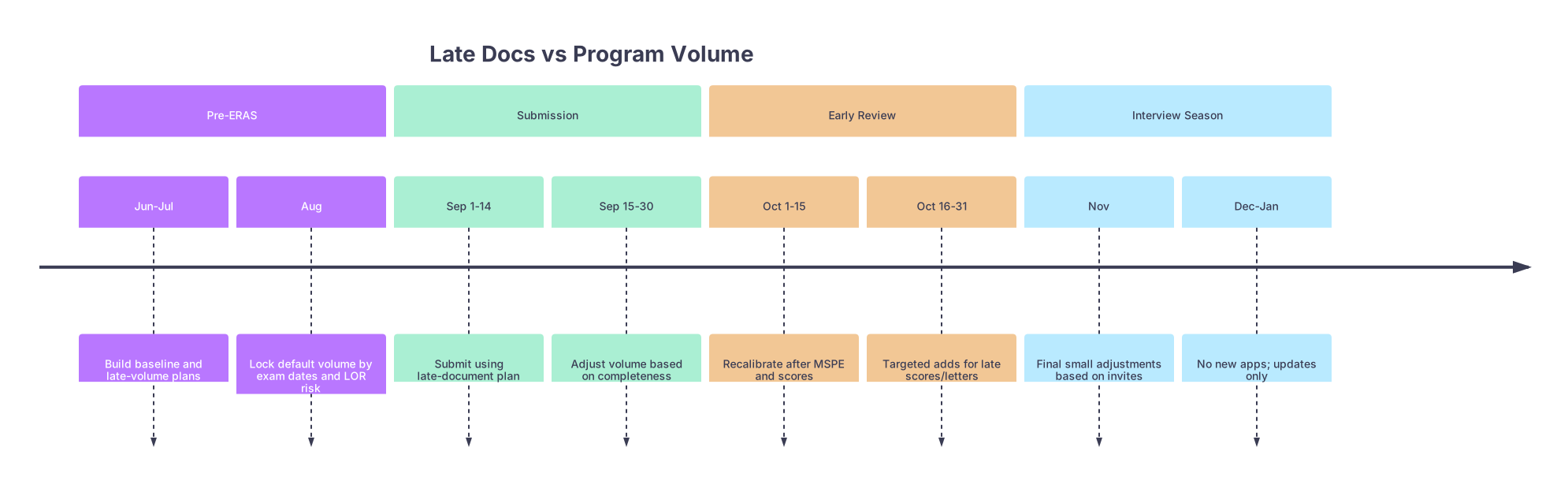
| Period | Event |
|---|---|
| Pre-ERAS - Jun-Jul | Build baseline and late-volume plans |
| Pre-ERAS - Aug | Lock default volume by exam dates and LOR risk |
| Submission - Sep 1-14 | Submit using late-document plan |
| Submission - Sep 15-30 | Adjust volume based on completeness |
| Early Review - Oct 1-15 | Recalibrate after MSPE and scores |
| Early Review - Oct 16-31 | Targeted adds for late scores/letters |
| Interview Season - Nov | Final small adjustments based on invites |
| Interview Season - Dec-Jan | No new apps; updates only |
Quick Practical Example
Let me walk you through a concrete scenario. I have seen almost this exact path multiple times.
- Applicant: US MD, applying EM.
- Step 1: Pass, no score.
- Step 2 CK: Scheduled Sept 5.
- LORs: 1 EM SLOE ready, 1 IM, 1 Surgery. Second EM SLOE from October rotation.
July:
- Builds plans:
- Baseline volume: 45 EM programs.
- Late doc volume: 60–70 EM programs.
- Red flag volume: 80+ or add IM backup.
August:
- Realizes Step 2 is after Sept 1 and second EM SLOE will be late.
- Locks “late document” volume target: 65 EM programs.
Early September:
- Applies to 65 EM programs on ERAS opening week.
- Sends to a mix of academic and community sites, but prioritizes community programs first while LOR set is weaker.
Late September:
- Only 40 of 65 programs show 3 letters, and Step 2 still pending → about 60% complete.
- Adds 10 more community EM programs in under‑applied regions → now at 75 total.
October 10:
- Step 2 posts: 247, solid for EM.
- Has 2 invites so far.
- Reassesses: new score is strong, but late. Decides:
- No massive expansion.
- Sends score update emails to 10 top‑choice academic EM programs only.
Late October:
- Few more invites trickle in, now at 6 total by Oct 31.
- Given late score, this is reasonable. Stops adding programs entirely.
November:
- Ends up with 10 EM interviews.
- Does not apply to IM backup because volume + invite count is adequate.
This is what controlled adjustment looks like. The Step 2 score was late. The second SLOE was late. Instead of randomly doubling total applications, they nudged the numbers in September, then stopped in November.
One More Visual: Where Most People Over‑ or Under‑Apply
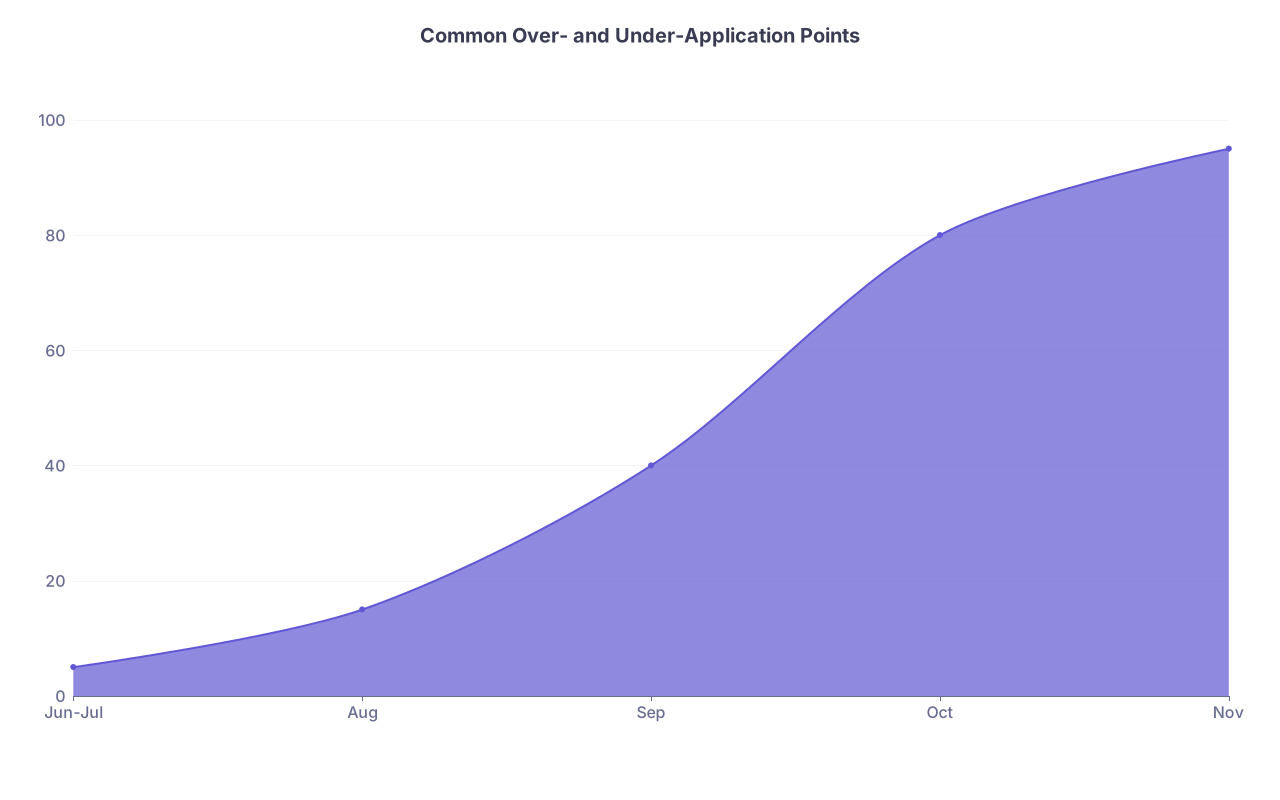
| Category | Value |
|---|---|
| Jun-Jul | 5 |
| Aug | 15 |
| Sep | 40 |
| Oct | 80 |
| Nov | 95 |
(The curve above is how panic tends to grow. What you want instead is a more controlled rise: big decisions by September–early October, then flat.)


Final Tight Summary
- Late letters and late scores are not just “annoying.” They change your risk category, and your program volume must be pre‑planned for each risk level by August.
- The real adjustment windows are late September (based on completeness) and early–mid October (after MSPE and scores). After late November, new applications are mostly wasted effort and money.
- Do your big volume decisions early. Use late information for targeted additions and focused updates, not for a November application binge that makes you feel busy but does not move your match odds.