
The worst SOAP mistakes are made in the first 60 minutes after you see “No Match.”
If you wing this, you will either apply to too many programs blindly or too few programs safely. Both are bad. You need a tight, time-based plan for how many programs to add, when to stop, and how to adjust between SOAP rounds.
This is that plan.
Big-Picture SOAP Structure (Before the Clock Starts)
Before we zoom into hour-by-hour, you need the skeleton of SOAP in your head. Otherwise the timeline below will feel chaotic.
| SOAP Round | Max Applications This Round | Cumulative Max |
|---|---|---|
| Round 1 | 45 | 45 |
| Round 2 | 15 | 60 |
| Round 3 | 15 | 75 |
| Round 4 | 15 | 90 |
You have:
- Up to 45 programs you can apply to at the start of SOAP.
- Then up to 15 additional programs after each of the 4 offer rounds, capped at 90 total.
- Offers go out in four short waves. You can accept only one position. Once accepted, you are done.
So the central question is not only “How many programs should I apply to?” but also:
- How many early vs late?
- How many reach vs realistic?
- How aggressively do I expand specialties over time?
We will walk that in chronological order—from the Friday before Match Week through the final SOAP round.
T-3 Days to T-1 Day: Pre-SOAP Groundwork
At this point you should be planning as if you might not match, even if you are optimistic. The people who are ready by Monday at 9 a.m. win SOAP.
Friday Before Match Week (T-3 days)
You do not know if you matched yet. You prepare anyway.
- Clarify your SOAP strategy scenarios
Decide now:
- If I do not match in my primary specialty (say, Internal Medicine), will I:
- Stay in that specialty only?
- Add close neighbors (IM prelim, Transitional Year)?
- Add categorical in less competitive fields (FM, Psych, Peds)?
- Go fully broad across several non-competitive specialties?
You should write down three tiers:
- Tier A – Primary specialty (your original field)
- Tier B – Adjacent options (prelim/TY or overlapping fields)
- Tier C – Backup categorical specialties (often FM, IM community, Psych, Peds, Path, etc.)
- Create your “numbers framework”
You need a default numbers plan before emotions spike. As a starting template:
- If you are US MD with decent board scores, not super red-flagged:
- Plan: 25–30 programs in primary specialty, 15–20 in backups in Round 1.
- If you are US DO or IMG with some weaknesses:
- Plan: 15–20 primary (if positions exist), 25–30 backups in Round 1.
- If you have serious red flags (exam failures, professionalism issues, no Step 2, etc.):
- Plan: 5–10 primary (max), 35–40 backups in Round 1.
These are starting allocations. You will refine them when you see the actual unfilled list.
- Build templates and documents
Have this ready in ERAS and on your computer:
- Updated CV
- Personal statement variants:
- One for your primary specialty
- One generic IM/FM-style statement
- One for any other realistic specialty you are willing to enter
- List of:
- Geographic constraints (hard no’s and strong preferences)
- Deal-breakers (visa policies, DO/IMG exclusion, etc.)
If you are still writing personal statements at 10 a.m. Monday, you are losing ground.
Monday of Match Week: Hour-by-Hour Decisions
9:00 a.m. ET – You Learn: Matched or Not
If you matched: stop reading. SOAP is irrelevant for you.
If you did not match or partially matched (e.g., advanced position but no prelim), things move fast.
At this point you should:
- Take 15–20 minutes to react. Vent, text family, sit in a hallway. Then flip the switch to tactical mode.
- Confirm any institutional help:
- Student affairs
- Dean’s office
- Specialty advisors
Tell them directly: “I need help deciding how many programs to apply to in SOAP and which specialties to include.”
10:00–10:30 a.m. ET – Unfilled List Appears
This is the first real data. Your pre-plan now meets reality.
At this point you should:
- Filter by specialty: mark all programs in your primary specialty, then adjacent specialties, then backups.
- Filter by visa status, DO/IMG acceptance, geographic constraints.
- Roughly count viable options by tier
You want quick numbers:
- Tier A (primary specialty) – “I am truly competitive here.”
- Tier B (adjacent) – “I am realistic if they are desperate and my story fits.”
- Tier C (backup specialties) – “I would take this to be in residency.”
If you see:
- >60 viable programs total: you can be selective with Round 1 and hold some for Round 2–4.
- 20–40 viable programs total: you must use almost everything in Round 1.
- <20 viable programs total: you apply to nearly all of them in Round 1, across specialties if needed.
Monday 10:30 a.m.–2:59 p.m.: Building Your Round 1 Application List
This is the most important block of the entire SOAP timeline.
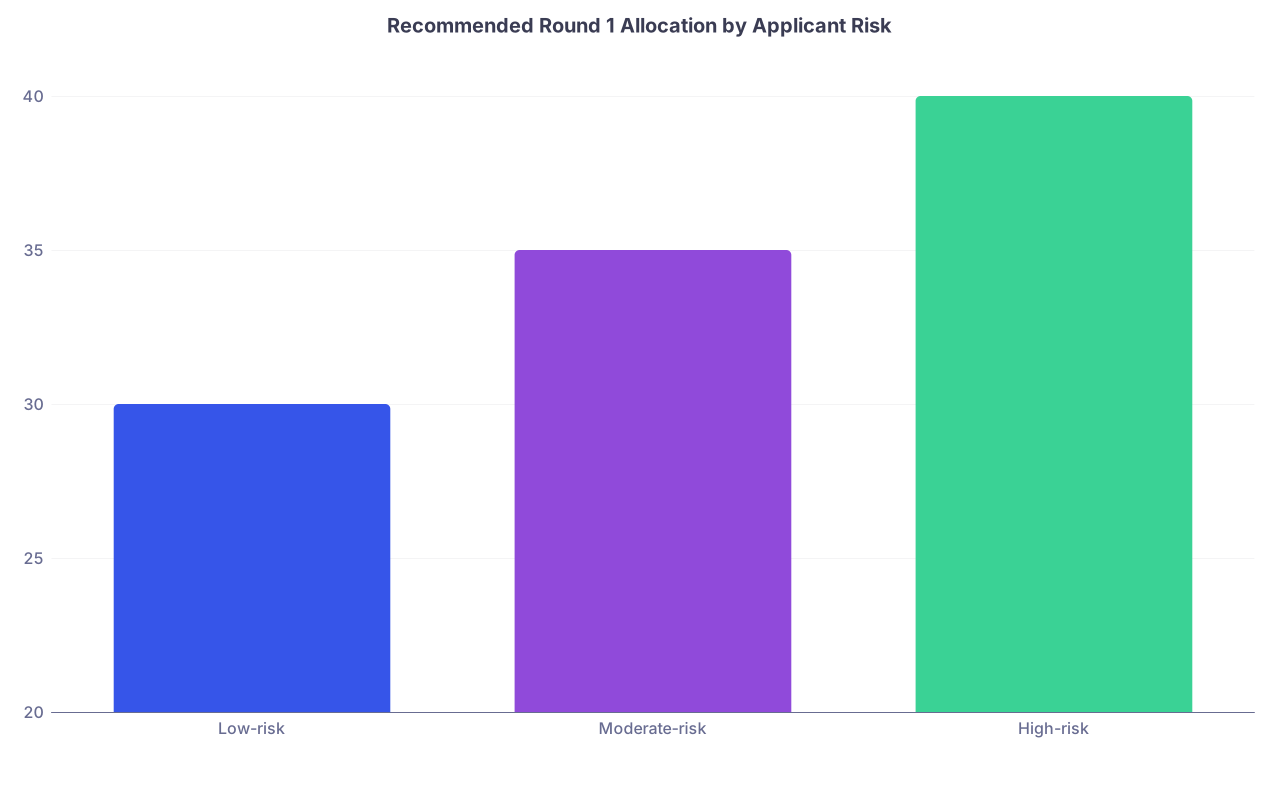
| Category | Value |
|---|---|
| Low-risk | 30 |
| Moderate-risk | 35 |
| High-risk | 40 |
Think of Round 1 as your high-yield blast. Programs do the heaviest initial screening here.
Step 1: Decide your Round 1 volume
You should not go light in Round 1 “to save spots” unless you have an absurd number of viable programs.
Use this as a reality-based guide:
- If you have strong application (US MD, no failures, decent scores):
- Apply to 30–40 programs in Round 1.
- If you are middle of the road (US DO, moderate scores, or minor red flags):
- Apply to 35–45 programs in Round 1.
- If you are high-risk (IMG, exam failures, big gaps, etc.):
- Apply to 40–45 programs in Round 1.
This is not the time to be precious.
Step 2: Distribute across specialties
Now the core question: how many programs in each category?
Use your pre-decided tiers, but anchored to what is actually unfilled.
Scenario A: Many unfilled positions in your primary specialty
Example: 80 unfilled IM categorical spots where your profile fits.
At this point you should:
- Allocate 60–80% of Round 1 to primary specialty.
- Allocate the remaining 20–40% to realistic backups.
Concrete:
- Total Round 1 applications: 40
- 26–30 IM categorical
- 10–14 FM / community IM / Psych (if willing)
You are betting that your primary specialty still wants you, just missed you in the regular Match.
Scenario B: Limited primary specialty spots, many backup options
Example: 8 unfilled categorical IM you are a fit for; 60+ FM/Psych/Peds spots.
At this point you should:
- Apply to all realistically reachable primary spots (say all 8).
- Use the rest on backups—especially categorical programs.
Concrete:
- Total Round 1 applications: 40
- 8 IM categorical
- 5 IM prelim / TY
- 27 FM / Psych / Peds depending on your readiness to pivot
If your dream specialty has almost no openings, clinging to it too hard in SOAP is a common way to end up unmatched again.
Scenario C: You are an advanced position without a prelim
You matched anesthesia, radiology, derm, etc. but no prelim year.
Your priority now is volume in prelim/TY:
- Apply to 30–35 prelim/TY programs in Round 1.
- Add 5–10 categorical FM/IM or other backups if you are genuinely willing to switch paths.
Do not underestimate prelim competitiveness in SOAP. Many advanced-position folks are fighting for the same small pool.
Monday 3:00 p.m. ET: Round 1 Applications Open
You should have your list fully built before this moment.
At this point you should:
- Submit your full Round 1 set (e.g., 40–45 programs).
- Double-check:
- Personal statement assigned correctly by specialty.
- No obvious geographic contradictions (saying “deeply committed to New England” in a statement sent to a Texas-only list is how you get laughed at on a Zoom).
Once submitted, the focus shifts from how many to apply to → how to handle interviews and offers.
Tuesday Morning: Interview Invitations and Reality Check
Most SOAP interviews are brief, rushed, and scheduled quickly. Some programs will call. Some will email. Some will send Zoom links with two hours’ notice.
At this point you should:
- Track where your interest is reciprocated:
- Which programs contacted you?
- Which expressed strong interest vs. lukewarm?
- Note any glaring silence:
- If an entire specialty tier ignores you (e.g., no IM calls, but FM calls nonstop), that is critical data for later rounds.
Do not change your application list yet—you cannot add new programs until after the first offer round. But you can mentally adjust your strategy.
Wednesday: Offer Rounds and Adding Extra Programs
Now we shift from day-by-day to round-by-round.
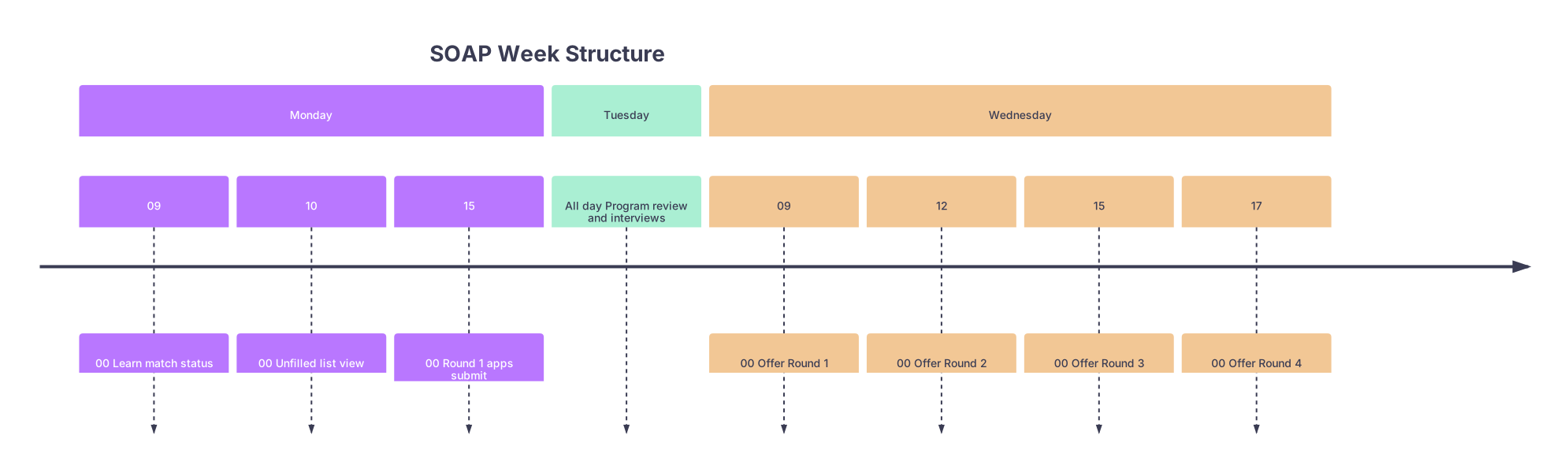
| Period | Event |
|---|---|
| Monday - 09 | 00 Learn match status |
| Monday - 10 | 00 Unfilled list view |
| Monday - 15 | 00 Round 1 apps submit |
| Wednesday - 09 | 00 Offer Round 1 |
| Wednesday - 12 | 00 Offer Round 2 |
| Wednesday - 15 | 00 Offer Round 3 |
| Wednesday - 17 | 00 Offer Round 4 |
Offer Round 1 (Wednesday 9:00 a.m. ET)
Either you get an offer, or you do not.
If you receive an acceptable offer:
- You accept. SOAP is over for you.
- The number of extra programs becomes irrelevant.
If you do not get an offer:
At this point you should:
Look at the pattern
- Did programs that interviewed you also fail to offer you?
That means your competitiveness is weaker than you or they hoped. - Did almost no one interview you?
That suggests your Round 1 list was too narrow or too ambitious.
- Did programs that interviewed you also fail to offer you?
Decide your Round 2 expansion volume
You now have 15 extra applications you can send.
How many to use?
- If you had multiple interviews and some felt warm:
- Use 5–10 additional applications, holding a few for later rounds.
- If you had few or no interviews:
- Use all 15 now. You need more shots on goal.
- Decide where to put those 15
Your strategy should diversify, not just deepen the same failing approach.
- If your primary specialty ignored you:
- Shift to backups and more flexible programs.
- Example: You applied to 25 IM and 15 FM in Round 1, no offers. For Round 2, send all 15 to FM/Psych/Peds, not more IM.
- If backups responded but primary did not:
- Double down on the responding fields. They are your lifeboat.
Offer Round 2 (Wednesday 12:00 p.m. ET)
Similar logic. Check for offers. Adjust.
If still no offer:
At this point you should:
- Accept your position on the spectrum
By now you have decent evidence of where programs see you:
- If you have interviews but no offers, you are borderline.
- If you have almost nothing, you are severely under-matched to your application choices.
- Use remaining capacity strategically
You again have up to 15 more applications.
Guidance:
- If this is your second straight round with silence:
- Use all 15 now, and send them almost exclusively to:
- Less competitive specialties
- Community programs
- Geographically less popular areas
- Use all 15 now, and send them almost exclusively to:
- If you had meaningful interviews late Tuesday / Wednesday morning:
- You may use 10–15 more, but still prioritize:
- Places that tend to be more open to DO/IMG
- Programs without Step 1/2 score cutoffs listed
- You may use 10–15 more, but still prioritize:
Many applicants make the mistake of “doubling down on dream specialties” at this point. It is almost always the wrong move.
Offer Rounds 3 and 4 (Wednesday 3:00 p.m. and 5:00 p.m. ET)
By these rounds, you should stop thinking about SOAP as “rescuing my ideal plan” and fully shift to “rescuing this application cycle at all.”
If you are still without an offer after Round 3:
At this point you should:
- Use every remaining application slot (up to the 90 limit) in Round 4.
- Prioritize:
- Any program still unfilled that:
- Accepts your degree/visa type
- Is in a specialty you would not absolutely hate
- Even if geography is not ideal
- Even if prestige is zero
- Any program still unfilled that:
Do not leave unused applications on the table. I have watched people end SOAP with 20 unused slots because they clung to “better fit” programs. They then spent an entire year scrambling for research or prelim spots instead of already being in a residency.
Quick Specialty-by-Specialty Numbers Reality Check
Some specialties simply do not give you the luxury of being picky in SOAP.
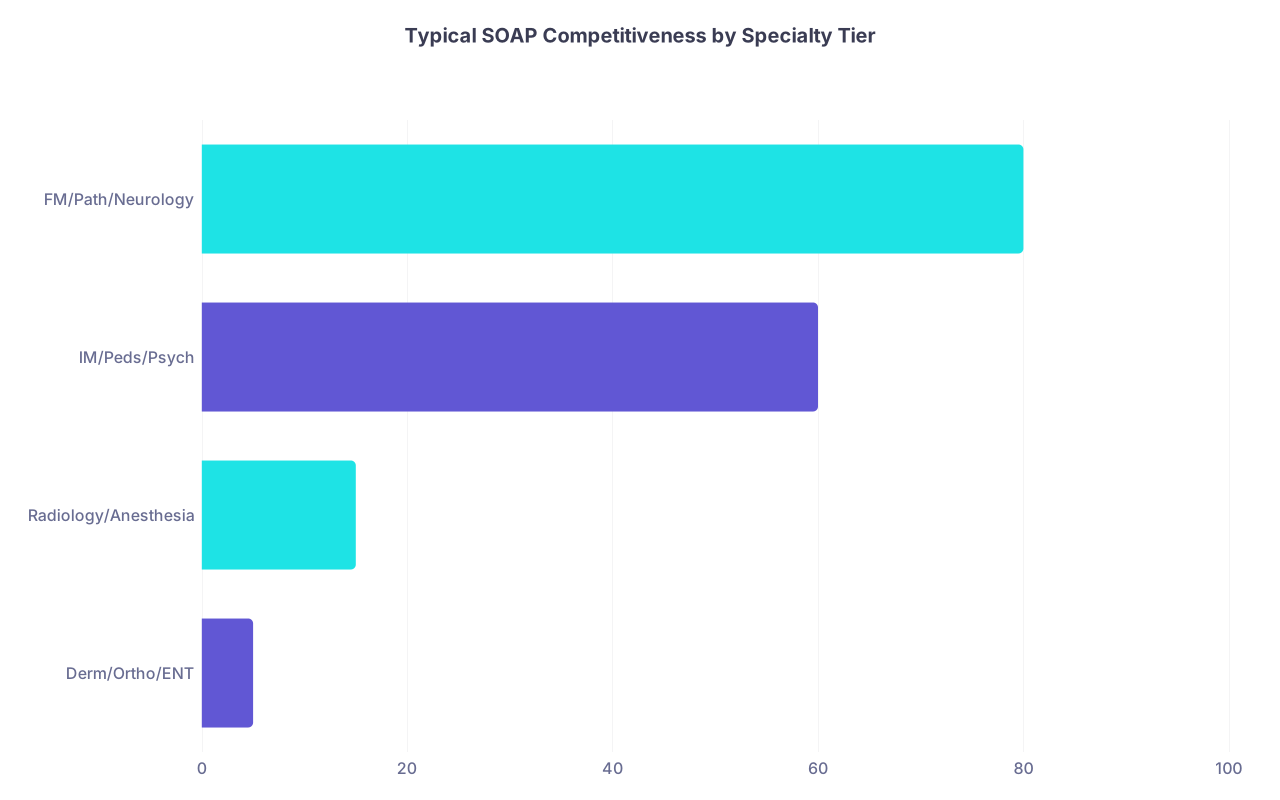
| Category | Value |
|---|---|
| Derm/Ortho/ENT | 5 |
| Radiology/Anesthesia | 15 |
| IM/Peds/Psych | 60 |
| FM/Path/Neurology | 80 |
Think like this when choosing how many programs in each direction:
- Highly competitive (Derm, Ortho, ENT, Plastics, etc.)
- If these appear on the list at all:
- You apply to every single one you even remotely fit.
- But you do not build your entire SOAP plan around them.
- If these appear on the list at all:
- Moderately competitive (Radiology, Anesthesia, EM in some years)
- Reasonable to allocate 5–10 spots if multiple are unfilled and you are close to their usual metrics.
- Core fields (IM, Peds, Psych)
- Where most of your realistic categorical chances will live.
- Often justify 15–30+ programs depending on availability.
- Historically less competitive (FM, Path, some community IM)
- Your volume workhorses.
- High-risk applicants should send 20–40+ applications across these by late SOAP if spots exist.
After SOAP: If You Still Do Not Have a Spot
If you walk out of Round 4 without an offer, the number of programs you applied to matters less than what you learned.
At this point you should:
- Log:
- Total programs per specialty
- Interview count per specialty
- Where you got even mild interest
- Use this to decide:
- Do you reapply in the same specialty with a gap year?
- Do you pivot permanently to a field that clearly showed more interest?
But that is another timeline for another day.
Two Days Before, Two Hours After, Two Rounds In: Key Moves
Condensing everything:
Two–three days before Monday
- Pre-decide your tiers and your Round 1 volume.
- Build personal statement variants and a numbers framework so you can move fast.
Two hours after you see “No Match”
- Analyze the unfilled list and commit to a 30–45 program Round 1 distribution across primary, adjacent, and backup specialties based on your actual competitiveness.
Two offer rounds in with no position
- Stop being selective. Use all additional application capacity toward realistic, less competitive programs, even if they are not where you pictured yourself training.
- Never end SOAP with unused application slots.
You do not control who offers you a position. You do control how many realistic doors you knock on, and when. In SOAP, timing and volume are not details—they are the entire game.