
The biggest mistake people make in NRMP Rank Week is pretending it’s a math problem when it’s actually a timeline problem.
You do not wake up on Rank List Deadline Day and decide “how many programs to rank.” By then, your options are already locked in by what you did during interview season. At that point, you’re mostly arranging deck chairs.
Here’s the straight answer up front:
- If you’re a US MD senior in a non-ultra-competitive specialty and you interviewed at 10 programs, you should almost always rank all 10.
- If you’re DO, IMG, lower Step scores, switching specialties, or in a competitive field (derm, ortho, plastics, ENT, etc.), you rank every single program where you’d be willing to train. No pride, no ego.
- The only programs you leave off your list are the ones you’d rather go unmatched than attend.
Now let’s walk this chronologically—the way your brain is actually experiencing it.
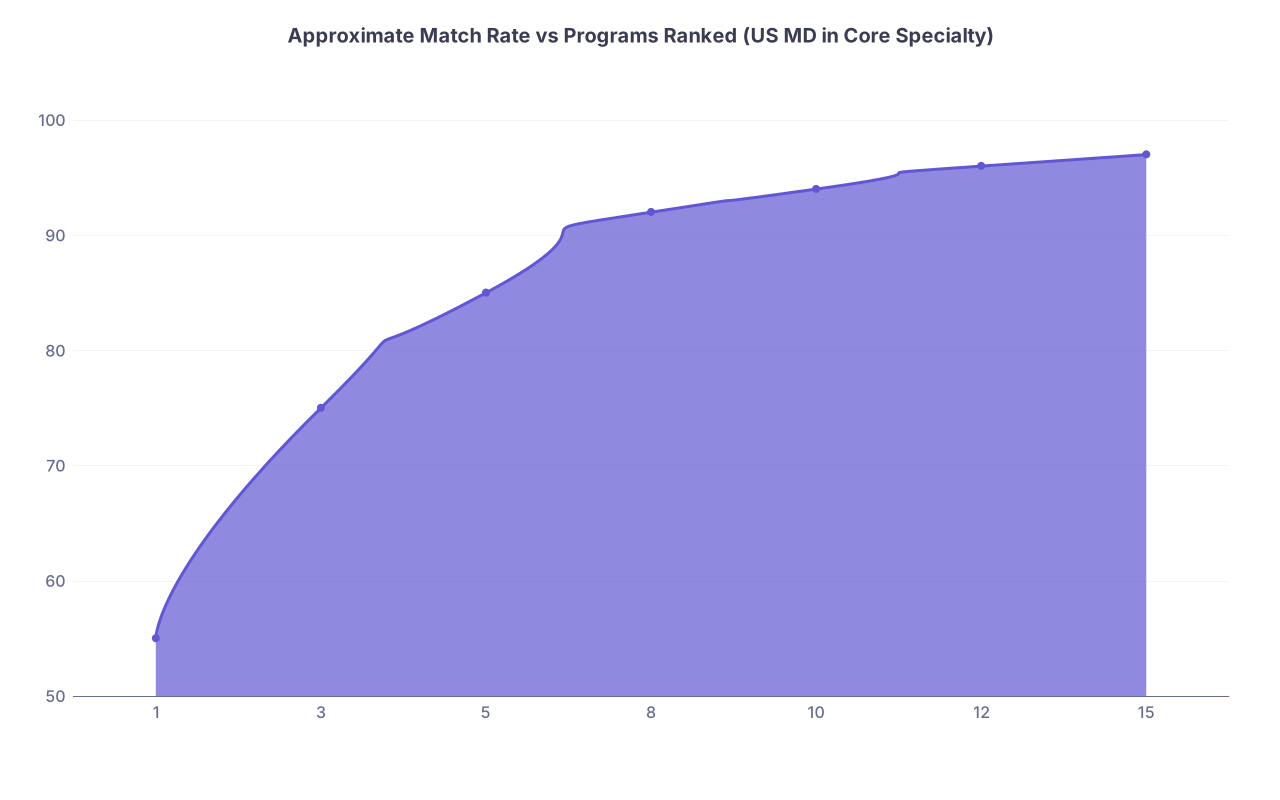
Big Picture: How Many to Rank vs How Likely You Are to Match
At this stage, you’re not deciding where to apply. You’re deciding how many of the places you already interviewed at should make your list.
The NRMP gives you the data. People just ignore it.
| Category | Value |
|---|---|
| 1 | 55 |
| 3 | 75 |
| 5 | 85 |
| 8 | 92 |
| 10 | 94 |
| 12 | 96 |
| 15 | 97 |
So:
- Ranking 1–3 programs? Dangerous unless you’re a superstar in a less competitive specialty with strong home support.
- 8–12 programs? That’s where match probability starts to plateau for many US MDs in IM, peds, FM, psych, etc.
- More than 15? Diminishing returns, but still helps if your application is weaker or specialty is tougher.
But that’s the macro view. Rank Week is lived day by day.
Two Weeks Before Rank List Deadline: Reality Check
At this point, you should:
List every program that interviewed you.
Spreadsheet, notebook, whatever. One line per program.Tag yourself honestly (this determines how aggressive you need to be with list length):
- US MD vs DO vs US-IMG vs non-US IMG
- Specialty: low-, mid-, or high-competitiveness
- Any red flags: failed exams, gap years, visa needs, late specialty switch, limited geographic flexibility.
Pull NRMP data for your group and specialty.
You want: “Charting Outcomes in the Match” for your applicant type and specialty. Look at:- Mean number of contiguous ranks for people who matched
- Match rate by number of contiguous ranks
At this point you should have a rough target range for how many programs you’d like to rank.
Here’s a simplified, rough guide (not gospel, but close to reality):
| Applicant Type | Core Specialty (IM, Peds, FM, Psych, Neuro, Path) | Competitive Specialty (Ortho, Derm, ENT, Urology*, etc.) |
|---|---|---|
| US MD | 8–10 | 12–18+ |
| US DO | 10–12 | 15–20+ |
| US-IMG | 12–15 | 18–25+ (if even viable) |
| Non-US IMG | 15–20+ | 20+ (very challenging) |
*Urology uses a different match, but the mindset is similar.
If you have fewer interviews than these numbers? Your decision becomes simple:
- Rank every single program that you would not absolutely refuse.
One Week Before: Sort, Then Decide “How Many”
At this point, your brain wants to obsess over “1 vs 2 vs 3.” You need to think in tiers instead.
Create three buckets:
- Tier 1 – Dream/Reach but Realistic
You’d be thrilled to match here, and they’re not utterly out of range. - Tier 2 – Solid Fits
You could see yourself training there without being miserable. Good training, culture at least tolerable. - Tier 3 – Safe / Backups / Flawed but Acceptable
These may be less ideal geographically, less prestigious, heavier workload, or weaker vibes—but you’d still rather be there than unmatched.
Now, at this point you should:
Count them.
- Tier 1: ___
- Tier 2: ___
- Tier 3: ___
- Total potential ranks: ___
Compare to your risk level.
- If your total potential ranks ≥ the minimum suggested for your category → great, you’re playing with enough cards.
- If your total is below the suggested minimum → you have no business trimming your list for anything short of “I’d genuinely rather go unmatched than train here.”
This is the fork in the road:
- Safe strategy: Rank every program that’s not toxic.
- Risky (and usually dumb) strategy: Cut a bunch of “meh” programs because you “couldn’t be happy there.”
I’ve watched people talk themselves into the second one. Then not match. Then they’re crying in a hallway on SOAP Monday, saying, “I just didn’t see myself there.”
Your future self in SOAP doesn’t care that the call schedule was bad or the city was ugly. They care that they’re scrambling for any open spot.
3–4 Days Before Deadline: Deep Dive Program by Program
Here’s where you make the final call about including or excluding each program. Do this before you obsess about order.
For each program, spend 5–10 minutes and answer:
- Would I rather go unmatched than train here?
- If yes, leave it completely off your rank list.
- If no, it belongs somewhere on your list.
- Did I observe any true red flags?
- Systemic abuse or discrimination
- Residents openly miserable + high attrition
- Massive, chaotic patient overload without support
- Safety concerns (physical or psychological)
These can justify excluding a program even if your numbers are weak.
- Is my dislike based on:
- Ego (“too community for me”)
- Minor preferences (weather, nightlife, hospital aesthetics)
- One awkward interview day interaction
Those are not good enough reasons to risk going unmatched if you’re below-average in competitiveness.
At this point you should have:
- A final “include” list
- A clear sense: “I am ranking X programs.”
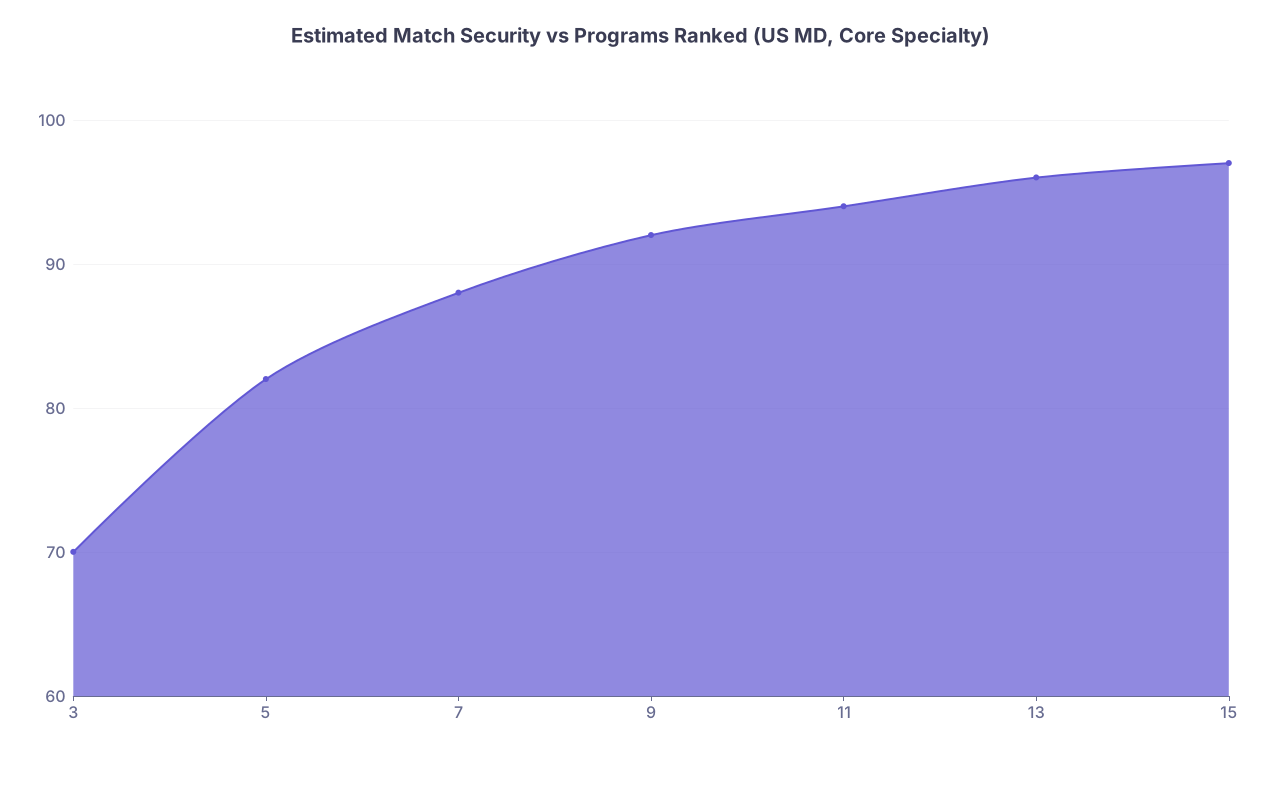
Here’s a rough match-safety gut check for US MDs in core specialties:
| Category | Value |
|---|---|
| 3 | 70 |
| 5 | 82 |
| 7 | 88 |
| 9 | 92 |
| 11 | 94 |
| 13 | 96 |
| 15 | 97 |
For DO and IMG applicants, shift that curve right: you generally need more ranks to get similar safety.
1–2 Days Before Deadline: Ordering vs Counting
By now, the “how many” piece should largely be solved.
You know:
- Total interviews: X
- Total you’re willing to attend: Y
- You’ve accepted that you’re ranking all Y unless a program is truly unacceptable.
So, what should you be doing now?
Step 1: Final Sanity Check on “How Many”
Ask yourself:
- Is my number of ranked programs:
- Above the NRMP average for matched applicants like me? → You’re safer.
- Below that average? → You’re voluntarily skating on thin ice.
If you’re below average and still thinking about removing places for soft reasons, you’re gambling with your own future.
At this point you should lock in a rule:
- “I will not remove any program unless I can clearly say: I would rather go unmatched than train here.”
Write that down if you have to.
Step 2: Now Worry About Order
People get this backwards and it hurts them. You decide which first. Then order.
Once you’re set on Y programs:
- Put them in true preference order
- The algorithm works in your favor; gaming it is almost always dumb.
Rank List Deadline Day: Last 6–8 Hours
Here’s the play-by-play of what you should be doing on the actual deadline day.
Morning (6–8 hours to deadline)
At this point you should:
Log in to NRMP early.
Servers get hammered in the final hours every year. Do not test their capacity and your luck.Check that every program you intend to rank is visible.
- Correct program codes
- Correct specialties (prelim vs categorical vs advanced)
- No duplicates or errors
Count again.
- Total ranks: ___
- Compare to what you decided earlier in the week.
- If you’ve suddenly gotten “braver” and removed programs last minute, ask yourself if that’s courage or self-sabotage.
Afternoon (3–4 hours to deadline)
This is the time for final rational decisions—not emotional flailing.
At this point you should:
- Print or write out your rank list on paper.
- Go program by program and say out loud (yes, literally):
- “I would prefer to train here rather than at any program below this line, and I would rather train here than be unmatched.”
If you can’t say that for a program, it doesn’t belong on the list.
- “I would prefer to train here rather than at any program below this line, and I would rather train here than be unmatched.”
But notice: this is now about order, not how many. The count is already set.
Final Hour
You’re not making smart decisions in the last 60 minutes. You’re making fear-based ones.
Your only jobs in the last hour:
- Confirm:
- All intended programs appear
- The list is in your true preference order
- Number of programs ranked matches what you chose when you were calm
- Save and verify confirmation from NRMP. Screenshot it.
If you find yourself deleting programs for vibe-based reasons in the last 20 minutes? Stop. Step away. You are not that special and the algorithm does not care about your impulses.
Special Situations That Change “How Many”
Let me walk through three scenarios where the raw numbers matter even more.
1. You Have 4 or Fewer Interviews
At this point you should forget pride. Entirely.
- Rank every single program where:
- You can physically live there
- You would not be in personal danger
- You would not be ethically compromised
Do not say things like “I’ll just SOAP into something better.” SOAP is a bloodbath, not a backup plan.
2. You’re Couples Matching
Couples matching breaks people’s brains. They start thinking like they have 12–14 ranks when in reality they only have like 6 viable pairs.
At this point (before Rank Week), you should have already:
- Counted unique pairs you can realistically rank.
- Understood that couples often need more total interviews across both partners to get a safe number of pairings.
During Rank Week:
- Aim for as many reasonable pair combinations as possible.
- Do not slash pairings just because one side is “less ideal” if:
- The alternative is one or both of you being unmatched.
- Again, the question is: “Would we rather go unmatched than be in this pairing?”
Only then should you exclude it.
3. You’re Applying in a Very Competitive Specialty
Derm, ortho, neurosurgery, ENT, plastics, IR, etc.
By Rank Week you usually already know if you’re playing in the major leagues or you’re just glad to have interviews.
If:
- You have <10 interviews in these specialties and no strong home support → you’re at real risk.
- You have a backup specialty list? Your total number of ranked programs across both specialties becomes your safety net.
At this point you should:
- Rank all competitive specialty programs you’d attend.
- Rank backup specialty programs too, unless you truly would prefer going unmatched and trying again over doing that other specialty.
Most people talk tough about that… until they’re staring at “You did not match.”
Quick Mental Models to Decide “How Many”
When you’re tired and anxious, having a couple of rules of thumb helps.
Use these:
The Floor Rule
“This is my floor number of ranks. I will not go below it.”- US MD, core specialty: floor around 8–10
- DO/IMG, core: floor around 10–15
- Competitive specialty: floor 12–18 depending on your stats
The No-Regrets Rule
“Could future me, on Match Day, look back and say, ‘I did everything reasonably possible’?”
If you’re cutting programs just because you’re tired of thinking about them, that’s not “reasonable.”The Unmatched vs Miserable Trade Rule
Only leave a program off if you clearly decide:
“I would rather go entirely unmatched than spend 3–7 years there.”
If your real thought is closer to:
“I’d be unhappy but I’d survive and be a board-certified physician at the end” → it usually belongs on the list.
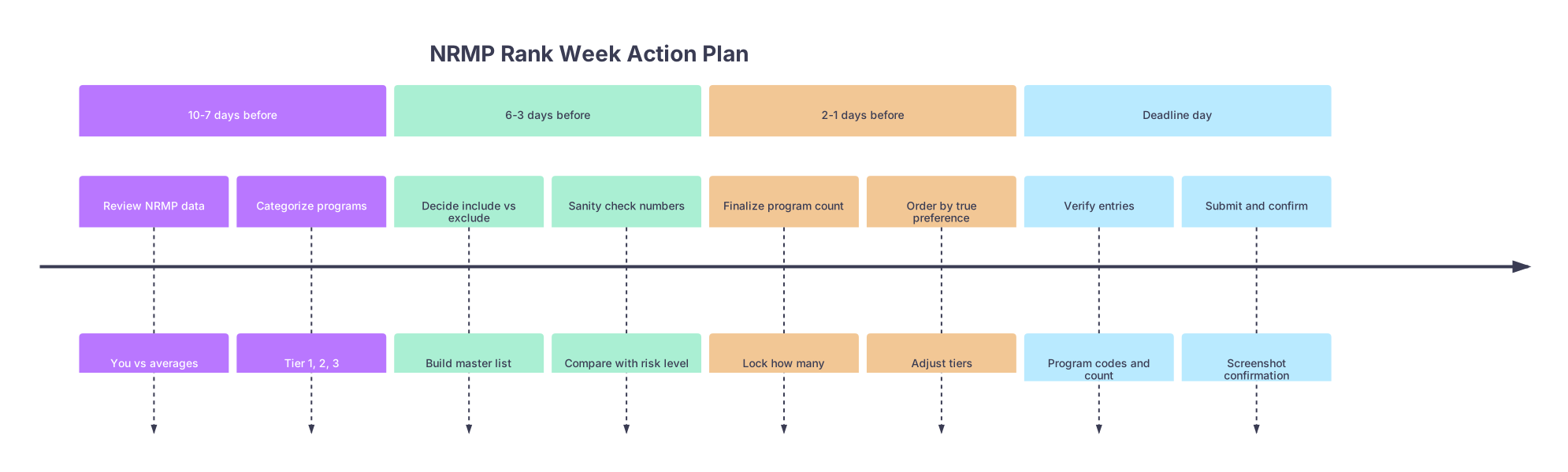
Visual Timeline: What You Should Be Doing When
| Period | Event |
|---|---|
| 10-7 days before - Review NRMP data | You vs averages |
| 10-7 days before - Categorize programs | Tier 1, 2, 3 |
| 6-3 days before - Decide include vs exclude | Build master list |
| 6-3 days before - Sanity check numbers | Compare with risk level |
| 2-1 days before - Finalize program count | Lock how many |
| 2-1 days before - Order by true preference | Adjust tiers |
| Deadline day - Verify entries | Program codes and count |
| Deadline day - Submit and confirm | Screenshot confirmation |
One Last Thing: Stop Chasing “Perfect”
Your rank list will not be perfect. Nobody’s is.
The point is not perfection. The point is:
- You rank enough programs for your risk category.
- You leave off only the places you’d legitimately rather not match than attend.
- You order them honestly by preference, not by what you think programs think about you.
If you remember nothing else:
- Decide which programs to rank first, and almost always include every place you’d actually attend.
- Only exclude a program if you’d truly rather go unmatched than spend years training there.
- Set a realistic minimum number of ranks based on your applicant type and specialty—and do not drift below it in a last-minute panic.
Hit those three, and you’ve done Rank Week better than most.