
The worst residency lists are built before score release and never touched again.
Your Step 2 CK score drops (or jumps), programs quietly update filters, and you keep clinging to the same 80-program list you made in April. That is how people waste thousands of dollars—and still under-apply where they actually have a shot.
Here is the fix: a strict, time-based system from the moment your score is released until the ERAS deadline that tells you, week by week, how many programs you should be planning to apply to and when to change that number.
Big Picture: The 4-Phase Window From Score Release to ERAS Deadline
From the day your Step score posts to ERAS submission close, you move through four distinct phases. Each phase has a different job and a different target list size.
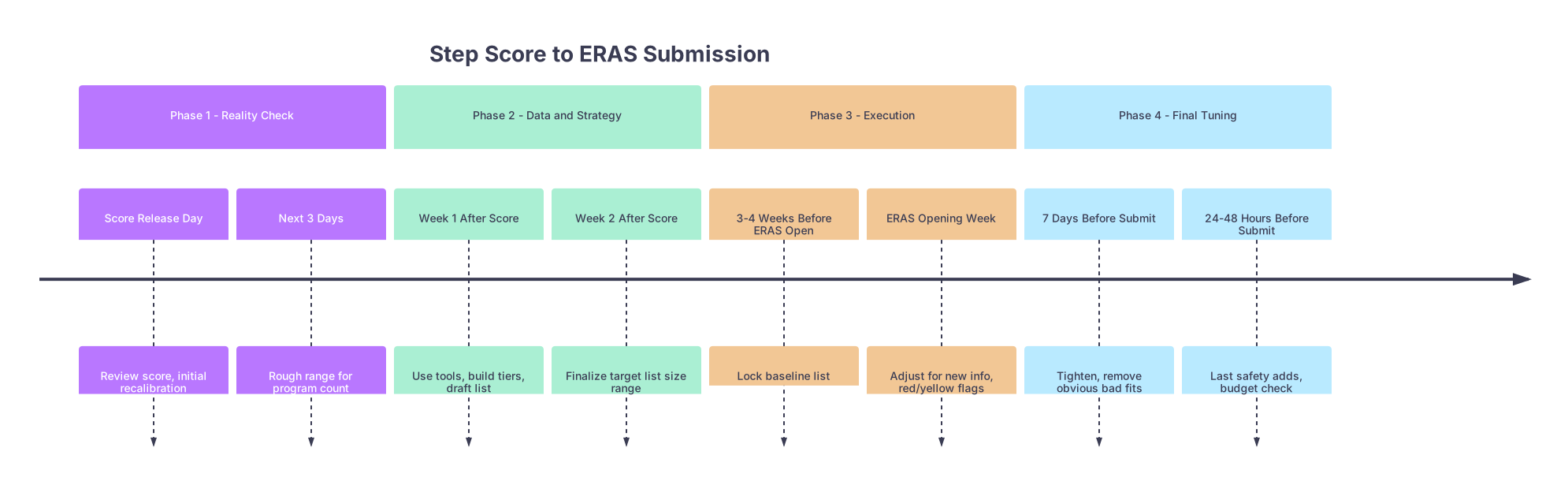
| Period | Event |
|---|---|
| Phase 1 - Reality Check - Score Release Day | Review score, initial recalibration |
| Phase 1 - Reality Check - Next 3 Days | Rough range for program count |
| Phase 2 - Data and Strategy - Week 1 After Score | Use tools, build tiers, draft list |
| Phase 2 - Data and Strategy - Week 2 After Score | Finalize target list size range |
| Phase 3 - Execution - 3-4 Weeks Before ERAS Open | Lock baseline list |
| Phase 3 - Execution - ERAS Opening Week | Adjust for new info, red/yellow flags |
| Phase 4 - Final Tuning - 7 Days Before Submit | Tighten, remove obvious bad fits |
| Phase 4 - Final Tuning - 24-48 Hours Before Submit | Last safety adds, budget check |
You are trying to answer one central question: “Given my score and profile, how many programs should I actually apply to in this specialty?”
You will not get that answer in one sitting. You refine it over time.
Phase 1: Score Release Day – 72 Hours After
Immediate reality check and emergency list triage
Day 0: Score Release Day – Initial Recalibration (1–2 hours)
At this point you should stop thinking in feelings and start thinking in ranges.
Classify your score relative to your specialty Use simple buckets:
- Well above average for your specialty
- Roughly ≥ +10 over recent matched averages
- Around average
- Within ±5 of recent matched averages
- Below average / borderline
- −5 to −12 or so below
- Significantly below / at-risk
12 below or below many programs’ informal filters
If you have not looked at recent data, pull it now:
- NRMP Charting Outcomes (by specialty)
- Program sites that list expectations (“typically >240”, “no minimum but average 245”, etc.)
- Well above average for your specialty
Immediate list-size reaction by bucket
You are not finalizing, only recalculating directionally:
Well above average:
- If you were planning 60 programs, you can probably land in the 35–50 range in many core fields (IM, Peds, Psych, FM).
- For competitive (Derm, Ortho, ENT, Plastics): you still apply broadly, but you might avoid 100+ insanity. Think 60–80 instead of 90–120.
Around average:
- Whatever number you had before score release is probably in roughly the right ballpark.
- Expect a working range, not a single number. Example: “I was thinking 45. With this score, I should be in the 40–60 band.”
Below average / at-risk:
- Your pre-score list size is almost certainly too small.
- Add 15–30 programs conceptually to your target range. You will refine which ones later.
- Also be prepared to consider:
- More community-heavy programs
- More geographic spread
- Possibly a parallel-plan specialty (FM vs IM, Path vs IM, etc.)
Score-day emergency edits On Day 0 you only do fast, high-yield actions:
- Delete:
- Ultra-elite programs that openly publish higher minimums than your score
- Programs that explicitly say “we rarely sponsor visas” if you are IMG/visa needing
- Add:
- A few realistic safeties based on quick filters (community-based, less desirable locations, new programs)
Target outcome for Day 0:
- A provisional range for list size, not perfection.
- Example: “I am aiming for 55–75 programs in IM based on being slightly below average as an IMG.”
- Delete:
Phase 2: Week 1–2 After Score Release
From emotional reaction to data-backed strategy
This is the critical period where most people either overreact and apply to 120 programs blindly or underreact and cling to a prestige-heavy list that does not like their score.
Days 1–3 After Score: Build Your Score-Adjusted Profile
At this point you should integrate your score into the rest of your application, not consider it in isolation.
Create a quick grid:
| Factor | Strong | Average | Weak |
|---|---|---|---|
| Step 2 CK | |||
| Clerkship grades | |||
| Research output | |||
| Letters | |||
| School reputation/IMG status |
Mark honestly. I have seen too many people with a 250 and weak letters act like they are automatic for top 20 programs. They are not.
Rough rules of thumb for baseline list-size ranges (single specialty, U.S. MD, non-IMG, no glaring red flags):
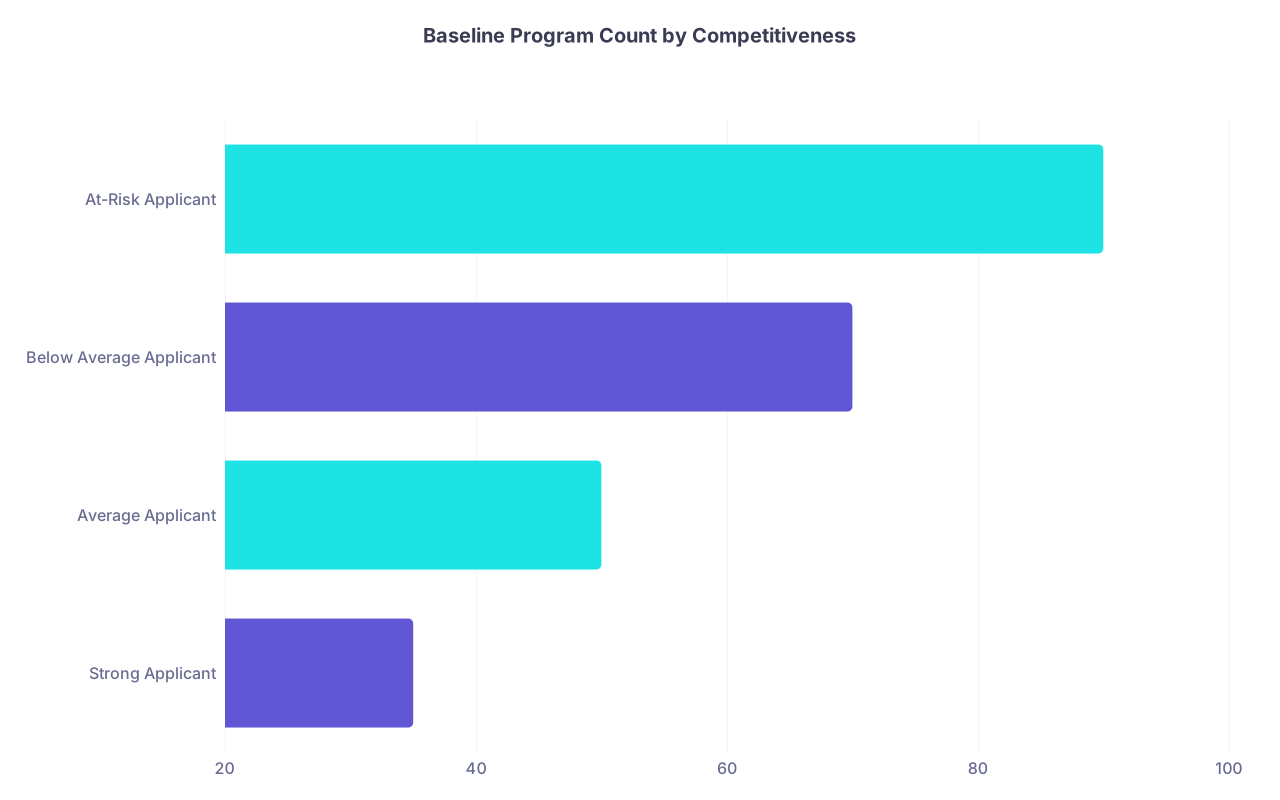
| Category | Value |
|---|---|
| Strong Applicant | 35 |
| Average Applicant | 50 |
| Below Average Applicant | 70 |
| At-Risk Applicant | 90 |
Interpretation:
- Strong: 30–40 (more for competitive specialties)
- Average: 45–60
- Below average: 65–80
- At-risk: 80–100+
If you are IMG or have fails/major red flags, shift the range up one category.
Days 3–7 After Score: Use Tools and Filters, Draft the First Real List
Now you translate that range into specific programs.
At this point you should:
Use data tools
- Residency Explorer
- FRIEDA
- Program websites + past interview lists from your school
Create three tiers of programs Start by overshooting your target range, then trim later.
- Tier 1 – Realistic / Core (about 50–60% of eventual apps)
- Your score and profile align closely with their averages
- They do not state cutoffs higher than your score
- Tier 2 – Reach (20–30%)
- A bit score-heavy, more academic, or high-demand location
- Tier 3 – Safety (20–30%)
- Historically take lower scores, community-based, less competitive regions
Example for an average IM candidate targeting 50 programs:
- 25–30 core
- 10–15 reach
- 10–15 safety
- Tier 1 – Realistic / Core (about 50–60% of eventual apps)
End of Week 1 Target
- You should now have:
- A working list 1.2–1.5x larger than your target.
- Example: if you plan to apply to ~60 programs, your draft list might have 75–90.
- Programs labeled by tier and flagged for obvious misfit issues (location you truly will not go to, incompatible visa policies, etc.)
- A working list 1.2–1.5x larger than your target.
- You should now have:
Week 2 After Score: Finalize the Target Range
By the end of Week 2, your list size should not be a complete guess anymore.
At this point you should:
Pressure-test list size with mentors
- Ask 1–2 people who actually sit on your specialty’s selection committee or recently matched:
- “Given this profile, is 55–65 programs in IM reasonable?”
- Listen if they say: “With that Step and IMG status, 80 is safer.” They have seen the match data you have not.
- Ask 1–2 people who actually sit on your specialty’s selection committee or recently matched:
Adjust for specialty competitiveness and parallel plans A few specific patterns I have seen repeatedly:
Derm, Ortho, ENT, Plastics, Neurosurgery
- Even with strong scores, lists in the 60–90 range are common.
- If you are below average for these, you probably need:
- A serious parallel plan specialty and
- 80–120 programs total across both specialties.
IM, Peds, Psych, FM, Neurology
- Strong applicants: 30–45
- Average: 45–60
- Below average or IMG: 65–90
EM and the current volatility
- Talk to current residents. The landscape has shifted. You may be able to lean slightly smaller, but only if you know recent match numbers from your school.
Lock a target band, not a single number By end of Week 2 you should end with a sentence like:
- “Given my 232 CK, solid passes on rotations, and IMG status, I should be in the 80–100 program range for IM, with at least 30–35 true safeties.”
That sentence will anchor every decision from here on.
Phase 3: 3–4 Weeks Before ERAS Opens – Locking the Baseline List
Now your job shifts from “how many” to “which ones” within that range. But list size still moves. Slightly.
4 Weeks Before ERAS Opens: Confirm Budget vs. List Size
At this point you should match desire to bank account. No way around it.
Rough cost structure for ERAS (Numbers change, but the pattern is the same: first 10 programs cheap, next blocks more expensive.)
Use a simple mindset:
- 20 programs: relatively inexpensive
- 40–60: moderate but tolerable
- 80–100+: you are spending real money
Check if your target range is financially realistic
- If you need 90 applications but can truly afford 60:
- You must:
- Increase safety proportion
- Consider adding a less competitive parallel specialty where 35–50 apps might be adequate
- Sacrifice some high-prestige reaches
- You must:
- If you need 90 applications but can truly afford 60:
Fix a “hard ceiling” and a “soft goal” Example:
- Soft goal: 65 programs
- Hard ceiling: 80 programs
You will aim for 65 and only go past 70–75 if multiple mentors tell you you are still under-applying.
3 Weeks Before ERAS Opens: Program-by-Program Fit Check
At this point you should already have a spreadsheet or tracker with columns for:
- Program name
- Tier (reach/core/safety)
- Location
- Visa/fellowship/research notes
- Red flags (explicit cutoff above your score, no IMGs, etc.)
Your task:
Trim obvious fantasy reaches
- Any program:
- Publicly states minimum ≥ your score + 10
- Has almost exclusively AMGs from top schools
- Historically takes 5–10 residents per year all from one region/school cluster
- Any program:
Backfill with realistic safeties
- If after trimming your total falls below your soft goal:
- Add more safeties in undesirable-but-acceptable locations:
- Rust belt community programs
- Less popular states
- Places with high service burden but solid match outcomes
- Add more safeties in undesirable-but-acceptable locations:
- If after trimming your total falls below your soft goal:
End of this step:
- Your baseline list size should be near your soft goal.
- Your ceiling is still in reserve for later panic or late program discoveries.
Phase 4: ERAS Opening to Submission Deadline – Micro-Adjusting List Size
Once ERAS opens, your list size should be relatively stable. But there are still points where you adjust.
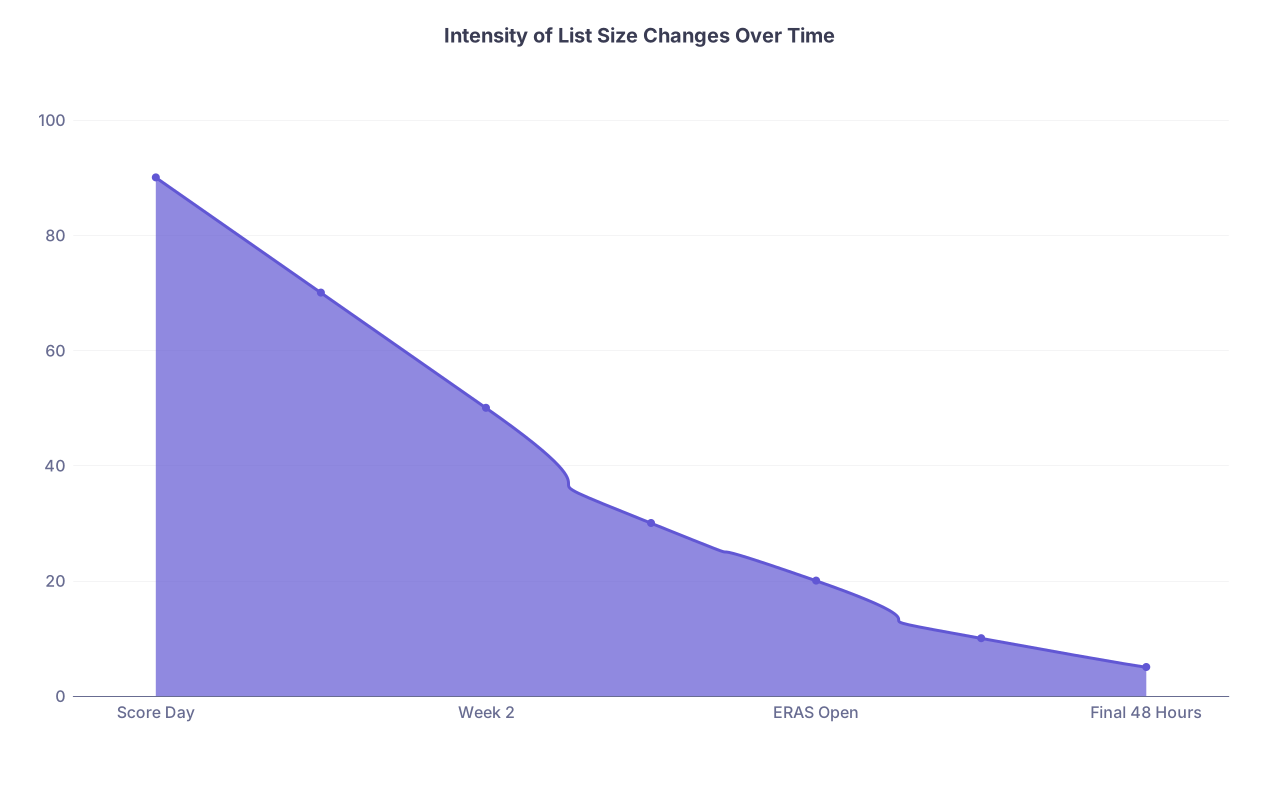
| Category | Value |
|---|---|
| Score Day | 90 |
| Week 1 | 70 |
| Week 2 | 50 |
| Pre-ERAS | 30 |
| ERAS Open | 20 |
| 1 Week Pre-Deadline | 10 |
| Final 48 Hours | 5 |
Interpret that chart as:
- The earlier you are, the more you should be changing the list.
- By the last 48 hours, you change very little.
ERAS Opening Week: Quiet Program Updates, Small Shifts
Programs sometimes update:
- Preferred minimum scores
- Visa policies
- Website language on research, diversity, or regional preference
At this point you should:
Scan 10–15 borderline programs Focus on programs where:
- Your score is just at/under their usual range
- You are applying mainly for location or prestige reasons
Make small, principled cuts or additions
- Cut:
- Newly posted strict cutoffs above your score
- Programs that explicitly state “we do not sponsor visas” (if you need one)
- Add:
- 3–5 replacement safeties if cuts drop you below your soft goal
- 2–3 schools where a mentor has a real connection and will contact on your behalf
- Cut:
List size movement here should be ±5–10 programs, not major swings.
7–10 Days Before Submission: The Last Rational Adjustment Window
This is your final serious chance to re-evaluate whether your list size matches your risk tolerance.
At this point you should:
Ask: “What if interview yield is lower than expected?”
- If you are in any at-risk category (IMG, low score, red flags, unusual path):
- Consider using some of your ceiling.
- Add 5–15 programs, mostly in the safety bucket.
- If you are strong and already well above your mentors’ recommended range:
- You can comfortably trim 5–10 obvious long shots and save money.
- If you are in any at-risk category (IMG, low score, red flags, unusual path):
Run the “night before Interview Spreadsheet” test Imagine three months from now, looking at your interview tally:
- Would you rather:
- Regret applying to 10 extra safeties you never interviewed at, or
- Regret missing interviews because you capped at 40 programs to save a few hundred dollars?
- Would you rather:
If you are below average or IMG, the answer is usually clear. Slight over-application is safer than wishful thinking.
Final 48 Hours Before You Hit Submit: Micro, Not Macro
By this point, if you are radically altering your list size, something upstream went very wrong.
At this point you should:
Do a last pass for obviously bad choices
- Programs in cities you truly will not move to
- Places that do not match your dealbreakers (OB-heavy vs. OB-light, heavy call vs. night float, etc.)
- Duplicates or programs you added by mistake
Spend your last 3–5 “emergency slots”
- Add:
- 2–3 extra safeties in less desirable areas
- 1–2 programs where you suddenly gained a real connection (alumni, away rotation, mentor email)
- Add:
Do not:
- Add 20 reach programs in coastal cities at the last second to “get lucky.”
- Panic-apply to completely random places you know nothing about.
Small, measured moves only.
Special Situations That Change List Size Late
A few things can happen between score release and ERAS deadline that legitimately force real-time list-size recalculation.
Late New Score (e.g., Step 2 CK Comes Back High Right Before ERAS)
If a new, much stronger score posts close to the deadline:
- You can:
- Shift some applications from safety to core/reach.
- Trim a modest number of low-yield safeties.
- You should not:
- Cut your overall list below your previously recommended range.
- You do not know yet how heavily programs will rely on each score component.
Negative New Information (Failed Attempt, Failed Rotation, Bad Grade)
If you receive bad news late:
- Do not shrink your list size. Ever.
- Strongly consider:
- Increasing safeties by 10–20 programs
- Adding or solidifying a parallel specialty
- Getting explicit mentor input about whether your previously chosen list is still adequate
This is one of the few times where a meaningful late increase in program count is rational.
Visual Snapshot: When to Change List Size (and How Much)
| Time Point | Typical Change Size | Reasonable Direction |
|---|---|---|
| Score Release Day | ±15–30 programs | Major recalibration |
| Week 1–2 After Score | ±10–20 programs | Data-driven refinement |
| 3–4 Weeks Before ERAS Opens | ±5–15 programs | Budget and fit adjustments |
| ERAS Opening Week | ±5–10 programs | Website updates, policy shifts |
| 7–10 Days Before Submission | ±5–15 programs | Risk check, small expansion |
| Final 48 Hours Before Submission | ±0–5 programs | Minor corrections only |

How to Sanity-Check Yourself at Each Phase
I will give you three simple questions to ask at each stage. If you cannot answer them cleanly, you are not done with your list.
Right After Score Release
- Do I know my competitiveness bucket for this specialty?
- Have I adjusted my old pre-score target number up or down?
- Is my current range realistic based on being strong/average/below average?
End of Week 2 After Score
- Do I have a clear soft goal and hard ceiling for total program count?
- Are at least 20–30% of my programs true safeties based on my profile?
- Have at least 1–2 knowledgeable people agreed my range is sane?
Week Before ERAS Deadline
- If interview yields are slightly worse than average for me, will I still be okay with this list size?
- Does my list size match my risk tolerance and budget, or just my ego?
- Am I making only small tweaks now (as I should), or still fundamentally unsure?

Core Takeaways
- Do not freeze your list before score release and never touch it again. You should re-evaluate your program count in structured phases: score day, Week 1–2, pre-ERAS, and the week before submission.
- Think in ranges anchored to your competitiveness: strong applicants can target 30–45 programs in many fields, average 45–60, below average or IMG 65–100+, and very competitive specialties usually require much broader lists or a parallel plan.
- Big list-size moves belong early; late changes should be small and deliberate. If you are still swinging your count by 20+ programs in the final 48 hours, the problem is not the deadline. It is that you skipped the earlier steps.