
It is December 10th. Your classmates are swapping interview war stories in the residents’ lounge. Group texts are lighting up with “another invite!” or “just got my first rejection.” You are staring at your ERAS dashboard and an uncomfortable thought settles in:
“Is this enough? Or am I about to go unmatched if I do nothing?”
This is the December checkpoint. The point in the cycle where denial stops being helpful and numbers start to matter. At this point you should not be “hoping for the best.” You should be making calculated decisions about:
- Whether to add more programs
- Whether to pivot specialty or program type
- Whether to prepare seriously for SOAP
Let’s walk through this week-by-week and scenario-by-scenario.
Early December: Take Inventory Like an Adult, Not a Hopeful
At this point you should stop thinking in vibes and start thinking in counts.
Step 1 (Today): Count Where You Actually Stand
Open a blank sheet and write three numbers:
- Total programs applied to
- Total interview invites received
- Total interviews you will realistically attend
Then break out by category if it applies:
- Categorical vs prelim vs TY
- Community vs academic
- Geographic spread
Now, compare where you are to what I’ll bluntly call “reasonable safety zones.”
| Specialty Tier | Examples | Reasonable Comfort Zone by Mid-December* |
|---|---|---|
| Very Competitive | Derm, Ortho, Plastics, ENT | 10+ interviews |
| Competitive | EM, Anesthesia, Gen Surg, OB | 10–12 interviews |
| Moderately Competitive | IM, Peds, Psych | 8–10 interviews |
| Less Competitive | FM, Path, Neuro | 6–8 interviews |
*Yes, people match below these numbers. They also play residency roulette. I would not.
If you are comfortably above the zone for your specialty, your job this month is to:
- Lock in and confirm interviews
- Protect time off for travel/virtual days
- Stop panic-applying everywhere
If you are at the lower edge or below these zones, you are not in disaster territory yet, but you are officially in “needs a deliberate strategy” territory.
December 1–10: Decide Which Bucket You Are In
At this point you should categorize yourself. Be honest.
Bucket A: “I’m Probably Fine, But Anxious”
You are:
- IM / Peds / Psych with 10+ interviews
- Gen Surg / OB / EM / Anesthesia with 12+ interviews
- Derm / Ortho / other ultra-competitive with 12–15+ interviews
Action in early December:
- Do not blindly add 30 more programs. That is fear, not strategy.
- Add only if:
- You have a new region you could be happy in, or
- You have a glaring gap (e.g., no community programs, all reach programs)
Bucket B: “Borderline – Could Go Either Way”
You are:
- IM / Peds / Psych with 6–8 interviews
- FM / Path / Neuro with 4–6 interviews
- Gen Surg / OB / EM / Anesthesia with 7–10 interviews
- Ultra-competitive with 8–10 interviews
You are the person December was made for. You need to:
- Tighten your analysis
- Decide whether to add strategically
- Decide whether a parallel plan (second specialty, more community, more prelims) is necessary
Bucket C: “High-Risk for Unmatched”
You are:
- IM / Peds / Psych with ≤5 interviews
- FM / Path / Neuro with ≤4 interviews
- Gen Surg / OB / EM / Anesthesia with ≤6 interviews
- Ultra-competitive with ≤7 interviews
Or worse: 0–2 interviews in any field.
Here you must assume you are at real risk. Not panic. Just math. At this point you should:
- Add programs
- Consider pivoting
- Begin mentally and logistically preparing for SOAP
December 10–20: Add More Programs… But Not Stupidly
This is where many people blow money and gain nothing. “Adding programs” in December does not mean “spraying 50 more applications and hoping.”
You need a targeted pivot, tied to your specific situation.
Step 1: Diagnose Why You Are Short on Interviews
Ask yourself, bluntly:
- Are you below-average on Step scores?
- Are you a reapplicant?
- Are you an IMG / FMG?
- Did you apply mostly to aspirational programs or narrow geography?
- Is your specialty overrun this year (like EM was a few cycles ago)?
The reason matters, because it changes what “adding more programs” actually does for you.
Scenario 1: US MD/DO, Mid Scores, Narrow List
You focused heavily on:
- One geographic area
- Mostly academic centers
- A relatively competitive specialty (EM, Anesthesia, OB, Gen Surg)
You have, say, 6 interviews.
At this point you should:
Open up geography
- Add community-heavy regions: Midwest, South, non-coastal states.
- Stop worrying about “would I love this city?” and start asking “would I learn here and be decently happy?”
Add more community programs
- Aim for 10–20 additional realistic community programs, not 5 more ivory-tower places.
- Check program websites for: recent match lists, % IMGs, % DOs.
Timing reality check
- New applications in early–mid December can still yield some interviews, especially for programs that overestimated their yield.
- Applications after late December are mostly for next year or SOAP positioning.
Scenario 2: IMG / FMG, Low Interviews
This is common. You sent 150+ applications. You have 0–4 interviews.
At this point you should:
- Stop adding the same type of program and expecting a different result. That is delusion.
- Instead, pivot your program type and specialty expectations.
I would recommend:
Reassess specialty realism
If you are IMG + mid / low scores and aimed at:
- EM, Anesthesia, Gen Surg, OB, Ortho, Derm
You should strongly consider a parallel path immediately: IM, FP, Psych, Pathology. Yes, in December.
Look specifically for IMG-friendly programs
- Filter by: programs listing visa sponsorship, high proportion of IMGs on their current roster.
- Use alumni data from your school: where have people with your profile matched?
Apply in a controlled way
- 20–40 targeted additional applications to IMG-friendly, less competitive specialties / programs can still produce interviews in late December / early January.
- Do not send 100 more apps to the same competitive list that already ignored you in October.
Scenario 3: High-Stat Applicant, But Chasing Only Top-20
You have:
- Good scores (260s / top decile)
- Strong letters
- Applied to 40+ programs, but they are almost all “top” institutions in big coastal cities
You have 6–8 interviews. Not a guaranteed match.
At this point you should:
- Accept that “I’ll probably be fine because my stats are great” is not a strategy.
Action:
- Add 10–20 strong, mid-tier academic or hybrid community programs that actually like high-achievers but do not sit in the US News top 10.
- Think places like: “solid state university program in smaller city,” not “another Harvard-equivalent.”
You are not undermatching. You are increasing your odds of matching.
Mid–Late December: Consider a Specialty or Program-Type Pivot
If you are in Bucket C with very low interview counts, you may need more than just “add programs.” You may need to pivot.
Two main pivot types:
- Parallel specialty (e.g., EM → IM, Gen Surg → Prelim + Categorical IM, Derm → TY + IM)
- Prelim / TY year strategy when categorical looks unlikely
Parallel Specialty: When and How to Do It in December
You consider a parallel specialty when:
- Your current field is objectively competitive
- Your interview count is low (≤5) by mid-December
- You are not willing to gamble entirely on SOAP
At this point you should:
Pick one realistic backup specialty
- EM → IM, FM
- Gen Surg → Prelim Surgery + Categorical IM
- Anesthesia → IM, TY + IM
- Derm / Rad Onc / Neuro surg → IM, Prelim / TY
Talk to your dean / advisor this week
- Ask clearly: “If I add a parallel specialty now, what is my chance of interviews for this cycle vs planning for next?”
Add a focused set of programs
- You are late; you do not have the luxury of broad, unfocused scatter.
- Think 20–30 backup specialty programs that are:
- Community-heavy
- Historically less competitive
- In regions that struggle to recruit
Prelim / TY Strategy as a Pivot
This is not glamorous. It is effective.
You consider prelim/TY pivot when:
- You want a competitive categorical field (e.g., Anesthesia, Radiology, Derm, Ortho)
- You have poor interview numbers in the categorical field
- You are willing to play the longer game: do a year → strengthen → reapply
At this point you should:
Add prelim / TY programs in IM, Surgery, or Transitional
- Transitional years are more competitive. Do not rely only on them.
- Mix: 10–20 prelim IM, 5–10 prelim surgery, some TY if realistic.
Adjust your letters if possible
- If you have a mentor in IM or Surgery, reach out now for a letter that frames you as someone who will excel in that environment.
Be ready to explain your plan on interviews
- “I am committed to X specialty long-term, but I want a strong clinical year in IM/Surg to build my foundation.”
Late December: Stop Pure Expansion, Start Match Risk Management
There is a point where more applications do not help. Late December is usually that point.
By December 25–31, your strategy should shift from “chasing more invites” to “protecting against not matching.”
That means:
1. Calculate Your Match Risk Honestly
Use your numbers:
- Competitive specialty with < 8 interviews
- Moderate specialty with < 6 interviews
- Less competitive specialty with < 4 interviews
You are in meaningful risk territory.
Do not expect miracles in January. Yes, some invites trickle in. But you cannot build your entire plan on “maybe 3 more invites will arrive.”
2. Begin SOAP Preparation Quietly
At this point you should prepare for SOAP like you might need it, even if you hope you will not.
That looks like:
- Updating your ERAS experiences and personal statement to be SOAP-ready in a second specialty or backup program type
- Identifying SOAP-appropriate programs / specialties ahead of time (FM, IM, Peds, Psych, Prelim IM/Surg)
- Talking privately to your dean’s office about logistics (how they support SOAP candidates, required forms, etc.)
This is not jinxing yourself. It is what serious adults do.
Parallel Track: Weekly Checkpoints Through December
Let me lay it out week-by-week, because this helps stop the “I’ll deal with it later” cycle.
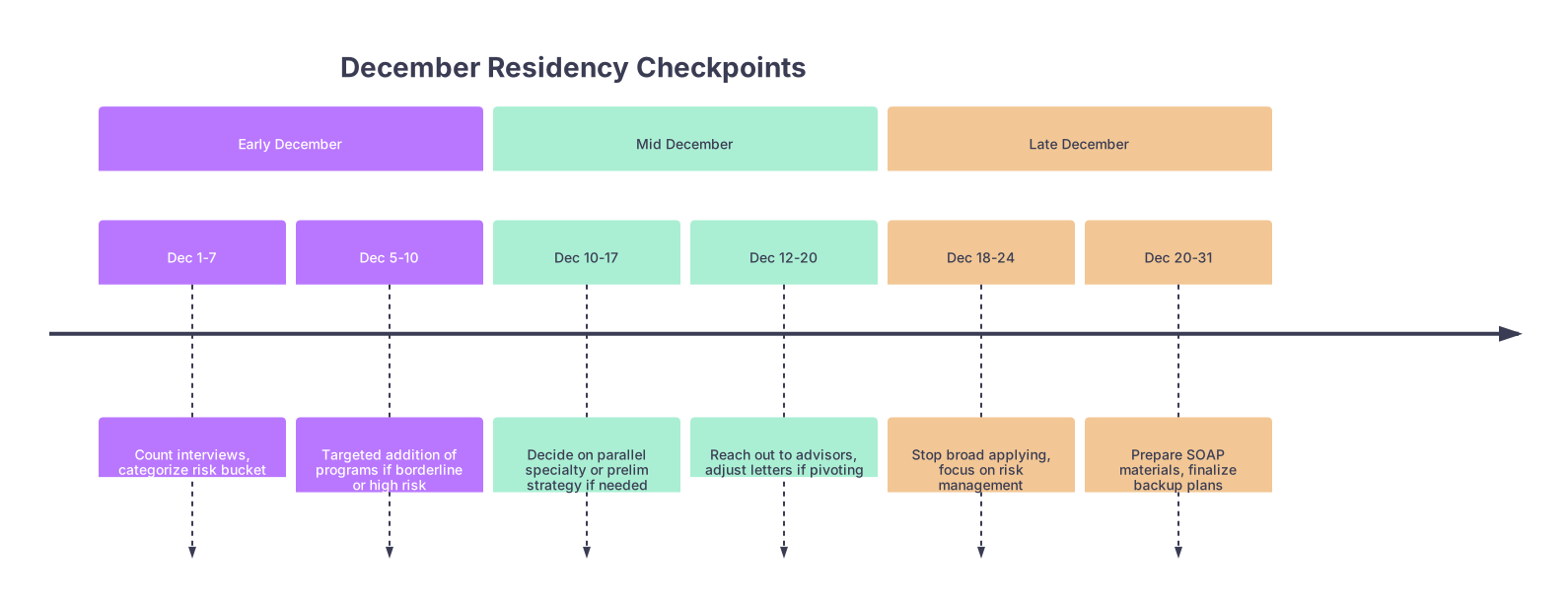
| Period | Event |
|---|---|
| Early December - Dec 1-7 | Count interviews, categorize risk bucket |
| Early December - Dec 5-10 | Targeted addition of programs if borderline or high risk |
| Mid December - Dec 10-17 | Decide on parallel specialty or prelim strategy if needed |
| Mid December - Dec 12-20 | Reach out to advisors, adjust letters if pivoting |
| Late December - Dec 18-24 | Stop broad applying, focus on risk management |
| Late December - Dec 20-31 | Prepare SOAP materials, finalize backup plans |
At each checkpoint, ask a simple question: “If I keep doing exactly what I am doing, what is the most likely outcome in March?”
If the honest answer scares you, you pivot. That week. Not “after the holidays.”
How Many More Programs Should You Actually Add?
You came here for numbers. So let us be concrete.
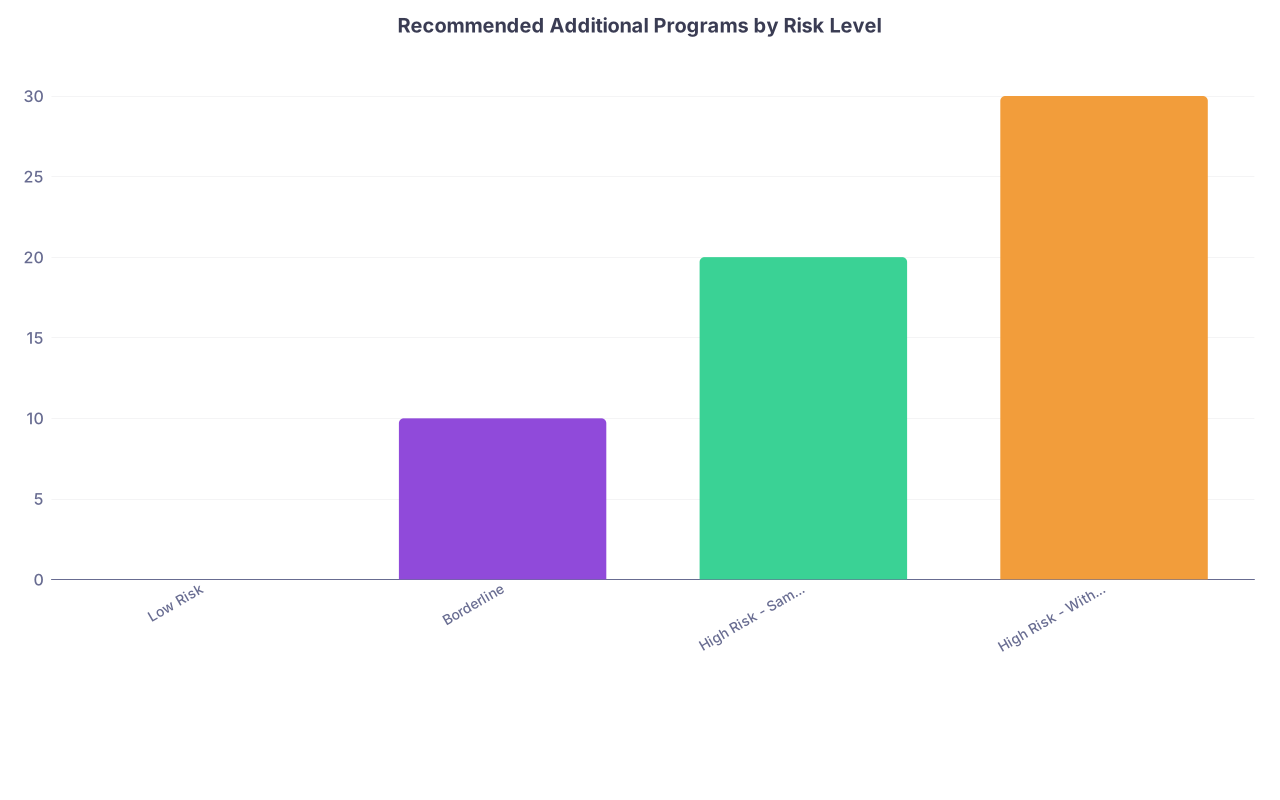
| Category | Value |
|---|---|
| Low Risk | 0 |
| Borderline | 10 |
| High Risk - Same Specialty | 20 |
| High Risk - With Pivot | 30 |
Use this as a rough starting point:
Low risk (already above comfort zone):
- 0 additional programs. Maybe 5–10 if you have a very narrow geography and want a bit more spread.
Borderline:
- 10–20 additional programs in the same specialty, but skewed heavier to community and less competitive regions.
High risk – staying in same specialty only:
- 20–30 more programs. Heavily community, heavily IMG/DO friendly if applicable.
High risk – with specialty pivot:
- 20–30 in backup specialty plus prelim/TY programs if appropriate.
- Yes, that is a lot of applications. Matching once is cheaper than reapplying next year.
If your dean or advisor tells you, “Honestly, your best chance is to plan for next year,” listen. But do not quit this cycle. You still use December to:
- Build prelim/TY options
- Set yourself up for a stronger reapplication (letters, research, etc.)
Common December Mistakes I See Every Year
Let me be blunt about the patterns that repeat:
Waiting for a “wave of invites” that never comes
- There is no magical second wave in January for most specialties. There is some trickle. That is all.
Adding only more reach programs
- If UCSF, MGH, and Hopkins did not invite you by December, adding Mayo and Penn is not strategy. It is fantasy.
Ignoring geography flexibility
- “I refuse to live in the Midwest” is a fine life decision. It might be a bad match decision if you are already under-interviewed.
Not considering a parallel specialty because of ego
- “I am a surgeon, not an internist.” Maybe. But unmatched surgeon is not a job.
Not preparing for SOAP until Match Week
- SOAP success starts in December with planning, not in March with panic.
What You Should Do Today
You are in December. The clock is not your friend, but it is not your enemy yet.
Here is your concrete next step for today:
- Open your ERAS application dashboard.
- Write down:
- Number of programs applied to
- Number of interview invites
- Number of interviews scheduled
- Look back at the “Bucket A/B/C” section and decide which bucket you are honestly in.
- Based on that bucket, make one decision before you go to bed tonight:
- How many additional programs you will apply to (if any)
- Whether you will explore a parallel specialty or prelim/TY strategy
- When you will meet with your dean or advisor this week
Then actually schedule that meeting or start the list of additional programs. Do not just “think about it.”
Open a fresh document right now and title it: “December Pivot Plan – [Your Name].” Your future matched self will be very glad you did.