
The worst residency strategy mistake isn’t applying to too few programs. It’s refusing to adjust when the data start hitting your inbox in October.
By October, your application season stops being theoretical. You’re no longer “an applicant planning to apply broadly.” You’re a data analyst looking at:
- How many invites you have
- Who is ignoring you
- How many weeks are left to fill
If you keep operating on your July assumptions in November, you’re doing it wrong.
This guide walks you, step by step, through October and November: exactly how and when to adjust the number and type of programs you’re targeting as interview invitations (or silence) roll in.
Big Picture: What October–November Actually Mean
By this point, the “how many programs should I apply to?” question changes flavor. Early season, it’s about raw numbers. Now it’s about course correction.
Here’s the mental shift you need to make:
- July–September: “How many should I apply to?”
- October–November: “Given my invite data, what is still missing and how aggressively do I fix it?”
Most programs in many specialties send the bulk of their invites between late September and mid-November. Not all, but enough that patterns start to matter.
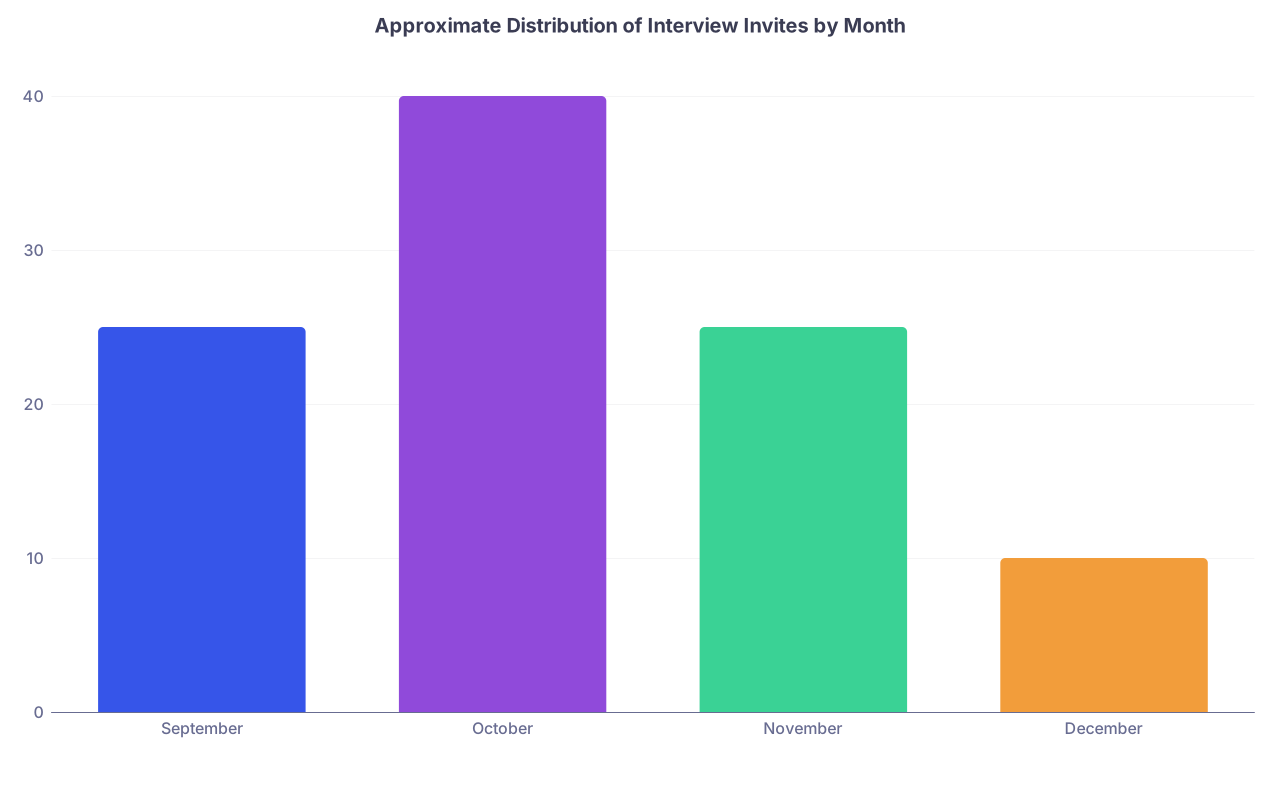
| Category | Value |
|---|---|
| September | 25 |
| October | 40 |
| November | 25 |
| December | 10 |
So your job in these two months is simple:
- Track your invites precisely.
- Compare your numbers to a realistic target.
- Adjust where you apply and how many additional programs you hit.
Let’s walk this week by week.
Early October: Reality Check and Baseline
At this point you should stop guessing and start counting.
Step 1: Build Your Invite Tracker (If You Have Not Already)
You need a single place – spreadsheet, Notion, whatever – with:
- Program name
- City / region
- Program type (university, community, hybrid, prelim/advanced if relevant)
- Date applied
- Date invite received (or “none”)
- Interview date (and whether scheduled/declined/waitlisted)
If I were you, I’d add a simple status column: No response, Rejected, Waitlist, Invite.
Step 2: Set a Target Number of Interviews
This is where students get vague and then panic. Don’t.
Use a specialty-specific target range. For most categorical specialties:
- Competitive (Derm, Ortho, ENT, Plastics, Neurosurg, Rad Onc):
You want to be aiming for 12–15+ interviews if you actually want to sleep before Match. - Mid–high competitiveness (EM, Anesthesia, Gen Surg, Radiology, OB/GYN):
Stable applicants usually feel ok around 10–12; weaker applicants push 12–15. - Less competitive (IM, Peds, Psych, FM, Neuro):
Many match comfortably with 8–10, but risk-averse or weaker applicants should target 10–12+.
Now factor in your risk profile (Step scores, class rank, red flags, IMG status, couples match, visa issues). Risky profile? Add 2–4 to those numbers.
| Specialty Category | Safer Target Range |
|---|---|
| Very competitive | 12–15+ |
| Mid–high competitive | 10–12 |
| Less competitive | 8–10 (12+ if risky) |
| SOAP backup needed | 12–15+ total |
Write your target down. Not in your head. On the tracker.
Step 3: Compare Where You Are vs. Where You Need to Be
At this point you should:
- Count total invites
- Break them down by type:
- Dream / reach
- Reasonable / mid-tier
- Safety / community / less desired region
If it’s early October and you have:
- 0–2 invites → treat it as an early warning siren.
- 3–5 invites → not fatal, but you may be behind if you’re aiming for 12+.
- 6–8 invites → you’re probably on track for most specialties, but do the math.
You’re not making final decisions yet. You’re just taking an honest snapshot.
Mid–October (Oct 10–20): First Major Adjustment
This is when patterns become obvious.
At this point you should do three things: assess, categorize, and respond.
1. Assess: Are Invites Actually Coming, Or Are You Hoping?
Ask yourself, by around October 15:
- How many total invites do I have?
- Have invites slowed to a trickle?
- Are they all from one type of program (e.g., only community, no university)?
If you’re under half of your target by mid–October, you should not be relaxed.
For example:
- Target: 12 interviews
- Mid-October: You have 3–4 → you are behind.
- Mid-October: You have 6–7 → you’re probably fine, but still monitor.
2. Categorize Programs by Response Pattern
Look at your full application list. Sort into:
- A. Already heard – invite or reject
- B. Silent but historically slow (some programs really don’t move until November)
- C. Silent and known to have already sent most invites (often from Reddit/Students Doctor gossip, but also from classmates)
Bucket C is the key. Those are basically “soft rejections” by this time in many fields.
3. Respond: Expand or Not?
Here’s the decision rule I give people:
- If you’re ≥60–70% of your target by mid–October
- You can hold steady, maybe add a few true safeties if you’re anxious.
- If you’re 30–60% of your target
- Start a modest expansion: add 10–20 programs, focused on realistic safeties.
- If you’re <30% of your target
- You need an aggressive correction: add 20–40+ programs, reassess specialty risk, involve your advisor yesterday.
This is where “how many programs should I apply to?” becomes “how many extra programs must I add so I do not land in SOAP by accident?”
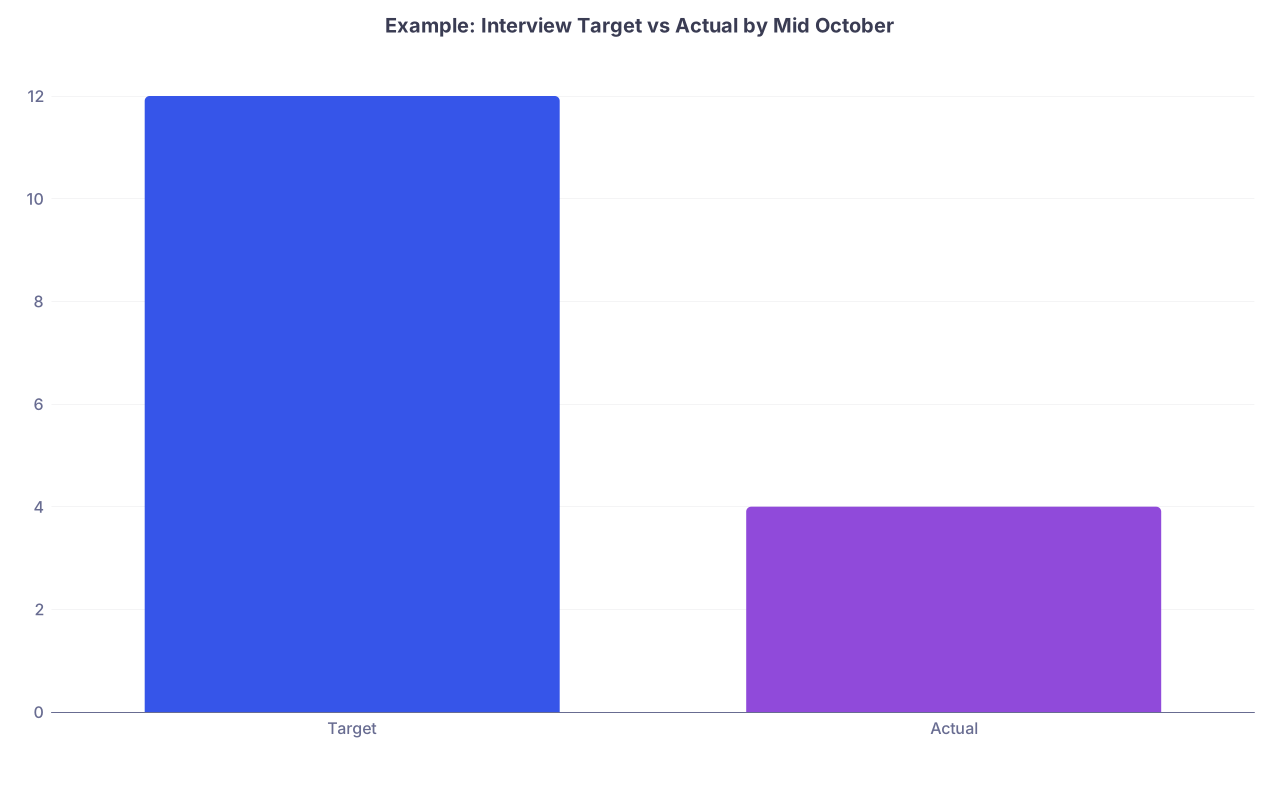
| Category | Value |
|---|---|
| Target | 12 |
| Actual | 4 |
Late October (Oct 20–31): Strategic Expansion, Not Panic Spraying
This is the most dangerous part of the season. People either overreact or underreact.
At this point you should be adding programs deliberately, not randomly.
Step 1: Decide Your Expansion Size
Use a simple gap-based model:
- Take your target (say 12).
- Subtract your current invites (say 4). Gap = 8.
- Estimate conversion: On average, late-season applications might yield invites at a lower rate than early ones. Be conservative and assume 5–10% invite rate on these additions in competitive fields, maybe 10–15% in less competitive ones.
So if each new batch of 10 programs might give you 1 invite, and you need ~4 more invites, you’re looking at 30–50 additional applications realistically.
Not pretty. But better to be realistic than matched to SOAP.
Step 2: Tighten Your Program Filters
When expanding in late October, you need to shift your program mix:
- Less of:
- Ultra-competitive academic powerhouses
- Places where your stats are clearly below their usual range
- More of:
- Community and hybrid programs
- Programs in less popular regions
- Newer or smaller programs
This is where geography pride kills people. If you’d “rather not” live in the Midwest, you may need to reconsider that in late October.
Step 3: Clean Up Your Application Materials (Silently)
If you’re adding a significant number of programs at this point, do a 1–2 day sprint on:
- Personal statement:
- Fix obvious fluff.
- Remove generic “I have always wanted to be a doctor” paragraphs that make PDs roll their eyes.
- Experiences:
- Tighten descriptions. No walls of text.
- Letters:
- Make sure at least one strong, specialty-specific letter is uploaded and assigned.
You’re not rewriting ERAS. Just removing the most self-sabotaging bits before they hit 30 more PD inboxes.
Early November (Nov 1–15): Second Wave and Hard Decisions
Some programs are slow. Others hold a second wave of invites if people decline. Early November is your “last real month” for meaningful course correction.
At this point you should:
1. Recount and Reassess
By November 1:
- Update how many interviews are scheduled, not just offered.
- Note any pending invites you haven’t scheduled yet (fix that).
- Recalculate your gap vs target.
Then decide: are you now:
- At or above target? (e.g., target 12, you have 11–13)
- Within 2–3 of target?
- Still badly short? (e.g., target 12, you have 4–6)
2. Decide If You Need One More Expansion
If you’re:
- ≥10 for a 12 target in a less competitive specialty → you can probably stop adding programs.
- 6–8 for a 12 target → you should still consider adding another 10–20 programs, focused on the bottom of your preference list (but programs you’d still actually go to).
- <6 for a 12 target in any specialty → this is serious.
- You either:
- Accept you’re extremely high risk for SOAP, or
- Add a large final round of 20–40 programs and seriously consider a backup specialty or prelim strategy.
- You either:
3. Consider Backup Strategies (Prelim/TY or Alternate Specialty)
This is ugly, but pretending it is not real is worse.
If you’re clearly under-invited by early November:
- Talk to your dean’s office or advisor about:
- Prelim/TY medicine or surgery as a bridge
- Less competitive backup specialty (especially for IMGs or applicants with failed Step attempts)
You may need to send fresh applications to a second specialty in early November. Does it feel late? Yes. Is it sometimes the thing that saves your match year? Also yes.
Mid–Late November (Nov 15–30): Final Tuning and Accepting Reality
There’s a painful truth here: by late November, your ability to change the narrative is shrinking fast.
At this point you should:
1. Lock In What You Have
By November 15–20:
- Finalize scheduling for any remaining open invites.
- Avoid overbooking yourself with so many interviews that you start canceling late and burning bridges.
- If you’re already at or slightly above target, stop adding programs unless there’s a specific, strategic reason.
Remember: more interviews isn’t always better if you’re exhausted and phoning them in. 12 real, focused interviews beat 17 where by the end you barely remember which hospital is which.
2. Decide on Any Last-Minute Applications
Late November applications have diminishing returns, but they’re not always useless. Who might still be worth adding?
- Programs that historically send late invites
- New programs or programs that only recently fixed ACGME issues
- Places where your school has a strong connection or pipeline
If you’re significantly short of your target and can afford it, sending a small final batch (5–15) to highly realistic programs can still make sense.
But if you’re already at a safe number (e.g., 10–12 strong invites in IM, Peds, Psych, FM), stop. You’re just lighting money on fire at that point.
How to Adjust Without Losing Your Mind
This whole process is stressful, so let’s cut the drama and keep it systematic.
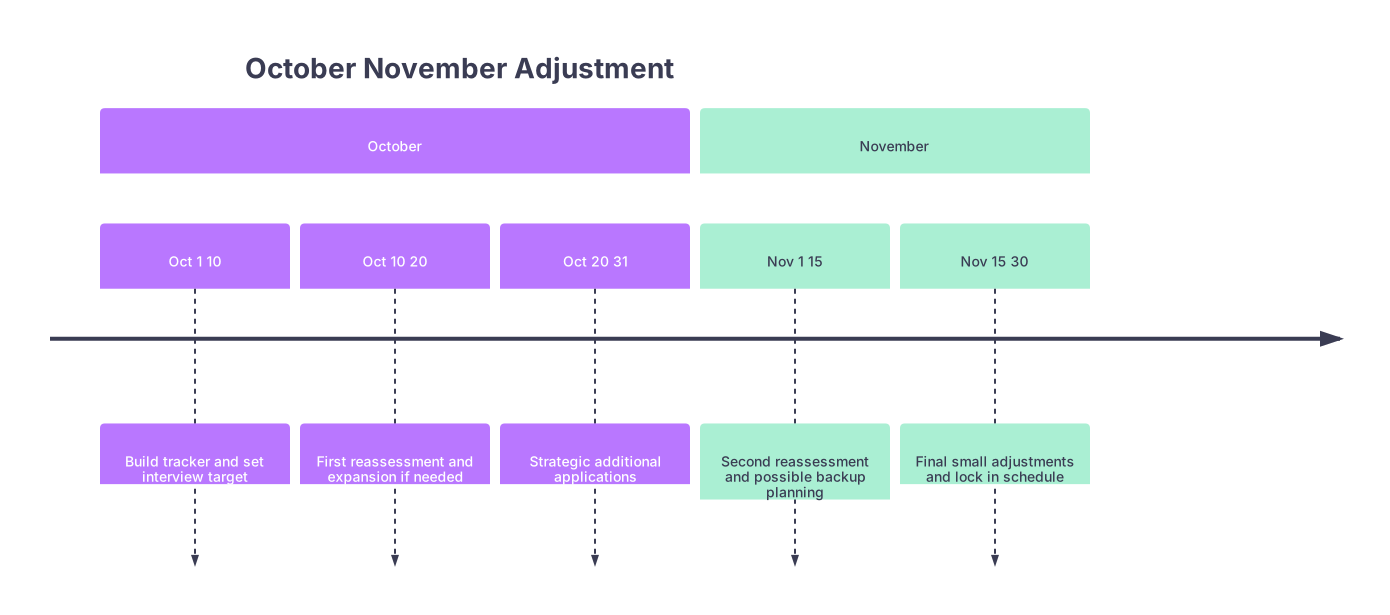
| Period | Event |
|---|---|
| October - Oct 1 10 | Build tracker and set interview target |
| October - Oct 10 20 | First reassessment and expansion if needed |
| October - Oct 20 31 | Strategic additional applications |
| November - Nov 1 15 | Second reassessment and possible backup planning |
| November - Nov 15 30 | Final small adjustments and lock in schedule |
Weekly Routine (October–November)
Every Sunday night, you should:
- Update your tracker:
- New invites
- Rejections
- Silent programs
- Count:
- Total invites vs target
- Distribution by program type (academic vs community)
- Decide:
- No change this week
- Add 5–10 safety programs
- Draft email to advisor about backup specialty options
If your Sunday meeting with yourself is just “open email and panic,” you’re doing it wrong.
Red Flags That Mean “Apply to More Programs Right Now”
If any of these are true after October 20, you should strongly consider adding programs:
- You have 0–3 interviews in any specialty.
- You are IMG or DO targeting a competitive specialty with <8 invites by early November.
- You have a failed Step attempt and fewer than 10 invites in a less competitive specialty.
- You are couples matching and your partner is also under-invited.
This is where I’ve seen people talk themselves into magical thinking — “but my personal statement is really strong” — while sitting on 3 interviews for a risky specialty. Don’t be that person.
Quick Example Scenarios
Sometimes it helps to see this play out.
Example 1: US MD, Internal Medicine, Mid-Range Stats
- Applied to 40 IM programs in September.
- Target: 10–12 interviews.
- Mid-October: 5 invites (2 university, 3 community).
- Action:
- Add 10–15 more community and hybrid programs in less desirable locations.
- By mid-November, total interviews: 11.
- Stop adding. Focus on interview prep.
Example 2: IMG, Psych, Step scores around national average
- Applied to 80 programs.
- Target: 12–15 interviews.
- Mid-October: 2 invites.
- Action:
- Aggressively add another 40–50 programs, including smaller, newer, and more rural sites.
- Reach out to mentors for any connection-based emails.
- Early November: total interviews rises to 7.
- Adds another 15 programs, and ends at 9 by late November.
- Still high-risk, but much better than staying at 2.
Example 3: US MD, Ortho, High Stats, Very Competitive Specialty
- Applied super selectively: 40 “top” programs.
- Target: 15+ interviews.
- Mid-October: 3 invites from mid–upper tier programs.
- Action:
- Reality check. High stats, but underperforming.
- Adds 30–40 more, including community-heavy and newer programs.
- By mid-November: total 9 interviews.
- Advisor recommends also submitting a last-minute backup prelim IM/TY plan.
Visual: Target vs Actual Over Time
Here’s how you should be thinking about your numbers between October and November.
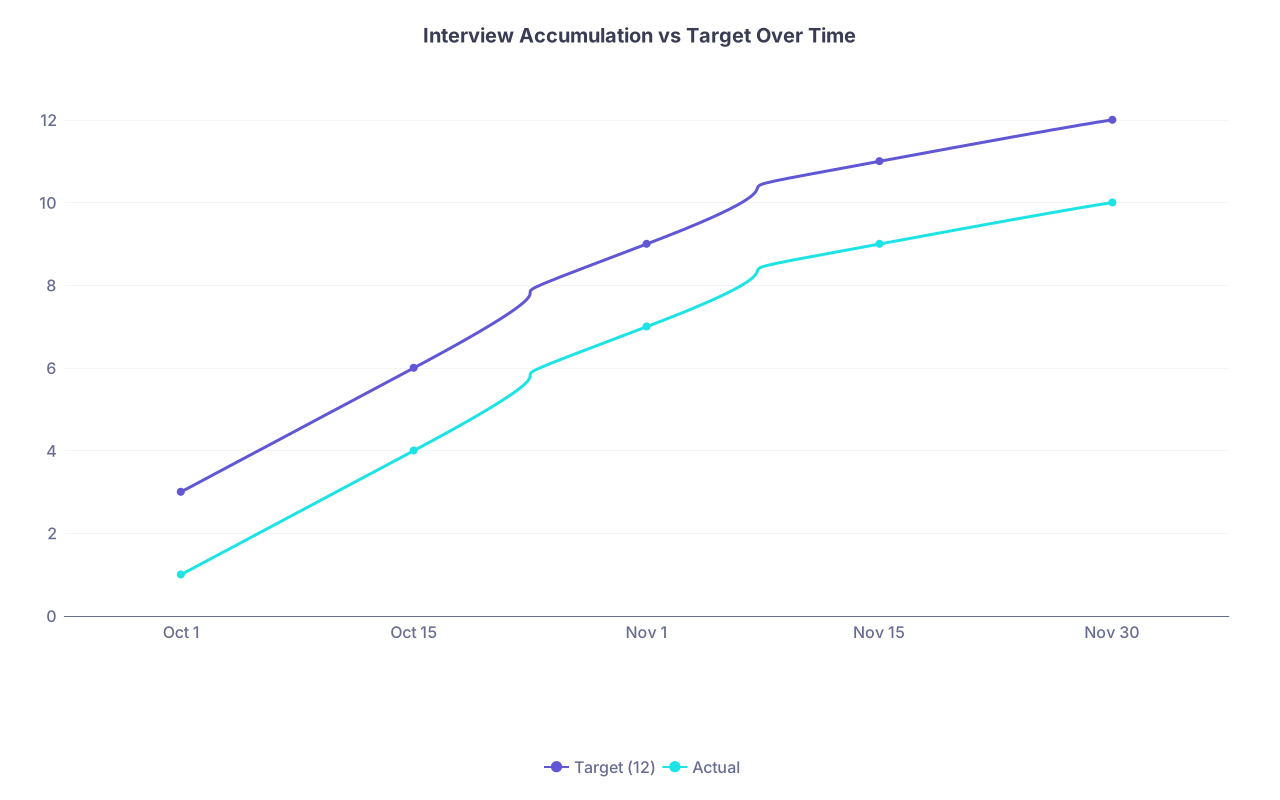
| Category | Target (12) | Actual |
|---|---|---|
| Oct 1 | 3 | 1 |
| Oct 15 | 6 | 4 |
| Nov 1 | 9 | 7 |
| Nov 15 | 11 | 9 |
| Nov 30 | 12 | 10 |
You want your “Actual” line to be tracking reasonably close to your “Target” by early–mid November. If it’s not, that’s when you increase program numbers, not when you just “hope something comes through.”
Final Mental Model for October–November
Let me simplify the whole season into one rule:
Your invite list is feedback. Treat it like data, not judgment. Adjust accordingly.
By the end of November, you should have:
- A clear, written target for number of interviews based on your specialty and risk profile.
- A tracker that tells you exactly where you stand each week.
- A deliberate expansion plan, not random late-night ERAS clicking.
Key points to leave with:
- Mid-October and early November are your two big checkpoints. At each one, compare your actual invites to your target and decide whether to expand by 10, 20, or more programs.
- Not adjusting is worse than over-applying. Within reason, it’s safer to add programs in October–early November than to sit at 4 interviews and hope a miracle arrives in December.
- Be brutally honest about risk and back-up strategies. If your numbers are far off by early November, you might need a second specialty or prelim plan.
If you treat October and November like a structured experiment instead of a rollercoaster, you’ll make smarter choices about how many programs to apply to – and give yourself a much better shot on Match Day.