
Discover how physicians can strategically use Real Estate Investing to diversify their portfolios, reduce tax burden, and move closer to Financial Independence—without compromising their medical careers.
Why Real Estate Investing Matters for Physicians
Physicians occupy a unique financial position: high income potential, but also high taxes, delayed career earnings, and significant student loan burdens. Real estate can be a powerful complement to traditional investments, especially when approached intentionally as part of a broader Physician Finance plan.
1. Pathway to Financial Independence Beyond Clinical Income
Relying solely on clinical income can feel risky. Burnout, illness, changing reimbursement models, and healthcare consolidation all threaten physician earning stability.
Real estate can:
- Create additional income streams separate from your W‑2 or 1099 clinical income
- Help replace a portion of your salary over time with rental cash flow
- Provide a saleable asset (your property portfolio) that can support retirement or a partial clinical schedule
Example:
A hospitalist owning four cash‑flowing rental properties netting $1,500/month each has an additional $72,000 per year of relatively stable income. That can fund retirement accounts, college savings, or allow reduced clinical shifts.
2. Passive (or “Passive-Enough”) Income for Busy Physicians
Physicians often hesitate to get involved in Real Estate Investing because they assume it will consume their limited free time. The key is choosing the right Investment Strategies and level of involvement:
- Truly passive options: REITs, private real estate funds, and some real estate syndications
- Semi-passive options: Long-term rentals with a professional property manager
- Active options: Flips, short-term rentals, or self-managed multifamily
For many physicians, a semi-passive approach—owning rentals but delegating property management—is the best balance between control, return, and time commitment.
3. Built-In Hedge Against Inflation
Real estate has historically been one of the most reliable hedges against inflation:
- Rents tend to rise over time as the cost of living increases
- Property values often track or exceed inflation in strong markets
- Fixed-rate mortgage payments stay constant while rent and income rise, widening your profit margin
For physicians aiming for long-term Financial Independence, this inflation protection can be especially valuable compared to holding large cash balances that erode in real terms.
4. Powerful Tax Advantages for High-Earning Physicians
Real estate can meaningfully reduce tax liability, particularly for high earners in top marginal brackets. Tax laws change, so always confirm with a qualified tax professional, but common tax advantages include:
- Depreciation: Deduct a portion of the property’s value each year to offset rental income—often creating “paper losses” that shelter real cash flow.
- Mortgage interest and operating expenses: Deduct interest, property taxes, insurance, repairs, property management fees, and more.
- 1031 exchanges: Defer capital gains taxes by exchanging one investment property for another, allowing your capital to compound without an immediate tax hit.
- Long-term capital gains: Preferential tax rates on properties held more than one year.
- Potential for real estate professional status (REPS): In specific situations (usually when a spouse meets the time requirements), you may be able to offset W‑2 or 1099 income with rental losses.
For many physicians, real estate is the most impactful lever in their entire Physician Finance strategy because of these tax efficiencies.
5. Diversification Beyond the Stock Market and Your Medical Practice
Concentration risk is a serious, often overlooked issue:
- Income from one employer or specialty
- Retirement assets mostly in stock/bond markets
- Net worth tied heavily to your human capital as a physician
Real estate offers diversification:
- Different asset class with distinct risk and return characteristics
- Income derived from local housing and business markets, not just global equity markets
- Option to invest across multiple cities, asset types, and strategies
This diversification helps cushion the impact of market crashes or specialty-specific reimbursement changes, supporting your path to Financial Independence.
Major Types of Real Estate Investments for Physicians
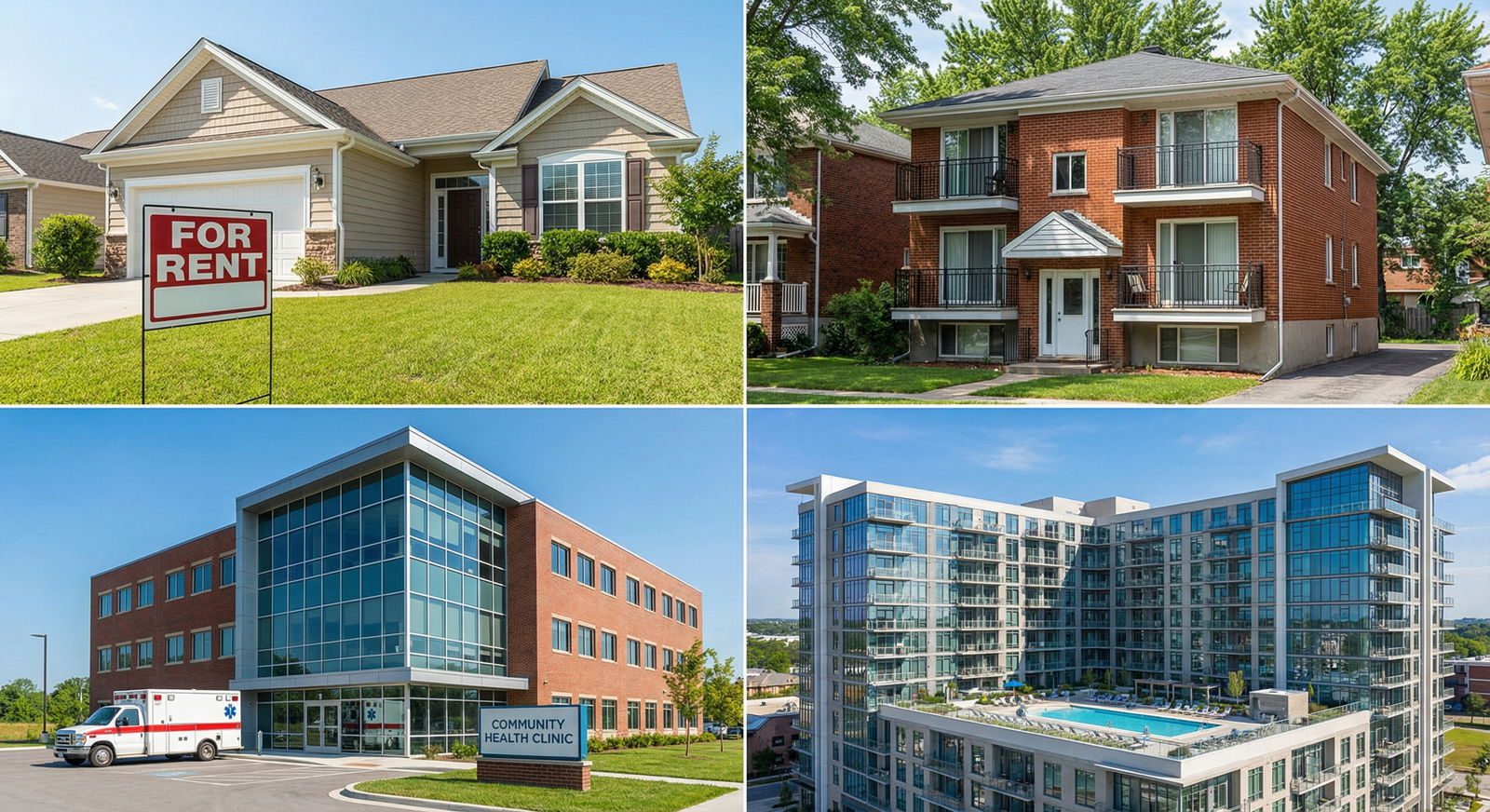
Not all Real Estate Investing is the same. Your time, interest level, and risk tolerance should guide which strategies you pursue.
1. Long-Term Residential Rental Properties
What it is:
Owning single-family homes, condos, or small multifamily buildings (2–4 units) rented to long-term tenants.
Pros:
- Understandable and intuitive
- Predictable monthly cash flow
- Easier entry point for beginners
- Financing options are widely available
- Can be managed by a property manager, making it semi-passive
Cons:
- Requires upfront capital for down payment and reserves
- Vacancy, repairs, and tenant issues still occur
- Local market risk (jobs, crime, school quality)
Example Strategy:
A young attending buys a 3-bedroom house in an emerging neighborhood near a major hospital. They hire a property manager who screens tenants, collects rent, and coordinates repairs, while the physician monitors performance via monthly statements.
2. Commercial and Mixed-Use Properties
What it is:
Office buildings, retail spaces, warehouses, medical office buildings, or mixed-use properties (commercial plus residential).
Pros:
- Potentially higher returns and longer lease terms
- Tenants often responsible for many property expenses (triple-net leases)
- Can be a strong fit for physician groups (owning your own clinic building)
Cons:
- More complex leases and legal considerations
- More sensitive to business cycles and economic downturns
- Higher entry cost; may require partnering or syndications
Many physicians ultimately invest in their own medical office building, capturing the rent they would otherwise pay to a landlord and creating long-term equity value.
3. Real Estate Investment Trusts (REITs)
What it is:
Publicly traded (or private) companies that own portfolios of income-producing properties. You buy shares, similar to purchasing stock.
Pros:
- Extremely passive; no property management
- Low minimum investment (just the share price)
- Liquidity if publicly traded
- Diversified across many properties and regions
- Easy to hold in retirement accounts
Cons:
- More correlated with stock market volatility
- Less control over specific properties
- No direct control over debt, renovations, or strategy
REITs are ideal for physicians seeking exposure to real estate without operational responsibilities, especially as part of a diversified investment portfolio.
4. House Flipping and Value-Add Projects
What it is:
Buying distressed or underperforming properties, renovating them, and reselling (“flipping”) or refinancing and holding for rental (“BRRRR” strategy: Buy, Rehab, Rent, Refinance, Repeat).
Pros:
- Potential for substantial short-term profits
- Opportunity to force appreciation through renovations
- Satisfying for those who enjoy projects and design
Cons:
- Very time-intensive; generally not ideal for full-time clinicians
- Construction, permitting, and contractor risk
- Market timing risk; sensitive to interest rates and buyer demand
- Short-term gains often taxed at higher ordinary income rates
If you are early in training or have a spouse/partner who can handle the operational side, this can be viable—but for most busy attendings, flips are better left to experienced operators.
5. Real Estate Crowdfunding and Syndications
What it is:
Passive investments where you pool capital with other investors to buy larger properties (apartment complexes, storage facilities, medical office buildings, etc.), usually managed by a professional sponsor.
Pros:
- Access to large, institutional-quality deals with smaller minimums
- Completely passive after initial due diligence
- Often targeted to accredited investors, including many physicians
- Can diversify across markets (e.g., Southeast multifamily, Midwest self-storage)
Cons:
- Illiquid—your money may be tied up for 3–10+ years
- Fees and complex structures
- Sponsor risk (execution and honesty)
- Requires careful vetting of operators and deal terms
Crowdfunding and syndications are increasingly popular among physicians pursuing Financial Independence who want real estate exposure without direct landlord responsibilities.
Understanding the Real Estate Market: Physician-Friendly Framework
Market Fundamentals to Evaluate
When evaluating potential investments, focus on:
- Job growth and economic drivers: Presence of hospitals, universities, tech or manufacturing hubs
- Population trends: Growing population often supports rent growth and occupancy
- Supply and demand: New construction vs. household formation
- Affordability metrics: Rent-to-income ratios; price-to-rent ratios
- Local regulations: Landlord-tenant laws, rent control, short-term rental rules
Many physicians practice in high-cost-of-living cities but invest in more affordable, landlord-friendly markets where returns are better.
The Importance of Location Within a Market
Within any city, micro-location matters:
- School districts, crime rates, access to transit
- Proximity to hospitals, universities, and major employers
- Neighborhood trajectory (improving, stable, or declining)
Practical tip:
Use tools like Zillow, Redfin, Rentometer, and local market reports. Then validate your impressions via conversations with local real estate agents, property managers, and other investors.
Financing Your Real Estate Investments as a Physician
Lenders often view physicians favorably due to stable income potential, even with high student loan debt. Understanding your financing options is critical to your Investment Strategies.
1. Down Payments and Reserves
- 20–25% down is common for investment properties
- Some lenders require 6–12 months of mortgage payments as reserves
- For your first property, ensure you also have an emergency fund and separate property reserve fund (for vacancies, repairs, and capital expenditures)
2. Common Loan Types
Conventional loans:
Ideal for 1–4 unit properties. Best for long-term holds with fixed interest rates.Portfolio loans (local banks/credit unions):
Lenders keep loans on their books and may be more flexible regarding physician income, student loan treatment, or unconventional properties.Commercial loans:
Used for properties with 5+ units or commercial use. Underwritten primarily on property income.Hard money loans / bridge loans:
Short-term, higher-interest loans often used for flips or rehabs. Typically not suitable for long-term holds.
3. Using Leverage Wisely
Leverage magnifies gains—but also magnifies losses.
- Aim for conservative leverage (e.g., 70–75% loan-to-value) rather than maximum borrowing
- Stress-test your numbers:
- Can you still cover the mortgage if rent drops 10–15%?
- What if interest rates rise at refinance?
- Avoid overleveraging with multiple deals that stretch your cash flow thin
Thoughtful leverage is a cornerstone of successful Physician Finance in real estate; reckless leverage is one of the fastest paths to financial distress.
Building a Strong Real Estate Team as a Physician Investor
Real estate is a team sport. Physicians with limited time must outsource intelligently to succeed.
Key players to consider:
1. Investor-Savvy Real Estate Agent
- Specializes in investment properties, not just owner-occupied homes
- Can help you analyze cash flow, rents, and cap rates
- Has relationships with local property managers and contractors
2. Real Estate-Focused CPA or Tax Advisor
- Understands depreciation, passive activity rules, and real estate professional status
- Helps align your real estate strategy with your overall Physician Finance plan
- Advises on entity structures (LLCs, S-corps, partnerships) and record keeping
3. Real Estate Attorney
- Reviews purchase and operating agreements
- Ensures compliance with state and local laws
- Protects your interests in partnerships or syndications
4. Property Manager
- Screens tenants and handles leases
- Manages repairs, inspections, and rent collection
- Provides monthly reporting so you can monitor performance quickly
For a busy cardiologist, surgeon, or hospitalist, the property manager is often the difference between sustainable real estate ownership and burnout.
5. Contractors, Inspectors, and Insurance Agents
- Home inspectors: Identify major issues before you buy
- General contractors and tradespeople: Execute repairs and renovations
- Insurance agents: Ensure appropriate coverage (liability, landlord policies, umbrella insurance)
Build this team before you buy, especially if you are investing out of state.
Practical Tips for Successful Real Estate Investing as a Physician
1. Start Small and Learn Intentionally
Begin with a manageable first step:
- One well-analyzed single-family home
- A passive REIT position inside your IRA
- A small commitment to a vetted syndication
Treat your first deal as tuition in your real estate education. Aim to learn systems, not just chase maximum return.
2. Rely on Data, Not Emotion
Use clear metrics when evaluating deals:
- Cash-on-cash return (annual cash flow ÷ cash invested)
- Cap rate (net operating income ÷ purchase price)
- Debt service coverage ratio (DSCR)
- 5–10 year return projections under conservative assumptions
Avoid buying properties because you “like the kitchen” or would personally live there. Investment decisions must be driven by numbers and strategy.
3. Prioritize Cash Flow Over Speculation
Hoping for rapid appreciation is speculation. Building real wealth requires solid cash flow:
- After accounting for mortgage, taxes, insurance, vacancy, repairs, capital expenditures, and management
- Cash flow should remain positive under realistic assumptions
Appreciation is a bonus, not the core of your Investment Strategy.
4. Systematize and Stay Organized
- Use property management software or spreadsheets to track income, expenses, and capital improvements
- Store all receipts and invoices (digital is fine) for tax time
- Review monthly reports, not daily operations
This level of organization supports better decision-making and maximizes your Tax Advantages.
5. Continuously Educate Yourself
The most successful physician investors treat this like a side business:
- Read targeted real estate books and physician finance blogs
- Listen to podcasts featuring other physician investors
- Attend local real estate meetups or virtual conferences
- Periodically reassess your portfolio and overall Financial Independence plan
Common Pitfalls for Physician Real Estate Investors—and How to Avoid Them
1. Underestimating Expenses and Vacancy
New investors frequently overlook:
- Capital expenditures (roof, HVAC, plumbing)
- Turnover costs (repairs, cleaning, re-leasing fees)
- Increases in insurance and property taxes
Solution:
Use conservative estimates and add healthy buffers to your pro forma. It is better to be pleasantly surprised than constantly stressed.
2. Chasing Deals Without a Clear Strategy
Jumping into flips, short-term rentals, and syndications all at once dilutes focus.
Solution:
Define your primary goal:
- Maximize passive income?
- Minimize time involvement?
- Optimize tax benefits?
- Build long-term wealth for early retirement?
Select 1–2 Investment Strategies aligned with your Physician Finance goals and stick with them long enough to develop competence.
3. Ignoring Legal and Liability Protection
Physicians are frequently (and often unfairly) seen as deep-pocket targets.
Solution:
- Discuss LLC structures, umbrella insurance, and proper leases with your attorney and insurance agent
- Separate personal and business finances
- Follow fair housing laws and document tenant interactions
4. Overleveraging and Growing Too Fast
Strong income can make it tempting to scale aggressively, but rapid expansion often leads to cash flow problems.
Solution:
- Ensure each property stands on its own financially
- Maintain robust cash reserves
- Limit new purchases until existing assets are stable and performing
5. Neglecting the Time Factor
Even “passive” investments take some time—especially upfront.
Solution:
- Be realistic about your schedule and energy, especially during residency, fellowship, or intense attending years
- Start with more passive options if you’re in a demanding clinical season
- Consider involving a spouse or partner who has time and interest in operations

FAQs: Physician Real Estate Investing, Finance, and Tax Considerations
1. I’m still in residency/fellowship. Is it too early to start investing in real estate?
Not necessarily. You can:
- Start with education and networking
- Invest small amounts in REITs through retirement accounts
- Consider “house hacking” (living in one unit of a duplex while renting the other) if it fits your lifestyle
- Explore real estate syndications or funds with modest minimums when you become an attending
Just ensure you aren’t overextending while still carrying significant student loans and lower income.
2. What real estate strategy is best for a busy attending physician?
For most full-time physicians, the best starting points are:
- Long-term rentals with professional property management
- REITs in taxable or retirement accounts
- Carefully vetted syndications or private real estate funds
These options align with limited time availability while still leveraging real estate’s cash flow and Tax Advantages.
3. How do real estate investments fit with my overall Physician Finance and retirement plan?
Ideally, real estate should complement, not replace, your other investments:
- Continue contributing to 401(k)/403(b), 457(b), Roth IRA, and HSA when available
- Use real estate for diversification, tax optimization, and income smoothing
- Revisit your asset allocation regularly to balance real estate, stocks, and bonds
- Coordinate with a fee-only financial planner who understands Real Estate Investing
4. What are the main Tax Advantages of real estate for physicians?
While specifics vary, key benefits often include:
- Depreciation, which can shelter rental income from taxes
- Deductions for mortgage interest, property taxes, maintenance, insurance, and management fees
- Potential for 1031 exchanges to defer capital gains on investment properties
- Favorable long-term capital gains rates on appreciated properties held more than a year
Always consult a tax professional familiar with both physician income structures and real estate.
5. How do I know if a property is a good investment?
A good investment typically:
- Produces positive cash flow after all realistic expenses
- Is located in an area with stable or improving fundamentals (employment, population, infrastructure)
- Fits your time availability, risk tolerance, and long-term Investment Strategy
- Offers reasonable upside through rent growth, debt paydown, and potential appreciation
Run the numbers conservatively, get a third-party inspection, and, whenever possible, have your real estate team review the deal before committing.
Real Estate Investing can be a powerful tool in a physician’s journey toward diversification, Tax Advantages, and long-term Financial Independence. By approaching it with the same diligence and evidence-based mindset you bring to medicine—clarifying your goals, learning the fundamentals, building the right team, and respecting risk—you can create a sustainable, wealth-building portfolio that supports both your career and your life outside of medicine.