Johns Hopkins University School of Medicine Program

Baltimore, MD
Message This Program
Specialty:Anesthesiology/Emergency medicine
ACGME Code:7962300001
NRMP Code:1242796C0
Status:Initial Accreditation

Overview

Welcome to the Johns Hopkins Combined Emergency Medicine and Anesthesiology Residency Program, an innovative five-year training program designed to equip residents with dual board certification in the fields of emergency medicine and anesthesiology. This unique program is the first of its kind nationally recognized by both the American Board of Emergency Medicine and the American Board of Anesthesiology, ensuring comprehensive training that prepares residents to excel in a variety of clinical settings.

The program emphasizes extensive clinical, humanistic, and professional development of a distinctive graduate, able to amplify the strengths of both fields and positively impact change in the field of medicine through innovation and national leadership.

Program Structure

The residency is structured to accept two residents per year, allowing for an intimate training environment with ample opportunities for mentorship and growth. The program encourages residents to explore various niches, including critical care, ultrasound, pain management, and international medicine, ultimately developing well-rounded clinicians equipped with the skills necessary for various healthcare settings.[1]

Curriculum

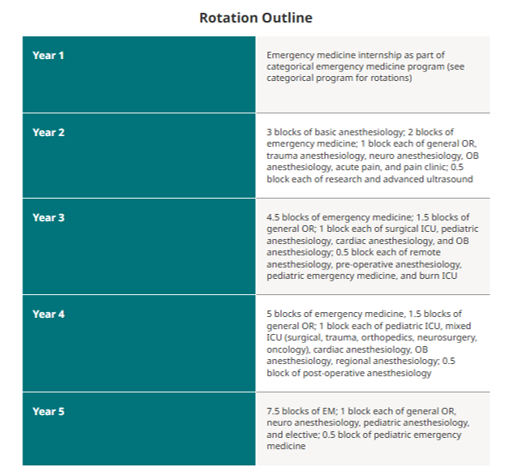
The curriculum is designed to ensure residents receive both emergency medicine and anesthesiology training. Key components include rotations through diverse clinical environments such as emergency departments, surgical units, and intensive care units. This extensive exposure enhances procedural skills and critical care management—skills that are vital in high-pressure medical scenarios.[1]

Application Information

To apply for this highly competitive program, candidates must submit their applications through ResidencyCAS. Essential documents include:

  • Completed ResidencyCAS application with a dean's letter

  • Three letters of recommendation, specifically one emergency medicine standardized letter of evaluation (SLOE) and one letter from anesthesiology or ICU rotation

  • Results of USMLE Step 1 or COMLEX Level 1, and if available, USMLE Step 2 or COMLEX Level 2

International medical graduates must provide ECFMG certification, along with other stated documents. It is crucial to note that previous residency experience requires letters from former program directors, and only J-1 visas are accepted for foreign applicants.[3]

Competitiveness and Special Considerations

The program is highly competitive, seeking candidates who have demonstrated commitment and passion for both emergency medicine and anesthesiology. Notably, there are no acceptable failing scores on either Step 1 or Step 2 of the USMLE, which underlines the program's high standards.[4]

Additionally, applicants should have a minimum of one year of clinical experience in the U.S. This exposure is critical for prospective residents to acclimatize to the American medical system and expectations.

Research Opportunities

Residents have the opportunity to engage in research that spans both disciplines, fostering an environment ripe for innovation. Collaborative initiatives encourage residents to participate in projects that could influence practice guidelines and improve patient care on a broader scale.[1]

Rotations and Training Sites

The training includes comprehensive rotations through various medical and surgical departments. Residents can expect to train in a range of settings, including:

  • Emergency Departments

  • Anesthesiology departments

  • Intensive Care Units

These rotations not only enhance clinical acumen but also provide opportunities to understand the interdisciplinary roles within healthcare teams.

Visa Support

The program has specific visa requirements, accepting only J-1 visas for international medical graduates. This designation bolsters the program’s approach to fostering a global learning environment, drawing in diverse talent from around the world.[4]

Residents' Experience

The residents of this program represent a blend of backgrounds and expertise, creating a rich learning environment. The program facilitates opportunities for residents to engage in educational initiatives and mentorship, enhancing professional development.[3]

Web sources

  1. Combined Emergency Medicine Anesthesiology Residency Program

  2. 15 Best Emergency Medicine Residency Programs Rankings

  3. Application Information

  4. Our Residents

From the Program

Program Information

Application deadline:October 31st

PGY-1 salary:$76,264

Positions per year:2

Accepting background:IMGs, DOs

Years since graduation cutoff:≤ 3 years

Failed exam attempts:Not considered

US clinical experience (USCE):Required

ECFMG certification deadline:At time of application

Letters of recommendation:Min 3, Max 4 · MUST include the following: One EM SLOE and One Anesthesiology letter of recommendation (anesthesia or ICU rotation acceptable)

Away / audition rotation:Not required

Interview format:In-person

Interview offer dates:Late Oct - mid Jan

Program signaling:Not participating

Program website:https://www.hopkinsmedicine.org/emergency-medicine/combined-residency

SmartPick

Program data

ACGME History

Accreditation Last updated: Jul 16, 2026
Initial accreditation2
Full accreditation0
Continued0
Warning0
Probationary Accreditation0
Withdrawal0

Program

Program Size

-- (5 years)

Accreditation Status

Initial Accreditation

(Effective: July 1, 2025)

Composition

--

Training

Faculty-to-Residents Ratio:2X

Quality of Life

First Year Paid Sick Leave: 5 days

First Year Paid Vacation: 21 days

First Year Salary: $76,264

Gender

No gender data available.

Rotation Duration by Site

Benchmarks

Scores

Match History

Track ID:  1242796C0
2020
2 of 2
2021
2 of 2
2022
2 of 2
2023
0 of 1
2024
1 of 2
2025
1 of 1
2026
2 of 2
Filled Position
Unfilled Position

Roster

Publications

11 Publications (5 yr)

Peer-reviewed output from faculty and residents, last 5 years

The Journal of surgical research2026

A Guide to the Anesthetic Management of Canine Models in Cardiac Surgery.

Jace C Bradshaw,1Isabel A Jimenez,2AlleaBelle Bradshaw,3Jessica Briscoe,3

Location

Baltimore, MD

Population
854,535
Median income
$87,056Below
Education
42.7%Above
Employment
63.2%On par
Health
5.1%Above
Age
40On par
  • Above the national average
  • Below the national average
  • Similar to the national average

Housing — Rental prices

Rental prices

Crime — All violent offences

Rate per 100,000 residents

Living in Baltimore, MD - Program Location Overview

Crime Rate and Safety

Baltimore has a higher crime rate compared to the national average, with some areas being safer than others. It's essential to research specific neighborhoods for safety before moving.

Fun Activities

Baltimore offers a variety of cultural attractions, such as the Inner Harbor, museums, historic sites, and waterfront activities. There are also parks, nightlife spots, and diverse dining options to explore.

Climate

Baltimore experiences all four seasons, with hot summers and cold winters. Spring and fall are mild and pleasant, making outdoor activities enjoyable during those times.

Races and Population

Baltimore is a diverse city with a significant African American population. It also has a mix of other races and ethnicities, contributing to its vibrant culture and communities.

Education

Baltimore is home to several universities and colleges, providing educational opportunities and contributing to the city's intellectual landscape.

Cost of Living

The cost of living in Baltimore is slightly above the national average, with housing costs being a significant factor. Rent and home prices can vary greatly depending on the neighborhood.

Proximity to Bigger Cities

Baltimore is about an hour's drive away from Washington, D.C., and Philadelphia. Both cities offer their own unique attractions, cultural experiences, and job opportunities for residents willing to commute.

Pros

  • Diverse population
  • cultural attractions
  • educational opportunities
  • proximity to other major cities.

Cons

  • Higher crime rate in some areas
  • slightly above average cost of living
  • extreme weather conditions.

Interview day shouldn't be your first run-through.

Run a free mock interview now — real questions from your specialty, an AI interviewer, and a scored read on how you actually came across.

Nearby programs

Anesthesiology/Emergency medicine Programs Near Baltimore, MD

External Links

1. Program website - visa sponsorship - https://www.hopkinsmedicine.org/emergency-medicine/combined-residency/application-information

2. United States Census Bureau - https://data.census.gov/profile/City,_VS?g=050XX00US24005

3. Zillow Research - Observed Rent Index (ZORI) - https://www.zillow.com/research/data/

4. FBI - Crime/Law Enforcement Stats (Uniform Crime Reporting Program) - https://www.fbi.gov/services/cjis/ucr

See something inaccurate or missing? If you represent this program, request portal access to update it directly.