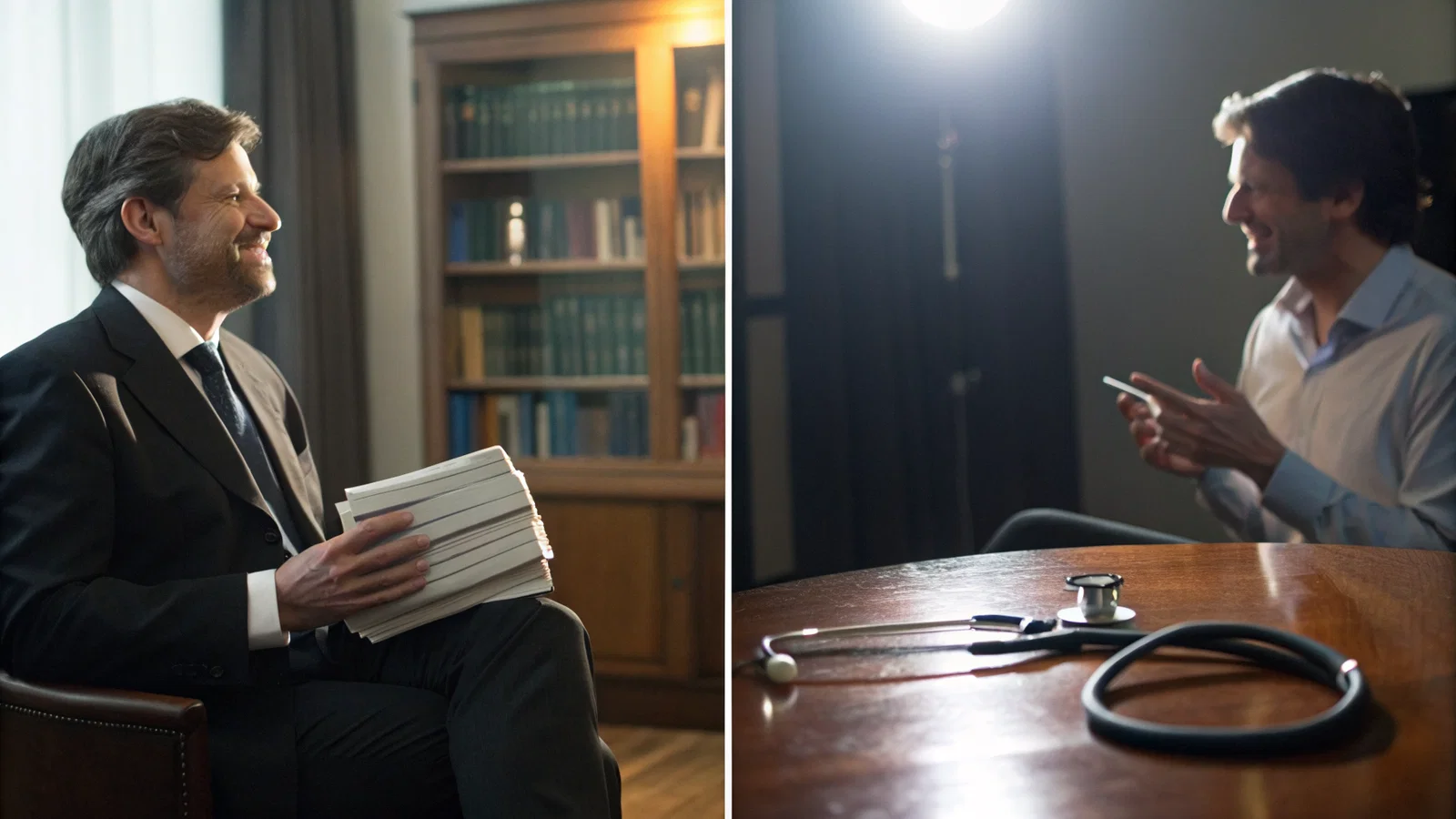
Picture the moment. You're on interview number six. The PD asks, "Tell me about a time you handled conflict on a team." You feel the internal scramble start. Do I launch into the perfect STAR answer I memorized in my hotel room? Or do I answer like a normal human being and risk sounding less polished?
That tension is real, and I've seen it wreck strong applicants. Not because they lacked good stories. Because they chose the wrong delivery mode. They either sounded robotic, every sentence pre-cut, every transition suspiciously tidy, or they rambled for three minutes and forgot to land the point. Neither one scores well.
Here's my position: scripted STAR answers do not beat conversational flow. Not in residency interviews. What gets higher program director scores is structured thinking delivered in a natural, responsive, human way. That means STAR is a tool, not a script. Use it to organize your answer. Don't recite it like you're defending a dissertation on teamwork.
Why does this matter to your medical career? Because PDs aren't just asking whether you've had a conflict, made a mistake, or shown leadership. They're deciding whether they can trust you at 2 a.m. with a sick patient, a stressed intern, and a family demanding answers. They're judging judgment. Self-awareness. Composure. Teachability. A weirdly over-rehearsed answer makes them wonder who you are when the script runs out. And a chaotic answer makes them wonder if you can think under pressure.
So the real question isn't STAR versus conversation. It's whether you can sound prepared without sounding manufactured. That's the whole game.
The Core Challenge
Most applicants get this wrong in one of two ways.
First mistake: they over-script. They build a beautiful STAR response with clean Situation, neat Task, heroic Action, and uplifting Result. Then they memorize it word-for-word. In practice, it sounds like this: "During my third-year internal medicine clerkship, I encountered a challenging interdisciplinary communication issue..." No one talks like that. Not in a real conversation. Not under stress. It sounds rehearsed because it is rehearsed.
Second mistake: they swing too far the other direction and "just talk." Bad plan. They open with too much backstory, toss in irrelevant details, and never make the lesson clear. You can almost see the interviewer trying to rescue them.
The problem isn't STAR. The problem is misuse.
STAR works because program directors like answers that are easy to follow. They want a clear setup, your role, what you actually did, and what happened. Clean structure reduces interviewer effort. That matters. Interviewers are tired. They've heard versions of the same answer all day. If your story is hard to track, you lose points.
But pure script hurts you because residency interviews are social evaluations, not speech contests. PDs are listening for authenticity. They want to hear your thought process, not your memorization skills.
Here's the practical framework I teach:
What leads to higher PD scores?
Structured spontaneity.
That means:
- You prepare 6-8 strong stories in advance.
- You know the lesson and key beats of each story.
- You adapt the wording live based on the question and interviewer.
- You sound like you're speaking, not performing.
That's the sweet spot.
I'm not claiming fake precision with interview scoring, but the pattern is dead real. Rigid answers underperform. Rambling underperforms. Organized and natural wins.
Why fully scripted answers score lower
A scripted answer creates three risks:
You miss the actual question. The interviewer asks about conflict with a peer, and you force in your preloaded story about a difficult attending. That mismatch is obvious.
You sound less self-aware. Memorized answers often skip reflection because applicants are busy hitting their lines. PDs care a lot about insight. What did you learn? What would you do differently? That's where maturity shows up.
You collapse when interrupted. Real interviews are messy. People jump in. They ask follow-ups. They redirect. If your answer only works as a monologue, you'll get thrown off fast.
I've seen this happen with excellent candidates. One applicant had a polished "failure" answer so rehearsed that when the APD asked, "What part of that was actually your responsibility?" she froze. Not because she lacked insight. Because she had trained for recital, not conversation.
Why pure conversational flow also fails
Let's not romanticize "being natural." Natural is overrated if your answer has no spine.
Applicants who rely only on conversational flow often:
- bury the main point
- spend too long on context
- fail to name their own action clearly
- skip the outcome
- forget reflection
That last one is huge. Reflection is often the difference between an average answer and a strong one. The story itself doesn't have to be dramatic. Honestly, dramatic stories are sometimes worse because people get lost in the plot. A small, well-analyzed example usually lands better.
What PDs are actually scoring
Not formally in every room, but functionally they're asking:
- Can this person communicate clearly?
- Can they answer the question asked?
- Do they understand team dynamics?
- Do they take ownership?
- Can they reflect without getting defensive?
- Would I want to work with them?
That last question dominates everything. You are not trying to sound like the most polished TED speaker in the applicant pool. You are trying to sound like a competent future resident people trust.
The better model: STAR, but lighter
Use STAR as an internal skeleton:
- Situation: one or two sentences
- Task: your role or challenge
- Action: the meat of the answer
- Result: outcome plus reflection
Then make it sound human. For example:
Too scripted: "During my surgery rotation, there was a conflict regarding operating room efficiency that required strategic communication."
Better: "On surgery, I worked with a co-student who kept interrupting me during prerounds, and it started affecting how we presented as a team."
See the difference? One sounds like corporate leadership training. The other sounds real.

A simple decision framework
If you're wondering how polished versus flexible to be, use this:
If your answers are too stiff, do less memorizing. Don't memorize sentences. Memorize:
- the story title
- the lesson
- 3 action beats
- the result
- one reflection line
If your answers are too rambling, do more structuring. Set limits:
- 20 seconds for setup
- 40-60 seconds for action
- 15-20 seconds for result and reflection
That alone fixes a lot.
Common pitfalls that tank otherwise good answers
These are the repeat offenders:
Hero stories where you save everyone. PDs hate inflated self-portrayal. You were a student. Act like one.
Conflict stories that make you sound impossible. If every bad interaction was someone else's fault, that's a red flag.
No reflection. If you learned nothing, the story is dead on arrival.
Trying to impress instead of trying to connect. Interviewers can smell performance.
Overusing buzzwords. "Leveraged communication," "facilitated synergy," "used emotional intelligence." Stop. You sound ridiculous.
The winning answer is usually calmer than you think. Specific. Honest. Brief. Thoughtful.
Actionable Next Steps
Here's how to build answers that score well without sounding fake.
Step 1: Build your story bank
You need 6-8 stories that can flex across common behavioral questions. Pick examples around:
- conflict
- failure or mistake
- leadership
- teamwork
- difficult feedback
- resilience
- ethical challenge
- patient communication
A single strong story can answer multiple prompts if you understand its lesson.
Step 2: Write bullet frameworks, not scripts
For each story, create this one-line outline:
- Situation: Where were you?
- Task: What was the problem and your role?
- Action: What 2-3 things did you do?
- Result: What happened?
- Reflection: What changed in how you work now?
Keep each answer to 90 seconds or less.
Step 3: Practice aloud with interruption
This is where most people get lazy. Don't just read your answers to yourself. That's useless. Practice with:
- a mentor
- chief resident
- advisor
- classmate who will actually interrupt you
You need to rehearse what happens when someone says:
- "What did you learn from that?"
- "What would you do differently?"
- "What was your specific role?"
- "How did the other person respond?"
That's the real interview.
Step 4: Cut dead language
Delete stiff openings like:
- "A great example of that would be..."
- "That's an excellent question..."
- "I was fortunate to have the opportunity to..."
Just answer. Try:
- "Yeah, one example that comes to mind was on my ICU rotation."
- "I had a situation like that during third year."
- "One mistake I still think about happened during my sub-I."
Cleaner. More believable.
Step 5: Use the 3-part delivery check
Before any interview, test each answer for:
- Clarity, Can someone follow it easily?
- Ownership, Is it clear what you did?
- Insight, Did you show growth?
If one is missing, the answer is weak.
Step 6: Record yourself
Painful. Necessary. Watch for:
- speaking too fast
- fake smile mode
- overexplaining context
- not answering directly
- sounding like you swallowed a student affairs handbook
If you cringe, good. That means you're seeing what interviewers see.
Step 7: Use the right resources
Best resources:
- your school's mock interview program
- specialty-specific advisors
- recent matched residents
- recorded Zoom practice
- official program websites to understand culture and priorities
Less useful:
- generic corporate interview advice with MBA energy
- random Reddit scripts you copy word-for-word
- overproduced answers from coaching services that bleach out your personality

The bottom line
If you want higher PD scores, don't choose between scripted STAR and conversational flow as if they're opposites. That's the wrong frame. Build structured answers and deliver them like a real person.
Prepared, but not canned. Polished, but not plastic. Reflective, but not theatrical.
That's what works.
And if your current answers sound like a compliance module or a therapy podcast, fix them now. Interview season is too competitive for that nonsense.
Key Takeaways
- Be prepared.
- Focus on high-yield areas.
- Use STAR as structure, not a word-for-word script.
- Conversational delivery beats robotic polish.
- Reflection is often the highest-yield part of the answer.
- Mock interviews should include interruption and follow-up questions.