
Educational note: This article discusses residency application strategy and references compensation-related validation rules, but it is for educational purposes only. It is not legal, financial, tax, or professional advising. For school-specific, ERAS, NRMP, contractual, or career-planning guidance, consult your dean’s office, specialty advisor, or other qualified professionals.
You’re a third-year or early fourth-year medical student. Your clinical letters aren’t ready yet, or they’re fine but not special. Meanwhile, you’ve spent a year in a lab, or on outcomes research, or grinding through chart review and abstract submissions with one faculty mentor who actually knows you. Really knows you. They’ve watched you miss nothing, fix other people’s messes, respond to feedback, and keep moving when the project was falling apart.
So naturally you think: great, this person can write me a strong letter.
Maybe. Maybe not.
Here’s what really happens in residency selection meetings. Almost nobody rejects a letter because the writer is “just” a research mentor. That’s not the real issue. The issue is whether the letter feels like fluff from someone who knows your PubMed profile, or a credible endorsement from someone who has seen how you operate when things are hard, ambiguous, and unglamorous. Program directors don’t care about the label nearly as much as students think they do. They care whether the letter reduces uncertainty.
And most research letters fail that test.
They’re often too generic. Too technical. Too obsessed with productivity, intelligence, and manuscripts in progress. They read like a grant support memo, not a prediction of how you’ll function at 2 a.m. on a cross-cover shift, or whether you’re the kind of intern people trust to close the loop, call back the nurse, and tell the truth when you’re unsure.
That’s the gap.
The good news is that a research mentor can absolutely write a residency-ready letter. I’ve seen it happen repeatedly. But it doesn’t happen by accident. You have to shape the relationship, give the mentor the right raw material, and help them translate what they’ve seen into the language residency programs actually believe.
This is how you do it.
What Program Directors Actually Want from a “Residency-Ready” LOR
Let me tell you how letters are really read. Not the fantasy version where every line is pondered with literary care. The real version. A program director or faculty reviewer opens the letter and does a rapid trust scan. Who wrote this? How well do they know the student? Are there specifics? Is there comparison to peers? Is there any sentence here that makes me feel safer ranking this applicant?
That’s it. Fast. Brutal. Efficient.
The best letters do four things quickly. They establish that the writer knows you well. They give specific observations, not adjectives. They compare you favorably to other trainees. And they offer a direct prediction that you will function well in residency.
Research letters often blow this because they overinvest in the wrong evidence. “Top 5% in analytic ability.” Fine. “Co-authored two manuscripts and presented nationally.” Nice. “Exceptionally bright and hardworking.” Generic wallpaper. None of that tells me whether you’re dependable, teachable, calm under pressure, or good with teams. Intelligence is assumed. Every residency applicant is “bright.” That word has lost all value.
What makes a research-heavy letter residency-ready is not fake clinical storytelling. It’s translation. A mentor can say you handled complex data integrity issues without being prompted, communicated clearly with statisticians and coordinators, took ownership when deadlines slipped, integrated feedback without defensiveness, and consistently behaved with maturity and judgment. That lands. Why? Because those are resident behaviors.
And yes, certain phrases matter a lot more than students realize. A sentence like, “I would trust this student with meaningful responsibility in a high-stakes clinical training environment,” carries more weight than a paragraph of polished but vague praise. Even stronger: “Based on how she works under pressure, communicates with a team, and follows through without supervision, I would expect her to excel as a resident.” That’s the money line. That’s a signal.
Program directors are not asking, “Was this student productive in research?” They’re asking, “Can I trust this person in my program?” If your mentor’s letter answers that, the label “research mentor” stops mattering so much.
Choosing the Right Research Mentor: Not Every Good Mentor Can Write a Good LOR
Here’s a mistake students make every year: they confuse a pleasant mentor with an effective advocate.
A mentor can like you and still write a mediocre letter. Happens constantly.
The right writer is not just someone senior, accomplished, or well known. The right writer is someone who can describe you concretely, enthusiastically, and in the language of training. Those are three different things. Some famous faculty produce dead-on-arrival letters because they’re too busy, too detached, or too lazy with words. Their names are impressive. Their letters are useless.
What should you actually look for? First, did this person observe you enough to comment on your habits, reliability, initiative, and growth? Second, do they write well? You can often tell from their emails, edits, manuscript comments, or prior recommendation style. Third, do they understand residency culture at all? Faculty who’ve worked with trainees, served on selection committees, or mentored prior medical students usually have better instincts. Fourth, and this matters, are they willing to go to bat for you?
You want someone who can say, “Among the medical students I’ve mentored over the last five years, he stands out for…” Comparative language is gold because it gives the reader scale. Without scale, praise floats.
And yes, let’s kill one bad assumption: the famous chair is not automatically your best option. An enthusiastic, detailed letter from an associate professor who actually watched you solve problems and grow can beat a prestigious but generic letter from a department celebrity every single time. I’ve seen program directors shrug at the famous name and then light up at the detailed letter two pages later. Name recognition opens the file. Specificity wins the argument.

How to Coach the Mentor Without Sounding Pushy or Inauthentic
This is where smart applicants separate themselves. You do not just ask, “Would you write me a letter?” and hope for the best. Hope is not a strategy. You send a package. You make the mentor’s job easier. You give them language, evidence, and direction without sounding like you’re ghostwriting your own sainthood.
Your packet should include your CV, your draft personal statement if you have one, your specialty choice, the type of programs you’re targeting, your ERAS timeline, and a short note about what you valued in working with them. Then add the most important piece: a concise bullet list of 3 to 5 specific stories or observations they could use.
Not fake stories. Real moments.
For example: the week the database was corrupted and you rebuilt the tracking sheet without drama. The time you identified a flaw in the study design and raised it respectfully. The stretch when your mentor was traveling and you coordinated with the statistician, research coordinator, and IRB office to keep the project moving. The manuscript revision where you took blunt feedback, turned around a cleaner draft in 48 hours, and improved the argument instead of sulking. That’s not just “research.” That’s ownership, communication, coachability, and resilience.
You are not telling them what to say. You are reminding them what they saw.
Here’s language that works: “If helpful, I’m happy to send a few bullet points about projects we worked on and qualities you may have seen in me that could be relevant to residency applications.” Professional. Normal. Not creepy. Another good line: “Because residency letters are often most useful when they speak to reliability, initiative, communication, and growth, I included a few examples from our work together in case that helps.” That signals maturity. It also subtly guides them toward the right frame.
You should also name the specialty directly. If you’re applying internal medicine, psychiatry, surgery, radiology, whatever it is, say it plainly. A generic letter is weaker than a targeted one. Your mentor needs to know what kind of future resident they’re endorsing. Otherwise they’ll write the all-purpose academic compliment letter, and those get ignored.
Another useful move is to prompt competence-based themes. Not by ordering the letter around, but by making the translation easy. Say something like: “I’d especially be grateful if the letter could speak to how I functioned on a team, took initiative, responded to feedback, and followed through independently.” Those are residency traits. Faculty often appreciate being told what matters because, frankly, many of them haven’t read a residency file in years.
What you must not do is ask them to imply clinical experience they did not witness. That’s amateur hour. Don’t script lines about patient care if they never saw you with patients. Instead, give them legitimate bridges: judgment, professionalism, communication, composure, ethical behavior, accountability, handling uncertainty. Those are transferable and believable. Residency committees can smell a fake clinical endorsement from a mile away.
And here’s the secret students miss: most mentors are relieved when you do this well. They’re busy. They want to help, but they don’t remember every detail. Your job is to jog memory, provide structure, and make it easy for them to tell the truth vividly.
What a Strong Research-Mentor Letter Should Actually Say
A strong letter has a predictable architecture. First, it explains the relationship: how long the mentor has known you, in what setting, and how closely you worked together. Second, it gives specific observations tied to meaningful responsibilities. Third, it compares you to peers or prior students. Fourth, it comments on growth and how you respond to difficulty. Fifth, it ends with a direct recommendation for residency.
Simple. Most weak letters miss at least three of those.
The opening should establish credibility and proximity. “I have worked closely with Ms. Patel for 14 months on two clinical outcomes projects, meeting weekly and observing her in collaborative work with research staff, residents, and faculty.” Good. That tells me the writer knows you. Compare that to the limp version: “I am pleased to write on behalf of…” Nobody cares. That phrase is the beige carpet of recommendations.
Then come specifics. Strong examples sound like this: “She consistently anticipated next steps without needing to be prompted.” “When a data discrepancy threatened our abstract deadline, he calmly tracked the source, proposed a fix, and coordinated the revision with our statistician.” “She accepted critical feedback on her early drafts with unusual maturity and returned markedly improved work within days.” Those lines show behavior. They also show how you function when something goes wrong. That matters more than your publication count.
Comparative language is the accelerant. “Among the medical students I have mentored in the last decade, he is among the few I would trust with substantial independent responsibility.” Or: “She ranks with the strongest student researchers I have worked with, not simply for intellect but for judgment, consistency, and professionalism.” Now the reader has scale. Now the praise means something.
The letter should also bridge directly to residency. This is where research mentors often freeze, but they shouldn’t. They don’t need to invent ward stories. They need to make a clean inference from observed behavior. For example: “Although I did not supervise her in a clinical setting, the reliability, communication, humility, and ownership she demonstrated are exactly the traits I associate with excellent residents.” That’s honest and powerful. Another excellent line: “I would expect him to be the kind of resident faculty can depend on and teammates want beside them.” Short. Sharp. Useful.

What should be avoided? Three things. First, overly technical praise that only another researcher cares about. “Exceptional facility with multivariable regression modeling” is fine as a supporting detail, not as the whole case. Second, inflated adjectives with no proof. “Outstanding,” “superb,” “brilliant,” “exceptional.” Empty calories unless backed by examples. Third, distancing language. If the letter says “to the best of my knowledge,” “I believe,” “should do well,” or “appears motivated,” that’s weak. It sounds tentative because it is tentative.
If you happen to see a draft or get clues about what’s being written, watch for red flags. No comparison to peers. No concrete anecdotes. Too much emphasis on publications. A bland close like “I recommend her without reservation” but nothing before it that earned that sentence. Or worst of all, a letter that reads as if it could be swapped with any hardworking medical student in America.
That kind of letter does not help you. It just occupies space.
The best research mentor letters make the reader think: this student already behaves like a trainee people can rely on.
Polishing, Proofing, and Protecting the Relationship
Before anything else, ask the question adults ask: “Would you feel comfortable writing me a strong letter of recommendation?” Strong. That word matters. It gives them an exit. A vague yes is dangerous. A warm, immediate yes is what you want. Hesitation tells you plenty.
Timing matters too. Ask early. Ideally at least 6 to 8 weeks before you need the letter, more if the mentor is chronically overloaded, which in academic medicine is basically everyone. Send your packet soon after they agree. Then follow up like a professional, not a mosquito. A reminder 3 to 4 weeks before the deadline is normal. Another 1 to 2 weeks before is fine. A brief check-in a few days before only if needed. Polite, short, organized.
If the mentor agrees but seems too busy to personalize the letter, rescue the situation fast. Send a cleaner summary. Offer updated bullet points. Clarify your specialty. You can say, “I know you’re juggling a lot, so I wanted to resend a concise version of key projects and a few examples that might be helpful.” That’s tactful. It also increases the odds they’ll write something real instead of recycling an old template.
If you suspect the letter will be weak, don’t be naïve. A lukewarm letter can do actual damage because it creates doubt without saying so outright. If the mentor is delayed, vague, or clearly disconnected from your goals, consider whether you need a different writer. Quietly. Professionally. No drama.
And preserve the relationship. Medicine is a tiny town pretending to be a city. People remember who was organized, gracious, and easy to help. Send a thank-you note. Update them on your match result. Don’t disappear after they upload the letter. Faculty notice that. More importantly, good mentors deserve better than transactional behavior.
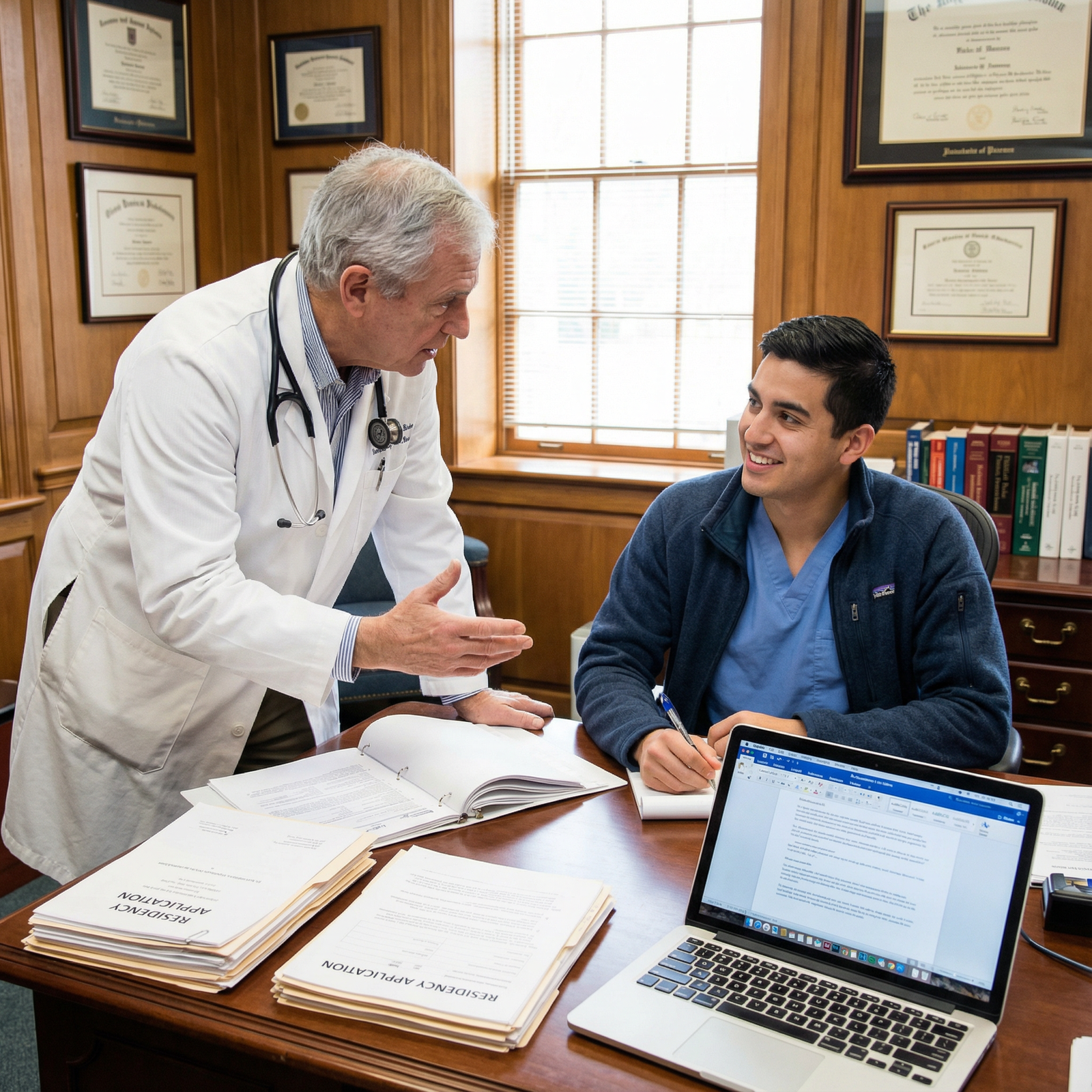
Closing Reminder: The Goal Is Not a Pretty Letter, It Is a Credible Signal
Here’s the final truth. A strong letter does not exist to flatter you. It exists to lower the program’s anxiety about you.
That’s what residency-ready means.
The best letters don’t just say you’re impressive. They tell a program, in believable detail, that you are reliable, coachable, mature, hardworking, and likely to function well when the stakes rise. A research mentor can absolutely deliver that message if they truly know you and if you help them frame what they’ve seen.
So stop obsessing over whether the title “research mentor” sounds less valuable than “clinical attending.” That’s the wrong question. The real question is whether the letter reads like it was written by someone who has watched you operate like a future resident.
Your job is not to manufacture a personality. It’s to help your mentor tell the truth well. Clearly. Specifically. Credibly.
That’s how a research relationship becomes a real asset in the Match.