
The dirty truth is this: template-style residency LORs are a red flag for seriousness and effort, even when nobody says it out loud.
People love to pretend “a letter is a letter” as long as it’s positive. That’s not how program directors actually think when they’re buried under 800 files at midnight with a half-cold coffee and 60 more apps to go. I’ve sat in too many rank meetings and heard the same muttered comment: “This looks like that same template again… next.”
You want to know what’s really happening behind the scenes when your letter writer uses a template or copy‑paste language? Let’s walk through it the way PDs and selection committee members actually experience it.
What PDs See All Day: The Sea of Sameness
Picture this.
A PD opens your ERAS file. They’ve already looked at your scores, transcript, and personal statement. Now they open your first letter.
Paragraph one: “It is my pleasure to recommend [Student Name] for a position in your residency program. I have known [him/her/them] for [X] weeks during [rotation].”
Second letter: “It is my pleasure to recommend [Student Name] for a position in your residency program. I have known [him/her/them] for [X] weeks during [rotation].”
Third letter: “It is my pleasure to recommend…”
You think I’m exaggerating. I’m not. The repetition is numbing.
After reading hundreds of these, PDs develop almost a reflexive eye-roll when they see that templated first line and the same structure: role, dates, generic adjectives, one vague patient story, standard closing. They can still extract what they need—but they’re already thinking:
- This writer didn’t invest much time.
- This student didn’t inspire a personalized letter.
- This tells me nothing I don’t already know.
Template letters don’t necessarily hurt you on paper. But they absolutely fail to help you, and in tight decisions that matters more than applicants realize.
How PDs Actually Use LORs
You’ve been told letters are “super important.” Let me be specific about how.
Letters are used to:
- Confirm you’re safe and functional.
- Distinguish you from the crowd when your stats are similar to others.
- Detect any hint of concern or coded negativity.
- Spot future stars or cultural fits.
No one is sitting there grading literary quality. But PDs are hunting for things that break the template: specificity, comparative statements, concrete anecdotes, and any evidence that the writer truly knows you.
Template-style LORs fail on exactly those points.
They give:
- Vague praise: “hard-working,” “team player,” “excellent communication skills.”
- Generic descriptors: “among the medical students I have worked with.”
- Formulaic patient stories: “One example of [Name]’s compassion occurred when…”
The letter reads like it could have been written for 20 different students with find-and-replace. Because it probably was.
Here’s what a PD thinks scanning a template letter:
- “Okay, no red flags.” (Baseline expected. Not a win.)
- “Nothing specific. I have no better sense of this applicant than before.”
- “This writer didn’t go to bat for them. Just filled the requirement.”
In other words: a template-style LOR is usually interpreted as neutral, not strong. And neutral in a competitive specialty is functionally weak.
The Tell-Tale Signs of Template Letters (And What They Signal)
Program directors and faculty can spot template letters in under ten seconds. They see dozens from the same department or same writer every year. The pattern is obvious.
Here’s what stands out.
1. Identical Structure and Phrasing
You’d be shocked how often we see this:
- “It is my pleasure to recommend…”
- “During this time, I found [Name] to be…”
- “In summary, I recommend [Name] without reservation…”
Same three-paragraph structure. Same transitions. Same adjectives. Just the name swapped out.
What it signals to PDs:
- Assembly-line process. The department or writer pumps out letters on autopilot.
- The writer probably didn’t sit down to think deeply about you specifically.
- The letter’s content is more about their standard format than your performance.
No one says, “We’ll rank them lower because of the template,” but here’s how it actually plays out in committee: the student with this kind of letter gets less discussion, less enthusiasm, and fewer champions in the room.
2. Over-Polished, Non-Clinical Language
When every sentence sounds like it was lifted from a corporate HR manual—“demonstrates strong interpersonal skills,” “works well in team-based settings,” “maintains a professional demeanor at all times”—it feels written to be safe, not honest.
Behind closed doors, attendings say things like:
- “This could be anybody.”
- “This doesn’t sound like someone they know; it sounds like something they should say.”
That faint sense of artificiality? It lowers trust in the letter.
3. Zero Comparative Context
Real letters from invested writers say things like:
- “Top 5% of students I’ve supervised in ten years.”
- “Strongest MS4 I worked with this year on our inpatient service.”
- “Performed at the level of a well-functioning intern.”
Template letters dodge comparisons and just list traits.
What PDs infer:
- The writer either didn’t want to compare… or couldn’t.
- The student likely isn’t at the top of that writer’s mental list.
- This is a “meets expectations” student, not “must have.”
In a competitive field, “no comparative language” quietly places you in the middle of the pack.
The Internal Scorecard: How Letters Really Get Weighed
Most programs don’t formally “score” letters the way they score Step or clerkship grades. But informally, everyone in that room has a mental rubric.
To make this concrete, here’s how template-style vs. strong letters land, in practice:
| Aspect | Template-Style LOR | Strong, Personalized LOR |
|---|---|---|
| Initial impression | Generic, low-effort | Invested, meaningful |
| Specific anecdotes | Vague or canned | Concrete and memorable |
| Comparative language | Absent or weak | Clear ranking among peers |
| Risk detection | Hard to read between lines | Easier to trust hidden signals |
| Impact on enthusiasm | Neutral at best | Creates advocates in committee |
No one quantifies this in front of you. But this is exactly how the conversation goes when choosing between two similar applicants. The one with the strong, alive letter gets remembered and defended.
The Real Problem: Template ≠ Bad, Template + Mediocre = Forgettable
Let me be fair. A template-style letter from a major name can still be helpful. A generic but solid letter from a department chair of your chosen specialty is better than a gushing letter from a random community preceptor in an unrelated field.
PDs understand that some departments have standardized letter structures. Some specialties even push toward uniformity. That’s not the problem.
The problem is when:
- Your template-style letter is from a mid-level or low-impact writer,
- It’s lukewarm, vague, and non-comparative,
- And it’s all you have.
Then PDs are left thinking: “Okay, this student exists. Next.”
They will not say that in emails or on panels. They don’t need more angry students. But in selection meetings, I’ve heard almost these exact words: “Letters are fine. Nothing special.” That “fine” might be the sentence that costs you an interview spot when you’re indistinguishable from 30 other applications.
How PDs React to Different Template Scenarios
Let’s walk through a few real-world patterns I’ve seen.
Scenario 1: Three Nearly Identical Medicine Letters
Student applying IM. Three internal medicine letters from the same hospital, all from hospitalists, all clearly using the same departmental template.
What happens?
- The good: Consistency. No red flags. Everyone says the student is reliable, pleasant, competent.
- The bad: Zero differentiation. No one calls them top-tier. No one gives a standout story. No big academic names.
Verdict: Gets interviews at mid-tier and regional programs, probably not at the top places they’re dreaming about unless their scores and CV are stellar.
Scenario 2: One Template Chair Letter + One Powerful, Specific Letter
Student applying general surgery. Chair letter is obviously formulaic, but then there’s a beautifully specific, punchy letter from the trauma attending who actually worked with them.
In committee, what gets quoted? Not the chair letter.
People read the chair’s generic praise, shrug, then circle phrases from the attending’s letter:
- “Top 5% I’ve worked with.”
- “Handled chaotic trauma cases like a junior resident.”
Verdict: The template letter does no harm; it fulfills political expectations. The personalized letter moves the needle.
Scenario 3: Template Language Hiding a Mild Warning
Here’s the dangerous one.
Some letter writers use a template to cover themselves and then slightly tweak language or tone to communicate concern:
- “Completed required tasks.”
- “Performed at the expected level of a fourth-year student.”
- “Was generally well liked by peers.”
PDs know exactly what that means. That’s code for “not standout, maybe issues, I’m not putting my name on the line.”
So while students think, “Oh, it’s just generic,” PDs think, “They’re trying not to say anything positive beyond the bare minimum.”
How This Affects Your Ranking Once You Get the Interview
You probably think letters stop mattering once the interview invite arrives.
Not quite.
On rank day, when a program is trying to decide whether you’re #8 or #28 on their list, people go back to the letters. The conversation often sounds like:
- “I liked them on interview day. Anything strong in the letters?”
- “Let me check… mostly generic, nothing negative, but no one really raved.”
- “Okay, we can move them down a bit. We have others with stronger support.”
That’s where template-style letters hurt you most: at the margins. They don’t usually sink you. They just fail to pull you up.
PDs remember standouts like, “Her performance was on par with my PGY-2s,” or “I would recruit him to our program without hesitation.” They don’t remember, “It is my pleasure to recommend…”
What You Can Actually Do About It (Without Annoying Faculty)
You can’t control your attendings. Some of them only write template-style letters. Some departments require standard forms. Fighting that is a good way to get nothing.
But you’re not powerless. Here’s how smart applicants minimize the damage.
1. Choose Writers Who Actually Know Your Work
Obvious? Apparently not, because every year students chase titles instead of relationships.
A personalized letter from a non-chair who:
- Saw you on call at 2 AM,
- Watched you present daily and manage patients,
- Gave you mid-rotation feedback and saw improvement,
is far more powerful than a templated chair letter written off a summary sheet.
Ideal setup in most specialties:
- One big-name or chair-style letter (even if templated).
- One or two strong, detailed letters from attendings who truly worked with you.
Template + specific can work. Template + template + template is where you drown.
2. Arm Your Letter Writers With Real Material
Most students hand over a CV and a generic “personal statement draft.” PDs see the end result: vague letters built off vague input.
What actually helps produce less templated letters:
- A one-page “Brag Sheet” with three or four specific clinical moments:
- “That ICU night where I stayed late to help discharge and call families.”
- “The multi-day workup I led for the patient with puzzling fevers.”
- Clear statement of what you’re aiming for: “I’m applying categorical IM; I’d love if you could comment on my clinical reasoning, reliability, and how I functioned compared to peers.”
You’re not writing the letter for them. You’re giving them leverage against their own lazy template.
3. Ask the Right Attending, the Right Way
If you approach someone who barely remembers your name with: “Can you write me a strong letter?”—most decent people will say yes and then default to a safe template.
A better approach is:
“I really valued working with you on the inpatient service and I felt we had good interactions on rounds and at the bedside. Would you feel comfortable writing me a strong letter of recommendation for [specialty]?”
If they hesitate? If they say “I can write you a letter” without the word “strong”? That’s your sign. Find someone else.
How PDs Talk About Template Letters When Applicants Aren’t in the Room
I’ve heard these exact types of comments in selection meetings:
- “Another boilerplate [School X] letter. They all sound like this.”
- “Nothing negative, but clearly just their standard format.”
- “Any letter actually say anything?”
- “Anybody know this attending? Are they someone who normally writes enthusiastic letters?”
PDs know which institutions crank out template letters like a factory. They mentally adjust for that. That helps you a little.
But here’s the nuance: even within those institutions, once in a while a letter breaks the mold. When a committee member says, “This is one of the best letters I’ve seen from [School X] this year,” everyone pays attention.
You want to be the student attached to that letter, not “just another template from School X.”
A Visual Reality Check: What PDs Actually Value in Letters
To make the balance clear, here’s how PDs say they value letter features vs how they actually behave when we watch decisions shake out over a season.
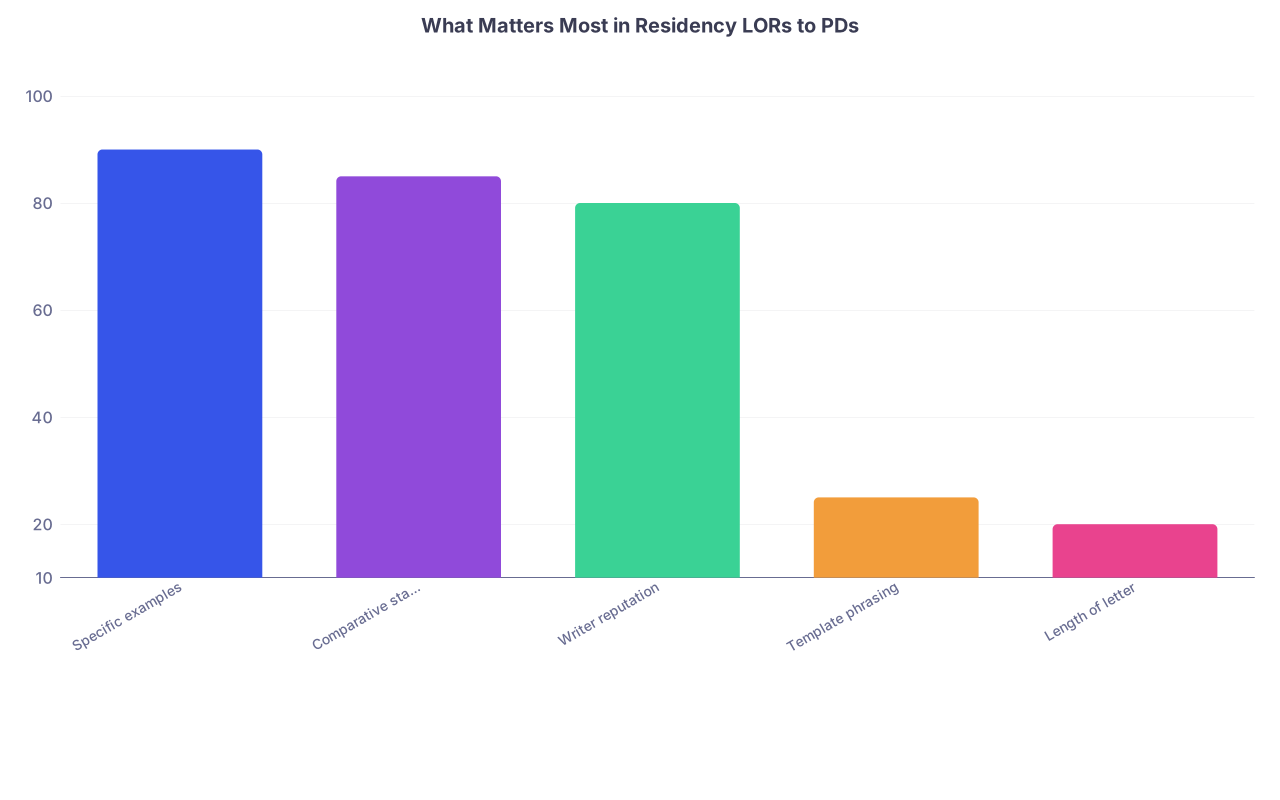
| Category | Value |
|---|---|
| Specific examples | 90 |
| Comparative statements | 85 |
| Writer reputation | 80 |
| Template phrasing | 25 |
| Length of letter | 20 |
Template phrasing isn’t what kills you. It’s the lack of specific content inside that template.
Where Template Letters Still “Work”
Let me be blunt: if you’re an average applicant aiming for less competitive programs or your home program, a set of generic but positive letters might be completely adequate.
They show:
- You’re safe.
- You’re not a problem.
- You can be trusted with patients.
Plenty of community and mid-tier academic programs will say, “Looks fine,” and interview you based on scores, geography, and school name.
But if you’re reaching:
- Competitive specialties (derm, ortho, ENT, plastics, rad onc, IR, urology, etc.).
- Hyper-competitive academic programs in any field.
- Or trying to compensate for a weak Step score or a rocky transcript.
Then “fine” letters are not fine. They’re missed opportunities.
Template-Style LORs and IMGs/Off-Cycle Applicants
For IMGs and non-traditional applicants, the bar is higher.
PDs are already trying to answer:
- Can this person function in our system?
- Is this letter from someone I trust?
- Is this student as strong as our usual candidates?
When they see a templated, impersonal letter from an unknown institution, two thoughts pop up:
- “I don’t know how to interpret this scale.”
- “The writer didn’t go out of their way for them.”
This doesn’t mean you’re doomed. But it raises the importance of at least one letter from a US-based attending who actually goes beyond the template. That single, detailed letter can carry your entire application’s credibility.
The One Thing You Should Stop Believing
There’s a comforting myth students cling to: “As long as the letter is positive and on time, I’m good.”
That’s not how this game works.
The hidden hierarchy PDs are using looks more like this:
- Truly exceptional, specific, comparative letter → Moves you up.
- Solid, personal, but not glowing letter → Confirms you, keeps you competitive.
- Generic template letter from a random attending → Neutral, forgettable.
- Template letter with faintly concerning language → Quietly harmful.
- Short, generic, or late letter from a high-profile name → Sometimes worse than a solid letter from someone who really knows you.
You’re not trying to avoid disaster. You’re trying to give someone in that committee room a reason to say, “I really like this one.”
Template letters almost never give that.

| Step | Description |
|---|---|
| Step 1 | Applicant Pool |
| Step 2 | Exceptional & Specific |
| Step 3 | Generic but Positive |
| Step 4 | Subtle Concerns |
| Step 5 | Moves Up On Rank List |
| Step 6 | Neutral - Depends on Other Stats |
| Step 7 | Moves Down or Screened Out |
| Step 8 | LOR Quality |