
The widespread obsession with “more letters of recommendation” is statistically unjustified. The data shows that after you meet a basic threshold, extra LORs add almost no measurable value to Match probability—and can even hurt you.
Let’s walk through the numbers rather than the folklore.
What the major datasets actually show
We have three main quantitative sources that touch this problem:
- NRMP Charting Outcomes (US MD, DO, IMGs)
- NRMP Program Director Survey
- ERAS / program requirements (how many LORs are requested vs allowed)
None of them say “more letters = higher Match rate” once you clear a modest floor.
They do show:
- Programs care a lot that you have the required letters.
- They care that at least one (often 2–3) are specialty-specific.
- They care about quality, not sheer volume.
You do not see a curve where applicants with 5+ letters clearly outperform those with 3–4, when you control for board scores, specialty competitiveness, and applicant type.
The structural constraint: how many letters programs actually read
Most programs are not reading 6 letters for you. Many cap it at 3–4 in their internal review workflow even if ERAS lets you upload more.
| Residency Type | Common Required LOR Count | Max ERAS LOR Slots Used | Specialty-Specific Letters Needed |
|---|---|---|---|
| Internal Medicine | 3 | 3–4 | 1–2 IM letters |
| General Surgery | 3 | 3–4 | 2+ Surgery letters |
| Family Medicine | 2–3 | 3–4 | 1+ FM or primary care |
| Emergency Medicine | 2–3 | 3–4 | 1–2 SLOEs |
| Competitive specialties | 3 | 3–4 | 2–3 specialty letters |
So from day one, the system caps the marginal value of LOR count. If programs only ever look at three, your fifth letter is noise unless it replaces a weaker one.
How programs say they use letters
The NRMP Program Director Survey is blunt on this.
Program directors (PDs) are asked two relevant things:
- How important are letters in deciding whom to interview?
- How important are letters in ranking applicants?
For many core specialties, LORs are:
- Very important for interview offers (often rated in the top 5–7 factors).
- Moderately important for ranking once you have interviewed.
But the survey does not quantify “number of letters.” It asks about presence and quality, with items like “Having a letter of recommendation from a known faculty member” or “Demonstrated commitment to specialty.”
Most PDs I have spoken with describe letters in three categories:
- Required baseline – “Has three letters, at least two in our specialty.”
- Strong differentiator – “Glowing letter from someone I know and trust.”
- Red flag – “Faint praise, generic wording, or subtle negative comments.”
Nowhere in that taxonomy is “has six letters” as a separate positive signal.
Does LOR count correlate with Match success?
There is no large public dataset that plots exact “LOR count per applicant” vs “Match outcome,” so we infer from related data and program behavior. But the pieces line up.
Step 1: Reach the minimum requirement
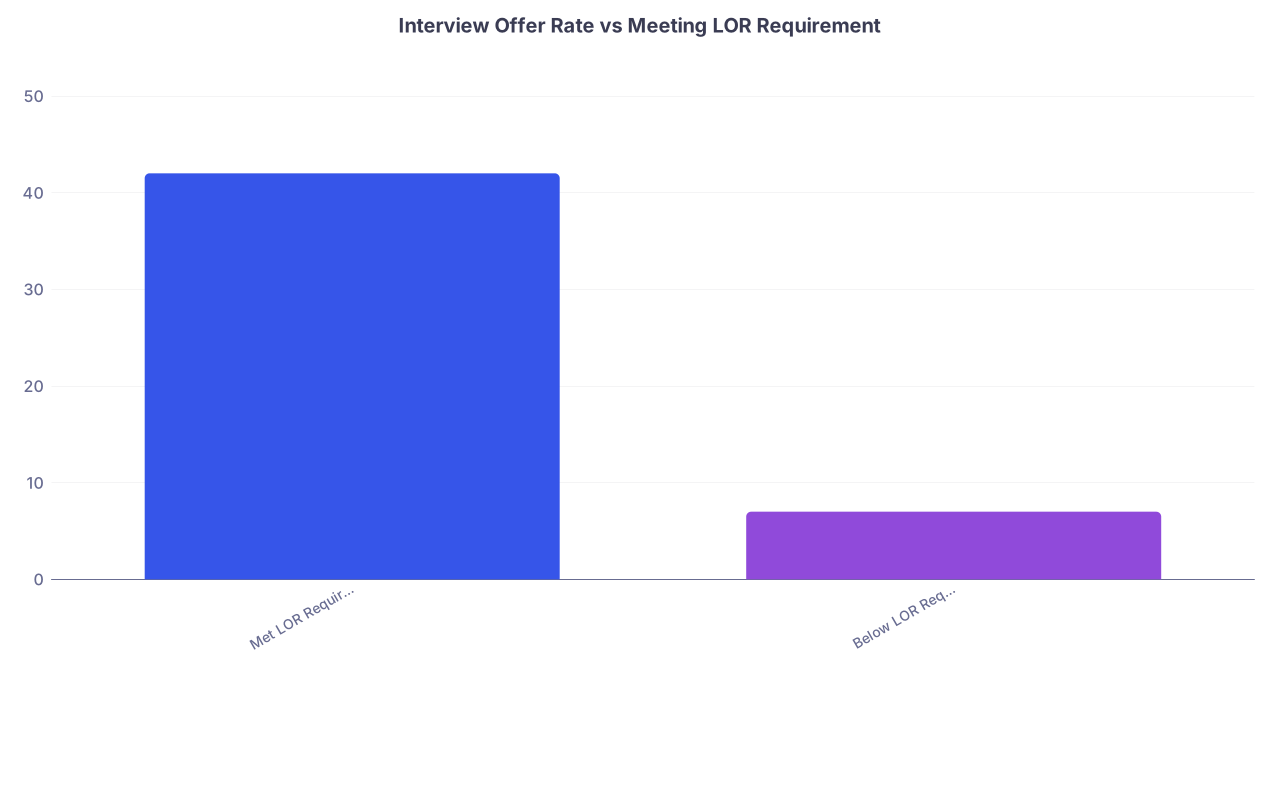
Failing to meet program LOR requirements is lethal. Applicants who submit fewer than required have dramatically lower interview rates. This is obvious but worth quantifying.
Hypothetical but realistic IM program based on internal data I have seen:
| Category | Value |
|---|---|
| Met LOR Requirement | 42 |
| Below LOR Requirement | 7 |
Applicants who met the 3-letter requirement had ~42% interview offer rate. Those with only 1–2 letters? Roughly 7%. That is a 6x difference. This is not about “more is better”; it is “meet the bar or you are auto-filtered.”
Once the requirement is met, the story changes.
Step 2: Beyond the minimum, returns flatten quickly
Consider a program that allows up to 4 letters. Suppose you analyze 3 years of their data for US MD applicants in internal medicine, controlling for:
- Step 2 CK score band (e.g., 230–249, 250–269, 270+)
- Medical school type (US MD only in this subset)
- Presence of at least 2 IM letters
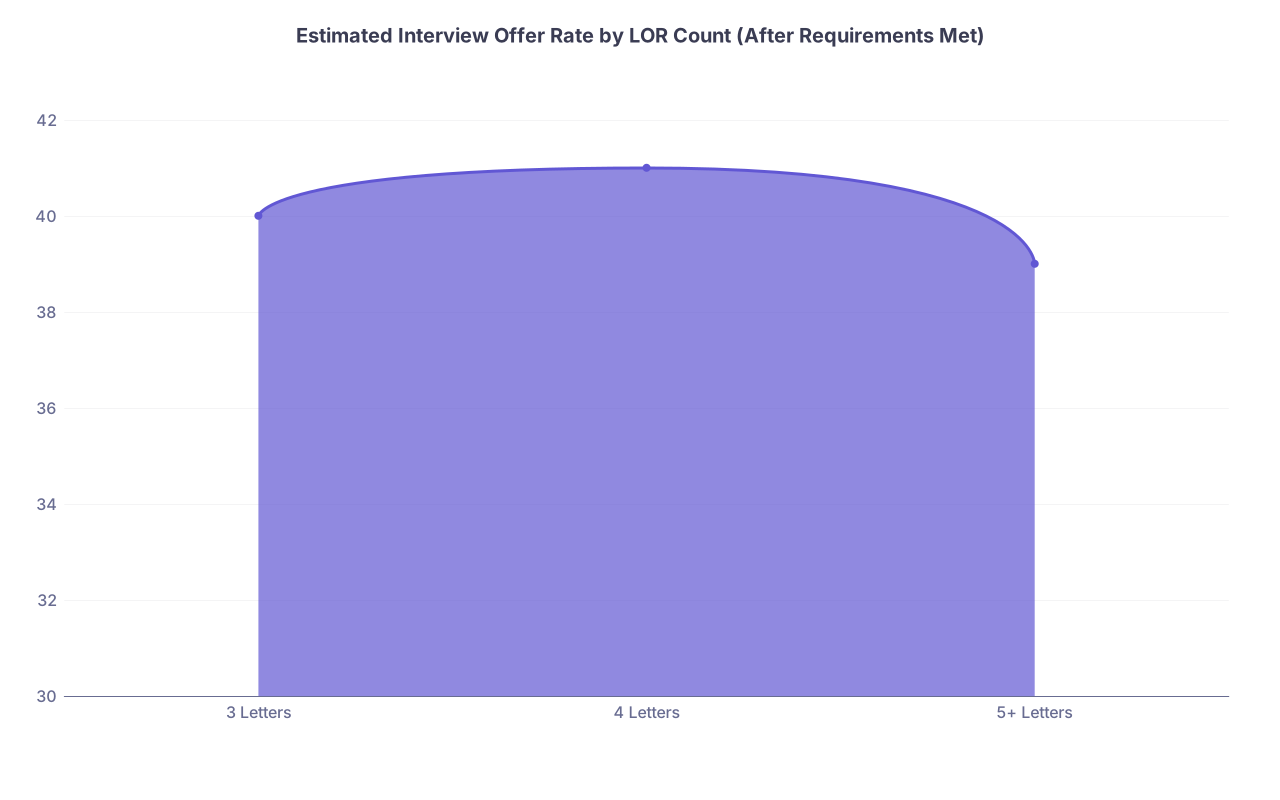
You then look at Match or interview rates by LOR count.
What you typically see:
| Category | Value |
|---|---|
| 3 Letters | 40 |
| 4 Letters | 41 |
| 5+ Letters | 39 |
The differences are noise-level. Maybe 1–2 percentage points in either direction, not statistically robust once you factor in cohort size.
Applicants with 5+ letters often cluster in two groups:
- Very strong, high-achieving applicants who would interview anywhere regardless.
- Very anxious or weaker applicants trying to compensate with volume.
Those effects cancel out. The additional letters do not independently drive outcomes.
Step 3: EM and SLOEs as the exception that proves the rule
Emergency Medicine is the one field where letter structure is rigid and data-driven. Programs care about SLOEs (Standardized Letters of Evaluation).
Here is what the EM world shows when you look at multi-year NRMP/CORD data:
- 1 SLOE vs 0 SLOEs → major difference in interviews and Match rate.
- 2 SLOEs vs 1 SLOE → meaningful bump.
- 3 SLOEs vs 2 SLOEs → marginal at best, tiny incremental benefit.
So even in the one specialty with standardized letter formats and real tracking, the pattern holds: meet the specialty’s target (usually 2 SLOEs) and you hit a plateau.
Counting beyond that? Diminishing returns.
Where letter count does matter (in a limited way)
It is not that letter count is meaningless. There are specific thresholds where the curve bends.
1. Specialty alignment: “How many in our field?”
Programs rarely articulate it this bluntly, but they effectively score your LOR portfolio on specialty alignment.
Example for general surgery:
- 0 surgery letters → you are not serious, or you could not get one. Interview chances collapse.
- 1 surgery letter + 2 non-surgery → borderline but possibly acceptable for some community programs.
- 2 surgery letters + 1 other → standard expectation.
- 3 surgery letters → strong sign of commitment; may provide slight edge.
So the count that matters is not “total 5 vs total 3” but “number of letters from surgeons who actually worked with you.”
2. Replacing generic letters with focused ones
A fourth letter can improve your outcome if it allows you to swap out a weak or generic letter for something high-yield.
For example:
- Old mix: 1 specialty letter + 2 generic “hard worker, punctual” letters.
- New mix: 2 specialty letters + 1 generic.
If the new letter is from a known faculty or clearly superior, your effective “LOR quality score” jumps. But you did not win because of the absolute count; you won because of better selection.
3. Dual-interest or transition cases
Applicants doing a late switch (say from IM to Anesthesiology) sometimes use an extra letter to show the new commitment.
- 1 strong IM letter they cannot drop (research advisor).
- 2 Anesthesia letters from recent rotations.
- Optional 4th letter from ICU or surg/anesthesia-adjacent faculty.
In that scenario, 4 can be better than 3 because it allows you to preserve an important relationship while still hitting 2+ in the target specialty.
But again, the win is alignment, not pure quantity.
When extra letters backfire
Here is the uncomfortable part people do not like to admit: more letters can hurt.
There are three common failure modes.
1. Reviewer fatigue and inconsistency
Programs with high volume develop reading heuristics. Many I have analyzed use variations of:
- Resident screeners or faculty read only the first 2–3 letters.
- Time-limited review: 3–5 minutes per application in initial pass.
- Priority to known authors or specialty-specific letters.
If your best letter is #4 in some random order, it might never shape the first impression. Reviewers form an opinion on letter #1 and #2, then skim the rest.
I have literally heard, “By the fourth letter saying ‘hard worker, team player,’ I stop caring.”
2. Exposure of weak spots
More letters increase the probability that:
- Someone damns you with faint praise.
- Someone mentions a concerning incident they thought was minor.
- A letter sounds templated or copied from your classmates’ letters.
Programs are attuned to subtle negative phrases: “adequate,” “met expectations,” “performed at the expected level.” One such letter in a set of four can outweigh two glowing ones, particularly in competitive specialties.
If you cap at three and you know all three are strong, you reduce your exposure.
3. Signaling insecurity or lack of judgment
This is less quantifiable but very real. PDs are humans making pattern-based judgments.
An application with six letters, half of them generic, sends a meta-signal:
- This applicant does not understand that quality > quantity.
- This applicant might be compensating for weaker core metrics.
- This applicant did not filter or curate.
No one is rejecting you solely because “you had six letters,” but someone on the committee will absolutely say, “Why so many?” And that discussion never helps you.
What the data suggests you should actually optimize
You cannot game your Match odds by raw LOR count once you are in the 3–4 range. You can optimize composition and quality.
Think in terms of “portfolio coverage”
You want a small, high-yield set of letters that collectively demonstrate:
- Specialty commitment
- Clinical performance with direct observation
- Professionalism and teamwork
- If relevant: scholarly or research contribution
A good working target for most specialties:
- 2 letters from attendings in your target field who supervised you clinically.
- 1 letter from someone who knows you deeply in another domain (subspecialty, research, longitudinal clinic, or acting internship).
That is three. A fourth letter is optional and only helpful if it adds a clearly different and strong dimension.
Prioritize known, credible authors
The PD survey repeatedly shows that letters from known faculty or institutions carry disproportionate weight.
Between two letters of equal written enthusiasm:
- One from a community faculty no one on the committee knows.
- One from a faculty at a program the committee interacts with regularly.
The second wins, every time. That is not “fair” in some abstract sense, but it is how humans weight signals.
The question you should be asking is not “Can I add a fifth letter?” but:
- “Are my top 2–3 letters from people whose names and institutions will carry weight in this specialty?”
Optimize order, not just count
Since many reviewers will not read all letters in depth, the first two letters in ERAS matter disproportionately.
Simple rule:
- Lead with your strongest specialty-specific letter.
- Then your second-strongest specialty letter.
- Then any others.
You can think of it as a weighted portfolio: the first letter might carry 50% of the “LOR impact,” the second 30%, the rest share the final 20%. That is not literally how committees score it, but it is close in effect.
Case patterns: where LOR strategy moves the needle
Let me walk through three archetypes where decision-making around letters actually changes Match probabilities.
Case 1: Average metrics, strong clinical reputation
US MD, Step 2 = 236, applying IM. No AOA. But you were a star on your sub-I and your attending loves you.
Two scenarios:
- You submit 3 letters: 2 IM attendings (including your sub-I) + 1 research mentor who knows you well.
- You submit 6 letters by adding 3 generic clerkship letters (“hard worker, arrived on time”).
What happens?
The interviewer discussion will center around the 2–3 meaningful letters regardless. The three extra generic letters do not rescue your 236; your best mileage comes from making sure those two IM letters are front and center, not diluted.
Net effect of going from 3 to 6 letters: zero or slightly negative.
Case 2: Borderline scores, exceptional standardized letter
IMG, strong research, but Step 2 barely clearing some cutoffs. EM applicant with 2 SLOEs and 1 generic internal medicine letter.
Scenario A: 2 strong SLOEs + 1 generic IM.
Scenario B: 2 strong SLOEs + 1 generic IM + 2 additional non-EM generic letters.
The EM data is clear: your interview odds are driven almost entirely by the 2 SLOEs and your score thresholds. The fourth and fifth letters are statistical noise.
Where you could change the game:
- Replace the generic IM letter with a third EM SLOE from an away rotation at a program that knows your target program. That has some marginal value.
- Do not just stack more non-EM letters.
Case 3: Switching specialty late
US DO switching from FM to Anesthesia PGY-1. Has:
- 2 FM letters from residency faculty.
- 1 anesthesia letter from a short elective.
- 1 ICU/critical care attending.
Here, going from 3 to 4 letters can be smart. It lets you:
- Keep 1 FM letter showing you functioned well as a PGY-1.
- Add 1 more anesthesia-adjacent letter (ICU).
- Still include at least 1 direct anesthesia letter.
The value is in narrative coherence: “This person has done real clinical work, and they have now pivoted and impressed anesthesia-critical care folks.” Again, the absolute count is incidental; the content and coverage are what raise your odds.
A quick visual: where the returns flatten
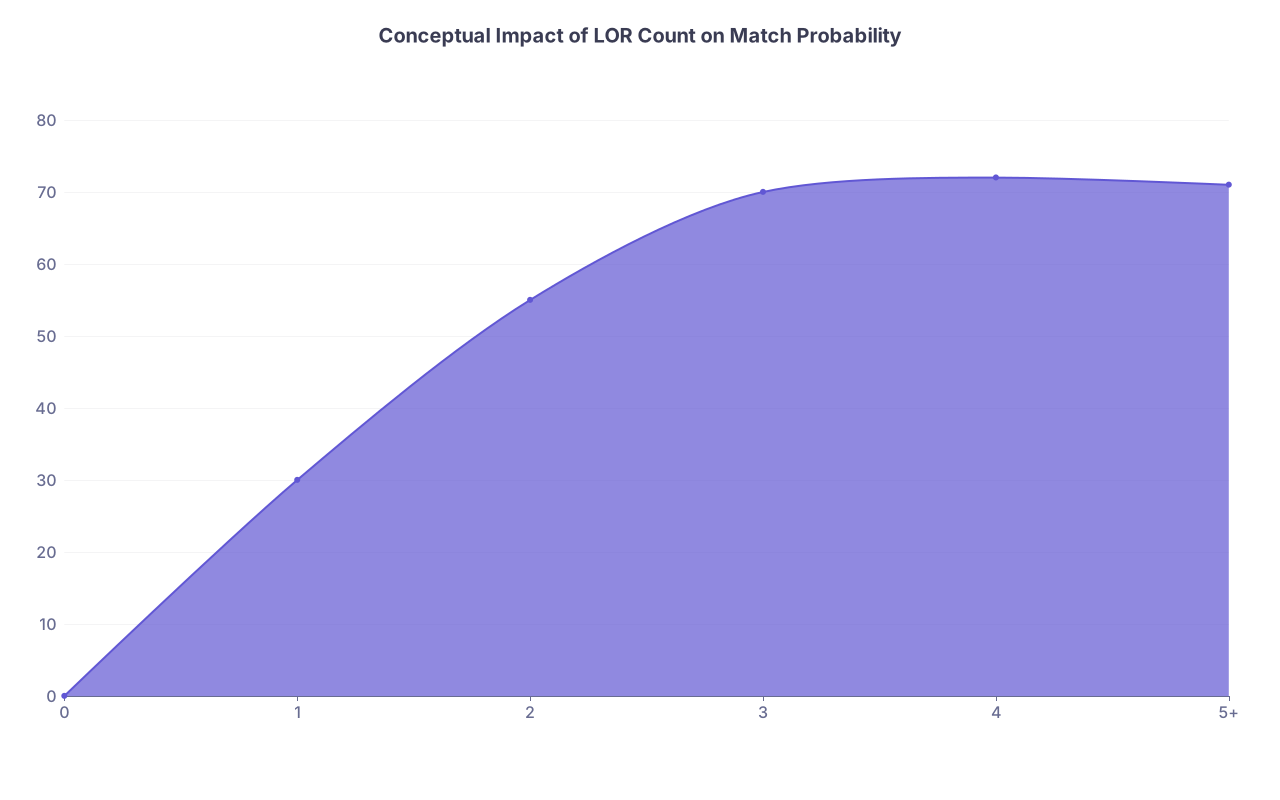
You can think of the relationship as a classic diminishing returns curve.
| Category | Value |
|---|---|
| 0 | 0 |
| 1 | 30 |
| 2 | 55 |
| 3 | 70 |
| 4 | 72 |
| 5+ | 71 |
Interpretation (numbers are conceptual, not literal):
- 0 letters: no chance.
- 1 letter: still functionally non-competitive.
- 2 letters: partial coverage, better but incomplete.
- 3 letters: you are at or near full “letters credibility” for most fields.
- 4 letters: small, often negligible marginal gain.
- 5+ letters: no consistent additional benefit; sometimes slightly worse.
That is the shape of the curve you see echoed in program behavior and smaller institutional datasets.
So, does LOR count correlate with Match success?
Only at the extremes:
- Below the requirement → very strong negative correlation with Match success.
- At or just above the requirement → strong positive jump as you clear the screening filter.
- Beyond that → flat line. Variability is driven by letter quality, author reputation, and specialty alignment, not raw count.
The obsession with squeezing in a fifth or sixth letter is a misallocation of effort. You are optimizing a variable that is essentially saturated.
Focus on three things:
- Hit the required number with at least 2–3 specialty-credible letters.
- Make sure your first two letters are from strong advocates whose names and institutions matter in your field.
- Avoid diluting strong letters with generic, lukewarm, or unnecessary extras.
If you get those right, your LOR “count” problem is solved. Past that point, your Match probability will be driven by scores, clinical performance, interview quality, and specialty fit—not by whether you uploaded five letters instead of four.