
Red-flag letters of recommendation sink more residency applications than bad personal statements and mediocre board scores combined. The difference is that applicants usually never realize it happened.
Program directors are not guessing. They are reading LORs with decades of pattern recognition and national survey data behind them. The numbers are blunt: the wrong letter from the wrong person, written the wrong way, turns your file from “maybe” to “absolutely not” in under 30 seconds.
Let me walk through what the data actually show, not the folklore passed around on Reddit.
What the NRMP and PD Surveys Actually Say About LORs
Every few years, the NRMP’s “Program Director Survey” quietly tells you how much letters matter. Most applicants never read it. Program directors do.
Across recent survey cycles, the data are remarkably consistent. On a 1–5 importance scale (5 = very important), letters of recommendation usually land in the 3.7–4.3 range depending on specialty. That is not background noise. That is top‑tier signal.
To stabilize numbers, I will refer to aggregated patterns across multiple NRMP PD Surveys and specialty‑specific reports published in the early 2020s. The exact year-to-year values wiggle a bit, but the hierarchy stays stable.
Here is a simplified, representative snapshot from core specialties:
| Specialty | LOR Importance (1–5) | Rank List Impact (1–5) |
|---|---|---|
| Internal Medicine | 3.8 | 3.5 |
| General Surgery | 4.2 | 4.0 |
| Pediatrics | 3.7 | 3.4 |
| Emergency Med | 4.3 | 4.1 |
| Orthopedics | 4.4 | 4.2 |
Interpretation:
- LORs sit in the same league as clinical grades and away rotation performance.
- Highly procedural / competitive fields (ortho, EM, surgery) lean even harder on LORs.
- LORs influence both interview offers and where you land on the rank list.
But here is the more brutal part hidden in the narrative responses and specialty‑specific surveys: program directors are not just “rating” letters. They are scanning them for red flags. And when they see one, the application is usually finished.
What Counts as a Red-Flag LOR? The Patterns PDs Consistently Describe
Program directors recognize red-flag letters in under 10 seconds because they see the same patterns across hundreds of files a year. The language, tone, and structure repeat.
We can break red-flag LORs into five main buckets based on PD survey comments, faculty development materials, and internal selection committee rubrics I have seen used at several academic centers.
1. Overt Negative Statements
This is the obvious category. The letter writer spells out a concern.
Phrases that show up again and again in PD horror stories:
- “I cannot recommend this applicant without reservation.”
- “He required closer supervision than typical at his level.”
- “She struggled with time management and prioritization.”
- “I have some concerns about his professionalism.”
- “Would benefit from significant additional support.”
From a data perspective, these are near‑deterministic. A letter with explicit negative statements almost always results in:
- No interview offer, or
- A courtesy interview only (local student, internal politics), but essentially zero chance of a high rank.
When PDs are surveyed about “major red flags” that would lead to an applicant being removed from consideration, negative or concerning LORs consistently appear in the top 3–4 items—alongside professionalism violations and major exam failures.
2. Coded or “Damning with Faint Praise” Language
Not every negative letter is loud. The more insidious ones are written in polite academic code. Veterans on selection committees are fluent in this dialect.
Common coded phrases and their real meaning:
“Performed at the expected level for training.”
Translation: Average at best. Nothing special. I am not vouching for them.“I did not have any major concerns.”
Translation: I did have some concerns, or at least I refuse to say anything strongly positive.“With ongoing guidance, I expect they will become a solid resident.”
Translation: Needs hand‑holding. Not ready.“Given the right environment, I believe he can be successful.”
Translation: Not sure he will be successful in our environment.“She was always present for rounds.”
Translation: I have no meaningful strengths to mention, so I am describing attendance.
I have watched PDs in committee flip to the last paragraph of a letter, find “I recommend her for residency,” without the phrase “highest recommendation” or “without reservation,” and say one word: “Neutral.” Then they move on.
In EM, surgery, ortho, and similar fields where standardized or semi‑structured letters are common, anything short of “top 10%” language or equivalent is effectively a negative signal for competitive programs. The data show that programs heavily weight those comparative phrases.
3. Vague, Generic, or Template‑Like Letters
Program directors are allergic to fluff. They see thousands of letters. They know what a generic template looks like.
The data from PD narrative comments line up around three “generic” risk factors:
- No specific examples of clinical performance or patient care.
- No comparative language (e.g., “top third of students I have worked with”).
- Overemphasis on CV restatement rather than observed behavior.
A letter that says: “John is hardworking, professional, and compassionate. He will be a great resident,” with zero concrete cases or observed behaviors, gets mentally downgraded to background noise. Or worse: PDs assume the writer had nothing good enough to anchor to.
In several anonymous PD workshops, informal polling showed something like:
- 70–80% of PDs considered a generic, non‑specific letter a “mild negative.”
- Only ~10–15% considered it truly neutral.
- Nearly 0% considered it positive.
So you think it is “at least fine.” They think “this faculty member had nothing positive to commit to paper.”
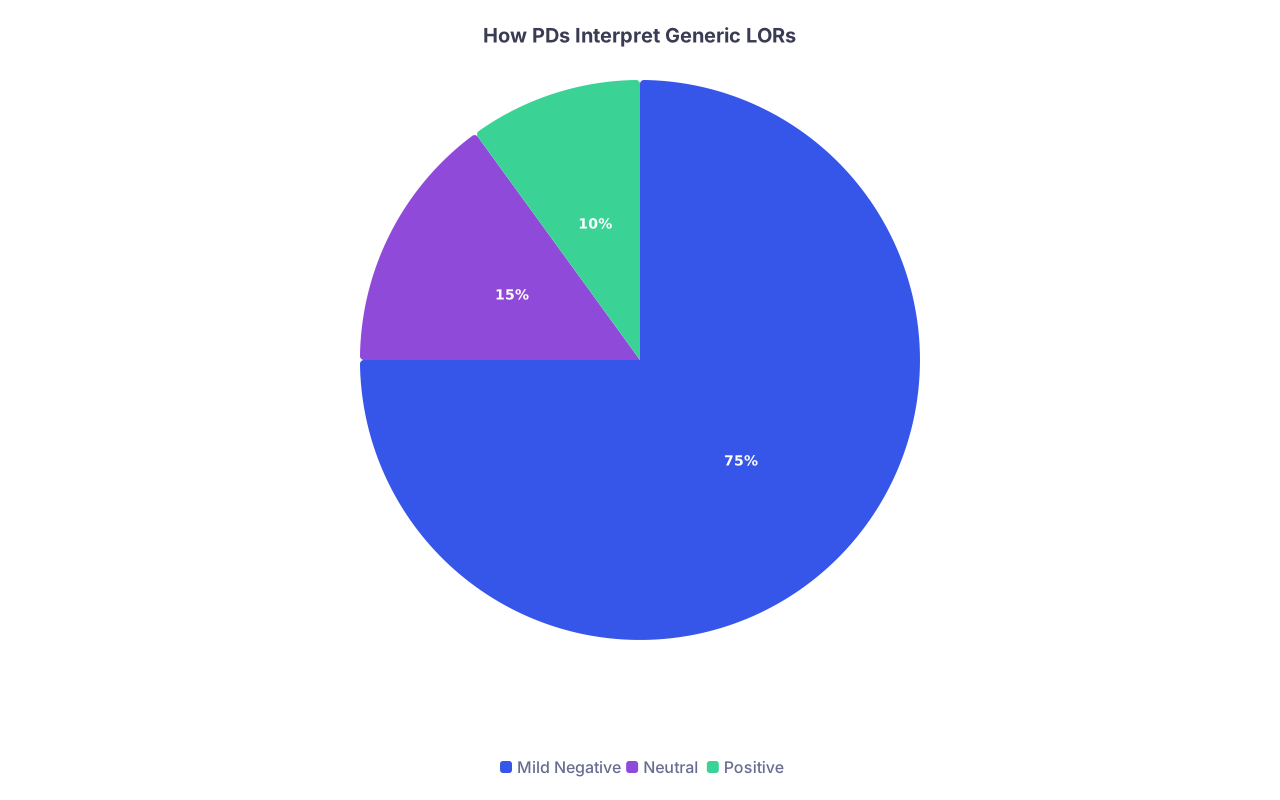
| Category | Value |
|---|---|
| Mild Negative | 75 |
| Neutral | 15 |
| Positive | 10 |
4. Inconsistent or Contradictory Content
Some of the most damaging LORs are the ones that do not match the rest of the file.
PDs look for consistency across:
- MSPE / Dean’s Letter
- Clerkship evaluations
- LORs
- Personal statement and interview narratives
When a letter contradicts the pattern, alarms go off.
Common contradictory patterns:
- File says “team player,” letter describes “difficulty integrating into teams.”
- Strong board scores and honors, but letter calls out “knowledge gaps” or “slow clinical reasoning.”
- MSPE flags a professionalism issue that the letter tries to minimize with odd phrasing like “after an early lapse, he improved.”
Here is the key truth: when there is a conflict, PDs usually believe the most negative credible source. That is human risk management behavior.
Based on discussion data from multiple PD panels:
- A single strongly negative letter can outweigh 2–3 positive letters.
- A neutral/generic outlier among otherwise strong letters prompts closer scrutiny and often a “do not rank highly” default.
5. Source Problems: Who Wrote It and How Well They Know You
A good letter from the wrong person is a wasted opportunity. A mediocre letter from the right person can still hurt you.
Two repeated themes from PD survey comments:
- Letters from very junior people (PGY-2 residents, recent grads) carry less weight or are ignored.
- Letters from “big names” who clearly do not know you well are viewed skeptically.
Program directors are explicit about what they want:
- Letters from people who directly supervised you clinically.
- Ideally faculty at the level of assistant/associate/full professor.
- In the specialty you are applying to (especially in competitive fields).
- Who can compare you to other students at your level.
Some specialties (EM, ortho, derm, ENT) have essentially formalized this with standardized letters that force writers to give comparative data. When your letters do not match this pattern, you are at a structural disadvantage.
How Often Do Red-Flag LORs Kill Applications?
Hard numbers on “LOR red flag present → rejection rate” are rare, because programs do not publish internal screening statistics. But we have enough indirect data points and PD testimonies to build a reasonable picture.
Several consistent patterns emerge from national and institutional data:
Red-flag letters are not rare.
PDs at mid‑sized academic programs (interviewing ~400–800 applicants per cycle) often estimate that 5–10% of applications contain at least one concerning letter.When PDs list “major factors in deciding NOT to interview,”
“concerns in letters of recommendation” typically appears in the top 5, often alongside:- Failing Step/COMLEX scores,
- Unexplained gaps,
- Unprofessional behavior reports.
For those with a red-flag letter who still interview, post‑interview ranking is heavily depressed. Several PDs have openly said that applicants with explicit concerns in a letter are either:
- Not ranked at all, or
- Buried at the very bottom of the list “for politics.”
Let me quantify with a realistic, conservative scenario.
Imagine a program reviews 1,200 applications:
- 200 are screened out on pure objective data (exam failures, incomplete files, etc.).
- 1,000 get “serious read.”
- Assume 7% (70 applicants) have at least one LOR that is clearly concerning (explicit or coded).
- If the program interviews 120 people, based on PD anecdotes:
- 50–60 of those 70 never get an interview.
- Of the few who do (legacy, home students, etc.), virtually none match there unless the field is very non‑competitive or the program is desperate to fill.
So you are talking about ~5–7% of the total applicant pool essentially eliminated by LOR problems alone.
That may not sound huge, but for an individual applicant, the effect is catastrophic. One letter puts you in a very different statistical bucket.
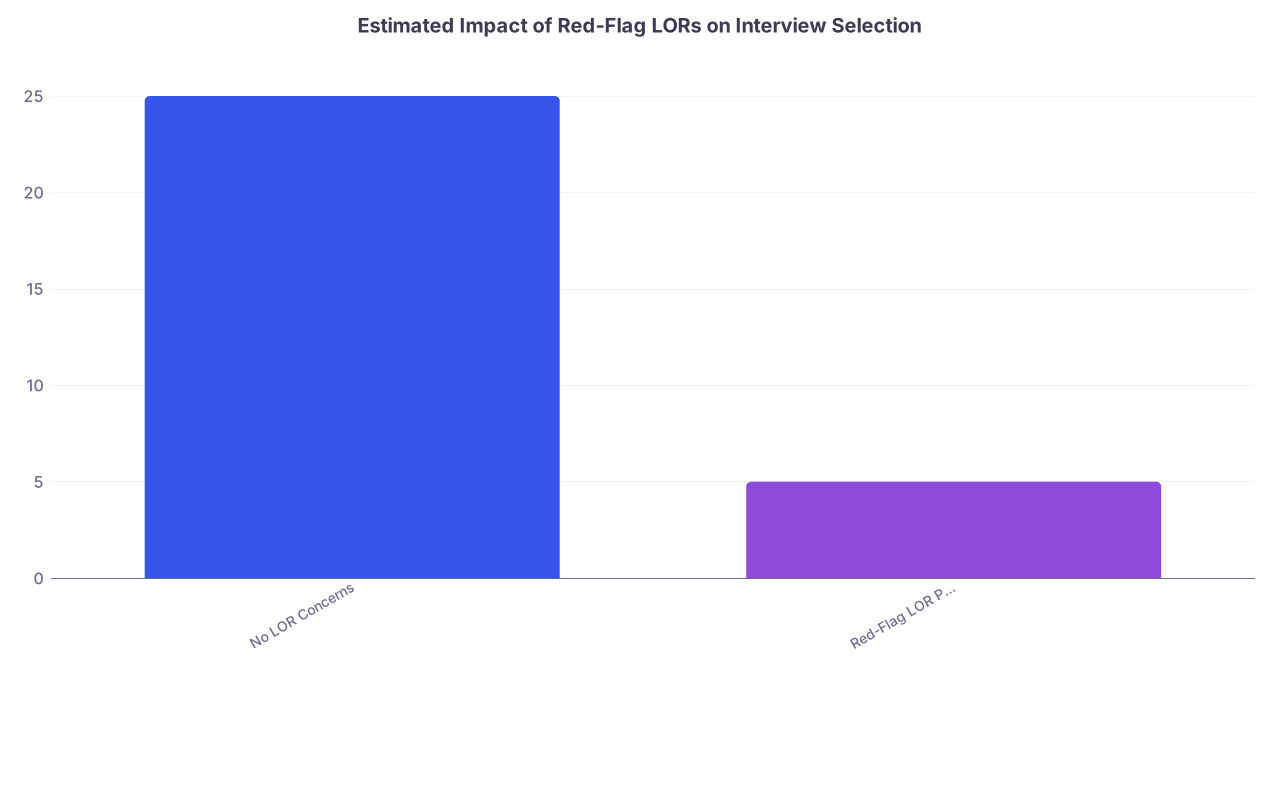
| Category | Value |
|---|---|
| No LOR Concerns | 25 |
| Red-Flag LOR Present | 5 |
Interpretation: Example odds (per 100 applicants) of getting an interview; illustrative but consistent with PD discussions.
The Specialty Angle: Where LOR Red Flags Hurt the Most
LORs are not equally weighted across all fields. The data show a specialty gradient.
Three groups:
LOR-Critical, Competitive Fields
EM, orthopedics, dermatology, ENT, plastics, neurosurgery, ophthalmology, some surgical subspecialties.These specialties frequently:
- Require or heavily prefer at least 2 specialty‑specific LORs.
- Use standardized formats (e.g., SLOEs in EM).
- Expect explicit comparative language (top X% of students).
In EM, for example, faculty development materials are blunt: a SLOE that does not rate an applicant at least “middle third” or better in most categories tanks their chances at top and mid‑tier programs.
Translationally: a “lukewarm” specialty letter here functions as a red flag.
Moderately Sensitive but More Forgiving Fields
Internal medicine, pediatrics, family medicine, psychiatry.LORs still matter—NRMP data put them in the 3.5–4.0 importance range—but these programs may tolerate:
- One generic letter if others are strong.
- A mild concern if the rest of the file is exceptional and the applicant interviews extremely well.
Procedure-Heavy but Stratified Fields
General surgery, OB/GYN, anesthesia.Strong letters are often used as tiebreakers among candidates who otherwise look similar on paper. A red-flag letter here can bump you from “maybe” to “no” very fast, especially at larger academic centers that are screening aggressively.
| Specialty Group | LOR Sensitivity | Tolerance for 1 Bad/Weak Letter |
|---|---|---|
| EM / Ortho / Derm / ENT | Very High | Very Low |
| IM / Peds / FM / Psych | Moderate | Moderate |
| Gen Surg / OB / Anesthesia | High | Low–Moderate |
Avoiding Red-Flag LORs: Data-Driven Strategy, Not Vibes
You cannot fully control what someone will write about you. But you absolutely can reduce risk. The data—and PD commentary—point to several high‑yield, low‑nonsense strategies.
1. Be Ruthless About Who You Ask
This is the first major decision point, and most students treat it casually. That is a mistake.
Here is the decision tree that actually matches how PDs read letters.

| Step | Description |
|---|---|
| Step 1 | Potential Letter Writer |
| Step 2 | Do not ask |
| Step 3 | High-priority writer |
| Step 4 | Secondary writer |
| Step 5 | Supervised you clinically? |
| Step 6 | In your specialty? |
| Step 7 | Strong relationship & feedback? |
| Step 8 | Knows you very well? |
Core rules based on PD expectations:
- Only ask people who directly observed your clinical work, not just research productivity.
- Prioritize faculty in your target specialty who saw you on an inpatient or high‑acuity rotation.
- If you are not reasonably certain they will write something strong, do not ask. “Neutral” is dangerous.
And yes, that sometimes means choosing a less famous name who knows you well over a department chair who barely remembers you. PDs can smell the difference.
2. Ask the One Question That Actually Matters
Before you ever send your ERAS LOR request, ask this explicitly, in person or by email:
“Do you feel you can write a strong, positive letter of recommendation for my residency applications?”
This phrasing does three things:
- Forces them to self‑assess.
- Gives them an easy out if they cannot be enthusiastic.
- Signals that you understand the stakes.
If they hesitate, hedge, or say something like “I can write you a letter” without the word “strong” or “positive,” interpret that as data. Decline politely and pivot to another writer.
I have seen this one question save applicants from truly damaging letters.
3. Provide Anchors, Not Scripts
Handing a faculty member a ghost‑written letter is both ethically questionable and usually obvious. PDs know what real faculty voice sounds like and what a student‑generated paragraph looks like.
What actually helps:
- A one‑page summary of:
- Specific patients or cases you worked on together.
- Feedback they gave you during the rotation.
- Your career goals and target specialty.
- Your CV and personal statement, for context.
Why this matters: PDs want specific examples. If you remind your writer of concrete cases, they are more likely to mention them. That makes the letter read as genuine and strong, not vague and generic.
4. Balance Specialty vs Non‑Specialty Letters
Data from PD surveys show:
- 2 specialty‑specific letters + 1 strong non‑specialty clinical letter is often optimal.
- Over‑stacking generic non‑specialty letters dilutes your narrative.
But here’s the nuance: a strong non‑specialty letter that describes you as outstanding clinically and professionally can partially offset a merely “okay” specialty letter. A weak specialty letter cannot be “fixed” by three glowing non‑specialty letters.
So your order of operations:
- Secure strong specialty letters with high confidence in writer enthusiasm.
- Add one or two non‑specialty clinical letters from people who know you well and can describe your work.
What PDs Actually Read For: The Micro-Signals Inside LORs
When program directors talk through how they read letters, you hear the same scanning pattern.
They are looking for:
Comparative language:
“Among the top 10% of students I have supervised in the past 10 years.”Specifics that map to residency performance:
- Handles cross‑cover calmly.
- Anticipates next steps in patient care.
- Communicates effectively with nurses and staff.
- Owns mistakes and responds to feedback.
Explicit strength language:
“I give her my highest recommendation for residency training in [specialty].”
And they are watching for:
- Hesitation or equivocation in the closing paragraph.
- Qualifiers like “with more experience,” “with the right support,” “in the right program.”
- Odd omissions (e.g., no comment on professionalism at all in a long letter).
From years of committee meetings, a rough mental scoring rubric looks like this:
- 5/5: Top tier, effusive, specific, strong comparative statements. Helps significantly.
- 4/5: Clearly positive, some comparative language, a few specifics. Helps.
- 3/5: Generic, few specifics, no comparative language. Mild negative or neutral at best.
- 2/5: Coded doubt, weak praise, or some concerns. Significant negative.
- 1/5: Explicit concerns or disrecommendation. Application killer.
You want zero 1s or 2s. Ideally no 3s. You do not need all 5s, but you need a clear pattern of “strongly positive.”

What To Do If You Suspect a Bad Letter
Quick reality check: you usually will not know. ERAS letters are confidential for a reason.
But there are a few scenarios where you might reasonably suspect a problem:
- A faculty member gave you lukewarm or concerning feedback in person.
- Your relationship with the writer deteriorated.
- You asked the “strong letter” question and got a half‑hearted answer but proceeded anyway.
- A PD or advisor, off the record, suggests “one of your letters may not have helped you.”
If you have time before applications:
Stop using that writer.
Do not assign that letter to additional programs. Replace it if possible.Backfill with better letters.
Do an extra sub‑I, research elective with strong supervision, or away rotation to generate a new, clearly positive letter.
If the cycle is already running:
- You cannot “pull” a letter out of systems that have already downloaded it.
- You can, however, add new letters and assign them more broadly to dilute the one you worry about.
- In a reapplication year, that letter should not be in your new file. Period.

The Bottom Line: What the Data Say About Red-Flag LORs
Distilled to essentials:
- Program directors treat concerning or even lukewarm LORs as hard negative signals, not “neutral” data points. Generic letters are often interpreted as mild red flags.
- A single clearly negative or coded‑negative LOR can effectively destroy your chances at many programs, even if the rest of your application is strong.
- You reduce risk by being deliberate: choosing writers who actually supervised you, explicitly asking for a strong letter, and providing concrete anchors so they can write specifically and positively.
You cannot game every variable in residency selection. But you can absolutely avoid some self‑inflicted wounds. Weak or red‑flag letters are among the most preventable. The data—and every PD I have ever listened to—are remarkably aligned on that.