
It’s late January. You’re sitting at your laptop, refreshing Thalamus like it’s a vital sign, trying to guess why a few programs that interviewed you are suddenly radio silent.
On the other side of the country, three faculty are in a cramped conference room, flipping through your file. They skim your personal statement, glance at your Step scores, then slow down when they hit your letters.
Some phrases make people lean in.
Some phrases make people put the pen down.
You want to know the second category.
Let me walk you through what actually happens in those rooms, and what specific lines in letters of recommendation make committees nervous fast—and what that means for you.
How Committees Really Read LORs
First thing you need to understand: committees do not read every word of every letter with loving attention. They scan. Hard.
Here’s the mental flow most PDs and faculty use when they open a letter:
- Who wrote it?
- How long is it?
- Are there any obvious superlatives early?
- Are there any coded red flags?
- Anything memorable or specific?
The first pass is about 15–30 seconds. If something weird or concerning pops out, then they slow down.
And yes—there is an entire shadow language in LORs. Especially in specialties that have been burned before (surgery, EM, anesthesia, psych). Faculty have figured out ways to communicate “do not rank this person high” without ever saying the word “bad.”
You’re about to see the phrases that trigger those alarms.
The “Damning With Faint Praise” Phrases
This is the most common category. No one wants to tank a student’s career outright, so they phrase concerns softly. Committee members are used to that, so they read these lines as red flags, not neutral comments.
Here’s what sets off radar.
1. “I expect they will be a solid resident.”
On its face, that sounds fine. Inside the room, this lands as: “average at best, not exciting, no upside.”
The problem is relative language. If the same writer has letters where they say:
- “Outstanding resident”
- “Truly exceptional”
- “One of the best I’ve worked with in years”
then “solid” becomes code for “bare minimum acceptable.”
Program directors remember how certain attendings write. They’ve seen years of their letters. So when Dr. X calls someone “solid,” the PD knows this student is not in the top group.
You rarely see someone top-ranked in a program’s list whose best phrase is “solid resident.”
2. “He/she/they will benefit from strong supervision.”
Translation in committee-speak: “Do not put this person on nights alone.”
I’ve literally heard someone say: “That’s their way of saying we’ll be babysitting.”
The underlying issues can be:
- Clinical judgment is shaky
- Poor organization or follow-through
- They panic when things get chaotic
But the letter writer doesn’t spell that out. They hide it in “benefit from strong supervision.” Everyone in that room hears the same thing: risk.
3. “With the right environment, they have potential to become a good clinician.”
This phrase gets underlined in red. Potential is not what PDs are shopping for. They are shopping for reliability.
“Potential” = they aren’t there yet, and the writer knows it.
“Right environment” = if your program is rough, busy, or understaffed, they might not do well (and the writer is warning you).
If this sentence appears in a letter without equally strong concrete praise before it, the application sinks.
4. “She performed at the level expected for her stage of training.”
Sounds neutral. On the committee side, it means: “Nothing special, not impressive, not a standout.”
Why? Because strong letters for good residents almost always overshoot “meets expectations.” They say things like:
- “Ahead of her level”
- “Functioned like a PGY-2”
- “Well above the expected level for a third-year student”
So “at the level expected” becomes a subtle way of saying “average in a big pool.”
The “I’m Avoiding Saying Something” Phrases
There are lines that scream: “There’s a problem I’m not naming explicitly.” Those make PDs lean back in their chairs.
5. “He is very nice and gets along well with others.”
Alone, that’s fine. If that’s the best or first thing the writer can say? That’s a bad sign.
When a letter leads with, “She is a very nice person,” instead of “She is clinically excellent” or “He is one of the strongest students I’ve worked with,” everyone in the room knows what’s happening: personality is being used to distract from performance.
You want “nice” to be the third or fourth thing after they’ve already hammered your competence.
6. “No major professionalism concerns during this rotation.”
I promise you, nobody writes this sentence by accident.
If you see “no major professionalism concerns,” the quiet part is: there were minor ones. Or there have been concerns elsewhere. This is how attendings cover themselves: if this student blows up as a resident, they can say, “Well, I did technically mention professionalism.”
Committees read this and immediately ask: what happened and where?
I’ve watched someone stop mid-meeting and email the clerkship director: “You wrote ‘no major professionalism concerns’ for this student—what am I missing?”
They don’t always get the full story, but the doubt sticks.
7. “She was always present and completed assigned tasks.”
Low bar language. Being physically present is the floor.
This line shows up when the writer can’t honestly give you “outstanding,” “strong,” or “dependable under stress,” but wants to avoid being negative. So they describe attendance.
When the group compares this letter to others that say, “He took ownership of his patients,” or “She was the de facto intern on the team,” it’s obvious who rises and who sinks.
The Behavioral Concern Phrases
Now we get into the phrases that, behind closed doors, get people quietly dropped on rank lists. You might not think they’re that bad. Committees do.
8. “He is continuously working on his time management skills.”
I’ve seen this line kill an otherwise decent application in surgery and EM.
Why? Because time management problems in residency translate into:
- Late notes
- Delayed orders
- Angry nurses
- Patient safety issues
This phrase tells PDs, “We’ve already tried to fix this. It’s not fixed yet.” In a busy program, that’s a hard no.
9. “She is receptive to feedback and has required frequent guidance.”
They could have stopped at “receptive to feedback.” They didn’t. That extra clause is not innocent.
“Required frequent guidance” signals that the student didn’t internalize expectations quickly, or needed hand-holding for basic tasks. Programs with heavy service loads don’t have that bandwidth.
On a review committee, I’ve watched people literally circle this and say: “I don’t have time for this as a PD.”
10. “He has grown significantly over the course of the rotation.”
This sounds positive until you realize what it implies: they started off behind.
If the letter mentions “tremendous growth” but then can’t confidently say they ended above average, that usually means the student was struggling and clawed their way to acceptable.
Some PDs like strivers. Many do not want to invest months of intensive teaching just to reach baseline.
The version that makes committees very wary is:
“He showed substantial improvement after early feedback.”
Translation: early performance was poor enough to trigger concern, and they needed an intervention.
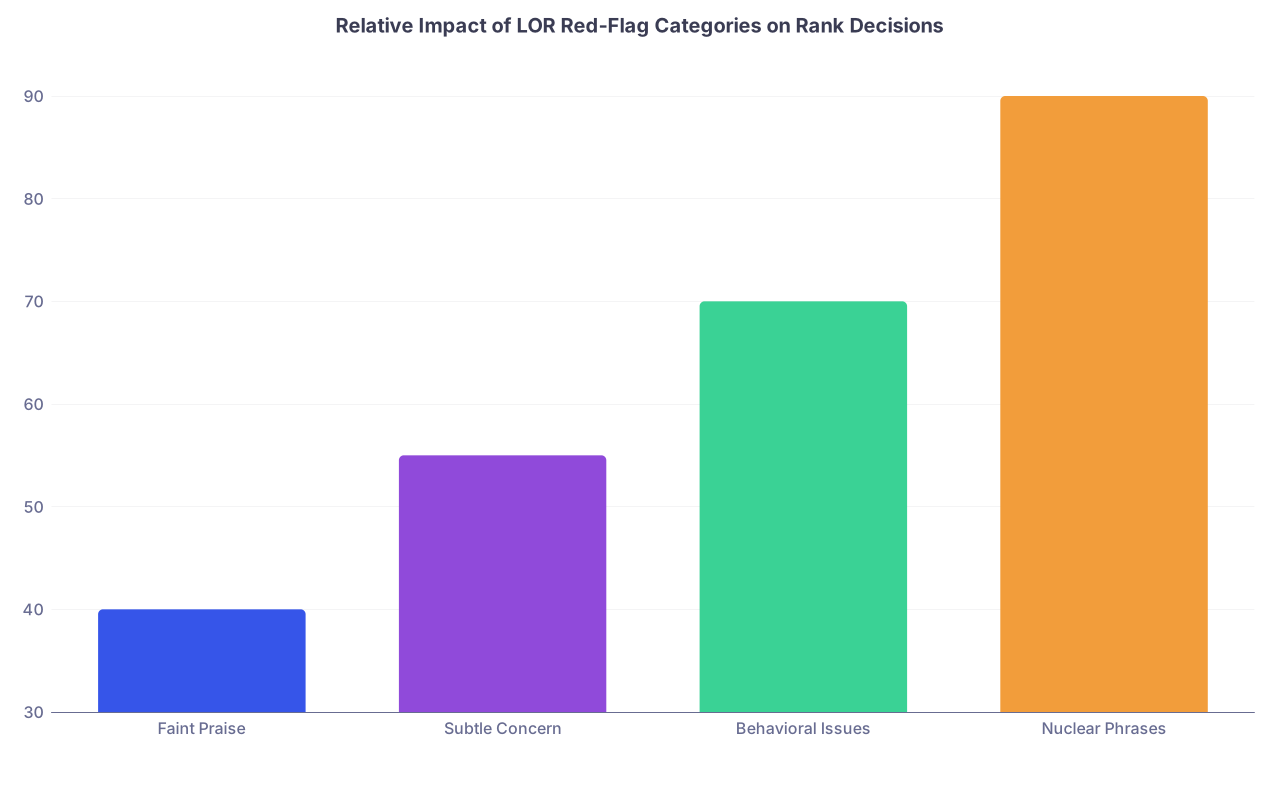
The Nuclear Phrases (True Red Flags)
There are phrases that, when spoken out loud in that room, are the end of the conversation.
| Category | Value |
|---|---|
| Faint Praise | 40 |
| Subtle Concern | 55 |
| Behavioral Issues | 70 |
| Nuclear Phrases | 90 |
That’s how committees feel about them, even if they’ll never quantify it on paper.
11. “I cannot fully endorse this applicant for your residency program.”
That’s game over at most places. You might still get ranked at smaller or very desperate programs, but this is essentially a professional warning label.
Variations:
- “I have some reservations about fully endorsing…”
- “I stop short of an unqualified recommendation…”
I’ve heard PDs say: “If the writer won’t take responsibility for this applicant, why should I?”
12. “He would be best suited for a supportive, non-demanding program.”
Translation: “Do not send this person to a high-volume center with real acuity, they will drown.”
This isn’t always malicious. Sometimes it comes from a well-meaning mentor who actually likes the student but knows their limits. Committees see this as: “We will be dealing with competence issues. Hard pass.”
13. “I would hesitate to place her in an independent role early in training.”
Some specialties will tolerate this if everything else is stellar and they’re desperate. Most won’t.
Residency is, by definition, increasing independence. If the letter says the writer wouldn’t trust you early on, that’s a direct contradiction of what a program needs.
I’ve seen this sentence get read aloud, followed by: “Okay, next applicant.”
The Shaded Comparisons and Rankings
Faculty know that comparisons carry more weight than vague adjectives. Committees perk up when they see numbers, percentiles, or rankings. But there are ways comparisons become quiet red flags.
14. “In the top half of students I’ve worked with.”
You see “top half” and think, “Alright, that’s not terrible.” On the back end, this is damning.
Strong letters say:
- Top 10%
- Top 5%
- Top few students I’ve worked with in X years
“Top half” means you are not remotely a standout. You’re in the 50th percentile. No one wants to invest $500k+ of GME money into a 50th percentile bet when they have a pile of top 10% candidates.
| Letter Phrase | How Committees Interpret It |
|---|---|
| Top 5% | Immediate green light |
| Top 10% | Strong positive |
| Top quarter | Good, but not elite |
| Top half | Mediocre / not competitive |
| Among many strong students | Vague, often neutral or weak |
15. “Among the many strong students we see each year…”
This looks like praise. It’s not. It’s a dodge.
When someone is truly outstanding, the writer doesn’t blur them into the crowd. They say something like, “One of the strongest students I have worked with in the last 5 years.”
“Among many strong students” = safe, forgettable, generic. Often used when they don’t want to lie but don’t want to hurt you.
Specialty-Specific Red-Flag Landmines
Some phrases are especially toxic in particular fields. I’ve watched this play out in ranking meetings where one line essentially torpedoes an applicant.
Surgery / EM / Anesthesia
These programs are allergic to anything that suggests slowness, anxiety under pressure, or fragility.
Red-flag phrases here:
- “Can become overwhelmed in fast-paced environments.”
- “May take extra time to reach decisions in acute situations.”
- “Would do best in a program with a gentle learning curve.”
Those lines say: this resident will freeze in a trauma bay or OR.
Psychiatry / Neurology
Here the landmines are around boundaries, emotional stability, and reliability.
Scary phrases:
- “Can occasionally be overinvolved with patients.”
- “Sometimes has difficulty maintaining boundaries with staff.”
- “Has struggled at times with consistent follow-up on tasks.”
Committees in these fields have seen what happens when those traits go unchecked. They are not eager to repeat that experiment.
Internal Medicine / Pediatrics
These programs care a lot about teamwork, follow-through, and how much oversight you’ll need.
Trigger lines:
- “Will benefit from clear structure and direct guidance.”
- “Requires frequent check-ins to ensure completion of tasks.”
- “May need help prioritizing in busy clinical settings.”
Every attending in that room can picture the exact resident who fits those descriptions. And they remember the pain.
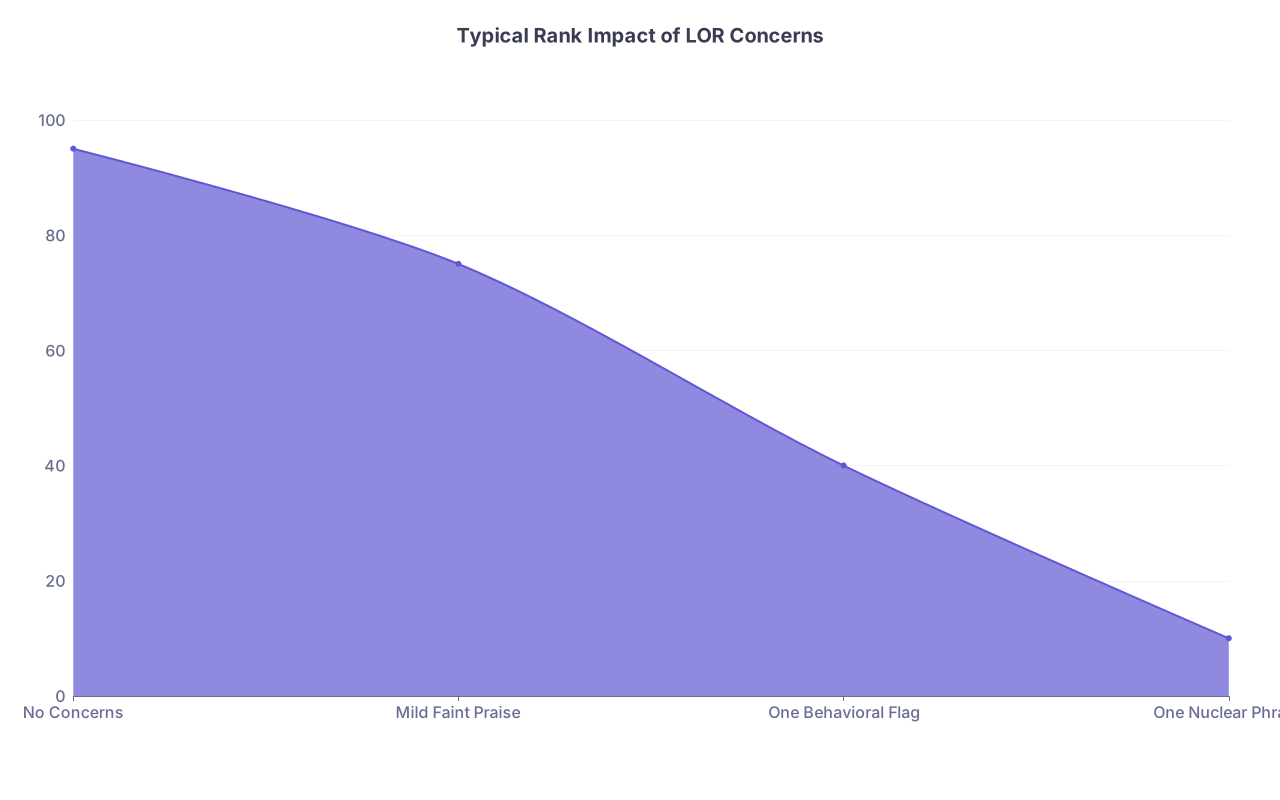
How These Phrases Actually Change Your Rank Position
You might be wondering what this looks like on the spreadsheet side. It’s not always dramatic, but it’s real.
| Category | Value |
|---|---|
| No Concerns | 95 |
| Mild Faint Praise | 75 |
| One Behavioral Flag | 40 |
| One Nuclear Phrase | 10 |
Roughly, this is how programs behave:
- Mild faint-praise phrases (like “at the expected level”) drop you within a tier. From maybe top third to middle third.
- Clear behavioral concern phrases (“time management issues,” “frequent guidance”) move you down entire tiers.
- Nuclear phrases (“cannot fully endorse”) usually land you near the bottom of the list or off it entirely, unless the program is in real trouble filling spots.
Most applicants never see any of this. They just “mysteriously” don’t match at a place where they thought the interview went fine.
What You Can Actually Do About It
You do not control the exact words a faculty member types. But you have more influence than you think over whether these red-flag phrases show up.
And yes, this part is the uncomfortable truth programs won’t say out loud.
Choose Your Letter Writers Strategically
The worst letters often come from:
- People who barely know you
- People who had to be chased repeatedly to write the letter
- Attendings who are chronically annoyed and stingy with praise
You want faculty who:
- Have seen you over time (not just 2–3 shifts)
- Have seen you in stressful situations
- Have previously written strong letters for others (ask upperclassmen; they know)
If a rotation went badly, you already know. Do not ask that person for a letter “because they’re big-name.” I’ve seen big-name letters tank solid applicants with one carefully worded sentence.
Ask The Right Meta-Question
The safe, grown-up way to avoid disaster is something like:
“Do you feel you know me well enough to write a strong letter of recommendation for residency?”
Emphasis on strong.
If they hesitate, say anything about being “neutral,” “standard,” or “supportive but not sure how strong,” thank them and do not use that letter.
Fourth-years are terrified of offending faculty. I’ve watched that fear cost people interviews.
Watch For Hints Before It’s Too Late
If you have a weird interaction, get formal feedback that mentions time management, professionalism, or communication, that’s your early warning sign. Do not assume it will vanish. It tends to resurface in letters.
Sometimes you have to actively not use the letter you thought you’d get from that rotation, even if it “looks good” on paper.
Quick Red-Flag Phrase Checklist
If you ever get the chance to see part of what someone wrote about you (some schools allow summaries, or attendings will verbally tell you how they described you), listen very carefully for any of these categories:
- “At the level expected” without any stronger positive comparison
- “Will benefit from supervision / structure / guidance”
- “Has potential” without clear current excellence
- “Frequently needed feedback / reminders / guidance”
- Any hint of “cannot fully endorse,” “reservations,” or “hesitation”
One of those? You might survive.
More than one? That letter is hurting you.

| Step | Description |
|---|---|
| Step 1 | Letter Arrives |
| Step 2 | Rank Low or Do Not Rank |
| Step 3 | Move to Lower Tier |
| Step 4 | Middle of Rank List |
| Step 5 | Competitive Rank Position |
| Step 6 | Any Nuclear Phrases? |
| Step 7 | Behavioral or Performance Flags? |
| Step 8 | Only Faint Praise Phrases? |
FAQ: Red-Flag LOR Phrases
1. Can one mediocre letter really ruin an otherwise strong application?
Yes. Especially in competitive specialties or small programs where every resident matters. If two letters are glowing and one is lukewarm with concern phrases, most committees don’t “average” them. They ask, “What went wrong there?” That doubt alone can drop you behind applicants with uniformly strong letters, even if their scores are slightly lower than yours.
2. Are shorter letters automatically bad?
Not always. Some excellent clinicians are terse writers. But a one-paragraph letter with generic adjectives and no specifics is usually read as “I don’t know this student” or “I have nothing enthusiastic to say.” Length plus specific examples of your behavior are what signal strength. A short but detailed, clearly enthusiastic letter can still be powerful. A short, vague one is almost never good.
3. Is a neutral letter better than no letter from a big-name attending?
No. A “neutral” letter from someone important can hurt you more than a strong letter from a mid-level faculty member who clearly loves your work. PDs care about content, not just name recognition. I’ve watched big-name, lukewarm letters sink people. When in doubt, choose the writer who will go to bat for you, not the one with the fanciest title.
4. Can I ever ask to see my letter or ask a writer to change something?
In most systems, you waive your right to see the letter. And you shouldn’t ask them to edit content. But you can have an honest conversation before they write it: “I’m aiming for a very strong application in X specialty; do you feel you can enthusiastically support me?” If they express any doubt, that’s your signal to thank them and choose someone else. Prevention beats damage control here.
5. If I already suspect I have a weak letter, is there anything I can do this cycle?
Realistically, not much mid-cycle. Programs don’t like being told to ignore a letter they’ve already read. Your best move is preemptive: add more strong letters from rotations where you performed very well, especially in the same specialty. Occasionally, the weight of multiple clearly stellar letters can dilute one average one. But if there’s a nuclear phrase in there, that damage is very hard to undo.
Remember:
- Committees read between the lines in LORs, and certain phrases are quiet but lethal.
- Your choice of writer—and your willingness to walk away from a “neutral” offer—matters more than the name on their door.
- “Strong” in conversation is not the same as “strong” in committee code; listen for the language, not just the vibe.