
It’s late November. You finally got all your Letters of Recommendation uploaded. ERAS shows “complete.” You exhale for the first time in weeks.
Then you sit on a Zoom with your mentor and they say, “Yeah, Dr. X’s letter will be fine. He’s… polite.”
You don’t totally know what that means, but your gut doesn’t like it.
Let me tell you what “polite but weak” really looks like from the other side of the table. Because program directors, selection committee chairs, and crusty senior attendings have been decoding these letters for years. And they are not reading them the way you think.
You’re hoping, “As long as it’s not bad, I’m safe.”
The truth: A “not bad” letter is often interpreted as “no one really wanted to go to bat for this applicant.”
Let’s walk through what’s actually happening when PDs read between the lines.
How PDs Actually Use LORs (Not How Schools Tell You They Do)
Here’s the part your dean won’t spell out: letters rarely get you an interview at a mid-to-large program. But they absolutely can:
- Kill your application
- Freeze you at the “meh, backup” level
- Or, in strong cases, push you from “borderline” to “we should interview this one”
At big academic programs, the workflow looks something like this:

| Step | Description |
|---|---|
| Step 1 | ERAS Application Arrives |
| Step 2 | Screen by Filters Scores, school, red flags |
| Step 3 | Quick Holistic Scan PS, CV, LOR headers |
| Step 4 | Invite or Reject |
| Step 5 | Read LORs Closely |
| Step 6 | Committee Discussion |
| Step 7 | Invite or Reject |
| Step 8 | On the Fence? |
At some community programs, they glance at the letter headers (who wrote it, where they’re from) more than the content. At top-heavy academic departments, the content is heavily scrutinized.
But in both settings, here’s what’s universal:
Weak letters are loud. Not in what they say. In what they carefully avoid saying.
The Code Words: How “Nice but Weak” Actually Reads
Let’s be blunt. PDs have an internal dictionary for LOR language. Nobody publishes it. Everyone uses it.
Let’s put some of that into a structured view.
| Phrase in LOR | How PDs Actually Read It |
|---|---|
| "I had limited contact with the student" | Writer is signaling distance or minimal commitment |
| "Completed the rotation satisfactorily" | Bare minimum; nothing memorable or impressive |
| "Pleasant to work with" | Socially normal, maybe quiet; no comment on work ethic or skill |
| "Will do well in any program" | Generic filler; writer doesn’t want to stake a claim |
| "I have no reservations in recommending" | Neutral; not an enthusiastic endorsement |
Here’s the uncomfortable truth: faculty know this code. They do it on purpose. It’s a way to avoid tanking you while also not lying to the next PD.
So when your letter is filled with:
- “pleasant,”
- “polite,”
- “respectful,”
- “will be an asset,”
but nothing about being “one of the top,” “outstanding,” “among the best I’ve worked with,” every experienced reader knows: this writer didn’t see you as a top-tier resident.
Does that mean you’re doomed? No. It means your letter is not helping you climb out of your Step or class rank profile. It’s just dead weight.
What Strong vs Weak Letters Actually Look Like Side-by-Side
Let me show you what committee members are actually looking for sentence by sentence.

Example 1: The Classic “Polite but Weak” Paragraph
“I am pleased to recommend John for your residency program. I worked with him for two weeks on our inpatient service. He was punctual, polite, and eager to learn. He completed all assigned tasks and interacted appropriately with patients and staff. I believe he will do well in a training program such as yours.”
How PDs read this:
- “Pleased to recommend” – totally boilerplate
- “Worked with him for two weeks” – short contact; not necessarily damning but not reassuring
- “Punctual, polite, eager to learn” – this is the minimum expectation, not a compliment
- “Completed all assigned tasks” – again, basic functioning
- “Interacted appropriately” – meaning: nothing weird, nothing great
- “Will do well in a training program such as yours” – generic, no stakes, no ranking
This is the kind of letter that gets skimmed, mentally filed as “neutral,” and your application lives or dies on everything else.
Example 2: A Quietly Damaging Line
“I have no reservations in recommending her for your program.”
Students love this line. “No reservations! That’s good!”
Faculty know better. This phrase is often a tell.
If the writer actually thinks you’re excellent, they do not default to the most legalistic, risk-avoidant language. Compare that to:
“I give my strongest recommendation for her without hesitation.”
or
“I would be thrilled to have her as a resident in our own program.”
Very different energy. PDs pick that up instantly.
The Subtext PDs Scan For In 30 Seconds
Here’s the internal checklist a PD is running, whether they admit it out loud or not.
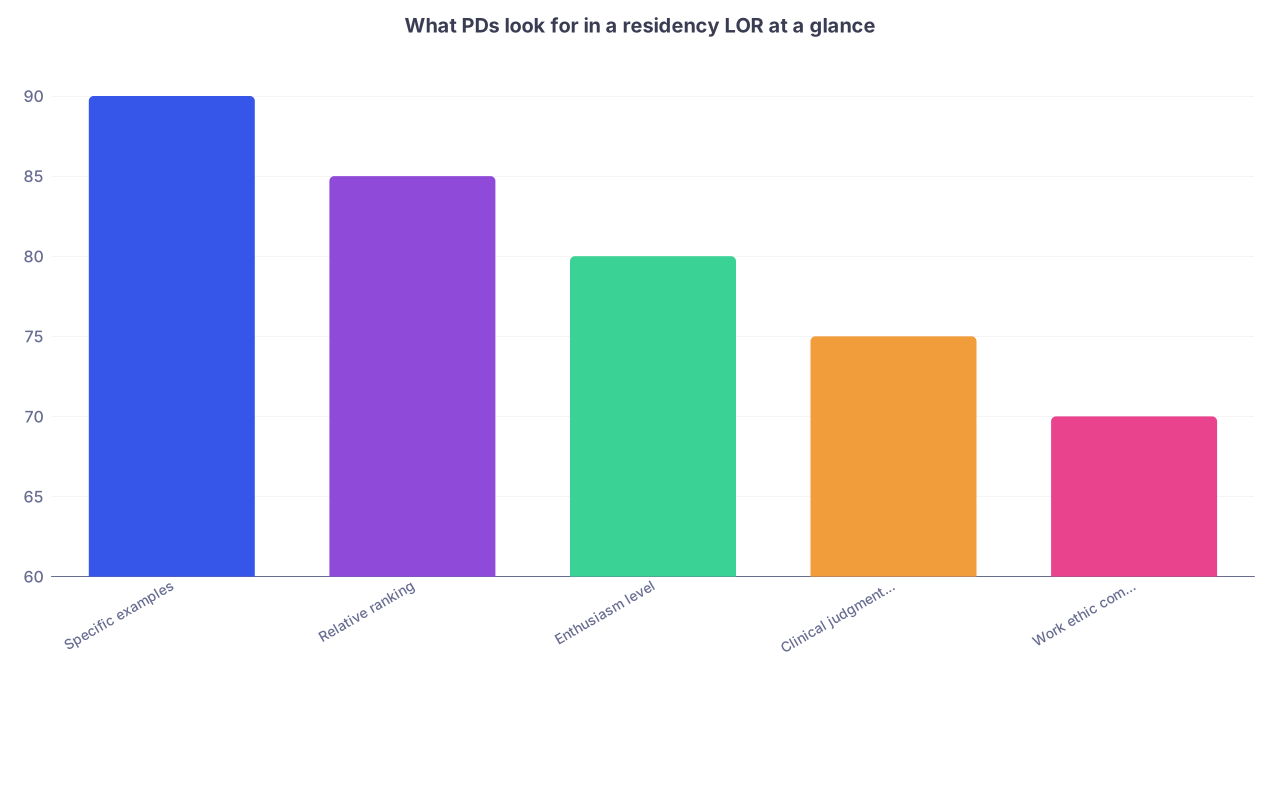
| Category | Value |
|---|---|
| Specific examples | 90 |
| Relative ranking | 85 |
| Enthusiasm level | 80 |
| Clinical judgment comments | 75 |
| Work ethic comments | 70 |
They do a mental speed-read for:
Level of enthusiasm
Is there any superlative language? “Outstanding,” “superb,” “among the best,” “top X% of students I’ve worked with.”
Or is it all: “good,” “solid,” “will do well,” “capable.”Relative ranking
Faculty who know the game will drop lines like:- “In the top 10% of students I have worked with in the last five years.”
- “Among the top 2–3 students on our service this year.”
When there is no comparative language at all, that is noticed.
Concrete examples vs adjective salad
Strong: “On a busy night on call, she independently recognized early sepsis in a decompensating patient, escalated promptly, and coordinated care smoothly with the ICU team.”
Weak: “She is caring, compassionate, and works well with the team.”Clinical judgment / responsibility
Do they trust you with escalating responsibility, or are you just “observant” and “interested”?
If a letter never mentions judgment, reliability, or initiative, your ceiling is lower in the PD’s mind.Would they hire you themselves?
This is the killer line:- Strong: “I would happily have him as a resident in our program.”
- Very strong: “We are actively recruiting her to our own residency.”
- Weak: nothing like this mentioned.
If a PD reads a whole letter and never once thinks “Wow,” your letter is not an asset.
Red-Flag Phrases Hidden Inside “Nice” Letters
The nastiest thing about LORs is that most truly bad ones don’t look harsh. They look polite. Civil. Academic.
Let’s go through some of the ones that quietly sink you.
| LOR Phrase | What It Suggests |
|---|---|
| "With appropriate supervision, they will make a good resident" | Concerns about independence or judgment |
| "Improved over the course of the rotation" | Started weak; may still be borderline |
| "Given his level of training, she performed adequately" | Only adequate; not impressive |
| "Can be relied upon for straightforward tasks" | Not trusted with complexity |
| "Will benefit from a structured training environment" | Needs a lot of hand-holding |
Couple of real-world things I’ve seen in committee:
- A letter that said, “She grew significantly in her ability to manage simple tasks.” That sounds positive until you realize they’re emphasizing simple.
- “He is receptive to feedback” was in a letter where everyone on the faculty knew the student had major professionalism issues. That’s as close as they got to warning other programs.
When PDs see this kind of phrasing, they don’t need Step scores. They’re out.
How PDs Compare Letters Within a Stack
PDs don’t read your letter in isolation. They read it in context.
They’re reading your LOR five minutes after:
- A Stanford student described as “the single best subintern we have had in three years”
- A mid-tier MD candidate called “in the top 5–10% of students I have ever worked with”
- An IMG whose letter says, “We fought to get him an interview here and would rank him highly if he applied”
Your letter that says, “She was polite and worked well with the team” doesn’t stand up in that crowd.
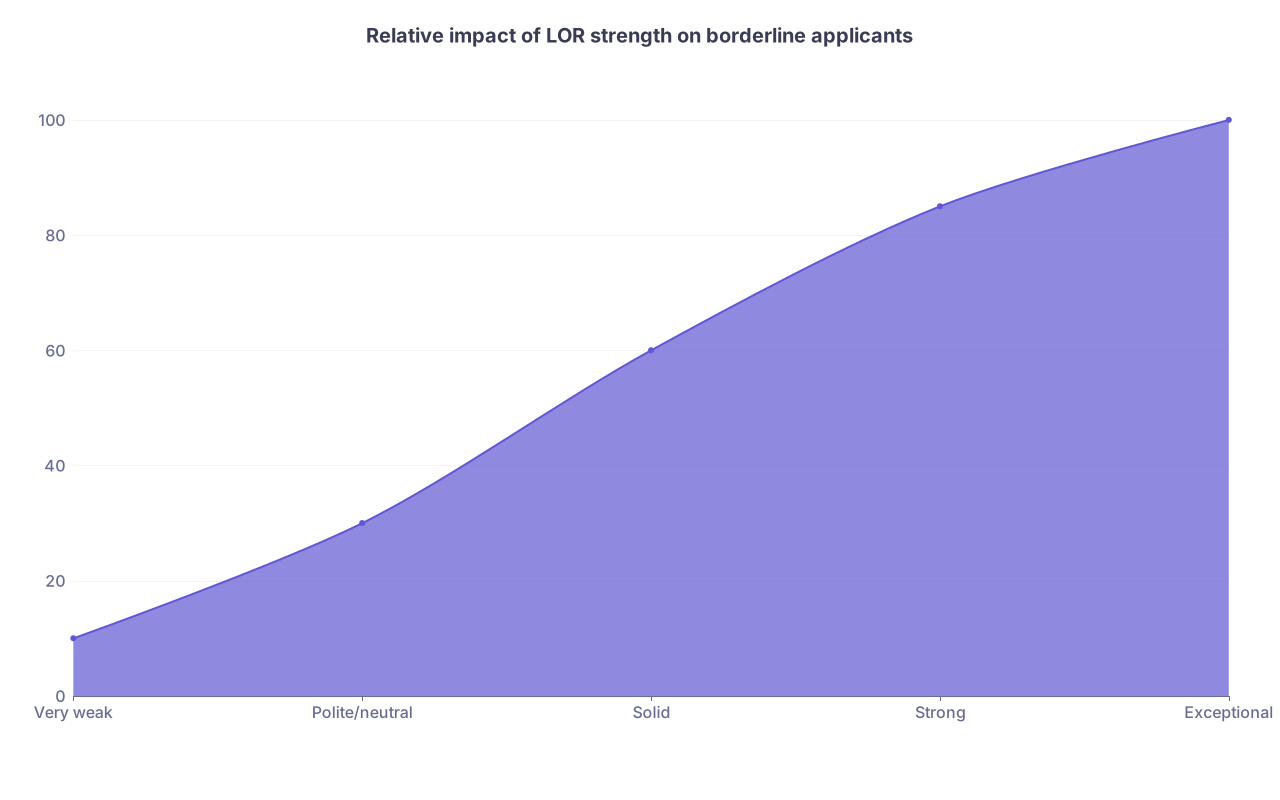
| Category | Value |
|---|---|
| Very weak | 10 |
| Polite/neutral | 30 |
| Solid | 60 |
| Strong | 85 |
| Exceptional | 100 |
On borderline files, letters are often the tiebreaker. When people say, “We’ve got four people for two interview spots,” this is where LORs get dragged into the argument.
Common real conversation:
Attending 1: “Her scores are fine, but look at this letter from Dr. S. He never uses ‘outstanding’ and he used it twice.”
Attending 2: “Compare that with this one. ‘Pleasant and completed tasks.’ That’s a no from me.”
You think you’re competing against some abstract “average applicant.” You’re actually competing against the best letter in the room that day.
What “Polite but Weak” Often Means About Your Rotation
Let’s talk about the unspoken clinical reality behind these letters. Because letters are coded summaries of what actually happened when you were in front of the team.
A “polite but weak” letter usually means one or more of these happened on your rotation:
- You did fine. No disasters. But you never really took ownership.
- You were slow to pre-round, slow to have plans, and mostly followed directions.
- You did not annoy anyone, but no one missed you when you left.
- You needed reminders to follow through, but ultimately got things done.
- You were overshadowed by a stronger student or sub-I on the same team.
I’ve seen this play out many times:
Two students rotate on the same month. Same attending. Same patient volume.
Student A:
- Shows up early, knows their patients cold, reads at night, calls consults, anticipates discharges.
- Attending writes: “Top 5% of students. Would take as a resident without hesitation.”
Student B:
- Shows up on time, presents okay, waits to be told what to do, sticks to med student tasks.
- Attending writes: “Pleasant, eager to learn, completed the rotation satisfactorily.”
Student B often has no idea the gap is that stark. On paper, both “did well.” In letters, only one did.
How Much Damage Does a Weak Letter Actually Do?
This depends heavily on specialty and program tier.
| Specialty Type | Effect of Polite/Weak LOR |
|---|---|
| Ultra-competitive (Derm, Ortho, Plastics) | Often fatal; you need at least 2 strong letters |
| Competitive (EM, Anesthesia, Rads, Gas) | Drops you a tier; might block interviews at top places |
| Middle (IM, Peds, FM in popular cities) | Keeps you in the “middle of the stack” at best |
| Less competitive or unfilled programs | Usually tolerated if rest of app is strong |
For something like dermatology, orthopedic surgery, plastic surgery: a generic letter is almost as bad as a negative one. Why? Because they know that if you were truly exceptional, your mentors would be raving.
For IM, Peds, FM: a neutral letter by itself won’t kill you, but a pattern of three “meh” letters absolutely will. PDs are pattern-recognition machines.
For EM: SLOEs are basically designed to avoid this. That’s why they force relative rankings and checkboxes. EM PDs hated guessing from vague prose, so they built a standardized instrument.
Can a Weak LOR Be Salvaged Once It’s Uploaded?
Short answer: usually no. But let’s be more precise.
What you can’t do:
- You can’t ask the PD to ignore a letter they’ve already read.
- You can’t “swap out” a bad letter mid-season and magically erase it.
- You can’t email programs and say “that one doesn’t count.”
What you can sometimes do:
- Add an additional strong letter later in the season.
- Use your personal statement, experiences, and interview to demonstrate strengths that the letter failed to mention.
- Have another faculty advocate mention, informally, “I know Dr. X’s letter is generic—he writes that way for everyone; I’ll write you a stronger one.”
But once it’s in ERAS, assume it’s staying. That’s why you need to be careful before you ever request it.
How To Avoid Getting a “Polite but Weak” Letter in the First Place
This is the part no one really trains you on: letter strategy is part politics, part self-advocacy, part timing.

| Step | Description |
|---|---|
| Step 1 | Identify Potential Letter Writers |
| Step 2 | Assess Relationship & Enthusiasm |
| Step 3 | Ask Directly with CV & Goals |
| Step 4 | Ask for Honest Appraisal |
| Step 5 | Do NOT Use This Writer |
| Step 6 | Will they strongly support you? |
| Step 7 | Hesitant Response? |
Here’s what strong, savvy students do differently:
They only ask people who seem genuinely enthusiastic.
You don’t chase the fanciest name who barely knows you. You chase the person who clearly liked working with you, gave you feedback, and said things like, “You’re doing a great job,” in front of others.They ask the right question, not just “Will you write me a letter?”
The insider move is:
“Would you feel comfortable writing me a strong letter of recommendation for [specialty]?”
If they hesitate, pause, or soften it—“I could write you a letter”—that’s a no. They’re already telling you it will be polite but weak.They give the writer ammo.
A good letter often mirrors what you hand them. If you send a blank email with “Can you write me a letter?” expect generic fluff. If you send:- Your CV
- A short summary of cases you worked on together
- A paragraph about why you’re going into that specialty
you’re much more likely to get specifics instead of adjectives.
They read between the lines early in med school.
By MS3 you should already know which attendings are known for strong, detailed letters versus one-paragraph templates. Residents know. Ask them.
How PDs Talk About This Behind Closed Doors
Let me pull back the curtain a bit more.
In closed-door selection meetings, no one is pretending these letters are completely objective. People say things like:
- “That’s just how Dr. L writes. If he calls someone ‘very good,’ they’re actually excellent.”
- “She writes everyone as ‘capable and eager to learn’ — I discount her letters.”
- “If [big-name faculty] doesn’t say ‘outstanding,’ they were probably average.”
PDs learn the “house style” of repeat letter writers. A dull-sounding letter from a notoriously stingy writer can actually be okay. A dull letter from someone who does gush when they like someone is bad news.
You don’t see that meta-layer as an applicant. But it’s absolutely shaping perceptions of your file.
What You Should Take Away From All This
You cannot control how every word in your letter is written. But you can absolutely control:
Whom you ask
Warm but noncommittal attending? Skip. Better a less famous name who actually liked you.How you ask
Always ask if they can write a “strong” letter. Do not be vague and then act surprised.How you perform on the rotation
“Pleasant” is what you get when you’re present but not leading. You want the attending to miss you when you’re off. That’s where strong letters come from.