It’s late November. You’ve just clicked “assign” on your ERAS letters, and now you’re staring at that section thinking: Are these actually good? They all say you’re “hard-working” and “a team player.” Sounds nice. Also sounds like every other applicant.
Here’s the problem: you read your letters like a normal person. Program directors don’t. They read them like cryptographers.
You see “pleasure to work with.”
They see “not a problem, but not a star.”
You see “highly recommend.”
They’re quietly asking: “Is that the top box or the default polite line?”
Let me walk you through what’s actually happening on the other side of ERAS when your letters show up, line by line, phrase by phrase.
How Program Directors Really Read LORs
Most applicants imagine PDs sitting there reading every word of every letter. They don’t. Not at first.
Here’s the usual sequence:
- They glance at the letter writer’s name and institution.
- They scan for a few key phrases and adjectives.
- They look for red flags or obvious code.
- Only if you’re on the bubble—or they recognize the writer—do they slow down and really read.
Most letters are skimmed in under a minute. I’ve watched it countless times.
When a PD opens your letter, here’s what’s immediately getting processed in their head, whether they articulate it or not:
- Who wrote this and do I trust them?
- How strong is the language compared to what I usually see?
- Is this a generic “good student” letter or a “I will fight for this person” letter?
- Any subtle digs or faint praise I need to pay attention to?
And here’s the part nobody tells you: PDs get “fluent” in certain writers. The medicine clerkship director at Big State U? They know that person tends to write very effusive letters for their top 10% only. The community preceptor who says “best student I’ve worked with” about 15 people a year? They know that too.
So the exact same sentence means different things depending on who wrote it.
But the patterns are pretty consistent. Certain phrases make people sit up. Others make them shrug. And a few are basically a quiet death sentence.
The Hidden Grading Scale Inside Letter Language
Think of LOR language as being on a 5‑tier scale in a PD’s head:
- Nuclear praise
- Strong endorsement
- Polite approval
- Concern hidden in politeness
- Soft red flag / hard red flag
They won’t say it that way out loud in a meeting. But this is how the conversation actually goes in selection committees:
“Her medicine letter?”
“Yeah, solid. ‘One of the strongest students this year.’ Not the best ever, but definitely interviewable.”
Or:
“How’s his surgery letter?”
“‘Consistently present and eager.’ Meh. Not coming here on that alone.”
Let’s translate what certain phrases really map to on that internal scale.
| Level | PD Interpretation | Typical Interview Impact |
|---|---|---|
| Nuclear Praise | Top few of career/decade | Strongly boosts, can rescue app |
| Strong Endorsement | Top 5–10% this year | Helps, confirms strong impression |
| Polite Approval | Average / slightly above | Neutral, rarely hurts or helps |
| Concern in Politeness | Below average / issues | Silent ding, may drop from list |
| Red Flag Language | Serious concerns | Almost always fatal |
Now let’s go category by category.
Nuclear Praise: The “Stop What You’re Doing” Phrases
These are the lines that make PDs lean forward, scroll back, and re-read. They’re rare, and people who write them casually get filtered out over time as “over-writers,” so the few whose praise matters are watched closely.
Phrases that usually land in this category:
- “Among the very best students I have worked with in my career.”
- “In the top 1–2% of students I have taught in the past decade.”
- “I would rank her in the top tier of residents in our program already.”
- “We tried to recruit him to stay with us.”
- “If we could keep one student from this class, it would be her.”
When PDs see this kind of language from a credible writer, the thought process is simple:
- This person is special.
- If their scores are decent and they’re not a social disaster, we want them.
What they infer beyond the words:
- Work ethic: Off the charts. No one gets nuclear praise for just being smart.
- Reliability: Trusted. The writer is signaling, “You will not regret this person.”
- Team fit: Usually excellent; attendings do not risk their reputation on socially toxic stars.
I’ve been in rooms where a mediocre Step 2 but a nuclear medicine letter led to, “We should at least interview; [Famous PD] basically blessed them.”
If your letter has this level of language and you’re not getting interview traction, either:
- The writer is known to be effusive and nobody buys it anymore, or
- The rest of your application has serious problems (professionalism, failures, big gaps).
Strong Endorsement: The Real Workhorse Category
Most “good” letters live here. This is what solid, competitive applicants have—especially in core rotations.
Typical language:
- “One of the strongest students on our service this year.”
- “In the top 10% of students I have supervised.”
- “I recommend her without reservation for residency.”
- “He performed at the level of our interns.”
- “I would be delighted to have her as a resident in our program.”
PD translation: This is a resident I’d be happy to have.
Notice the precision. When someone says “top 10% this year,” they’re telling us they thought about the whole class. That specificity matters. Vague “outstanding” by itself doesn’t.
What else PDs infer:
- This student will show up, do the work, not create drama.
- Probably capable of independent work at an early stage.
- Not necessarily “future faculty material,” but reliable, safe, maybe better.
A lot of you think letters like this aren’t “special enough.” Wrong. Multiple strong-endorsement letters from credible writers, paired with a coherent application, is exactly how people match at solid academic programs.
Polite Approval: The “Yeah, They Were Fine” Letter
These letters aren’t bad. They just don’t help you. And if too many of your letters sit here, you blend into the pile.
Language looks like this:
- “Hard-working and reliable.”
- “A pleasure to work with.”
- “Will make a fine resident.”
- “Completed all assigned tasks.”
- “Got along well with the team.”
PD interpretation: They did their job. No more, no less.
Here’s what’s usually missing from these letters:
- No ranking language (top X%, among the best, etc.)
- No comparison to residents/interns.
- No concrete examples of going above and beyond.
- No sense of genuine excitement from the writer.
When PDs scan and see only these phrases, the conclusion is, “Average student, no obvious issues, not a standout.” If your application is already strong in other domains, this is survivable. If you’re borderline, this does not push you over the edge.
I’ve also seen students misinterpret, “He will be a good resident” as glowing. It’s not. That’s the LOR equivalent of, “Yeah, he’s nice.”
Concern Buried in Politeness: The Code Words
This is where the real inside baseball starts.
Your letter doesn’t have to say “lazy” or “unprofessional” for PDs to smell smoke. Attendings rarely write overtly negative letters because it creates drama for them. Instead, they use carefully chosen bland phrases that everyone in academics knows how to read.
Watch for phrases like:
- “With appropriate supervision, she will be a good resident.”
- “He responded well to feedback.”
- “She grew a lot during the rotation.”
- “He completed all assigned tasks.”
- “Given time, she will continue to develop into a competent physician.”
- “She is best suited for a program that can provide close mentorship and structure.”
PD translation:
- “With appropriate supervision” = this person can’t function independently at all yet.
- “Responded well to feedback” often = there was a problem we had to address.
- “Grew a lot during the rotation” = started out shaky.
- “Completed all assigned tasks” = met the bare minimum, nothing memorable.
- “Close mentorship and structure” = don’t put this person in a sink‑or‑swim environment.
I’ve literally heard this at a ranking meeting:
“Her OB letter says, ‘She responded very well to constructive feedback and improved significantly over the month.’ What was she doing at the start that required ‘significant’ improvement in four weeks?”
That one sentence tanked her from “maybe” to “no” for a program that prides itself on independence.
This is where your choice of letter writers matters. A risk‑averse, cautious attending who doesn’t love you doesn’t realize how much damage their “faint praise” can do.
True Red Flags: Language That Torpedoes Applications
These are uncommon, but you need to know exactly how hard they hit when they show up.
Obvious ones:
- “I cannot fully endorse him for residency at this time.”
- “Her performance was below that of her peers.”
- “He struggled with punctuality / reliability.”
- “There were concerns expressed by multiple team members.”
- “She had difficulty accepting feedback.”
Soft-but-deadly ones:
- “He is improving but will benefit from continued close supervision.”
- “I have some reservations about her readiness for residency.”
- “He is best suited for a program with strong remediation resources.”
Most PDs will not touch a candidate with language like this unless they have direct, trusted backchannel information explaining it away. And even then, they’re nervous.
I’ve seen an applicant with a great Step score, good research, and a charismatic personal statement get totally buried because of one internal medicine letter that said, “He required frequent redirection regarding priorities on the wards.”
They didn’t say “unprofessional.” They didn’t say “unsafe.” But the message landed: this person might be a lot of work.
What Different Specialties Secretly Care About in LOR Language
Different programs read the same phrase differently, because they’re looking for different traits.
Surgical specialties
They zoom in on:
- Work ethic and grit: “Stayed late,” “never complained,” “took ownership of patients.”
- Technical promise: “Excellent hands,” “advanced quickly in the OR.”
- Stamina and attitude: “Maintained a positive attitude during long, demanding cases.”
A letter that says, “Pleasure to work with, completed all tasks” screams: not a surgical personality.
Medicine and subspecialties
They care about:
- Clinical reasoning: “Insightful presentations,” “synthesizes data well.”
- Ownership: “Knew every detail about her patients,” “proactive follow-up.”
- Team dynamics: “Trusted by residents,” “sought out by interns for help.”
“Mature beyond his level of training” is big currency in IM letters.
Pediatrics / Psych / FM
They’re scanning for:
- Empathy and communication: “Families loved her,” “built immediate rapport.”
- Reliability and low drama: “Calm under stress,” “stabilizing presence on the team.”
- Fit with patient population: “Exceptional with children,” “culturally sensitive.”
“Soft skills” language weighs more here than in, say, ortho. But no one ignores work ethic.
The Subtext of Structure, Length, and Specificity
PDs don’t just read the adjectives. They read how the letter is written.
A few structural things they quietly use as data points:
Length
A one-paragraph letter from an academic attending is bad news. It means either they didn’t know you or they had nothing specific to say. Two-thirds of a page to a full page is the functional norm. Over two pages is usually a rambling writer, not automatically better.Specific examples
“On one particularly busy call night, she took the initiative to…” carries more weight than 10 adjectives. Specific stories = the writer actually paid attention.Comparisons
Phrases like “compares favorably to our residents” or “in the top 5–10% of students this year” are gold. Vague “excellent student” is weak by comparison.Tone
You can hear when a writer is genuinely enthusiastic. The energy changes. “I am absolutely delighted to recommend…” versus “I am pleased to write in support of…”
PDs read hundreds. They feel the difference.
Translation Guide: Common Phrases and What PDs Hear
Here’s a quick decoding reference you wish someone had given you in MS2.
| LOR Phrase | What PD Actually Hears |
|---|---|
| “Among the best I have worked with” | Top-tier, standout, pay attention |
| “Top 10% of students this year” | Strong endorsement, very competitive |
| “Performed at the level of an intern” | Ready for residency responsibilities |
| “Hard-working and reliable” | Fine, average, nothing special |
| “Pleasure to work with” | Likable, but not necessarily strong |
| “Completed all assigned tasks” | Met minimum, no initiative |
| “Responded well to feedback” | There were issues that needed fixing |
You notice what’s missing? Almost nobody ever writes “lazy,” “unsafe,” “mean,” or “difficult.” They code it in.
How This Should Change Who You Ask for Letters
You can’t control the exact adjectives, but you have more influence than you think over the tier of letter you end up with.
Here’s the insider calculus you should be doing (and most students don’t):
A shorter, very strong letter from someone who loves you is better than a long, bland one from a big name who barely remembers you.
If you sense your performance on a rotation was “fine but not special,” that’s a bad person to ask for a crucial letter—especially in your chosen specialty.
You can and should ask directly: “Do you feel you can write me a strong letter of recommendation?” That word matters. A hesitant pause? Move on.
Residents do influence attendings. If the senior or chief loved you and tells the attending, “This student was amazing,” that colors the letter. Same in reverse.
I’ve seen students pick the “famous department chair” who barely saw them instead of the associate program director who worked with them every day and adored them. Predictably, the chair submitted a two-paragraph generic note. The APD would have written nuclear praise. Huge self-own.
What To Do If You Suspect a Mediocre or Bad Letter
Nobody talks about this, but bad letters sink people every year. And yes, PDs compare the “flavor” of your letters.
Let’s say you’re seeing a pattern: you struggled on one core rotation, and the attending seemed lukewarm. You’re anxious that letter may be weak or subtly negative.
Here’s how programs actually handle conflicting letters:
- Three strong + one mediocre = they usually ignore the outlier unless it’s from your specialty.
- Two strong + two mediocre = you fall into the “safe but unremarkable” pile.
- One strong + one mediocre + one concerning = you’re on the “only if we have extra spots for interviews” list.
Where it kills you is when the key specialty letter is the lukewarm one. Example: you’re applying IM and your medicine chair letter says, “He completed all assigned tasks and responded well to feedback.” Death by politeness.
If you’re still early enough in the process and have doubts, you can:
- Get another letter from a different attending in the same specialty who genuinely loved working with you.
- Lean heavily on away rotation letters where you performed well and ask explicitly for a strong letter.
- For future rotations, be transparent early: “I’m hoping to go into X. I’d really like to work hard and, if things go well, ask you for a strong letter.”
Program directors notice when your strongest and most specific letters come from places that actually saw you under pressure. That can offset one weak home letter more than you think.
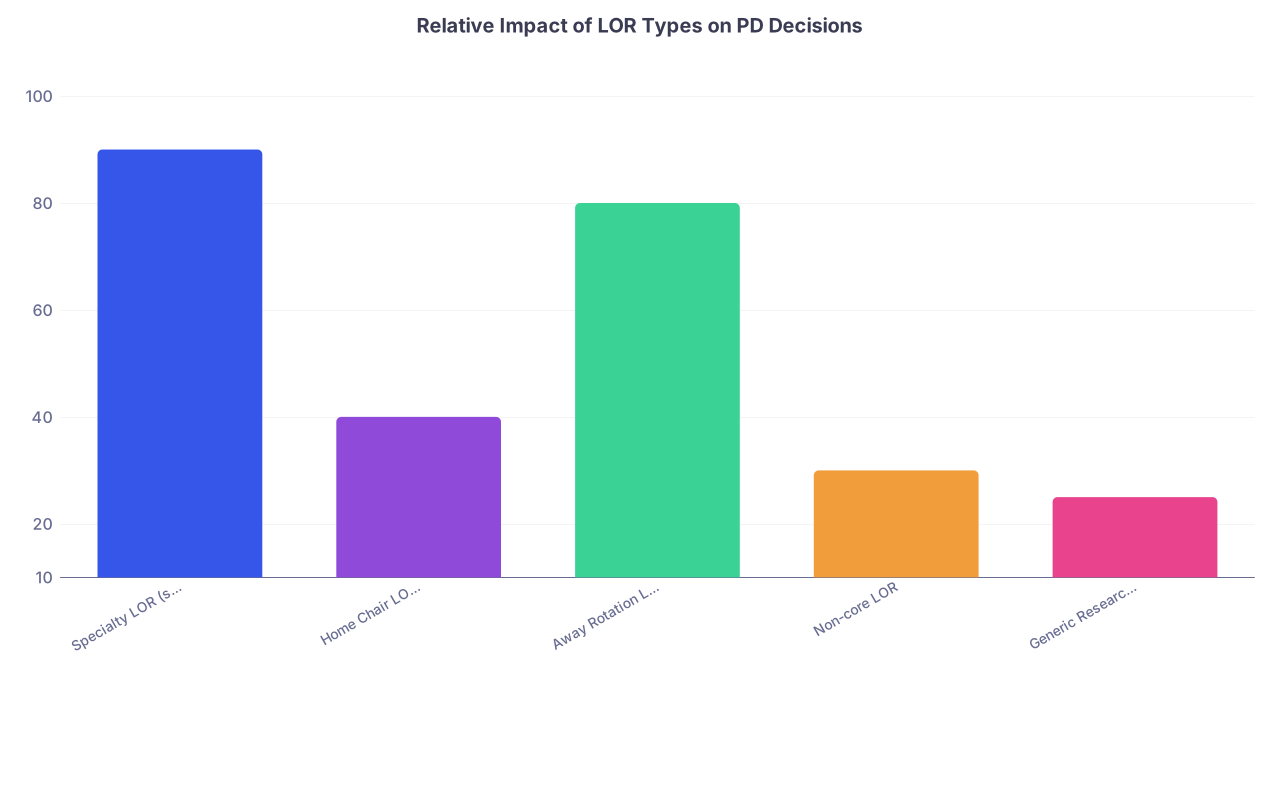
| Category | Value |
|---|---|
| Specialty LOR (strong) | 90 |
| Home Chair LOR (mediocre) | 40 |
| Away Rotation LOR (strong) | 80 |
| Non-core LOR | 30 |
| Generic Research LOR | 25 |
How This Plays Out in Real Selection Meetings
Let me pull back the curtain on a very typical scenario.
You’re an IM applicant. Step 2 is good, 245–250 range. Decent research, nothing flashy. Your file gets opened in committee:
PD: “What do the letters say?”
APD: “Medicine sub-I letter from Dr. Singh—‘top 10% this year, took ownership, would be thrilled to have him as a resident.’ Strong. Chair letter—‘hard-working, completed all assigned tasks, will be a good resident with appropriate supervision.’ Peds letter—glowing.”
PD: “So the primary person who really worked with him in medicine loves him. Chair barely knows him. Fine. Any flags?”
APD: “No. Let’s interview.”
Now change one sentence in that chair letter:
“Will be a good resident with appropriate supervision and structure.”
Suddenly the room’s thinking:
“What’s this ‘structure’ business? Are they hinting he struggles with independence? Do we want that risk?”
Same scores, same CV. One extra word. Different outcome. This is why I hammer language so much.
Final Thoughts: What You Should Take Away From All This
Let me distill this down, because you don’t need a philosophy course on letters—you need to match.
First: the words and tone in your LORs are not decoration. Program directors read them as data, and there is a very real internal hierarchy from nuclear praise down to veiled concern.
Second: polite, generic praise is not helping you. “Hard-working,” “pleasure to work with,” “completed all tasks” – these are baseline descriptors. If your key specialty letters live entirely in that world, you’re not competitive at the level you think you are.
Third: your biggest leverage point is who you choose and when you ask. Only ask people who saw you at your best and can truthfully say “strong letter.” A shorter, concrete, enthusiastic letter from a mid-level faculty who knows you well is much more powerful than a long, vague letter from a famous name who barely remembers your face.
Everything else—scores, grades, activities—matters, of course. But when PDs are splitting hairs between you and the person whose file is right above yours in ERAS, the specific language in those letters is often what breaks the tie.