
It’s late November. You’re on your “dream” away rotation. The big-name attending you’ve been trying to impress all month just walked out of the workroom and you’re staring at your email draft:
“Dear Dr. —, I was wondering if you’d be willing to write me a strong letter of recommendation…”
Your cursor is blinking. You’re doing the mental math:
Name brand vs actually knows me. Chair vs beloved associate PD. Fellowship director vs hospitalist who watched me grind for four weeks straight.
Here’s the part nobody spells out: there is a hierarchy. Program directors absolutely read letters with a pecking order in mind. Certain signatures trigger an instinctive: “Ok, pay attention.” Others get mentally downgraded before the second sentence.
Let me walk you through how that hierarchy really works behind closed doors.
How PDs Actually Read Letters (Not How They Pretend To)
First, understand the psychology.
PDs aren’t reading 2–3 letters. They’re sifting hundreds, sometimes thousands. By December or January, they triage on autopilot. Here’s the sequence you do not see but they absolutely follow:
- Look at who wrote it and where they’re from
- Glance at the first and last paragraph
- Skim the middle for signal phrases
- Mentally assign it to a tier:
- Heavyweight
- Solid
- Neutral
- Damning (or useless)
Notice what comes first: the author. Not you. The signature sets the starting bias.
Let me give you a framework PDs won’t put on a website but talk about openly in committee.
| Tier | Letter Writer Type | Initial Impact |
|---|---|---|
| 1 | Known national name / Chair / PD | Strong positive |
| 2 | APD / fellowship director / well-known faculty | Moderate positive |
| 3 | Core faculty who knows you well | Mild positive |
| 4 | Non-core / weak connection / non-physician | Neutral or negative |
That’s the skeleton. Now let’s put real flesh on it.
The True Top of the Food Chain: Whose Signature Makes PDs Sit Up
1. Program Directors (Especially in the Same Specialty)
A PD letter in their specialty is almost always Tier 1. The logic is simple: “This person does my job. They know exactly what I need.”
A PD from:
- A strong academic program in the same specialty
- A reputable community program that sends people to good fellowships
will carry far more weight than an “impressive-sounding” but random subspecialist who barely knows how residents function day to day.
What PDs really think when they see a PD letter:
- “This writer understands resident performance, not just med student fluff.”
- “They know what ‘top 10% of students I’ve worked with’ actually means operationally.”
- “They understand how painful it is to remediate someone, so if they’re vouching, that matters.”
If the PD is from a program that regularly trades residents or fellows with their own institution? That’s gold. You’ll often hear in committee: “Oh, I know her. If she says this student is solid, we’re fine.”
I’ve watched an application go from ‘borderline for interview’ to ‘invite’ on the strength of a single line in a PD letter from a known colleague:
“Happy to discuss this applicant by phone.”
Translation to the room: “I will back this person up if you call.”
2. Department Chairs – But With a Huge Asterisk
Chairs are tricky.
A chair’s name sounds powerful, and on paper, it is. PDs glance at a chair letter and acknowledge the status. But behind the scenes, they’re thinking:
“Did this chair actually work with this student… or did their chief resident write this and they just signed it?”
Chair letters break down into two flavors:
- Real chairs who still work clinically and write candid letters. Very valuable. They know their faculty, they know what resident success looks like, and they’re skeptical by nature.
- Ceremonial / political chairs who rubber-stamp every “outstanding” student with the same boilerplate praise. PDs learn quickly which chairs to ignore.
When is a chair letter truly powerful?
- Same specialty as the one you’re applying into
- Known name in the field
- Specific anecdotes that clearly show they actually worked with you
- Any phrase that compares you directly to their own residents or fellows
Example of a chair line that moves a PD:
“Her performance was indistinguishable from my second-year residents.”
Example of a chair line that gets mentally downgraded:
“She will be an excellent asset to any program.”
(Vague. Generic. Sounds copy-pasted from 400 other letters.)
Between a generic chair letter and a detailed letter from a core faculty who clearly knows you? PDs will take the detailed one. Every time.
The Middle Tier That Actually Matches You: APDs, Fellowship Directors, Core Faculty
Here’s where most of your letters should live. And honestly, where the real decisions are made.
3. Associate Program Directors (APDs)
APDs live in the weeds of:
- Evaluations
- Remediation
- Who’s quietly struggling
- Who actually shows up to do the work
They’re trained to separate “nice med student” from “resident who will not explode at 2 a.m.”
An APD letter gets a mental boost because PDs know they are detail people. They’ve read the student’s evals, spoken to residents, and often actually supervised you clinically.
APDs who regularly attend national meetings, present at specialty societies, or sit on committees? Their names get recognized. Those letters carry more weight than a rando full professor who only appears on Thursday afternoons for a teaching conference.
4. Fellowship Directors (In Your Desired Field)
Fellowship directors are overrepresented on admissions committees, especially in academic programs. A fellowship director letter is like a specialty “vote of confidence”.
The catch:
- PDs know some fellowship directors only see the top few students and write automatically glowing letters. Those get discounted.
- Others are brutally honest and their praise is rare. Those are highly weighted.
If you’re applying to IM with an eye on cards, for example, and the cardiology fellowship director writes:
“I would be happy to have him as a fellow in our program.”
That absolutely lands. PDs read between the lines: this person can function at the level needed for competitive fellowship.
5. Core Clinical Faculty Who Worked Closely With You
This is the most underrated tier.
A core faculty member who ran your team for 4 weeks, saw you in the trenches, and writes a rich, specific letter? That often carries more practical weight than the “big name” who barely knows your last name.
PDs are not stupid. They can see:
- Who actually observed you doing notes, presenting, running a list
- Who knows how you handle feedback and night float
- Who knows if residents liked working with you
If the writer is a known steady faculty member at a respected program in the specialty, their letter becomes a calibrated signal. PDs know: “This person doesn’t oversell. If they’re this positive, it matters.”
Between:
- Famous sub-subspecialist who saw you in clinic once
vs - Mid-career core faculty who saw you grind for four weeks on wards
The second letter is the one PDs quietly lean on when they’re on the fence.
The Letters That Don’t Help (And Sometimes Hurt)
Now for the stuff students keep chasing that impresses almost nobody on the selection committee.
6. Research Mentors (Especially Outside the Specialty)
This stings a bit, because you’ve probably spent months or years with them.
Research mentors range from highly valuable to completely useless in residency selection.
They help when:
- It’s in the same field you’re applying to
- The mentor is recognized in that field
- They explicitly comment on your work ethic, accountability, follow-through, and how you handle setbacks
- They compare you to other residents / fellows they’ve mentored
They’re borderline worthless when:
- They never saw you clinically
- The letter describes you like a graduate student: “hard-working, intellectually curious”
- It’s multi-paragraph fluff about your project with no behavioral content about how you function in a clinical team
PDs care more about, “Will this person show up at 5:30 a.m. and not melt down?” than “Did this person do 300 hours of data entry for an epidemiology study?”
The brutal reality: A generic research letter is usually Tier 4. It’s filler.
7. Non-Core “Random” Attendings
The “nice doc” who supervised you once in a subspecialty clinic and said, “Sure, I’ll write you a letter”?
PDs can spot these a mile away. They’re full of:
- “Pleasure to work with”
- “Good rapport with patients”
- “Will make an excellent resident”
No comparison. No specifics. No teeth.
If the attending isn’t part of the core teaching faculty and clearly doesn’t know you deeply, their letter does not move your rank. It might round out your file. That’s it.
8. Non-Physician Letters (PhDs, MPHs, etc.) – For Residency
Harsh truth: outside of physician-scientist / PSTP tracks, non-physician letters are rarely decisive.
A PhD letter about how brilliant you are in a lab doesn’t solve the PD’s core anxiety:
- Can you take call?
- Will nurses hate you?
- Are you coachable?
There are exceptions in research-heavy or PSTP-type programs, where a big-name PhD in the specialty with a serious letter can boost you. But for standard categorical spots, this is usually an “extra,” not a core letter.
Where You Rotated Matters Almost As Much As Who Signed
You’ve probably heard, “Any letter from a home institution is good.” That’s not how PDs think.
They subconsciously (and sometimes out loud) rank the source institution too.
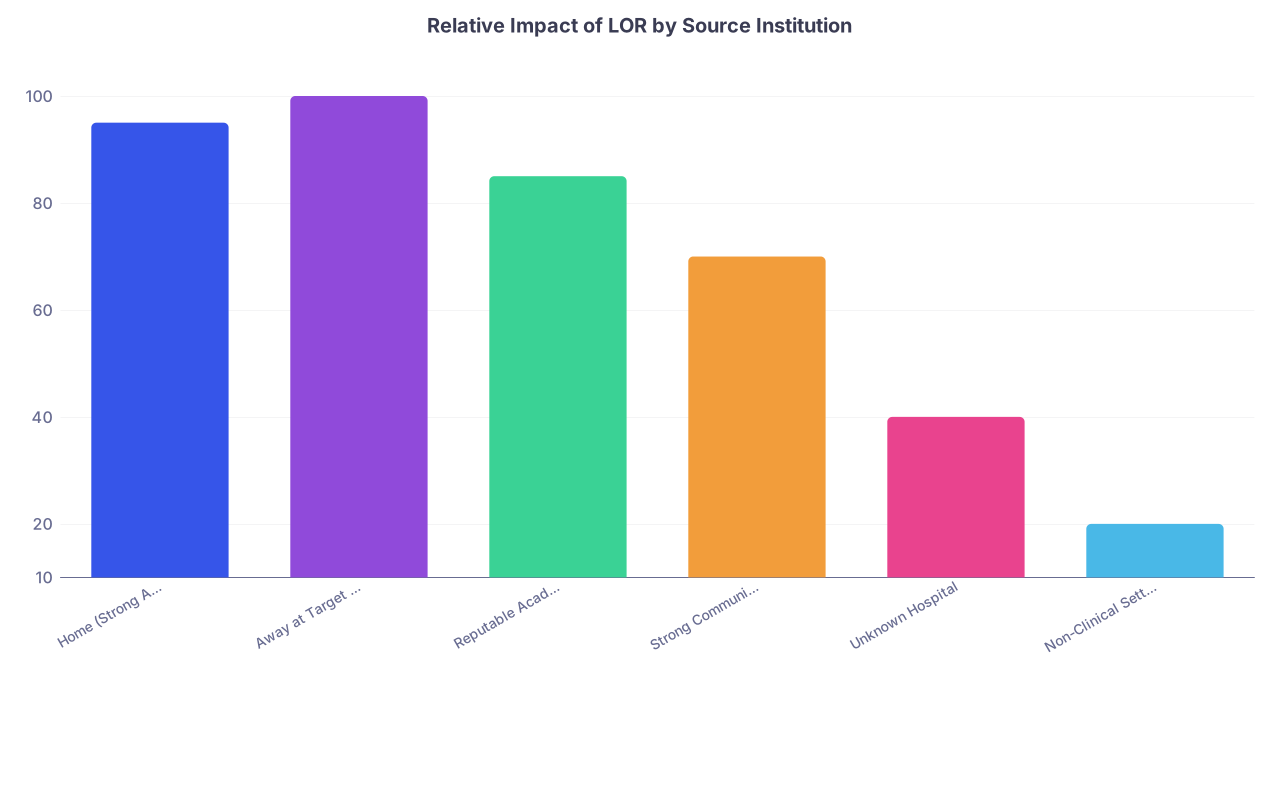
| Category | Value |
|---|---|
| Home (Strong Academic) | 95 |
| Away at Target Program | 100 |
| Reputable Academic Elsewhere | 85 |
| Strong Community Program | 70 |
| Unknown Hospital | 40 |
| Non-Clinical Setting | 20 |
Here’s the rough truth:
Away rotation at the PD’s own institution
That letter can override almost everything else. They know their own people. If their APD says, “Keep this one,” you’re in very good shape for an interview and more.Home institution in the same specialty, solid academic program
Calibrated, expected, and heavily weighted. PDs know the training environment and the bar.Random community program nobody on the committee has heard of
You’re fighting both an unknown letter-writer and an unknown standard. Even a glowing letter will be taken with a grain of salt unless it’s very specific and grounded in behaviors.Prestige halo
Letters from high-tier academic centers (MGH, UCSF, Penn, Hopkins, etc.) in the same specialty are given more initial credit than letters from small, unheard-of places. That’s not fair, but it’s real.
Am I saying you can’t match from a smaller place? No. But your letters need more content to make up for the lack of name recognition.
The Subtext PDs Look For Inside the Letter
Once the hierarchy of “who wrote it” is processed, PDs start scanning for key phrases. And this is where the writer matters even more.
A Tier 1 or Tier 2 letter-writer using strong language is extremely powerful. Same language from a random per-diem locums doc? Discounted heavily.
What PDs read for:
- Explicit comparisons:
“Top 5% of students I’ve worked with in the last decade.”
“Better than many of my interns at the start of the year.” - Commitment signals:
“I would be thrilled to have her as a resident in our own program.”
“We attempted to recruit him to our residency.” - Behavioral evidence:
Concrete stories: the difficult patient, the disastrous call night, the time you messed something up and owned it.
A PD from a nationally known program writing “top 10%” is extremely different from a random attending tossing “outstanding” at every student.
That’s why who writes your letter is more important than how flowery it sounds.
How To Choose Your Letter Writers Strategically
So what should you do with this hierarchy?
Think in layers.
Your ideal 3–4 letters (specialty-dependent) usually follow this pattern:
- One heavyweight in the specialty
PD > APD > Chair > Fellowship director who knows you clinically. - One core faculty who observed you closely and can write specifics
They don’t need to be famous. They need to know you. - One additional faculty in the same or closely related area
Again, core teaching faculty is ideal. - Optional: research or non-core letter
Only if it’s truly strong and in your field.
Given a choice between:
- Big-name chair who barely interacted with you
- Associate PD who worked with you daily and is widely respected internally
Pick the APD. Always.
And if someone hesitates when you ask—“I’m not sure I know you well enough to write a strong letter”—believe them. That’s them trying to save your application.
The Hidden Politics: Known Over-Inflaters and Quiet Snipers
Here’s the part you only hear in closed-door meetings.
Certain letter writers get reputations.
- The “everything is amazing” chair whose “top 1%” shows up on 40 applications a year. Committee members roll their eyes. Discounted.
- The perennially negative curmudgeon who never calls anyone above “average.” When that person writes “one of the best,” everyone notices. Big jump in impact.
- The honest brokers. Faculty whose letters always track with real performance. PDs and selection chairs quietly trust them more than anyone.
So, at some institutions, the single most powerful letter you can get isn’t from the department chair. It’s from the grizzled mid-career APD or core faculty whose name carries trust locally.
You usually find this out from residents, not from websites. When they say, “If Dr. X writes for you, that’s the letter you want,” listen.
Putting It Together: Realistic Scenarios
Let’s look at a few profiles the way a PD committee actually reacts.
Applicant A
- IM applicant
- Letters: IM chair (generic), cardiology clinic attending (saw them twice), PhD research mentor in oncology
Behind the scenes reaction:
“Where’s the letter from someone who actually rounded with them? This feels thin.”
Name recognition might get a glance, but the lack of a strong core ward letter is a real red flag.
Applicant B
- Same specialty
- Letters: Associate PD on wards (detailed), core faculty on night float (specific on performance under pressure), fellowship director in the specialty (short but strong)
Reaction:
“Ok, this is someone multiple real teachers are willing to vouch for. We know how to interpret these.”
Applicant C
- Away rotation at the PD’s own institution
- Letter from their APD: “We considered ranking this student highly if they’d applied here.”
Reaction:
“Interview. Now.”
This kind of line can move you from borderline on paper to safely on the list.
A Quick Visual: Who Actually Moves the Needle
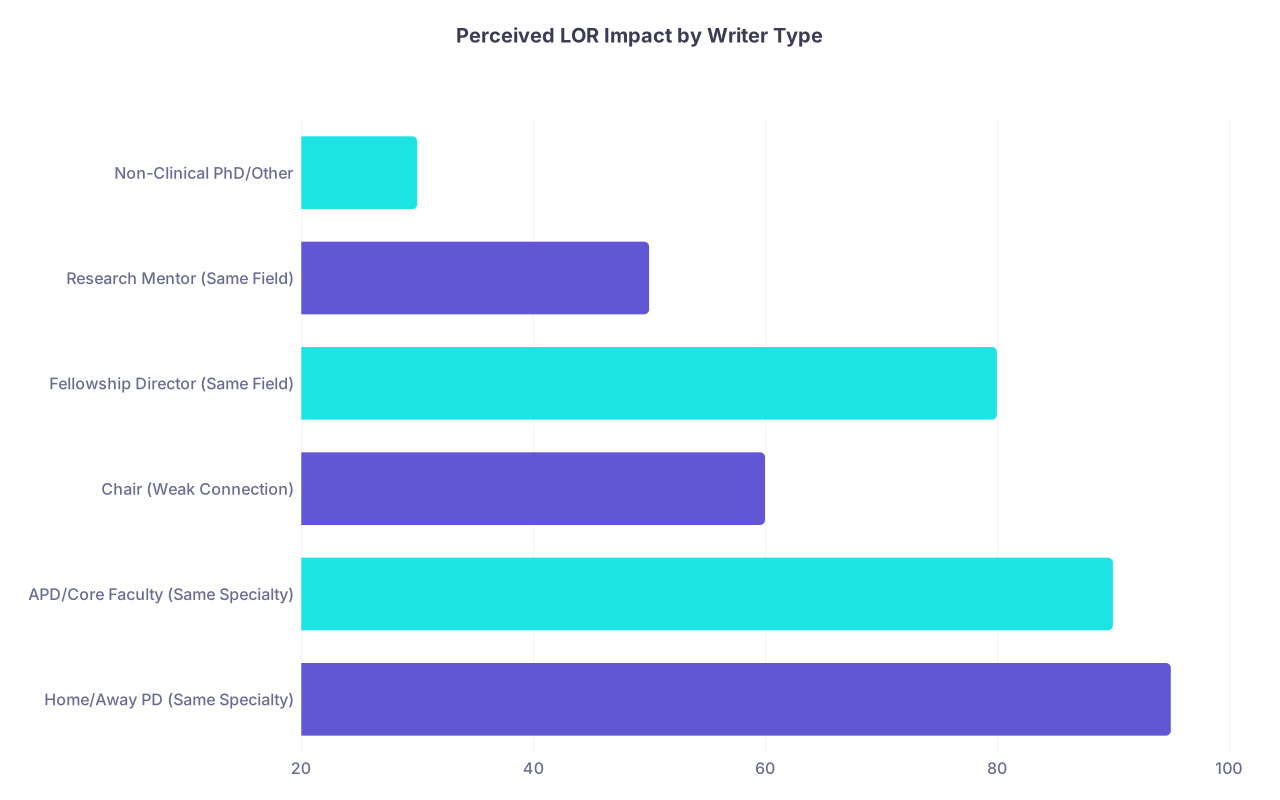
| Category | Value |
|---|---|
| Home/Away PD (Same Specialty) | 95 |
| APD/Core Faculty (Same Specialty) | 90 |
| Chair (Weak Connection) | 60 |
| Fellowship Director (Same Field) | 80 |
| Research Mentor (Same Field) | 50 |
| Non-Clinical PhD/Other | 30 |
FAQ: The LOR Hierarchy, Answered

1. Is a famous name who barely knows me better than a mid-level faculty who knows me well?
No. PDs are increasingly numb to empty prestige. If the letter from the famous name is superficial, generic, or clearly ghostwritten by a resident, it’s Tier 3–4 at best. A detailed, behavior-rich letter from a core faculty who actually observed you carries far more weight in the room. If you can get a famous and substantive letter, great—but never sacrifice content for name.
2. How many letters should come from my chosen specialty?
For most core specialties (IM, surgery, peds, EM, etc.), aim for at least 2, preferably 3 letters from that field or closely allied areas. One may be from your home program, one from an away (if you did one), and one from another solid rotation in the same specialty. One “wild card” (research, related specialty, PhD) is fine, but your backbone must be same-specialty clinicians who’ve seen you in action.
3. Does it matter if my PD letter is from a different specialty than the one I’m applying to?
It helps less. A pediatrics PD letter for an internal medicine applicant, or a surgery PD letter for an EM applicant, is seen as: “This person functions well in clinical environments.” That’s not useless, but it’s not as impactful as a same-specialty PD/APD letter. If that cross-specialty PD actually supervised you in a rotation highly relevant to your chosen field (e.g., SICU for EM), it helps more—but still sits below a strong same-specialty letter.
4. Are research letters ever truly game-changing?
Yes, but only in narrow circumstances. They move the needle when:
- The mentor is a big name in your specialty or in a directly connected subspecialty
- The letter describes you like a future resident, not just a data analyst
- You’re applying to research-heavy or physician-scientist tracks where scholarship really matters
For standard categorical spots, a strong research letter is a nice supplement, not the central pillar. If it replaces a key clinical letter in your specialty, you’ve usually weakened your application.

If you remember nothing else:
First, the who matters: PDs/APDs and core same-specialty faculty beat big but distant names.
Second, the where matters: home and away letters from strong programs carry a built-in calibration.
Third, the content matters most: specific, behavior-focused, comparative letters from trusted writers are what actually move PDs when they’re building the rank list.