
The worst letter of recommendation you will ever “get” is the one you secretly wrote yourself.
Not because programs will always catch you. But because when they do, your credibility is finished. And when they do not, the letter is usually so generic and hollow that it quietly hurts you anyway.
Let me be blunt: the self-written LOR draft trap is one of the most common, under‑discussed ways strong applicants sabotage their residency applications.
You think you are “helping” a busy attending. You are actually handing programs evidence that you do not understand professionalism, boundaries, or how serious these documents are in residency selection.
Let us walk through the landmines so you do not step on them.
The Self‑Written Draft Trap: How It Really Starts
Almost nobody wakes up and decides, “I will fabricate my own letter of recommendation.” It happens in slow, seemingly harmless steps.
The pattern looks like this:
- You rotate on a busy service. The attending likes you.
- You ask for a letter. They say, “Sure, happy to. Could you send me your CV and maybe a few bullet points or a draft to get me started?”
- You panic. You have heard that generic letters are death. You have also heard attendings are “terrible” at writing them.
- Someone (a classmate, a Reddit thread, even a resident) tells you: “Just write it yourself. They will sign it. Everybody does it.”
So you sit down and write your own “strong” letter.
This is the trap.
The original ask—“send me bullet points” or “remind me what we worked on”—is normal. Supplying talking points is fine. Taking over the entire authorship of the letter is not.
You cross a line the minute the document becomes your voice pretending to be someone else’s.
Why Programs Hate Self‑Written Letters (Even When They Cannot Prove It)
Program directors are not naïve. They read hundreds of letters every year, often for the same students, same schools, same hospitals.
Patterns jump out.
Here is what raises red flags:
- The diction and style of the letter match your personal statement or ERAS experiences a little too closely.
- The letter uses language no attending from that specialty or institution would ever use.
- The writer “observed” you performing tasks that do not match your training level.
- The writer comments on your “lifelong dream” in a way that sounds like a first‑person essay, not a third‑party assessment.
- The tone is over‑the‑top, superlative on every line, without a single specific observation.
Are programs going to run plagiarism software on every LOR? No. They do something more powerful: pattern recognition combined with skepticism.
They compare letters across your application.
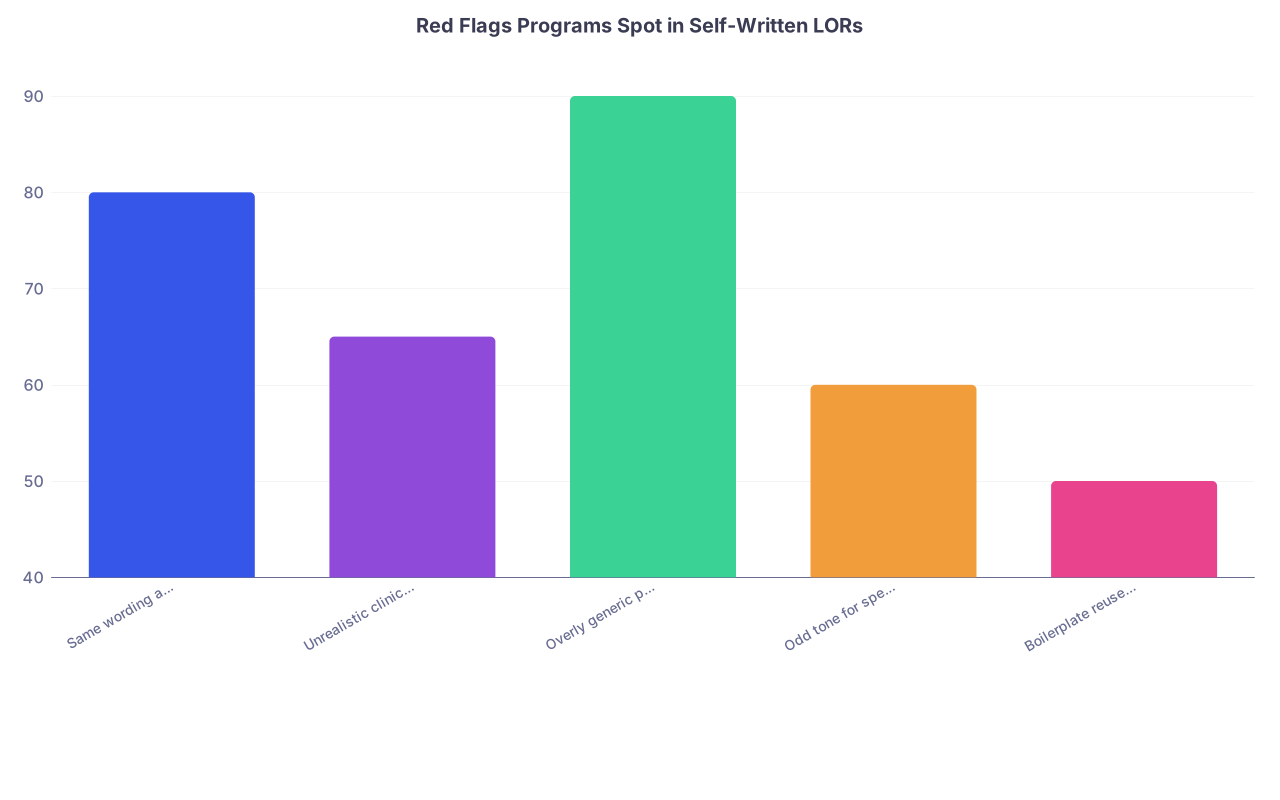
| Category | Value |
|---|---|
| Same wording as personal statement | 80 |
| Unrealistic clinical claims | 65 |
| Overly generic praise | 90 |
| Odd tone for specialty | 60 |
| Boilerplate reused across applicants | 50 |
Those percentages are not “official” statistics, but they reflect what PDs repeatedly complain about at conferences and in panel discussions: generic letters and obviously coached or ghostwritten content.
Even when they do not conclusively know you drafted it, a fake‑sounding letter triggers a quiet but deadly reaction:
- They discount the letter almost entirely.
- They start questioning the rest of your file.
- If there are multiple similar concerns (odd personal statement, unusual gaps, inconsistent narratives), you fall down the rank list fast.
The damage is not just ethical. It is tactical.
The Big Mistakes Students Make Around LOR “Help”
The problem is not just writing your own letter. There are a few related mistakes that live in the same neighborhood and can hurt you more than you expect.
Mistake 1: Confusing “Talking Points” With “Write My Letter”
Acceptable:
“Please send me your CV and a brief summary of the things you did on the rotation so I can remember details.”
Not acceptable:
“Send me a full draft, I will edit and sign.”
If you answer the second request by sending an actual polished letter, you have now participated in misrepresentation, even if you did not initiate the idea.
What you should send instead:
- A one‑page document with:
- 4–6 bullet points of specific things you did.
- A few concrete clinical encounters they might remember.
- Any projects / presentations you completed for them.
- Your CV.
- A short paragraph reminding them of your career goals and what you hope the letter will emphasize (e.g., work ethic, team skills, interest in their specialty).
That is it. You are giving raw material, not finished product.
Mistake 2: Writing in Their “Voice” and Getting It Wrong
I have seen this mistake up close.
A student writes a letter “from” a trauma surgery attending using phrases like:
- “I was particularly impressed by her calm demeanor in emotionally charged situations.”
- “She consistently sought feedback in a humble, growth‑oriented manner.”
Does this sound like anything a trauma surgeon at 6 am on post‑call would write? Not usually.
Program directors know how different specialties talk. A pediatrician’s letter reads differently from a neurosurgeon’s. An academic researcher’s tone is not the same as a community internist’s.
When your fake voice does not match the specialty culture, it screams “ghostwritten.”
Mistake 3: Overinflating Your Abilities
Students who write their own letters tend to make themselves look like junior attendings.
Phrases that get you into trouble:
- “Performed complex procedures independently”
- “Displayed knowledge equivalent to a PGY‑2”
- “Functioned at the level of an intern”
Could an attending choose to say something like that? Yes. Rarely. When it is genuinely true and usually with strong justification.
When you invent that kind of language for yourself, you create a mismatch with your actual performance on applications, grades, and interview impressions. Programs will notice.
Mistake 4: Recycling the Same Draft for Multiple Letter Writers
This one is sloppy and common.
You write one glowing, generic letter. Then you:
- Change the name at the top.
- Swap a few course names.
- Use it for three different attendings.
Program directors at a single institution sometimes share letters informally. When they see practically the same language from two different physicians, it looks awful for you and embarrassing for them.
Even if they never compare notes, generic “copy‑paste” content is easy to recognize:
- Same structure, same adjectives across multiple letters.
- No unique details about the specific rotation or service.
You think you are being efficient. You are actually proving that no one took the time to write something real about you.
Ethical Lines You Cannot Afford To Cross
There are gray zones in residency applications. This is not one of them.
Letters of recommendation are supposed to be:
- Independent assessments.
- Authored and owned by the recommender.
- Based on direct observation.
When you write your own letter, several ethical problems pile up:
Misrepresentation
You are presenting your own words as someone else’s independent evaluation. That is not “help.” It is a form of dishonesty.Coercion by convenience
Some attendings ask for drafts because they are busy, not because they want you to fabricate. When you respond with a full letter, you push them into a corner: either rewrite heavily (time‑consuming) or sign something they did not really author.Unequal playing field
Programs assume letters carry weight because they believe physicians are vouching for you with their own reputation. When that is not true, you are gaming a system that others are trying to respect.Professionalism test failure
Residency is full of small ethical crossroads: documentation, billing, procedure logs, research data. Program directors want to know if you understand where lines are. If you blur them in your application, they rightly worry you will blur them with patients.
If you are thinking, “But everyone at my school does this,” no. Everyone you are talking to may be doing this. Those with better mentorship are not.
What To Do When an Attending Asks You for a Draft
Here is where students get stuck. You are afraid that if you push back, you will lose the letter.
You do not have to be confrontational. You do have to be clear.
Use language like this:
- “I can definitely send you my CV and a list of things I worked on. I have been advised not to draft full letters myself, but I am happy to provide bullet points or examples to make it easier.”
- “I want to make sure the letter reflects your own perspective, so I will send you detailed notes instead of a full draft. That way you can phrase it how you see fit.”
Most attendings will respect that. The ones who get annoyed? Those are often the same ones who would have written you a lazy, generic letter anyway. Losing that letter is not a loss.

| Step | Description |
|---|---|
| Step 1 | Attending asks for draft |
| Step 2 | Offer CV + bullet points instead |
| Step 3 | Prepare detailed bullet list |
| Step 4 | Politely decline & seek another writer |
| Step 5 | They write letter from your notes |
| Step 6 | Exact request? |
| Step 7 | Attending insists on full draft? |
If someone insists that you write your own full letter and makes you feel like you have no choice, that is a problem. You have to decide if you are willing to tie your professional integrity to that person. In most cases, finding another writer is safer.
The Quiet Way Self‑Written Letters Hurt Strong Applicants
Even if you never get caught, there is another, more subtle consequence.
Self‑written letters usually sound:
- Overly polished.
- Unnaturally structured.
- Weirdly similar to your personal statement.
They lack the odd, human details that make real letters powerful:
- “He was the only student on the team who stayed late to help the night float intern with signouts.”
- “She came in early to see a patient whose social situation was complex, and I watched her walk the family through difficult news with maturity beyond her years.”
- “I remember him volunteering to present an article on a topic we had only briefly mentioned on rounds—that initiative stood out.”
Students rarely invent these because they are too busy trying to “sound impressive.” So you end up with vague fluff:
- “She is compassionate.”
- “He is hardworking.”
- “She will be an asset to your program.”
Program directors glaze over. You blend into the pile.
I have seen mid‑tier students with authentic, specific letters beat objectively stronger candidates with inflated, generic ones. Because programs value trust and detail more than scripted perfection.
Safer, Smarter Ways To “Help” Your Letter Writers
If you want to improve the quality of your letters without crossing ethical lines, there are ways. Use them.
Give them a strong “brag sheet”
One page. Bulleted. Focus on specifics, not adjectives.- Procedures you assisted with.
- Presentations you gave.
- Feedback you acted on.
- Memorable patient encounters.
Share your goals upfront
Before they write:
“I am applying to EM, and it would help me if you could comment specifically on my performance during high‑acuity cases and team communication.”This nudges them into relevant, concrete commentary.
Ask early and in person when possible
The more time they have, the less likely they are to cut corners or lean on you.Choose your writers strategically
You want:- People who know you reasonably well.
- People who have written letters before.
- People whose writing style, if you have seen it, is specific rather than bland.
Accept that some letters will be average
Not every letter has to be a glowing masterpiece. Three honest, solid letters can be better than two over‑the‑top, fake‑sounding ones.
Recognizing Red Flags Before You Get Involved
Certain situations almost always lead to trouble. Learn to spot them early.

Be cautious when you hear:
- “I am swamped. Just write something and I will sign it.”
- “Everyone does this. The system is broken anyway.”
- “If you want this to be strong, you should just draft it for me.”
Translation in reality:
- “I do not want to invest time in this, but I also do not want to say no.”
- “I am willing to put my name on something I did not write, which says something about my own boundaries.”
- “I do not fully appreciate how much trouble this can cause for you, not me.”
You are allowed to walk away from that dynamic.
Remember: you are the one whose career is on the line, not the attending signing a piece of paper.
How Programs Actually Use Letters (So You Do Not Overreact)
You might be overestimating what a “perfect” letter does.
Programs usually care about:
- Red flags (unexplained professionalism issues, clear negative comments).
- Strength of endorsement (lukewarm vs strong, especially for home department).
- Specific examples that align with their values (teamwork, resilience, teachability).
They do not have time to parse subtle stylistic differences between “excellent” and “outstanding.” But they do quickly weed out:
- Obvious template letters with no substance.
- Letters that contradict other parts of the application.
- Letters that feel manufactured.
| LOR Feature | Impact on You |
|---|---|
| Clear negative comment | Huge red flag |
| Vague / generic content | Quietly harmful |
| Specific clinical detail | Strongly positive |
| Overblown superlatives | Mildly suspicious |
| Tone mismatch with PS | Raises questions |
You do not need a cinematic, Hollywood letter. You need trustworthy, grounded, consistent voices who can say:
“I worked with this person. Here is what I actually saw. You should trust them.”
That is it.
If You Already Wrote a Draft: Damage Control
If you are reading this late, and you have already written a draft for someone, do not panic. But do not ignore it, either.
Ask yourself:
Did they significantly rewrite it?
If they made it their own, added their own stories, changed the tone, the ethical issue is smaller. You still learned something: do not do this again.Did you provide the first draft but later feel uneasy?
You can go back and say:
“I realized I crossed a boundary by drafting that letter. I am uncomfortable with it reflecting my own words. Would you be willing to revise it using only bullet points from me instead?”
Yes, that is awkward. So is explaining to a program why your letter appears self‑written if it ever becomes an issue.
Worst‑case scenario: consider whether that letter is essential. You may be better off with fewer, more legitimate letters than one questionable one.
The Point You Cannot Afford To Miss
Let me strip this down to the essentials.
Writing your own letter of recommendation—or anything close to it—is a professional and ethical mistake that can quietly wreck a strong application.
You absolutely can and should help your writers with detailed notes, bullet points, and reminders. The line is crossed when you turn that into actual authored prose in their “voice.”
Programs are not stupid. They have seen countless cycles of self‑written, generic, or inflated letters. At best, they ignore them. At worst, they start doubting everything else you say.
Stay out of the self‑written draft trap. You do not need it, and you cannot easily undo it once you step in.