
Vague, lazy reminder emails are one of the fastest ways to annoy a letter writer and put your residency application at risk.
You are asking someone to stake their reputation on you. If you follow up poorly, you signal that you may waste their time, make them look disorganized, or drag them into preventable drama with programs. Many attendings will never say this out loud. They just quietly say “no” next time. Or write a shorter, colder letter than you thought you were getting.
Let me walk you through the biggest follow‑up mistakes students and applicants keep making—and how to avoid sabotaging yourself with a single sloppy email.
1. The Classic Offender: The Vague Reminder Email
This is the one that inspired your title, so let us start here.
You know the email I am talking about. It looks like:
“Hi Dr. Smith,
Just checking in about my letter. Please let me know if you need anything from me.
Thanks,
Alex”
Or worse:
“Hi Dr. S,
Just a friendly reminder about the LOR. My application is due soon.
Best,
Alex”
That is not “friendly.” That is anxiety wrapped in vagueness, handed to a very busy person and expecting them to do extra work to figure out what you want.
Why vague reminders irritate letter writers
I have heard attendings say versions of this in workrooms more times than I can count:
- “I have no idea which portal this kid is talking about.”
- “Due when? For what program? Which specialty is he even applying to?”
- “If you want me to help you, at least make it easy for me.”
Vague reminders create several problems:
- They force the writer to search their inbox or memory for details you should have repeated.
- They provide no concrete deadline, which makes it easy to postpone indefinitely.
- They increase cognitive load during a clinic day already crammed with notes, patient calls, and results.
- They sound like you want them to do emotional work (“I’m anxious, reassure me”) instead of logistical work (“Here are the exact steps to help me”).
What a concrete, respectful reminder looks like
Compare those vague examples with this:
Subject: LOR Reminder – ERAS, Internal Medicine, Due Sept 15
Dear Dr. Smith,
I hope your week is going well. I wanted to send a quick reminder about the residency letter of recommendation you kindly agreed to write for my Internal Medicine ERAS application.
The ERAS target submission date is September 15, 2026, and the letter can be uploaded directly through the AAMC/ERAS link that was emailed to you on August 10 from “[email protected].”
For convenience, I am re-attaching my CV and personal statement in case they are helpful.
Thank you again for supporting my application. I really appreciate your time.
Best regards,
Alex Rivera
MS4, XYZ School of Medicine
Specific. Bounded. Easy.
The rule: every reminder must include at least:
- What the letter is for (specialty + “residency” + ERAS/VSLO/etc.).
- The realistic target date (not your fantasy date; more on that later).
- How they submit it (portal, link, system).
- Key context documents attached (CV, personal statement).
Do not make them hunt for context you could deliver in three extra lines.
2. Waiting Until You Are Panicking To Follow Up
Another huge error: you delay reminders because you “do not want to bother them,” then suddenly realize ERAS opens next week and half your letters are missing.
So you fire off frantic emails like:
“Hi Dr. X, I just noticed your letter has not been uploaded and my application is due in three days. Could you please submit it ASAP?”
That is how you turn a previously positive interaction into a resentment test. You made your poor planning their emergency.
Reasonable reminder timing (that does not feel pushy)
Here is a timeline that most letter writers actually appreciate:
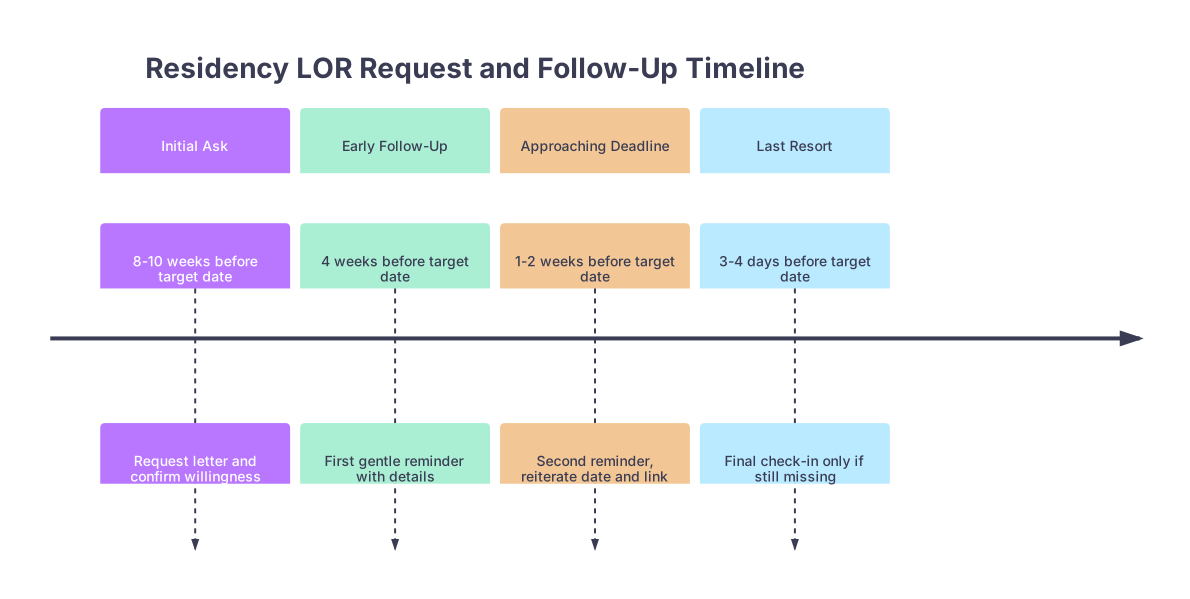
| Period | Event |
|---|---|
| Initial Ask - 8-10 weeks before target date | Request letter and confirm willingness |
| Early Follow-Up - 4 weeks before target date | First gentle reminder with details |
| Approaching Deadline - 1-2 weeks before target date | Second reminder, reiterate date and link |
| Last Resort - 3-4 days before target date | Final check-in only if still missing |
Key mistakes to avoid:
- Asking in August for a September letter and expecting a polished, thoughtful document.
- Sending zero reminders because you “assumed no news is good news.” It usually is not.
- Realizing the problem after programs can already download incomplete applications.
You are not “bothering” someone by reminding them of something important they already agreed to do. You are helping them protect their own professional reputation—they do not want to be the attending who kept a student from matching because they forgot to upload a letter.
3. The Disrespectful Nudge: Guilt, Pressure, and Weird Tone
Plenty of students get the timing right but completely wreck the tone. The writer reads the email and thinks: “This person sees me as an obstacle, not a mentor.”
Red flags in tone:
- Guilt‑tripping: “This letter is really important for my future and I am very worried since it is still missing.”
- Implicit ultimatum: “My other writers have already uploaded their letters; yours is the only one missing.”
- Overly casual: “Hey Dr. C, any chance that letter is done yet? Lol this process is killing me.”
- Passive‑aggressive: “I know you are very busy but I have been counting on this letter for months.”
A busy faculty member does not want to feel like they are on trial in your inbox.
What respectful urgency looks like
Urgency without attitude:
“I know this is a very busy time of year for you, so I truly appreciate your help with this.
My ERAS application will be released to programs on September 27, so having the letter in by September 20 would be very helpful.”
You state the need. You give a real date. You acknowledge their workload. You do not elevate your anxiety above their reality.
You are not their only trainee. You are not their only obligation. Act like it.
4. Being Disorganized and Making Them Dig For Information
One of the top complaints I have heard from letter writers: “I spent more time digging through this student’s emails than I did writing the letter.”
Disorganization shows up as:
- Sending your CV, personal statement, and photo in three separate emails over two weeks.
- Changing your specialty mid‑season and not clearly updating your writer (“I think I’m maybe also applying psych for a few programs”).
- Using multiple email threads with different subject lines so they cannot easily find instructions or links.
- Forgetting to include your AAMC ID or exact name in ERAS when you have multiple last names / changed your email.
If you make the process annoying, some will still write the letter—but they will remember the hassle. And no, they are not thrilled about vouching for someone who cannot organize a simple email chain.
What to include every time
In any follow‑up or reminder, assume they do not want to hunt through old messages. Include:
- Your full name and class (e.g., “Alex Rivera, MS4, XYZ SOM”).
- Specialty you are applying to.
- System and method: “ERAS letter upload via AAMC link sent on [date].”
- Target date for submission.
- Relevant attachments in a single email: PDF CV, personal statement, optional photo.
Think of yourself as tech support for your own recommendation letters. Your job is to remove friction.
5. Ignoring System Realities: ERAS, Upload Dates, and Clerkship Chaos
Another mistake: treating letter writers as if they understand the inner workings of ERAS better than you do. Many do not. They see “some portal link from AAMC” once a year and forget the details by the next cycle.
If your reminders rely on them knowing the system, you will lose.
Use specific, simple language like:
- “The email came from ‘[email protected]’ with subject line ‘ERAS Letter of Recommendation Request’.”
- “You can upload the letter as a PDF directly in that portal; you do not need my AAMC ID again.”
- “Once you submit, it may take a few days to appear in my ERAS portal, so earlier is safer.”
That kind of clarity avoids a very common disaster: the attending thinks they submitted, but your side never updates, and now you are chasing down IT three days before programs can view applications.
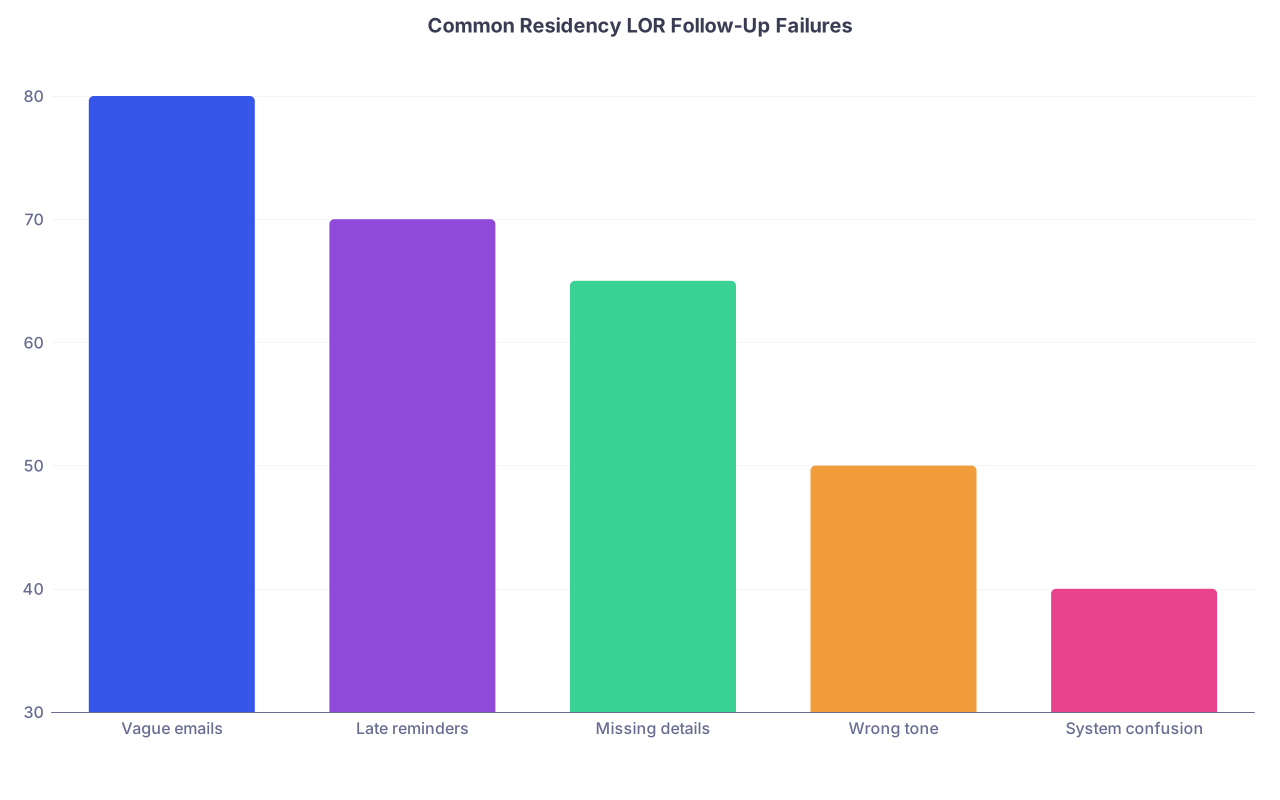
| Category | Value |
|---|---|
| Vague emails | 80 |
| Late reminders | 70 |
| Missing details | 65 |
| Wrong tone | 50 |
| System confusion | 40 |
Do not be in that majority.
6. Over‑Following Up (Yes, You Can Cross The Line)
So far I have warned you against not following up enough. Let us flip the coin.
Some applicants spam.
Examples I have seen:
- Following up weekly starting two months before the date.
- Sending a reminder, then a text, then a DM on Twitter/LinkedIn/Instagram the same week.
- CC‑ing program coordinators or deans to “document” that the letter is late.
- Asking for a status update (“Have you started my letter yet?”) as if this is a graded assignment.
That is how you go from “mildly behind on a letter” to “I regret agreeing to this” in three messages.
Reasonable frequency
If you already did a proper initial ask and provided all materials:
- 1 reminder about 4 weeks before your target date.
- 1 reminder about 1–2 weeks before.
- 1 final check‑in 3–4 days before, if still missing.
That is it.
If they are unresponsive after three properly spaced messages, you shift to Plan B (alternate writer), not harassment. You cannot force professionalism out of someone via repeated email.
7. Failing To Set Clear Target Dates (And Then Blaming Writers)
Many students never give a real, earlier internal deadline. They only say “before ERAS opens” or “before programs download.” This is dumb. You are baking stress into the process.
Programs may start downloading applications on a certain date, but:
- Technical glitches happen.
- Offices close unexpectedly.
- Faculty get sick, go on vacation, or have emergency coverage.
You cannot treat the official ERAS date (or a program’s “priority review” date) as your actual letter deadline.
Set your own target: at least 7–10 days before any true external deadline. Then communicate that clearly.
Bad version:
“ERAS opens Sept 27 so I need the letter by Sept 27.”
Good version:
“My goal is to have all letters submitted by September 18, a week before ERAS applications are released to programs on September 27.”
You build in buffer. You reduce the odds they will accidentally hurt you. You protect yourself from their chaos.
8. Asking For Edits Or Access To The Letter After The Fact
If you waived your right to view the letter (as you should, for credibility), do not make the classic mistake of trying to peek anyway through backdoor asks:
- “Can you send me a copy for my records?”
- “Can I see what you wrote so I can make sure it matches my personal statement?”
- “If programs contact you, could you please emphasize [specific talking point]?”
Faculty talk about this. It makes you look unprofessional and distrustful. It also suggests you do not understand how confidential evaluations work.
If you are worried a letter might be weak or misaligned, that should have been addressed before you asked them, during the initial conversation, not afterward through hints and micromanagement.
9. Neglecting Basic Professionalism: Subject Lines, Signatures, and Channels
Silly but true: sloppiness in your communication decreases goodwill.
Common small but damaging mistakes:
- Subject lines like “Quick question” or “LOR thing” instead of “Residency LOR Reminder – [Your Name] – [Specialty].”
- No email signature, so they have to dig to remember your school or year.
- Using personal emails with joke handles (e.g., “dr.partytime@…”).
- Sending follow‑ups through patient portals or random messaging systems instead of institutional email.
- Typo‑riddled messages sent from your phone with “Sent from my iPhone” and nothing else.
These signal immaturity. And they prime the writer to subconsciously downgrade your professionalism in the letter itself.
Here is a clean baseline:
- Professional email address (ideally school‑issued).
- Clear subject line with your name, “LOR,” and specialty.
- Short, complete sentences. No texting shorthand.
- A simple signature:
“Alex Rivera
MS4, XYZ School of Medicine
AAMC ID: 12345678”
You would be stunned how many students skip half of this.
10. Not Having a Backup Plan When a Writer Drops the Ball
Sometimes you can do everything right and still get burned.
The attending agrees enthusiastically. You send perfect materials. You remind them politely. They still never upload. Or they vanish during a crisis month. Or they swear they submitted but ERAS disagrees and they do not respond again.
Your mistake is assuming this cannot happen, then having no backup.
Practical protection:
- Identify at least one alternate writer for each specialty early.
- Prioritize at least two reliable clinical letters over chasing a “big name” who is flakier.
- Watch your ERAS portal. Do not wait until the night before you submit to see what is missing.
| Role | Primary Writer | Backup Writer |
|---|---|---|
| Core Specialty (IM) | Ward attending | Sub‑I attending |
| Secondary Specialty | Subspecialty attending | Clinic attending |
| Research Letter | PI (MD/PhD) | Co‑mentor or co‑author |
| Department Chair | Chair (template letter) | Program Director/Clerkship |
The worst‑case scenario is not “one letter is a week late.” The worst‑case scenario is “you submitted with a weak or generic letter because you panicked at the last minute and took whatever you could get.”
Do not wait until someone fails you to think about redundancy.
11. Forgetting The Human Relationship After You Get What You Need
Final mistake: treating your letter writers like one‑time vending machines.
You got the letter. You submitted ERAS. That is not the end of the relationship, or it should not be—unless you behave like it is.
Faculty notice who writes a quick thank‑you and who vanishes. They remember who sends a brief update on Match Day and who only emails again three years later needing a fellowship letter.
You want to be in the first group.
Basic courtesy:
- A short, sincere thank‑you email once the letter is submitted.
- A follow‑up in March: “I matched at [Program] in [Specialty]. Thank you again for your support.”
- Optional: one holiday or end‑of‑year note during residency if they truly mentored you.
Not performative. Just adult.
Those 60 seconds of effort are how you keep doors open for future opportunities—fellowship letters, job references, or simply a person willing to vouch for you off the record when a PD calls.

12. A Simple Follow‑Up Template You Will Not Embarrass Yourself With
Use this as your baseline and modify as needed. It avoids all the mistakes I just hammered on.
Subject: Residency LOR Reminder – [Your Name] – [Specialty]
Dear Dr. [Last Name],
I hope you are doing well. I wanted to send a quick reminder about the letter of recommendation you kindly agreed to write for my [Specialty] residency application through ERAS.
My goal is to have all letters submitted by [Target Date], ahead of the ERAS release date to programs on [Official Date]. The ERAS system should have sent you an email from “[email protected]” with the upload link on [Original Request Date].
For your convenience, I am re-attaching my CV and personal statement. Please let me know if there is any additional information I can provide.
Thank you again for your support and for taking the time to assist with my application. I truly appreciate it.
Best regards,
[Your Name]
[Year, School of Medicine]
AAMC ID: [ID]
If your current draft looks weaker than this, fix it before you hit send.
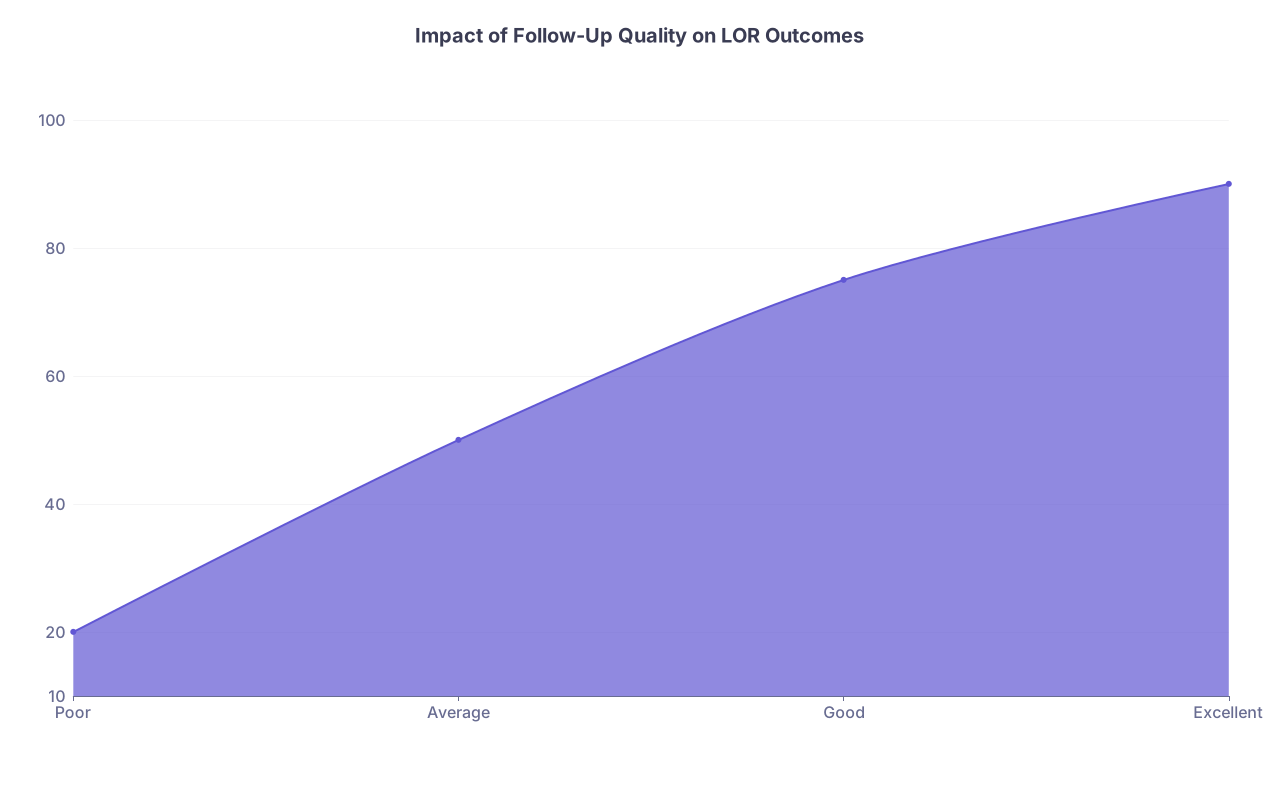
| Category | Value |
|---|---|
| Poor | 20 |
| Average | 50 |
| Good | 75 |
| Excellent | 90 |

FAQs
1. How many reminders are too many for a residency LOR?
Three is the upper limit for a single letter writer in one season: one about a month before your target date, one 1–2 weeks before, and one final check‑in a few days before. If they have not responded or submitted after that, you pivot to a backup writer rather than escalating pressure. More than three starts to look desperate and disrespectful of their boundaries.
2. What if my letter writer agreed in person but never replied to my follow‑up email?
Send one clear follow‑up referencing the conversation: “Thank you again for agreeing to support my application with a letter of recommendation after our discussion on [date] during [rotation/clinic].” Attach your materials and the ERAS request confirmation. If they still do not respond after another reminder closer to your target date, you treat them as unreliable and move on to a different writer for your primary letter.
3. Should I tell a letter writer that they are my “number one” or “most important” letter?
No. That kind of ranking talk is cringeworthy and has no upside. It can make you sound manipulative or naive about how committees actually read letters. You can absolutely say you “valued working closely with you on [rotation] and would be honored to have your support,” but do not frame it as a competition among your recommenders.
4. What if a writer submits my LOR late and it delays my ERAS application?
First, confirm through ERAS whether the application is actually delayed; sometimes letters can arrive after submission and still be attached. If it truly hurt your timing: do not send angry emails to the writer or CC your dean in an attempt to assign blame. You thank them anyway and adjust strategy next time by prioritizing more reliable writers and building in more buffer time. Quietly upgrade your backup plan; loudly complaining will only damage your reputation.
5. Is it ever appropriate to remind a letter writer by text message?
Only if you already have an established texting relationship with that person for professional reasons (e.g., your attending routinely texts the team about rounding times) and they have texted you first. Even then, the primary channel should be email. A single, polite text like “Hi Dr. X, I sent an email about my residency letter last week—just wanted to make sure it reached you” is acceptable. Repeated or casual texts about the letter are not.
If you remember nothing else, remember this: Do not send vague, context‑free reminders. Do not turn your poor planning into someone else’s emergency. And do not assume good intentions will save you from bad systems—protect yourself with clarity, buffer, and a backup plan.