You can destroy a strong application with perfectly good letters requested at the wrong time. Timing mistakes around residency LORs are quiet application killers.
Most applicants obsess over who should write their letters and what they will say. Meanwhile, the programs are silently judging you on when you asked, when they were uploaded, and what that timing implies about your professionalism, reliability, and planning.
I have watched excellent applicants slide down rank lists—or off them—because their letters screamed “disorganized” or “backup applicant” purely from timing. The content was fine. The timing was fatal.
Let’s walk through the biggest red-flag timing errors and how to avoid them before they stain your ERAS profile.
Error #1: Waiting Until After The Rotation Ends To Ask
This is the classic rookie mistake. You finish the month, you leave service, you tell yourself you will “email later.” Then:
- Faculty forget specific details about you.
- They are already buried in new rotators.
- Your name is now one of 40 faces from that block.
- The letter becomes vague, generic, and lukewarm.
Worse, the timing of your request tells the writer something: you do not plan ahead, you are uncomfortable advocating for yourself, or you do not prioritize residency applications.
You should be asking for LORs before the rotation ends, and often before the last week.
What this looks like in practice
Strong timing:
- Week 3 of a 4-week rotation: you ask for a letter in person after demonstrating work ethic and reliability.
- You follow up with an email that night with your CV, personal statement draft (or specialty interest paragraph), and ERAS deadlines.
Weak, red-flag timing:
- Two months after the rotation, long after the attending has forgotten specific cases.
- During interview season, when attendings are exhausted and annoyed by late requests.
- The week before ERAS opens, when everyone else is also begging.
Programs will not see the date you asked, but they will see the date the letter was uploaded. And late uploads are usually the fallout from late or poorly timed requests.
Do not make your letter writer dig through old notes trying to remember who you were. Ask while you are fresh in their mind, and while they can still say specific, meaningful things about your performance.
Error #2: Requesting LORs After ERAS Opens (Except In Very Narrow Cases)
If you are asking for your core LORs for the first time after ERAS opens, you are telegraphing that you did not treat this process as a priority.
Programs know how this works. They know:
- Students have 3rd-year and early 4th-year rotations.
- Letters can be requested in May, June, July, August.
- Organized applicants get this done early.
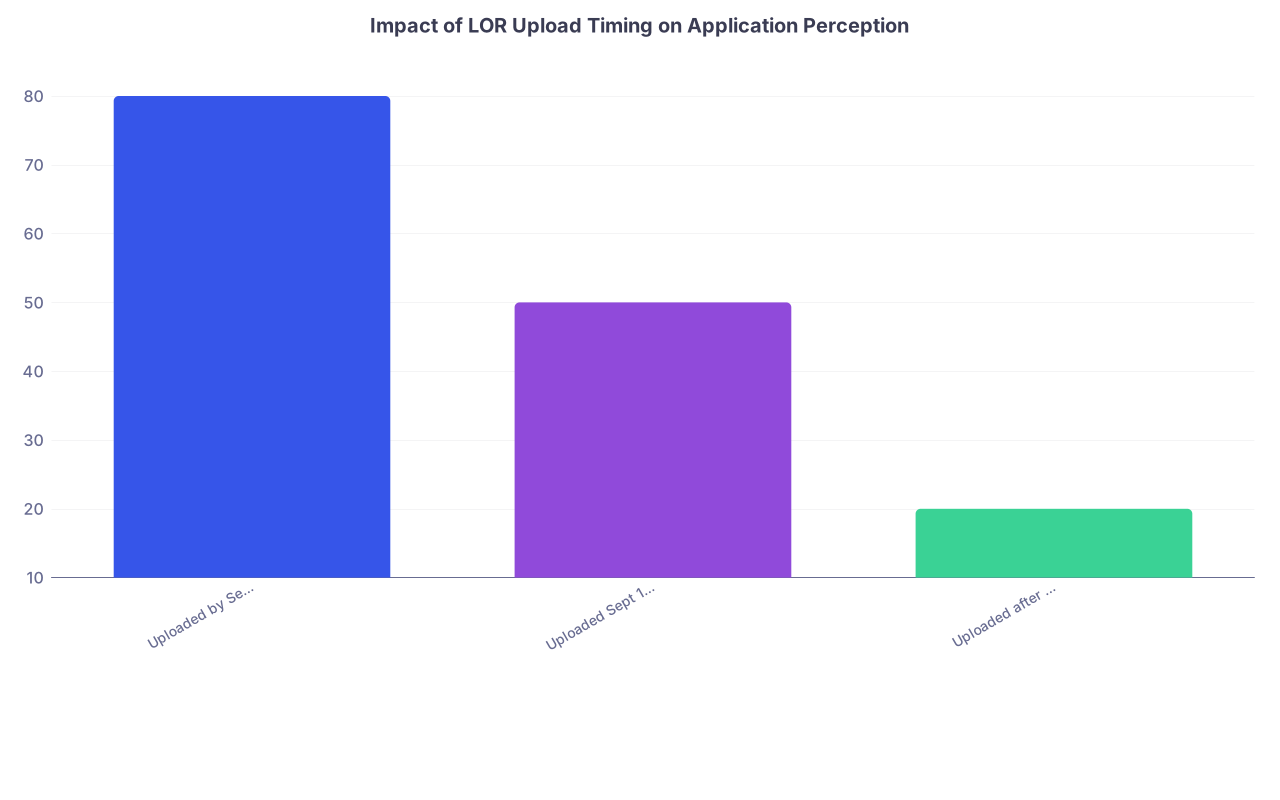
So when they see that your letters were uploaded in late September or October, they make assumptions. None of them flattering:
- You were not decisive about your specialty.
- You did not impress enough attendings to comfortably ask earlier.
- You are applying as a backup and just scrambled for letters.
Are there exceptions? Yes—but they are narrow and obvious:
- An August or September Sub-I specifically in that specialty that you waited for on purpose.
- A home program letter where the chair asks you to wait until later in the summer.
- A late-switch specialty after a genuinely pivotal experience.
Those are different. But if your entire letter set is dated late September or October, it screams, “I did this last minute.”
Aim for this instead:
| Letter Type | Ideal Ask Time | Ideal Upload Window |
|---|---|---|
| 3rd-year core clerkship | Last week of rotation | Within 4-6 weeks |
| Early 4th-year Sub-I | Week 3 of rotation | By mid-August |
| Chair/Program letter | Late June–July | By ERAS opening |
| Supplemental LOR | When rotation ends | Before October 1 |
Your goal: by the time ERAS opens, your core letters (3–4 of them) should already be requested and in motion, with most uploaded by mid-September at the latest.
Error #3: Asking For “Just in Case” Letters With No Clear Use
Another quiet timing failure: requesting random letters months before you have any idea what specialty you want, then trying to repurpose them.
Students do this all the time:
- They ask a random internist during a meh rotation for a letter in January of third year.
- They later decide on surgery.
- They try to use that early, generic letter to look “well-rounded”.
The problem is not the letter itself. It is the signal:
- Very early, random letters often look weak and nonspecific.
- A February letter for a September application often reads like “student was fine, I barely knew them.”
- Programs notice that the strongest LORs usually cluster around late 3rd year and 4th year when the student is motivated and targeted.
Early, unfocused letters can make your later, specialty-appropriate letters look like an afterthought, when they should be the main event.
If you are going to ask early, you must be very clear with yourself:
- Will this person actually write a strong, detailed, advocacy-style letter?
- Will this letter still reflect who I am and what I am aiming for months from now?
Otherwise, you are collecting weak letters early instead of strong letters at the right time.
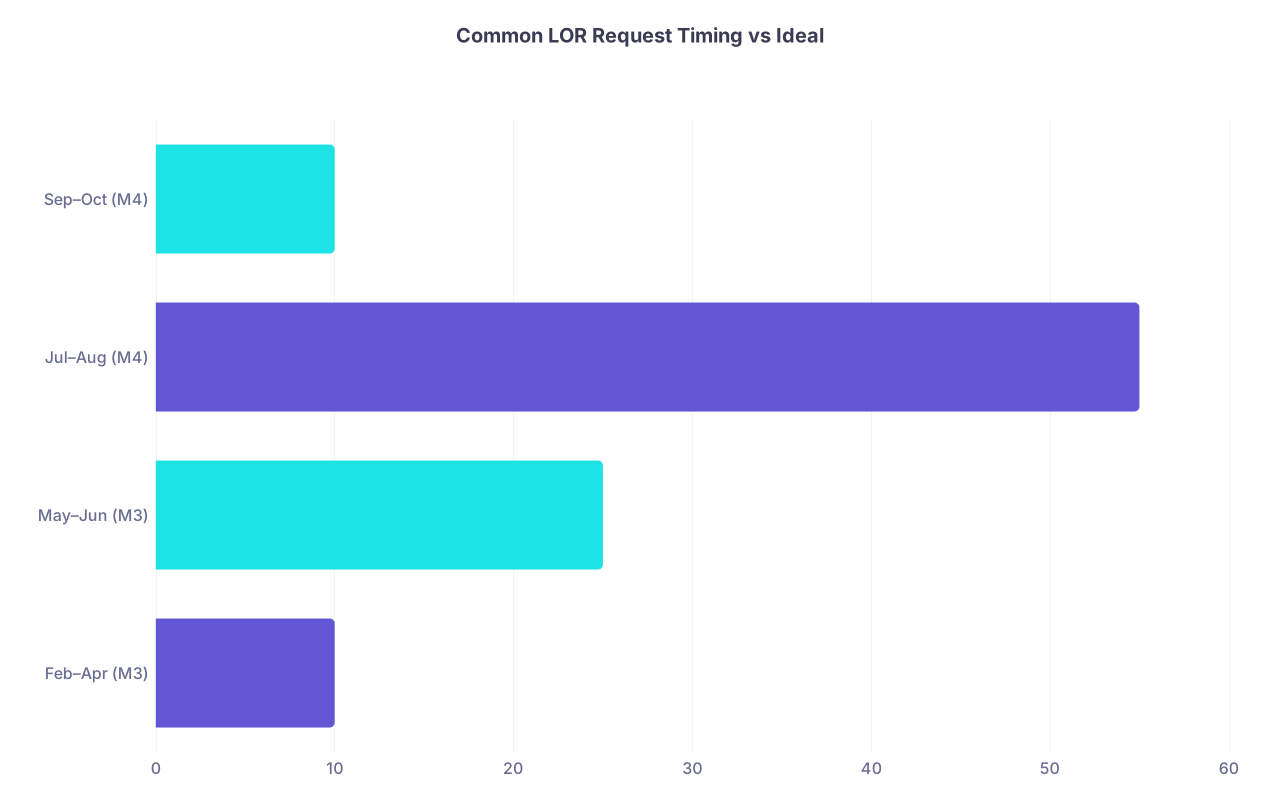
Error #4: Compressing All LOR Requests Into One Month
Cramming every ask into a single frantic month—usually July or August—is how people wind up with:
- Overloaded attendings who accept and then forget.
- Confused writers mixing up details between students.
- Rushed, boilerplate letters written after-hours and resented.
You also end up playing chicken with ERAS deadlines because three different people all told you “I will try to get to it next week” at the same time.
A smarter and safer rhythm:
- Ask some attendings near the end of M3 (April–June).
- Ask again during your early Sub-I or AI in M4 (June–August).
- Reserve one “late” request for an away rotation or special opportunity if truly needed.
Think of it this way: spreading out the requests spreads out the risk. Letters get written when the attending actually has some bandwidth, not when you and 12 of your classmates all show up with “Can you write me a strong letter?” in the same week.
| Category | Value |
|---|---|
| Feb–Apr (M3) | 10 |
| May–Jun (M3) | 25 |
| Jul–Aug (M4) | 55 |
| Sep–Oct (M4) | 10 |
In reality, most students pile everything into Jul–Aug. You do not want to be in that pile if you can avoid it.
Error #5: Requesting After A Mediocre or Short Interaction
Timing is not just about the calendar. It is about the arc of your performance.
Students often ask right after a single good week with an attending, or worse, after a rotation where they were mostly invisible and then tried hard the last three days.
Two big problems:
- The attending does not have enough data.
- The ask comes at a time that clearly does not match the depth of the relationship.
Programs recognize vague “the student was pleasant and hard-working” letters. They are deadly for competitive specialties.
If you are going to ask, your timing should follow sustained performance:
- You have worked with that attending for at least 2–3 weeks, ideally more.
- They have seen you do write-ups, follow patients, respond to feedback, handle call or stress.
- They have initiated positive feedback or advocacy on your behalf.
A very common red-flag situation:
- The only available attending is someone you worked with for 3–4 days on an away.
- You feel pressure to get a letter from that away rotation.
- You ask them anyway.
Those letters are usually thin. Programs can tell. Away letters that appear on ERAS with date stamps very close to the end of a short rotation are often weak because the writer simply did not know you well enough.
You are better off with:
- A home rotation attending who knew you for 4 weeks.
- A Sub-I supervisor who saw you function almost like an intern. Than a “famous name” who barely remembers you.
Error #6: Ignoring ERAS and Program-Specific Cutoffs
Timing error that screams inexperienced or careless: you request letters so late that they are uploaded after programs start reviewing and offering interviews.
Yes, ERAS allows letters to be uploaded later into the season. Yes, programs can see new letters after submission. But there are hard practical realities:
- Many programs screen heavily in the first 1–3 weeks after ERAS release.
- Some set internal deadlines (unpublished) after which new documents are essentially ignored.
- By late October, many interview slots are already assigned, especially for competitive fields.
So if your strongest letter shows up October 25th, it may as well not exist for some places.
Programs will not wait for you. They have more than enough complete applications. An incomplete or “pending letters” status early often gets tossed in the “review later” pile that no one has time to revisit seriously.
So you need to work backwards from:
- ERAS opening and the date you plan to submit.
- The reality that most interview decisions are front-loaded.
Aim for:
- All core letters uploaded by 1–2 weeks after ERAS opens, not “sometime this fall.”
- Any truly late, special letter (e.g., an away rotation in September) used strategically to send an update to select programs, not to complete your file.
Error #7: Failing To Confirm Timing Expectations With Writers
Another self-inflicted wound: you request the letter, the attending says yes, and you assume it will be done “soon.”
Then you watch the ERAS portal for weeks. Nothing.
You do a polite nudge. Nothing.
You panic in mid-September because your most important letter is still not uploaded.
Most of this could have been prevented by a blunt, respectful timing conversation when you ask.
When you request the letter, you should not just say, “Can you write one?” You should add:
- “My goal is to have my application ready by [date].”
- “Programs start reviewing heavily the first weeks after ERAS opens.”
- “Would you be able to submit by [specific date, usually 2–3 weeks before ERAS submission]?”
If they hesitate or say something like:
- “I am really backed up; it might take a while.”
- “I have several other letters to write first.” That is your quiet signal to secure another writer as backup.
Do not wait passively and hope. Timing is part of professionalism. You are allowed to care about it and plan around it.
Error #8: Using Chair or Department Letters At The Wrong Time
Department or chair letters are sometimes required or heavily preferred (especially in fields like internal medicine, surgery, OB/GYN, some competitive subspecialties). The timing here is its own trap.
Two common mistakes:
- Asking too late: you delay contacting the department because you are nervous, so the formal process starts in late August or September. The chair or designee is swamped, and your letter becomes a generic afterthought.
- Asking too early and then changing direction: you request a chair letter for one specialty, then pivot specialties in late summer. Now you have a legacy letter tied to a field you are no longer applying to.
You need to learn, early:
- Does your specialty typically expect a chair letter?
- How does your school handle it (committee, form, meeting, packet)?
- What is their stated deadline and what is the real one if you want it in on time?
Then you work backward:
- Decide your specialty by late M3 or very early M4, if at all possible.
- Initiate the chair/department process in June or July for a September-ready letter.
If you are genuinely undecided and considering two fields, do not lock yourself into a premature chair letter that you might not use. Focus first on rotation-based letters from people who have actually seen you work.
Error #9: Misjudging Away Rotation Letter Timing
Away rotations are a minefield for timing errors.
What usually happens:
- Student does an away in August or September.
- They assume they MUST get a letter from that away.
- They finish late in the season. The letter, if it appears at all, comes in October or November.
Meanwhile, programs in that specialty have already made many interview decisions.
If you want an away letter to matter:
- Do the away earlier (June/July) if your schedule allows.
- Make sure you work closely enough with someone that a letter is realistic.
- Ask them near the end of the away with clear timing: “I plan to submit ERAS by [date]. Would you be able to upload by then?”
If your away is necessarily late (August–September), treat that letter as:
- A possible booster for specific programs, not the foundation of your application.
- Something that may help with rank list decisions, not necessarily interview offers.
Do not delay your ERAS submission waiting on an away letter that may show up weeks after programs start screening.

| Step | Description |
|---|---|
| Step 1 | Identify Specialty |
| Step 2 | Choose Core Rotations |
| Step 3 | Request Letters During/End of Rotations |
| Step 4 | Confirm Writer Timeline |
| Step 5 | ERAS Submission with Core LORs |
| Step 6 | Optional Late Booster LORs (e.g., away) |
Error #10: Treating LOR Timing As Separate From Your Overall Application Strategy
Letters do not exist in a vacuum. Programs see the whole timeline:
- When your Step/COMLEX scores were released.
- When you submitted ERAS.
- When your letters were uploaded.
- When your MSPE (Dean’s letter) was released (fixed date, but viewed relative to everything else).
Patterns matter.
A strong pattern:
- Step scores on time.
- ERAS submitted early or on time.
- Letters uploaded within the first 1–2 weeks of ERAS.
- No big gaps or unexplained delays.
A red-flag pattern:
- Scores released late because of delays or retakes.
- ERAS submitted at the end of the “acceptable” window.
- Letters trickling in over weeks or months.
- Updates repeatedly needed to complete your file.
Programs are trying to answer one question above all: Will this person show up, do the work, and handle deadlines as an intern?
Your LOR timing is indirect but powerful evidence of that.
| Category | Value |
|---|---|
| Uploaded by Sept 15 | 80 |
| Uploaded Sept 16–Oct 1 | 50 |
| Uploaded after Oct 1 | 20 |
(The values here are illustrative, but the pattern is real: the later core documents appear, the colder the reception.)
How To Stay Out Of Trouble: A Simple, Safe Timing Plan
If you remember nothing else, follow this:
Ask during the rotation, not after.
Week 3 of a 4-week block is prime time.Spread your asks across late M3 and early M4.
Do not cram every LOR request into July and August.Anchor your application on letters that will be uploaded by mid-September.
Treat anything later as a nice bonus, not an essential component.Have explicit timing conversations with letter writers.
Never assume their timeline matches your needs.Do not delay submission waiting for one “perfect” letter.
A complete, on-time file with very good letters beats a late, “perfect” one that never gets fully considered.
The Bottom Line
Two or three timing truths will protect you:
- Strong letters, requested late and uploaded late, lose power. Programs are already moving on.
- Vague, rushed letters from short or distant interactions—often a result of poor timing—hurt more than they help.
- Your LOR dates quietly reveal whether you are organized, decisive, and reliable.
Get your timing right, and your letters amplify your file. Get it wrong, and they whisper exactly the things you hope programs will not think about you.