
The chairs’ letters are the part of your residency application you never see fix—and the part that can move you ten spots up or down a rank list in one five‑minute conversation.
You’ve been trained to obsess over your personal statement, ERAS activities, Step scores, and how you answer “tell me about yourself.” Meanwhile, the real power often sits in a 3–5 paragraph letter written by a department chair who’s never scrubbed with you and maybe barely knows your name.
Let me tell you what actually happens with chairs’ letters behind closed doors.
What a Chair’s Letter Really Is (And Isn’t)
Students talk about “getting the chair’s letter” like it’s some standardized, objective evaluation. That’s mythology.
In reality, a typical chairs’ letter in a core specialty (IM, surgery, peds, OB/GYN, psych, etc.) is three things at once:
- A political document inside your own department.
- A signaling device to outside programs that know how your school “codes” its letters.
- A shortcut tool for busy program directors and rank committee chairs.
Here’s the uncomfortable truth: your chair often hasn’t directly evaluated you. They’re aggregating input from clerkship directors, rotation evaluations, whispers from chiefs, and occasionally a faculty member who says “this one is special.”
There are roughly three tiers of chairs’ letters in the eyes of program directors:
| Tier | What It Really Means | Typical Impact |
|---|---|---|
| Strong/Advocacy | Clear, specific praise + explicit signal | Can bump you up significantly |
| Neutral/Standard | Polite, positive, generic | You rise/fall on the rest of your app |
| Concern/Damning by faint praise | Vague, hedged, or coded negatives | You drop, sometimes off the list |
Most students assume they’re getting Tier 1. They’re not. At many schools, fewer than 10–15% get a truly advocacy‑level chair’s letter.
You’ll never be told that explicitly. But program directors learn, over the years, exactly what “top third” from School X means, or what it means when School Y’s chair “strongly supports” you versus “supports” you.
How Chairs’ Letters Get Used in Rank Meetings
Let’s go into the room where you’re not allowed.
Rank meetings are never as formal as students imagine. Picture a conference room or Zoom grid with:
- Program director
- Associate/assistant PDs
- A couple of core faculty
- Often a chief/senior resident
- Maybe the department chair for the final pass at the list in some places
There’s a giant spreadsheet. Columns for Step 2, med school, AOA, clerkship grades, interview score, “vibe,” and then: LORs. Among those, a separate column or note field for “Chair’s Letter.”
Here’s how that column actually shifts rank lists.
1. The borderline candidate discussion
You and four other applicants are all in the “maybe” band. Similar scores. Decent interviews. Limited differentiation.
Someone says:
“Does anyone have anything on letters?”
If your chair’s letter says, “I give [Name] my strongest possible support and would be delighted to have them in our own program,” and the PD trusts your school’s chair, you get nudged up. I’ve watched this happen in real time:
“Her chair really went to bat for her. I’d move her up three spots.”
No discussion of your personal statement. Not your “great story.” A single sentence from your chair.
Flip it: your chair’s letter is bland. “Performed well on core rotations. Professional and reliable. I support their application to (specialty).”
Someone in the room has read enough of these to know: that’s the default. No extra credit.
So when there’s a tie, the person with the advocacy‑level letter moves ahead. You quietly slide down a few lines.
2. The “do we trust this risk?” situation
Programs occasionally love a candidate who’s “off the grid”:
- IMG or Caribbean grad
- Non‑traditional path, gap years
- Redeemed Step 1 failure with strong Step 2
- Lower metrics but lit interview
The PD likes you, but someone says, “We’re taking a risk. What do the letters say?”
If your chair’s letter is clear and specific—“[Name] had a rocky start but demonstrated marked improvement and is now among the strongest graduates of this year’s class”—that can be the difference between, “Let’s take the chance” and “I don’t want to explain this failure to the dean two years from now.”
I’ve seen chairs’ letters override a mediocre transcript because the chair took ownership: “I would match this student here without hesitation.” That line lands.
3. The quiet veto
Program directors won’t say this on the record, but here’s the reality: a chair’s letter can also kill you without ever explicitly trashing you.
Common phrases that trigger a quiet drop down the rank list:
- “Requires ongoing supervision” (translation: not ready)
- “Steady and dependable” with zero superlatives (translation: middle of the middle)
- “Improved over the course of the year” with no details (translation: we had concerns)
- “I support [Name]’s application” when others got “strongest support” or “highest recommendation”
I’ve watched a PD read one sentence and say, “Ok, I’m out. Move them down 20.” No debate. No one fights to keep you up there if your home institution wouldn’t fully back you.
The Coding Systems Nobody Tells You About
Most chairs are not writing these free‑form. They’re writing inside an unwritten code book.
Your school, like every other, has a quiet ranking system it doesn’t show you. Sometimes it’s explicit (top 1/3, middle 1/3, lower 1/3). Sometimes it’s more subtle. But it exists.
Here’s how it plays out.
Internal tiers → external wording
Chairs don’t want their inbox exploding with complaints, so they don’t email students saying, “You’re in my bottom third, good luck.” Instead, they code it into language that other chairs and PDs have learned to decode over the years.
At one well‑known Midwestern med school, the tiers look something like this in practice:
- Top tier: “Among the very best students we’ve trained in recent years” / “would rank at the top of any list”
- Middle tier: “Very good student” / “will make a solid resident”
- Bottom tier: “Meets expectations” / “will be an asset with appropriate supervision”
They never use “bottom tier” or “weak.” They don’t have to. The PD at a large academic program has read 20 of those letters a year for 10 years. They know the dialect.
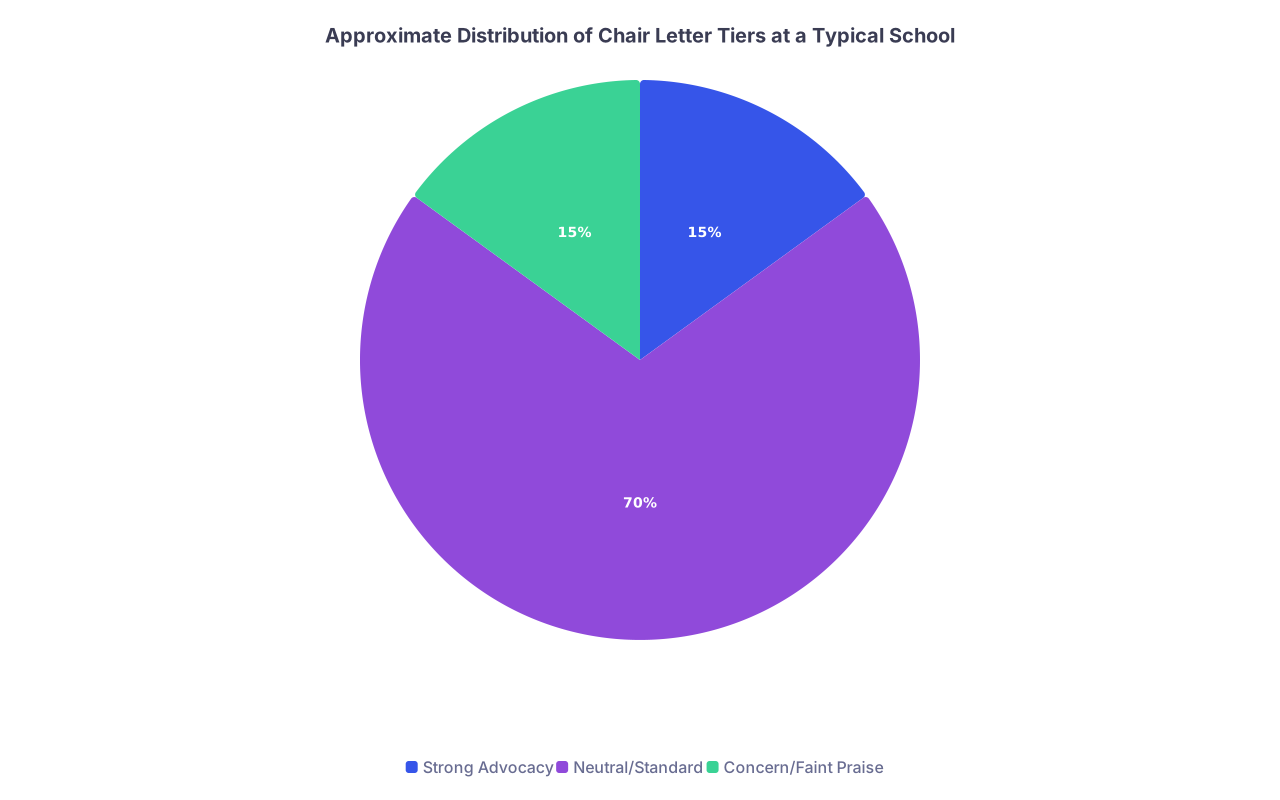
| Category | Value |
|---|---|
| Strong Advocacy | 15 |
| Neutral/Standard | 70 |
| Concern/Faint Praise | 15 |
If you’re wondering which slice you’re in, you’re already feeling the part no one explains: this is happening whether or not you engage.
When the Chair’s Letter Overrides Other Parts of Your Application
There’s a hierarchy in faculty brains. It’s not always logical, but it’s real.
Roughly, it looks like this in tough decisions:
- Category 5 alarm: Negative or lukewarm chair’s letter
- Category 4: Pattern of weak clinical comments + meh chair’s letter
- Category 3: Excellent chair’s letter contradicting borderline metrics
- Category 2: Standard chair’s letter + good metrics
- Category 1: Nobody mentions the chair’s letter at all
So yes, Chair’s letters sometimes re-weight your entire file.
Example 1: The quietly protected student
You’re at your home institution, applying to the same specialty. You had one bad evaluation from a notoriously brutal attending. Without intervention, that eval could haunt you.
But your clerkship director and program director like you. They go to the chair and say, “Look, that comment isn’t representative. This is one of our top students. We want them here.”
The chair’s letter suddenly includes:
“[Name] is among the top residents we hope to recruit to our own program this year.”
During ranking, the PD at another program notices that line and says, “Their chair wants them badly. This eval looks like an outlier. Move them up.” The single attending’s opinion gets diluted by the chair’s shield.
I’ve seen a chair’s assertive letter neutralize a mediocre shelf exam or a minor professionalism blip because the message was: “We know this person. We stand by them.”
Example 2: The smiling grenade
You interviewed beautifully. Everyone liked you. Scores fine. Research solid.
Then the PD reads your chair’s letter in detail and sees:
“[Name] has grown significantly in their professionalism and communication skills.”
That sounds positive to you. To someone who reads hundreds of these, their brain translates: “we had concerns about professionalism and communication skills.”
Suddenly, your smiling interview performance looks rehearsed. Not authentic. The PD starts mentally replaying the day, wondering what they missed.
They don’t confront you. They just move you from “rank to match” down to “if we get to this far, fine, but I doubt we will.”
You never know why you fell.
The Backchannel: Chairs Talking to Chairs
Here’s the part almost nobody outside faculty circles appreciates: the formal letter is just the start. There’s a parallel channel that matters just as much.
Phone calls. Emails. Hallway conversations at national meetings.
PDs and chairs use each other as trusted filters. They don’t want to make a bad bet on a resident who will blow up on them, and they know letters are often sanitized. So they do what you’d do if you were hiring someone important: they call someone they trust.
Common scenario:
- You’re a strong student at a mid‑tier school, applying to a higher‑tier residency.
- Their PD is interested but not entirely sure.
- That PD emails or calls your chair: “Off the record, how is [Name] really? Any concerns?”
If your chair says, “We’d be thrilled if they matched here,” you get a quiet bump.
If your chair says, “They’re fine, they’ll do ok,” you don’t get blacklisted, but you’re less appealing than the candidate whose chair literally said, “Steal them from us if you can.”
And yes, sometimes a chair will quietly warn another chair: “Solid academically, but had some professionalism flags. Nothing formal, but I’d keep an eye on them.” That single sentence can drop you from “rank to match” to “only if we need to fill.”

| Step | Description |
|---|---|
| Step 1 | Program Interested in Applicant |
| Step 2 | Call Applicants Chair |
| Step 3 | Proceed with usual ranking |
| Step 4 | Move Applicant Up |
| Step 5 | No Bump / Slight Drop |
| Step 6 | Move Applicant Down or Off List |
| Step 7 | Any concerns from file? |
| Step 8 | Chairs Off-Record Impression |
How Different Specialties Treat Chairs’ Letters
Not every specialty gives equal weight to the chair’s letter. But the more traditional, hierarchical, or small the field, the more it matters.
| Specialty | Relative Weight | Comment |
|---|---|---|
| General Surgery | Very High | Rigid hierarchy, small world |
| Internal Med | High | Especially academic IM |
| OB/GYN | High | Strong backchannel chatter |
| Pediatrics | Moderate-High | Chair commentary still matters |
| Psych | Moderate | Varies a lot by program |
| EM/FM | Moderate | SLOEs / narrative can rival it |
In surgery, a lukewarm chair’s letter is a red flag. They expect their own chairs to fight for their top trainees. When they see no fight, they assume there’s a reason.
In internal medicine, especially at university hospitals, the chair’s letter often anchors the clinical impression. Residents on the committee will ask, “What did their chair say?” when trying to sort the “good” from the “great.”
In EM or FM, strong SLOEs or narrative letters from clinical rotations sometimes carry as much or more weight, but the chair’s stance still matters for borderline calls.
Timing and Logistics: Where You Can Quietly Win or Lose
Most students think chairs’ letters are a pure content problem. They’re not. Timing and your behind‑the‑scenes reputation inside the department matter as much.
When the letter is written matters
Some schools batch these letters. The chair does 80 of them over a compressed period. The early ones get more attention; by applicant #53, they have a template.
The students whose advocates spoke to the chair early—clerkship director, sub‑I supervisor, PD—get a richer, more specific letter.
The ones who just appear as “Form for chair’s letter due next week” get the boilerplate: “Hard‑working, reliable, will be a fine resident.”
You think you’re just turning in a form by the deadline. Meanwhile, someone with less raw talent but better departmental relationships had their champion talk to the chair in September. Their letter reads personal, concrete, and convincingly strong.
The informal “are they one of ours?” tagging
Chairs absolutely tag certain students as “ours.” Meaning: we’d be proud to have them as our own residents.
Some programs will go further and explicitly say in the letter: “We hope strongly that [Name] will remain at [Home Institution] for residency.” Outside programs read that one of two ways:
- “If we want them, we need to rank them high—they’re probably ranking their home program first.”
- “If their own place really wants them and we’re lukewarm, we can let them go; they’ll be fine.”
If that line isn’t there for you—but is there for some of your classmates—understand you’re already behind your peers before interviews even start.
How You Can Actually Influence Your Chair’s Letter
You can’t write it. You won’t see it. But you’re not powerless.
You influence the inputs and the context.
1. Who’s in the chair’s ear?
Chairs don’t pull these letters out of thin air. They usually lean on:
- Clerkship director in that specialty
- Program director
- A couple of key faculty who do lots of teaching
- Chief residents
If the people in that group know you well, like you, and can tell a coherent story about you, your letter improves. If your best work was with some peripheral community preceptor no one in the academic office trusts, that praise doesn’t convert as well.
You want at least one person who actually sits in faculty meetings to say, “We should really go to bat for [Name].”
2. Give them a coherent narrative
No, not a 4‑page manifesto. But when you request the chair’s letter, a short, direct summary of:
- What you’re aiming for and why
- Who knows you best clinically
- Any obvious “soft spots” you’ve already improved
Something like:
“I had a slow start in third year on my first rotation and got a Pass in [X], but since then my evals and grades have been Honors, including on my sub‑I. Dr. [Y] and Dr. [Z] have worked with me closely and can speak to that growth.”
This let the chair frame “improved over time” as a positive arc, not a red flag they discovered without context.

3. Avoid quiet enemies
Faculty talk. Chiefs talk. Admin staff talk.
If you burned a bridge with a key attending or blew off a meeting with the program coordinator, that story sometimes reaches the chair in a casual “oh, by the way” pre‑meeting chat.
When someone asks, “Any concerns about [Name]?” and a chief pipes up, “They were fine clinically but kind of dismissive with nursing,” that’s the sentence that becomes, “Has grown in their interpersonal communication skills” in the letter.
You don’t need everyone to love you. You do need to avoid giving anyone an easy negative story to share.
Red Flags You’ll Never See But They See Instantly
There are phrases that are chair‑letter poison. You’re never going to read them, but you should know they exist.
Faculty, PDs, and chairs can spot these across specialties:
- Vague time‑anchored praise: “Was a pleasure to work with during their rotation” with zero mention of ability, initiative, or teamwork. Translation: nice, not impressive.
- Growth with no baseline: “Has grown into a capable team member.” Translation: we were worried earlier.
- Repeated “with supervision”: “Performs well with supervision.” Translation: not ready for autonomy at expected level.
- Comparative avoidance: No “among the top,” no “one of our strongest,” just “a good medical student.” Translation: middle or bottom.
On the flip side, there are phrases that ring like a bell:
- “One of the best students I have worked with in the last X years.”
- “We would be thrilled to have [Name] as a resident in our own program.”
- “Stands out for [very specific trait] that will make them an excellent [specialty] physician.”
Those are the lines that get quoted out loud in the rank meeting when someone argues to move you up.
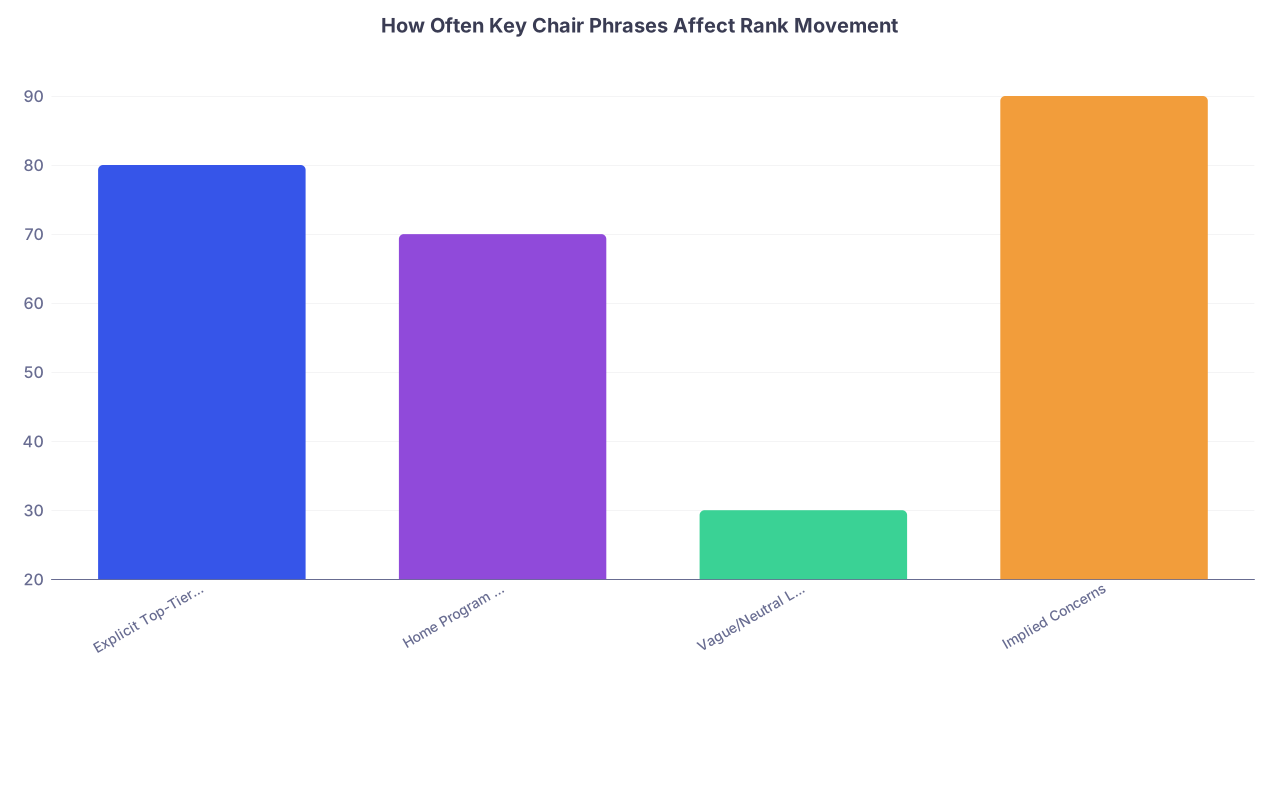
| Category | Value |
|---|---|
| Explicit Top-Tier Praise | 80 |
| Home Program Strongly Wants | 70 |
| Vague/Neutral Language | 30 |
| Implied Concerns | 90 |
(Values here represent rough percentage of time I’ve watched these phrases move an applicant significantly on the rank list.)
What Happens on Final Rank List Night
Let me walk you through the last 60–90 minutes of a typical rank meeting.
They’ve interviewed dozens (or hundreds) of you. Preliminary scores exist. A draft list exists. Now comes the massaging.
There’s a group of “locks”: people everyone loves. There’s a group of “no’s”: people off the list. The real work is in the middle—where you probably are.
Here’s what I’ve seen repeatedly:
- Someone scrolls down to the 10–30 band. “Anyone we’re undervaluing?”
- A faculty member says, “What about [Name]? Their interview was fantastic.”
- PD says, “Good point. What do the letters say?”
- Someone opens the chair’s letter. Reads a sentence or two out loud.
- Group reaction, often unspoken:
- Strong, specific praise → small nods → “Yeah, bump them up a few spots.”
- Generic language → shoulder shrug → “They’re fine where they are.”
- Subtle concerns → small frown → “Let’s be cautious; move them down a chunk.”
Then they look at the “maybe” group near the bottom. Same process. Your chair’s letter becomes the tie‑breaker you never knew you needed.
I’ve literally watched an applicant move from #18 to #9 purely on the strength of the sentence: “I would rank [Name] at or near the top of any list.” No new information. Just conviction from someone the PD trusts.
The Part You Take Forward
By the time you’re reading this, you might already have your chair’s letter sent. You can’t change its content now. But you can change how you think about these dynamics for the rest of your training.
Because this doesn’t stop after med school. Department chiefs, fellowship directors, future chairs—they all still trade on the same currency: how they talk about you to each other when you’re not in the room.
For now, here’s what you carry into the rest of this cycle:
- Your interviews and performance still matter—even the best chair’s letter can’t save a disastrous interview day.
- Among roughly similar candidates, a strong, specific chair’s letter is a real competitive advantage.
- A bland or coded‑concern letter doesn’t always kill you, but it makes everything else in your application pull double duty.

If you’re early enough in training to influence your future chair’s letter, align your clinical relationships toward people who actually sit at those tables. Become someone your program director and clerkship directors are willing to go to the mat for.
If you’re late in the cycle and that letter is already out there, focus your energy where you still have control: interview performance, signals, and how you communicate with programs that are on the fence.
The hidden machinery of chairs’ letters will keep grinding along regardless. The art, for you, is learning how to work with that machinery instead of being crushed by it.
With a clear picture of how these quiet letters bend rank lists, you’re better positioned than most of your classmates. Next comes the other half of the game: how you show up on interview day so that when someone reads your chair’s letter aloud, the room says, “Yeah, that matches what we saw—move them up.” But that’s a conversation for another night.