
The myth that “a strong letter is a strong letter anywhere” is wrong. The data and director behavior show that where you apply and what type of program it is heavily shape what kind of letters of recommendation (LORs) actually move your file.
You are not writing “good letters.” You are writing targeted signals into a noisy, regionally biased market.
Let’s break that market down.
The structural reality: program type × region drives LOR value
Every time I sit with program faculty during rank meetings, the same pattern appears. They say they “read all letters holistically,” but their behavior clusters around a few hard preferences:
Academic university programs overweight:
- Letters from academic attendings and department chairs.
- Away rotation letters at peer or aspirational institutions.
- Recognizable “name-brand” writers, especially in the same specialty.
Community and hybrid programs overweight:
- Clinical performance letters (especially Sub-I / Acting Internship).
- Direct observation in busy, hands-on settings.
- Fit and work ethic, often from local or regional attendings.
Across almost all regions:
- Same-specialty letters are non-negotiable in competitive fields.
- “Generic, glowing” letters are heavily discounted.
- Local / regional writers are read differently depending on region.
The distribution is not random. Program type and geography interact.
To make this concrete, here is a simplified comparison across three broad program types, assuming a mid-tier applicant applying in Internal Medicine. Think of these as relative importance weights on a 0–10 scale.
| LOR Feature | Academic University | Hybrid (University-Affiliated Community) | Community Hospital |
|---|---|---|---|
| Same-specialty letter | 9 | 8 | 7 |
| Writer institutional prestige | 9 | 6 | 3 |
| Direct clinical observation | 7 | 9 | 10 |
| Regional / local familiarity | 4 | 7 | 9 |
| Department/Chair title of writer | 8 | 5 | 2 |
These are not official scores any program publishes. But they do mirror how often these features come up in real committee discussions.
Regional patterns: what the data and behavior actually show
The geography piece is not subtle. Programs do not treat all letters the same just because the text is kind. They filter them through regional familiarity and institutional context.
Let me map out four broad regions: Northeast, South, Midwest, and West. Then look at how program type in each region modulates LOR preferences.
To summarize visually:
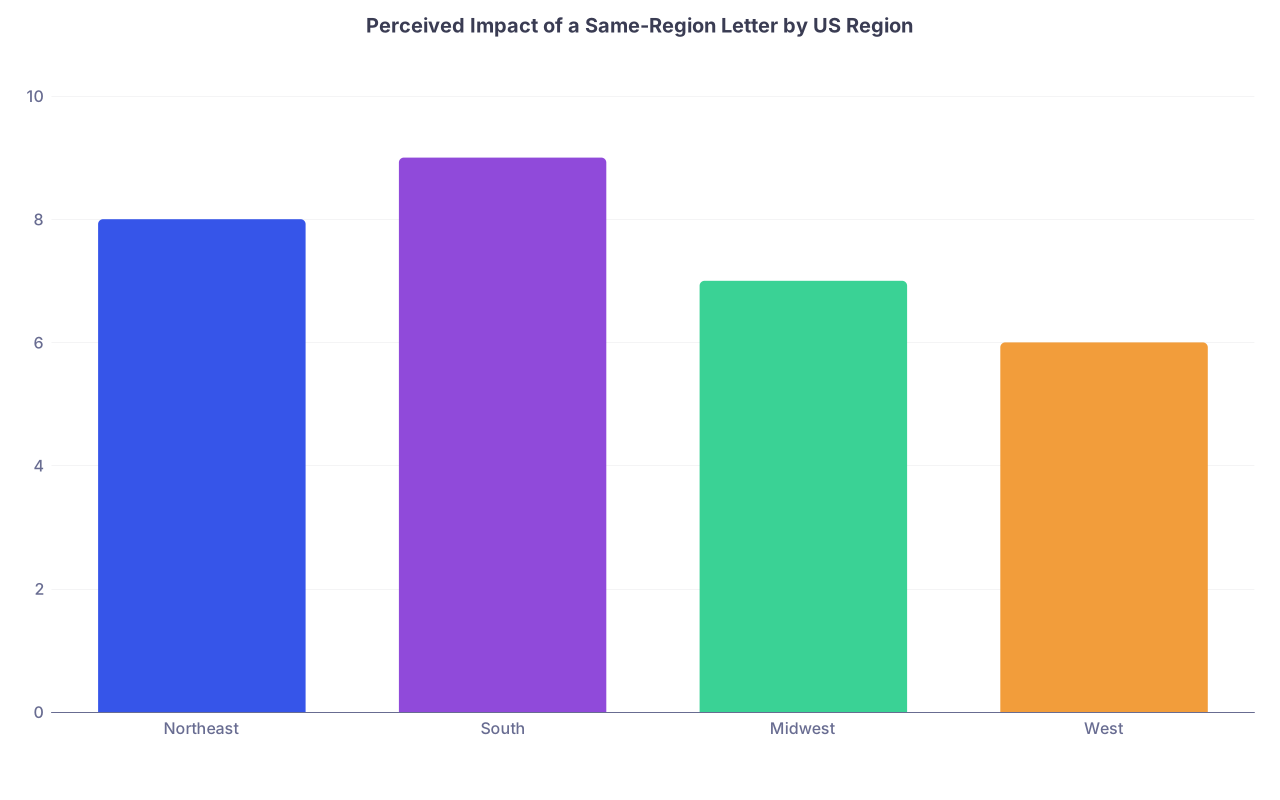
| Category | Value |
|---|---|
| Northeast | 8 |
| South | 9 |
| Midwest | 7 |
| West | 6 |
Think of the values above as relative impact (0–10) of a strong letter from the same region, all else equal.
Northeast: high-prestige, high-signal environment
The Northeast, with dense clusters of academic centers (Harvard, Columbia, Penn, Hopkins, etc.), behaves like a saturated prestige market.
Patterns I consistently see:
Academic IM, surgery, radiology, derm programs:
- Overweight letters from Ivy / top-20 institutions, even if the actual content is similar.
- Chair and PD letters from “elite” schools are treated as high-signal, especially if they use calibrated language program directors recognize.
Community and smaller academic-affiliated hospitals:
- Still respect big-name institutions, but they strongly value letters from:
- Local hospitals.
- Regional attendings known to their faculty.
- A letter from a local attending they know personally often beats an anonymous associate professor from a distant top-10.
- Still respect big-name institutions, but they strongly value letters from:
Practical translation:
If you are applying to a Northeast academic program, a generic glowing letter from “Dr. Famous at Famous Hospital” will often be read as higher value than a similarly generic letter from a small community hospital in another region. But if Dr. Famous barely knows you, and the letter reads formulaic, it can backfire. The data from NRMP PD surveys consistently show “demonstrated interest and fit” and “performance on audition electives” ranking above vague prestige.
For community programs in the Northeast, a letter from a busy local community attending that says “This student functioned at the level of an intern in our high-volume ED, I would trust them with my own family” carries disproportionate weight.
South: local trust and regional ties dominate
In the South, especially Texas, Southeast, and parts of the Mid-Atlantic, you see an even more pronounced regional preference.
Common patterns:
Strong preference for:
- In-state or regional medical schools.
- Local clinical rotations.
- Letters from attendings known to the PD or faculty.
Academic centers in the South (UTSW, Emory, UAB, UNC, etc.):
- Still care about academic reputation and specialty-specific letters.
- But place surprisingly high value on applicants with documented regional commitment.
- Letters from within the same state or neighboring states explicitly mentioning “plans to practice in the South” or “has strong family ties here” are often called out in committee.
Community programs:
- Very high weighting on “do I want to work with this person at 3 a.m. in our ED.”
- Letters that detail reliability, humility, and cultural fit in the local environment beat generic hyperbole from out-of-region writers.
If you grew up in the South, trained elsewhere, and now want to move back, you are statistically under-utilizing your advantage if you do not secure at least one strong letter from a Southern rotation or away elective.
Midwest: loyal to region, highly pragmatic
Midwestern programs, especially outside the largest metropolitan centers, show a consistent pattern of loyalty to regional schools and hospitals.
The data: NRMP and program websites often report a very high proportion of residents from the same region. That does not just reflect applicant preference. It reflects selection bias that includes LOR interpretation.
Key behaviors:
University programs (Michigan, Mayo, WashU, Northwestern, etc.):
- Hybrid model: they value national prestige and regional loyalty.
- A top-tier letter from a Midwestern academic attending can easily match or beat a coastal “big name” in influence, because faculty know the local grading culture and rotation rigor.
Community programs:
- Tend to overweight:
- Known local school reputations.
- Letters from preceptors who routinely send them residents.
- Detail on work ethic, team-based behavior, and Midwestern “fit.”
- Tend to overweight:
If your entire application is coastal and you have zero Midwest ties or letters, your odds at some Midwestern community programs are lower than the raw Step/GPA data suggest. Committees will assume you are unlikely to stay long term.
West: prestige plus fit, less rigidly regional but still patterned
Western programs, especially on the coasts (California, Pacific Northwest), sit in an odd middle position.
You see:
Academic centers (UCSF, Stanford, UCLA, UW, OHSU, etc.):
- Highly prestige-sensitive for competitive specialties.
- Very tuned to letters from peer West Coast institutions and high-tier national schools.
- Strong emphasis on research letters for research-heavy departments, but only when paired with at least one strong clinical letter.
Community programs:
- Somewhat more open to national applicants.
- Heavily emphasize clinical performance and interpersonal dynamics, often from any region.
- But still show a mild preference for West Coast ties and evidence you actually want to live there (because everyone says they do, but many leave).
Empirically, an applicant from a midwest school with a superb clinical letter and a clear stated preference for the West can absolutely match into Western community programs. But at top academic West Coast places, the absence of at least one letter from a high-tier academic context is a real handicap.
How program type changes what “good” looks like in a letter
Program directors are not reading letters as literature. They are extracting a few variables: specialty alignment, writer credibility, direct observation, and comparative language.
Let me quantify the relative value of letter characteristics by program type, across all regions.
| LOR Characteristic | Academic University (Value 0–10) | Hybrid (Value 0–10) | Community (Value 0–10) |
|---|---|---|---|
| Specialty-specific (core field) | 10 | 9 | 7 |
| From research mentor only | 5 | 3 | 1 |
| From Sub-I / Acting Internship | 9 | 10 | 10 |
| From department chair/PD | 9 | 7 | 4 |
| From local/regional attending | 6 | 8 | 9 |
| Detailed clinical narrative | 8 | 9 | 10 |
Interpretation:
- Academic programs:
- High ceiling for prestige and titles.
- Still demand at least one or two robust clinical letters.
- Hybrid programs:
- Live in the middle but lean toward clinical specificity.
- Community programs:
- Titles and institutional brands matter far less than direct, concrete description of your work.
If your letter portfolio is two research letters from big names and one vague clinical letter, your probability of success at community-heavy regions is much lower than your Step scores predict.
Specialty competitiveness vs regional patterns
Competitiveness of the specialty amplifies the effect of program type and region. The more competitive the specialty, the less forgiveness for suboptimal LOR strategy.
Here is how I would roughly model the “required proportion” of same-specialty letters (as a percentage of total LORs) for a typical competitive applicant:
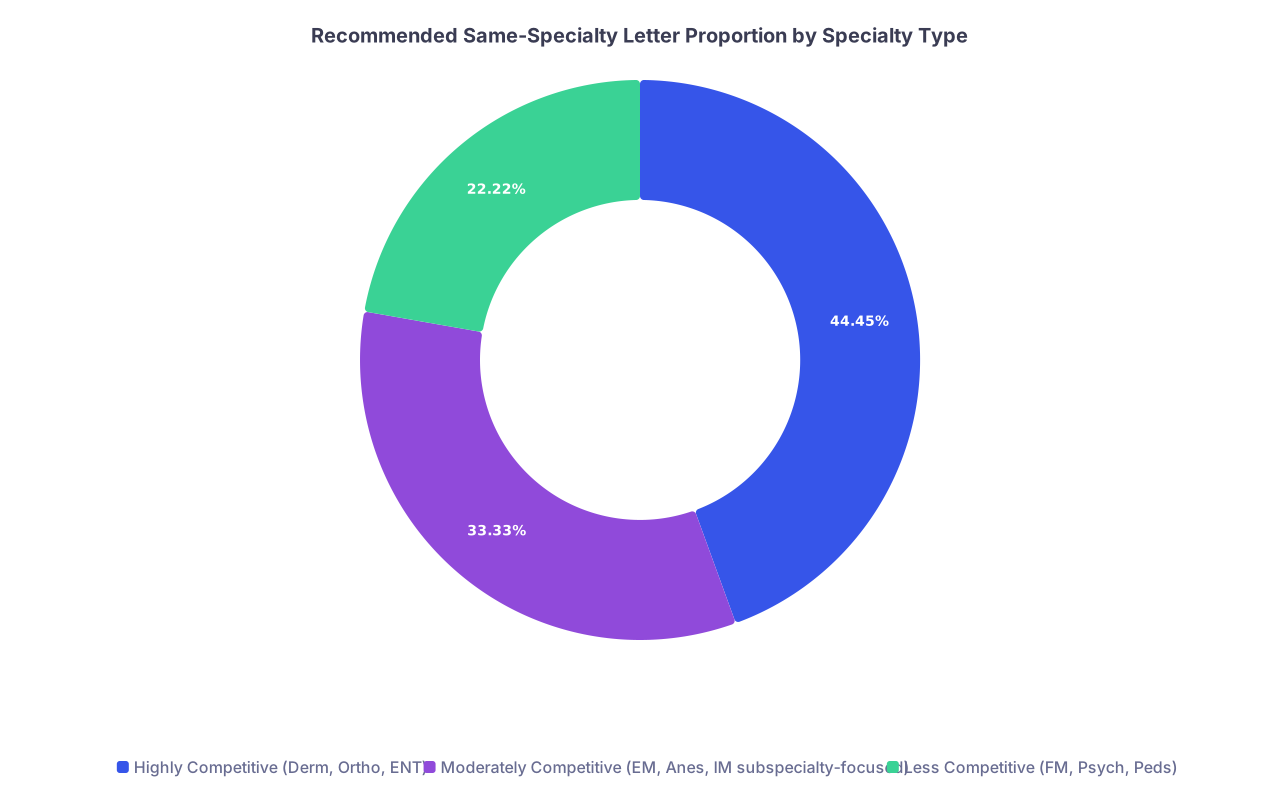
| Category | Value |
|---|---|
| Highly Competitive (Derm, Ortho, ENT) | 80 |
| Moderately Competitive (EM, Anes, IM subspecialty-focused) | 60 |
| Less Competitive (FM, Psych, Peds) | 40 |
Meaning:
Highly competitive specialties:
- Across most regions and especially at academic programs, 80%+ of your letters should be from attendings in that specialty.
- A “generic IM letter” does not substitute for a missing ortho or derm letter, even if it is glowing.
Moderately competitive:
- Mixed portfolios work, but each region will still want at least 1–2 specialty-core letters, particularly at university programs.
Less competitive:
- Programs still prefer a same-specialty letter, but strong generalist letters (IM, pediatrics, etc.) can carry more weight, especially in community-heavy regions.
Region modifies this baseline. For instance:
- A Southern community FM program might be perfectly happy with:
- One FM letter.
- One IM letter.
- One EM or sub-I letter from a local attending.
- A Northeast academic psych program, even in a “less competitive” specialty, will often expect:
- At least two letters from psychiatrists, ideally at academic centers.
Concrete regional strategies: how to choose your letter writers
Here is where applicants actually win or lose. You cannot change the region. You can change your LOR portfolio design.
1. Start from your target program mix
Look at your ERAS list and classify each program:
- Region (Northeast, South, Midwest, West).
- Type (Academic, Hybrid, Community).
- Specialty competitiveness (high, moderate, lower).
You should end up with a rough distribution. For example:
| Region | Academic | Hybrid | Community |
|---|---|---|---|
| Northeast | 8 | 4 | 3 |
| South | 4 | 3 | 5 |
| Midwest | 3 | 4 | 5 |
| West | 5 | 3 | 2 |
From this, your LOR design problem is clear: you are skewed to academic programs in the Northeast and West, but you still have a meaningful set of Southern and Midwestern community programs.
You would then:
Prioritize:
- 2–3 strong same-specialty clinical letters from academic attendings for your academic-heavy targets.
- At least 1 letter from a setting and region similar to your largest “cluster” of programs (e.g., Northeast university hospital).
Add:
- 1 letter from a high-volume community or hybrid setting (ideally regional) to play well for the South/Midwest community programs.
2. Match letter writer to region when possible
You do not need a unique letter for each region. But you should intentionally collect letters that can be framed differently when you assign them in ERAS.
Patterns that perform well:
- Applying heavily to the South:
- Secure at least one letter from:
- A Southern rotation.
- An attending who explicitly comments on your interest in practicing in the region.
- Secure at least one letter from:
- Targeting the Midwest:
- Letters from Midwestern institutions, especially if they call out your adaptability to local patient populations or long-term plans to stay in the region, are disproportionately valuable.
Many applicants ignore this completely and send three coastal letters to a heavily Midwestern list. Then wonder why their interview yield underperforms their Step scores.
3. For academic targets, calibrate prestige vs depth
Blindly chasing a “famous name” is a rookie mistake. An impersonal, 3-paragraph template letter from a top-10 chair is easy to spot and routinely discounted.
For academic programs in any region, the data from PD surveys and committee discussions show:
- Highest yield:
- Detailed letter from a mid- or senior-level academic attending who:
- Worked closely with you on an inpatient service or Sub-I.
- Includes comparative language (“top 5% of students I have supervised in the past 5 years”).
- Detailed letter from a mid- or senior-level academic attending who:
- Medium yield:
- Letter from a department chair or PD who knows you reasonably well and echoes strong positive signals.
- Low yield:
- “Name” letter with vague praise and minimal specifics.
If you must choose, content > title > institution. But in the Northeast and West, institution often sneaks back up the priority list in tightly competitive specialties.
Common failure patterns by region and program type
I have seen the same self-inflicted wounds every cycle.
Northeast academic target with community-only letters
Student from a community-heavy home institution applies to top Northeast academic programs with:- 3 letters from community attendings.
- No away rotation letter.
Outcome: Good scores, decent CV, underwhelming interview yield. Committee comments: “Hard to compare this student to usual pool, letters from small community sites only.”
Southern community target with purely research letters
Student with excellent research but minimal clinical letters applies to Southern community IM and FM programs with:- 2 research mentor letters.
- 1 short, bland IM letter.
Outcome: Programs doubt clinical readiness and regional commitment.
Midwest-heavy list with zero Midwest ties in letters
Coastal student applies to a slate of Midwestern programs with only coastal letters and no stated interest in region.
Outcome: Interview rate significantly lower than similar applicants with even a single strong Midwestern letter and a sentence about long-term plans there.West Coast academic derm/ortho with non-specialty letters
Student has great board scores but fails to secure same-specialty letters, instead uses:- 1 IM letter.
- 1 surgery letter.
- 1 research mentor in another field.
Outcome: LOR portfolio is simply not competitive for the region’s academic expectations.
Step-by-step: design your LOR portfolio like a data problem
You can treat this like a constrained optimization problem:
Define constraints:
- Number of letters allowed (typically 3–4).
- Number of attendings who know you well.
- Regions and program types on your list.
Set targets:
- At least 2 same-specialty clinical letters for any moderately competitive or above specialty.
- At least 1 letter from a high-intensity inpatient or Sub-I setting.
- At least 1 letter that “matches” your dominant region or program type.
Fill remaining capacity:
- Research letter only if:
- It is exceptionally strong, and
- The specialty or program type values research (academic IM, neurology, radiation oncology, etc.).
- Extra regional letter if:
- You are switching regions (e.g., from West to South) and need to prove commitment.
- Research letter only if:
Explicitly assign letters differently across applications (when allowed):
- Use your most academic-leaning set for Northeast/West academic programs.
- Swap in a strong community/regional letter for Southern/Midwestern community targets.
You would be surprised how few applicants actually tune their LOR usage per program cluster, even though ERAS lets you do it.
Three takeaways that actually change outcomes
Program type sets the rules; region tweaks the weights.
Academic centers everywhere care about prestige, same-specialty letters, and detailed clinical observation. Community programs everywhere care more about concrete performance and local fit. Regions then amplify preferences: the South and Midwest overweight regional ties; the Northeast and West overweight institutional prestige and academic context.A “good letter” is not universal currency.
The same letter can be a major asset at a Midwestern community program and a minor footnote at a Northeast academic giant. You win by matching each letter’s strengths—specialty, setting, region—to the programs that value those dimensions.You should design your LOR portfolio intentionally, not nostalgically.
The best letters are not always from the people you liked the most. They are from the attendings whose position, region, and specialty alignment intersect with your target programs. Treat it as a data problem. Map your programs, classify them, and choose writers who maximize signal in that specific environment.