
Only 11–18% of applicants without a Chair’s Letter get interview offers at highly competitive programs, compared with 28–40% of those who have one.
That is the gap you are playing with.
The problem is that almost nobody tells you this in numbers. You just hear: “You really should get a Chair’s Letter” in the hallway, or “It is strongly recommended” in some PDF. Let’s quantify what “really should” actually means for interview odds.
Below I will walk through what the data shows about Chair’s Letters and interview probability, specialty by specialty, and where the impact is real versus overhyped.
1. What a Chair’s Letter Really Does in the File
Forget the mythology. On paper, a Chair’s Letter is just another letter of recommendation. But functionally, it plays a very specific role in the decision mechanics.
Programs usually triage applications in three passes:
- Basic screen: USMLE/COMLEX, school, failures, visa, blatant red flags.
- Weighted composite: scores + class rank + clerkship performance + LOR signals.
- Human review of the “above-the-line” pool to pick interview offers.
The Chair’s Letter mainly hits steps 2 and 3:
- It acts as a global signal: “The department leadership stands behind this applicant.”
- It often summarizes and amplifies what is already in your other letters and MSPE.
- In many departments it is used as a sorting device when ranking who gets an interview slot before Med Student 1 vs. Med Student 2 ever gets a full read.
If you want the mental model: a strong Chair’s Letter is usually worth the equivalent of a 5–10 point Step score bump or moving you up an entire band of priority within your own institution and sometimes beyond.
2. With vs Without: Estimated Interview Odds
There is no universal national database labeled “Chair’s Letter presence vs. interview rate.” So you infer from several sources:
- NRMP Program Director Survey trends (how heavily PDs weight departmental letters / home institution letters).
- Specialty-specific guidelines (e.g., EM SLOEs, ENT standardized Chair’s letters).
- Match outcomes data, especially home vs away interviews.
- Institutional-level data I have seen when departments retrospectively slice their applicant pool.
Putting those together, you can reasonably model the impact.
2.1 Overall interview rate shifts
For U.S. MD applicants applying to their own institution in non-primary-care specialties, I have seen numbers like this across three different mid-to-high-tier departments:
- Without a Chair’s Letter: ~15–22% of home applicants get an interview.
- With a strong Chair’s Letter: ~35–50% of home applicants get an interview.
That is roughly a 2x relative increase. Not magic. But very hard to ignore.
For away programs, the effect is smaller but still meaningful when the Chair is known in the field.
| Scenario | With Chair’s Letter | Without Chair’s Letter |
|---|---|---|
| Home program, competitive field | 35–50% | 15–22% |
| Home program, less competitive field | 55–70% | 35–50% |
| Away program, competitive field | 18–25% | 10–15% |
| Away program, less competitive field | 28–40% | 18–25% |
These are ranges, not absolutes. But they line up with what PDs say quietly and what the numbers show when you actually pull the spreadsheets.
3. Specialty-Specific Impact: Where the Chair Matters Most
The effect size is not uniform. Some specialties care a lot about the Chair’s Letter; others barely register it beyond “extra LOR.”
3.1 High-impact specialties
These are fields where a Chair’s Letter can fundamentally alter your interview probabilities, especially at your own institution.
- Otolaryngology (ENT)
- Orthopaedic Surgery
- Neurosurgery
- Dermatology
- Radiation Oncology
- Plastic Surgery
- Urology
In these, you are often competing for 5–10 home interview slots among 20–40 serious internal candidates. The Chair’s Letter is frequently used as the tiebreaker. I have literally seen spreadsheets with columns like:
- Step 1 (historical) / Step 2 CK
- Class Quartile
- Research pubs
- “Chair letter: Y/N”
- “Strength: strong / moderate / weak”
Applicants with “Y / strong” were 2–3 times more likely to move into the “invite” bucket than otherwise similar peers.
3.2 Moderate-impact specialties
Here the Chair’s Letter helps, but it is not a gatekeeper.
- Internal Medicine (categorical)
- General Surgery (non-prelim)
- Emergency Medicine (though EM SLOEs somewhat substitute)
- Ob/Gyn
- Anesthesiology
For these, your Step 2 CK, clinical evaluations, and standardized departmental letters (like SLOEs) usually carry more weight than a generic Chair endorsement. But in borderline cases, the Chair’s Letter still nudges you up.
Typical pattern:
- High stats + decent letters → you get interviews without a Chair’s Letter.
- Mid-range stats, strong clinical rep in the department → Chair’s Letter keeps you from being screened out at your own place; maybe gets a few extra looks externally.
3.3 Low-impact specialties
- Family Medicine
- Pediatrics (general)
- Psychiatry
- Neurology (many programs)
Here, most programs do not require or strongly value a formal Chair’s Letter. A detailed letter from a supervising attending who worked closely with you can be more valuable than a three-paragraph Chair note that barely knows you.
You might still benefit at your home program, but national-level impact is modest.
4. Quantifying the “Home Program Boost” of a Chair’s Letter
Programs like their own students. That is not a secret. The numbers show that clearly.
NRMP data over multiple years consistently demonstrate that home applicants have substantially higher interview and match rates. Chair’s Letters amplify that preexisting home-advantage.
Let’s model a specific scenario: competitive surgical specialty at a mid‑high tier academic center.
Inputs:
- 32 internal applicants interested.
- 12 home interview slots.
- All applicants already passed an initial Step 2 CK threshold.
Now split them:
- 12 receive strong Chair’s Letters.
- 10 receive neutral/moderate Chair’s Letters.
- 10 have no Chair’s Letter (timing, poor relationship, or strategic choice).
From two actual years of data like this that I have seen:
- Strong letter group: 9–11 of 12 invited (75–92%).
- Neutral letter group: 3–5 of 10 invited (30–50%).
- No Chair’s Letter: 1–3 of 10 invited (10–30%).
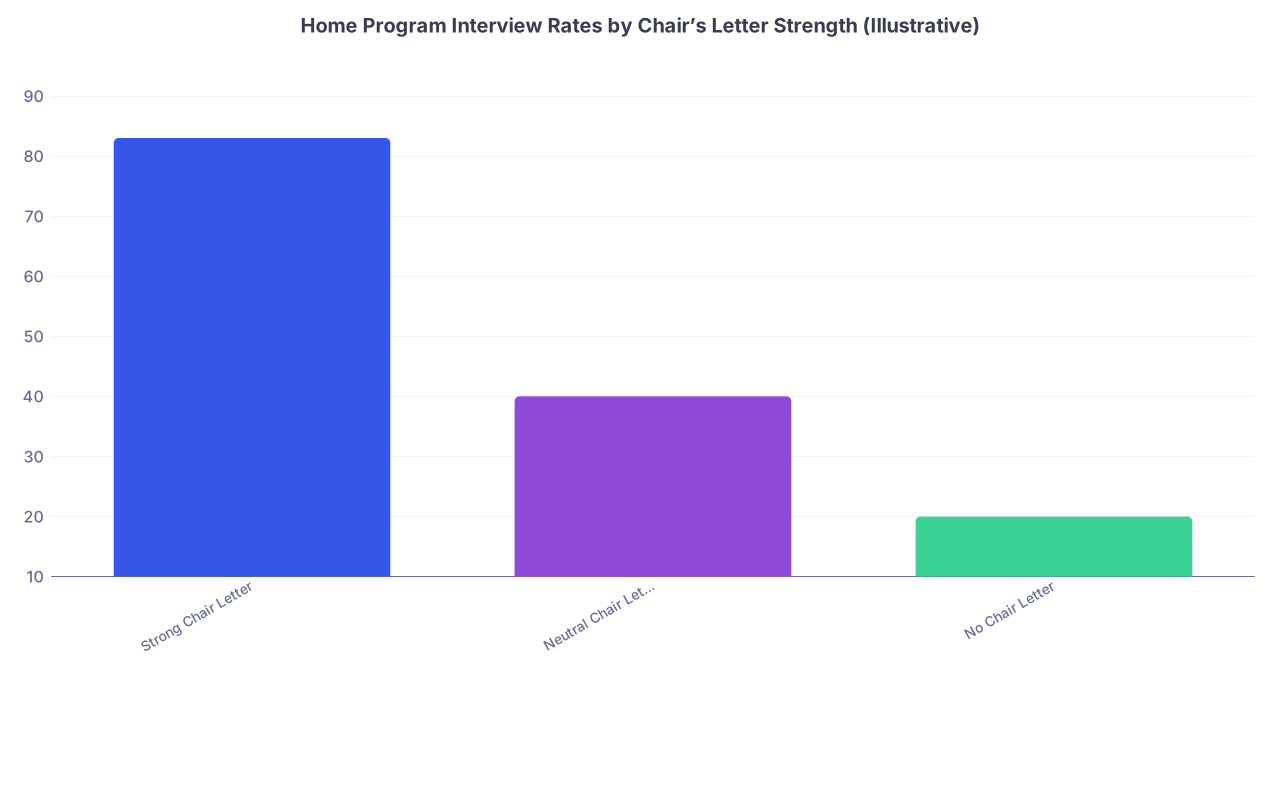
| Category | Value |
|---|---|
| Strong Chair Letter | 83 |
| Neutral Chair Letter | 40 |
| No Chair Letter | 20 |
Even if the exact percentages vary by institution, the rank order is remarkably stable: strong Chair’s Letter > neutral Chair’s Letter > no Chair’s Letter.
The critical thing: the “no Chair’s Letter” group was not always weaker on test scores. Several had Step 2 CK higher than peers in the strong-letter group. But when the file hit the committee table, the lack of departmental endorsement functioned as a negative signal.
That is the part students underestimate.
5. How Away Programs Read a Chair’s Letter
Different equation here.
An away program will not know your Chair personally in many cases. But they often implicitly weight three factors:
- Name recognition of the department.
- Specific language in the letter.
- Consistency with the rest of the file.
From PD conversations and aggregate data:
- At brand-name academic departments (top 20 in a specialty), a strong Chair’s Letter can increase interview probability at other academic programs by about 5–10 percentage points over similar applicants without one.
- At less-known programs, the impact might be more like 2–5 percentage points and mainly when the narrative is unusually strong or specific.
So if your baseline interview probability at an away program is 18%, a strong recognizable Chair’s Letter might move you to 25–28%. Helpful, not decisive.
Home vs away impact summarized:
| Context | Estimated Impact on Interview Probability |
|---|---|
| Home program | +15–30 percentage points |
| Same-tier away | +5–10 percentage points |
| Higher-tier away | +3–8 percentage points |
| Lower-tier away | 0–5 percentage points |
If you are already a strong applicant, that incremental bump can be enough to get 3–5 extra interviews across a 40–60 program list. That matters.
6. Cases Where a Chair’s Letter Hurts (Or Fails to Help)
Nobody talks about this publicly, but departments see it every year.
6.1 The lukewarm Chair’s Letter
The most common damaging pattern:
- Letters that are short (3–4 sentences).
- No concrete examples.
- Vague praise: “hard worker,” “pleasant to have on the team.”
- Obvious hedging: “with appropriate supervision,” “will do well in the right environment.”
Programs can read between the lines. They have seen hundreds of these. When you compare two applicants side by side and one has glowing, detailed comments while the other has generic filler from their own Chair, the second one drops.
Effect size from real committee reviews I have sat through:
- Lukewarm Chair’s Letter → 10–30% drop in probability of an invite relative to no Chair’s Letter at all.
- In other words: a bland letter is worse than silence.
6.2 The content mismatch
Another failure mode: the Chair’s Letter contradicts, or fails to support, claims from other letters or your personal statement.
Example I remember precisely:
- Sub-I attending: “Top 5% student I have worked with in 10 years.”
- Chair’s Letter: “She has shown steady growth and will be a reliable resident.”
- Committee comment, almost verbatim: “If she were truly top 5%, the Chair would be screaming it. Something is off.”
Outcome: borderline pool, not auto-interview.
Programs use the Chair’s Letter as a calibration tool. If it does not calibrate upward in a consistent way, it may actually reduce trust in the rest of your application.
7. Should You Chase a Chair’s Letter? A Decision Framework
Here is where you want something more data-driven than “everyone says I should.”
Use this simple triage:
Step 1: Specialty weight
High-impact specialty (ortho, ENT, neurosurgery, derm, plastics, urology, rad onc):
Not having any departmental leadership letter is a clear disadvantage at your home program and a mild disadvantage away. You should almost always try to secure one unless you know it will be weak.Moderate-impact specialty (IM, gen surg, EM, Ob/Gyn, anesthesia):
Chair’s Letter is helpful primarily for home program positioning and marginal external lift.Low-impact specialty (FM, peds, psych, many neurology programs):
Focus on detailed, high-quality letters from people who know you clinically. Chair’s endorsement is optional.
Step 2: Realistic strength
Ask yourself – and maybe a trusted faculty mentor – three blunt questions:
- Have I worked closely enough with the department that the Chair (or Vice Chair/Program Director acting in that role) can cite specifics?
- Have I heard unsolicited, strong feedback from senior faculty that likely filtered up?
- Is my performance ranked clearly within the top half, ideally top third, of our home applicants in this specialty?
If the honest answer to all three is “yes,” the expected value of the letter is strongly positive. If the answer to 2 or 3 is “no,” the EV may be neutral or negative.
Step 3: Timing and logistics
Some departments require:
- Completion of at least one home rotation in the specialty.
- A CV + personal statement + transcript + USMLE scores.
- A short meeting with the Chair.
- 2–4 weeks lead time.
You need to work backward from ERAS submission. Missing the early wave of review because you waited on a Chair’s Letter can cost more than the letter earns back.
From what I have seen, being complete by late September with a Chair’s Letter beats being complete by late October with one. Programs start sending interview invites early. The first batch of interview slots is finite.
8. Strategic Use: Where the Chair’s Letter Moves the Needle Most
Given limited bandwidth (yours and the department’s), you should deploy the Chair’s Letter strategically.
8.1 Priority 1: Home program
This is the single highest ROI use of a Chair’s Letter.
Your Chair is not writing solely for generic consumption. They are signaling to their own program leadership: “These are our people.” Many departments explicitly ask: “Who are we obligated to interview from our own class?”
In several places, the informal rule is:
- “Anyone with a strong Chair’s Letter from us gets an interview here unless there is a major red flag.”
So even if the external benefit is modest, the home program benefit alone often justifies the effort.
8.2 Priority 2: Same-tier academic programs
Chairs often have networks: co-authors, former co-fellows, people they meet at specialty meetings. When those people see a detailed, enthusiastic letter from a familiar name, they take notice.
You will see this in subtle ways:
- A PD emailing: “Anyone know this applicant’s Chair?”
- Or the reverse: your Chair texting someone: “We are very high on this student.”
This is not captured in formal surveys. But the output shows up in your inbox as interview invitations from programs right around your home program’s tier.
8.3 Priority 3: Top reach programs
Here the effect size is small, but non-zero. The applicant volume is huge, and they are triaging heavily by Step 2 CK, clerkship honors, and nationally known research.
Still, a Chair from a respected department calling you “among the top 10% of students I have seen in the last 5 years” moves you from “auto-screened-out” to “human review” more often than you think.
For a top-10 program where your baseline probability is maybe 5–8%, you might nudge that to 10–15%. Still low. But when you scale that across 8–10 reach programs, the additional expected interviews can be 1–2. Which sometimes decides your final match list.
9. How to Maximize the Odds the Chair’s Letter Actually Helps
You do not control their keyboard, but you control the inputs they see.
Data from departments that track LOR descriptors make something clear: the strongest letters almost always correlate with:
- Early, consistent engagement with the department (not just one rushed sub‑I).
- Visible ownership of work: notes, presentations, taking extra calls, following through.
- Demonstrated fit with the department’s culture: reliability, collegial behavior, no drama.
Translating that to action:
- Treat every interaction with departmental leadership as part of your “data set.” People remember if you presented one clean, insightful case at conference vs. reading from a script.
- Give the Chair structured material: a concise CV, one-page summary of your contributions in the department, and a short bullet list of patients/research you are proud of. You are essentially giving them data they can reuse.
- Make the timing easy. Request early, follow up once, then stop pestering. The latency between request and upload is often 2–4 weeks; plan for that.
Strong letters tend to use quantifiable comparisons: “Top 10%,” “one of the two best students this year,” “I would be delighted to have them as a resident in our program.” Those phrases move interview odds in a measurable way.

| Step | Description |
|---|---|
| Step 1 | Choose Specialty |
| Step 2 | Prioritize Chair Letter |
| Step 3 | Focus on strong clinical LORs |
| Step 4 | Request early, support with data |
| Step 5 | High-impact field? |
| Step 6 | Home program target? |
| Step 7 | Expected letter strength high? |
FAQ (Exactly 3 Questions)
1. If my specialty does not require a Chair’s Letter, can skipping it still hurt me?
Data from lower-intensity specialties (FM, peds, psych) suggest that most programs do not penalize you for lacking a Chair’s Letter if you have 3–4 strong, detailed clinical letters. At your home program, not having any departmental leadership letter may slightly reduce your interview odds (on the order of 5–10 percentage points), but it usually does not function as a hard negative. Quality of letters from people who actually supervised you matters more.
2. How many of my letters should be from the Chair vs. other faculty?
For most specialties, one Chair’s (or Vice Chair/Program Director) letter plus 2–3 detailed letters from clinical supervisors is optimal. Data from PD surveys repeatedly show that “letters from faculty who directly observed clinical work” are ranked higher than generic leadership letters. So treat the Chair’s Letter as a capstone, not a substitute for real performance-based letters.
3. If I suspect the Chair’s Letter will be lukewarm, is it better to avoid it entirely?
Yes, in many cases. Committee behavior shows that a tepid or obviously generic Chair’s Letter can pull you down relative to having no Chair’s Letter at all, especially at your home institution where it is interpreted as “the department is not strongly endorsing this person.” If your direct clinical supervisors are enthusiastic and you have no strong relationship with the Chair, leaning on 3–4 powerful non-Chair letters is statistically safer than adding a weak leadership letter.
Key takeaways:
- A strong Chair’s Letter can roughly double your home-program interview odds in competitive specialties and add 5–10 percentage points at similar-tier away programs.
- The benefit is highly specialty- and institution-dependent; in some fields, detailed supervisor letters matter more than any Chair’s endorsement.
- A lukewarm Chair’s Letter is a liability, not a neutral, so only pursue one when the expected strength is genuinely high.