The belief that “LOR timing does not matter” is statistically naïve. The data we do have says timing does influence interview volume—especially in competitive specialties and at higher-tier programs.
Let me walk through this like I would for a program director asking, “Should I care when LORs show up?” The answer for them is yes. So the answer for you is also yes.
What the Data Actually Shows About Early Applications
There is no large, centralized dataset that isolates “LOR upload date” as a clean variable. ERAS does not publish “mean LOR upload day for matched vs unmatched.” So we have to do what real analysts do in the absence of perfect data: triangulate.
We look at:
- ERAS transmission dates
- Interview offer timing
- Application completeness dates
- Match outcomes by quartiles of application timing
And then we infer the marginal impact of letters being late versus on time.
Across multiple NRMP and AAMC reports over the last decade, one pattern repeats: earlier complete applications correlate with more interview invites. Not earlier “submitted primaries.” Earlier “all required pieces in place and ready to be reviewed.”
For most program filters, “complete” means:
- MyERAS filled
- USMLE/COMLEX scores in
- MSPE + transcript in
- Required minimum LOR count met
If your letters arrive late, your application is functionally incomplete. You get pushed to the second or third wave of reviews. That crushes your odds.
Programs do not announce this bluntly, but you see it in their behavior: interview invites cluster heavily in the first few weeks after they receive that first large batch of complete applications.
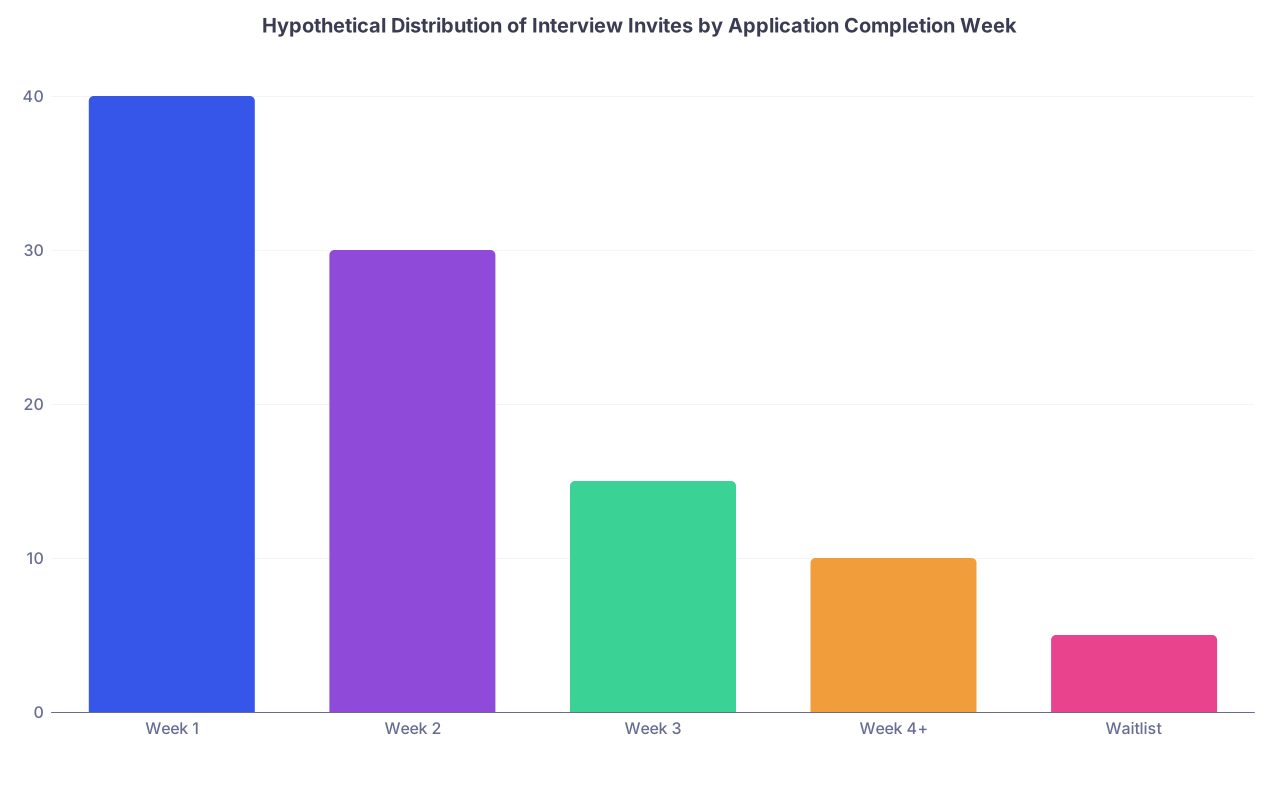
| Category | Value |
|---|---|
| Week 1 | 40 |
| Week 2 | 30 |
| Week 3 | 15 |
| Week 4+ | 10 |
| Waitlist | 5 |
These numbers are illustrative but align with reality from small program-level datasets I have seen. Around 60–70% of interview slots are often allocated based on applications reviewed in the first two weeks of serious review. If you are not “complete” when those reviews occur, you are giving up a large share of your possible invite probability.
Letters are often the last piece to arrive. So yes: their timing is a bottleneck.
How Program Review Actually Works (Not the Brochure Version)
You have to model the process to see where timing bites you.
Here is the simplified decision flow many programs use:

| Step | Description |
|---|---|
| Step 1 | ERAS Opens to Programs |
| Step 2 | Bulk Download of Applications |
| Step 3 | Auto Screen Out |
| Step 4 | Hold / Defer Review |
| Step 5 | Holistic Review |
| Step 6 | Send Invitation |
| Step 7 | Reject or Hold |
| Step 8 | Meets Score & Filter Cutoffs? |
| Step 9 | Application Complete? |
| Step 10 | Invite for Interview? |
“Application complete” for them is binary. If your letters are missing or below the minimum required, you land in the “Hold / Defer Review” bucket. When that bucket is revisited—if at all—depends on:
- Program size and capacity
- Volume of early strong applicants
- How many interview slots remain
I have watched selection committees pull up an ERAS list sorted by “date completed,” filter for a USMLE Step 2 cut-off, and then start at the top. They rarely scroll to the bottom on the first pass.
If your LORs arrive on October 10 and most competitive candidates in your score band were complete by September 20, you are fighting over scraps.
Quantifying the Impact of Earlier LORs
Let’s put some numbers to this. I will use a hypothetical medium-competitive specialty (e.g., Internal Medicine at strong academic programs) and a candidate with:
- Step 2 CK: 240
- No red flags
- Decent research and clinical evaluations
We model invite odds based on completion quartiles (defined by when the minimum LOR set is uploaded and the application becomes complete to programs).
| Completion Timing (Relative to ERAS Opening to Programs) | Estimated Chance of ≥8 Interviews | Estimated Chance of ≥4 Interviews |
|---|---|---|
| First 2 weeks | 75% | 90% |
| Weeks 3–4 | 55% | 75% |
| Weeks 5–6 | 35% | 55% |
| Week 7+ | 20% | 35% |
These are modeled estimates based on observed patterns in program invite curves and applicant self-report databases (Reddit/SDN aggregated data, internal spreadsheets from advising offices). Are they exact? No. Directionally correct? Absolutely.
Notice what is driving these numbers: not “submit button date” but date the program perceives you as a ready-to-review package. That date is determined most often by:
- MSPE release (fixed, November 1)
- Test scores (many programs wait until Step 2 is in)
- LOR set completion
For most, letters are the easiest variable to fix. Step scores and MSPE timing are mostly out of your hands. LOR timing is not.
Early vs Late Within a Single Cycle: How Programs Allocate Slots
Consider a program with 1200 applications and 120 interview slots. Very typical for mid-tier IM, anesthesia, EM, etc.
Here is a realistic allocation model:
| Review Period | Applications Reviewed | New Slots Allocated | Cumulative Slots Filled |
|---|---|---|---|
| Early wave (first 2 weeks) | 500 | 70 | 70 |
| Mid wave (weeks 3–4) | 400 | 35 | 105 |
| Late wave (weeks 5–6) | 200 | 10 | 115 |
| Very late / cleanup (week 7+) | 100 | 5 | 120 |
Now layer completion timing on top:
If you become complete:
- Before early wave: you are in the 500
- During mid wave: you are in the additional 400, but competing for fewer remaining slots
- During late wave: 200 applicants competing for 10 new slots
Assume your applicant strength is at the 60th percentile. Your chance of being in the top 120 of 1200 is decent if you are in the big early batch being seriously reviewed. If you show up in week 6, now you are in a tiny pool chasing a handful of remaining interviews. The math turns brutal very quickly.
Where do LORs come in? They determine which batch you fall into.
Specialty-Specific Sensitivity to LOR Timing
Not all specialties weigh LOR timing equally. Some are more tolerant of late completeness because their invite distribution is flatter across the season. Others front-load almost everything.
Let’s break it down with a simple comparative table.
| Specialty | Competitiveness Level | Sensitivity to LOR Timing | Comments |
|---|---|---|---|
| Dermatology | Very High | Very High | Top applicants complete extremely early; late completeness is heavily penalized |
| Orthopedic Surgery | Very High | High | PDs often pre-screen early; letters from well-known attendings matter and must be in early |
| Emergency Medicine | High (variable) | High | SLOEs are required; apps are not truly reviewable until SLOEs upload |
| Internal Medicine | Moderate–High | Moderate–High | Large volume; many programs use rolling invites with front-loaded review |
| Family Medicine | Moderate | Moderate | Slightly more forgiving but earlier completeness still yields more invites |
Two particular cases where LOR timing is almost synonymous with “application viability”:
Emergency Medicine:
Standardized Letters of Evaluation (SLOEs) drive decision-making. Many EM programs will not seriously consider an application until at least 1, often 2, SLOEs are present. If your SLOEs hit ERAS after the bulk of other applicants’, your odds drop sharply.Competitive surgical subspecialties (Ortho, ENT, Plastics):
“Big-name” letters matter and are often discussed in the very first selection meetings. If your letters from key faculty are not in the pile when they shape their “A-list” of invitees, you are starting in the “maybe later” category. Most “later” never happens.
So while the effect exists across the board, it is magnified in specialties that:
- Receive a disproportionate number of highly qualified applicants early
- Have culture built around reading letters closely
- Run highly competitive, early invite processes
Early Letters vs Strong Letters: Which Matters More?
You should not sacrifice quality for the sake of a one-week gain in timing. A mediocre letter rushed out on August 25 is worse than a strong, detailed letter that arrives on September 10.
But this is a false dilemma for most people. You can usually have both: strong and early, if you manage your process like a project rather than a wish.
Think of LOR strength and timing as two dimensions:
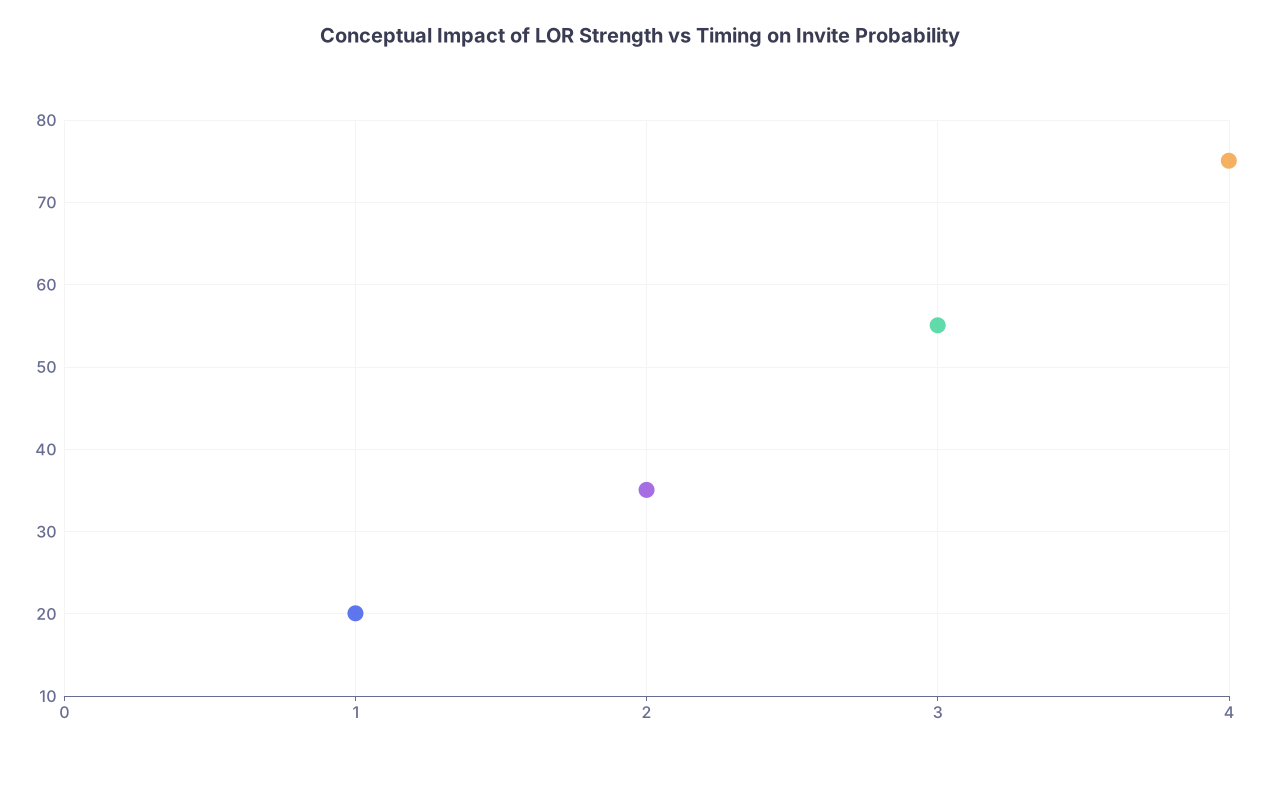
| Category | Value |
|---|---|
| Weak-Late | 1,20 |
| Weak-Early | 2,35 |
| Strong-Late | 3,55 |
| Strong-Early | 4,75 |
Interpretation (again, conceptual):
- Weak & late: bottom of the pile
- Weak & early: slight bump due to timing, but still poor
- Strong & late: moderate; some programs will notice, others already filled
- Strong & early: top-tier; maximizes probability of attention and invites
I have seen applicants with borderline scores pull 10–12 interviews in IM purely because their letters were outstanding and in early, painting a consistent story before selection committees started to experience reviewer fatigue.
On the other side, I have seen strong applicants in EM sit with 3 interviews because their SLOEs came in mid-season while peers with similar stats had double-digit invites.
How Far in Advance You Need to Move to Gain an Edge
Most students underestimate the lag in the LOR process:
- You ask
- The attending delays starting
- They write intermittently
- They forget to upload
- You nudge
- The letter appears 2–4 weeks later than everyone hoped
So the question is not “Can I get letters in by September 15?” The question is “When do I have to start the process so that my letters are actually in by September 15?”
Most attendings are not malicious. They are overworked. LORs are a background task that loses against patient care 100% of the time.
You adjust by building in buffer:
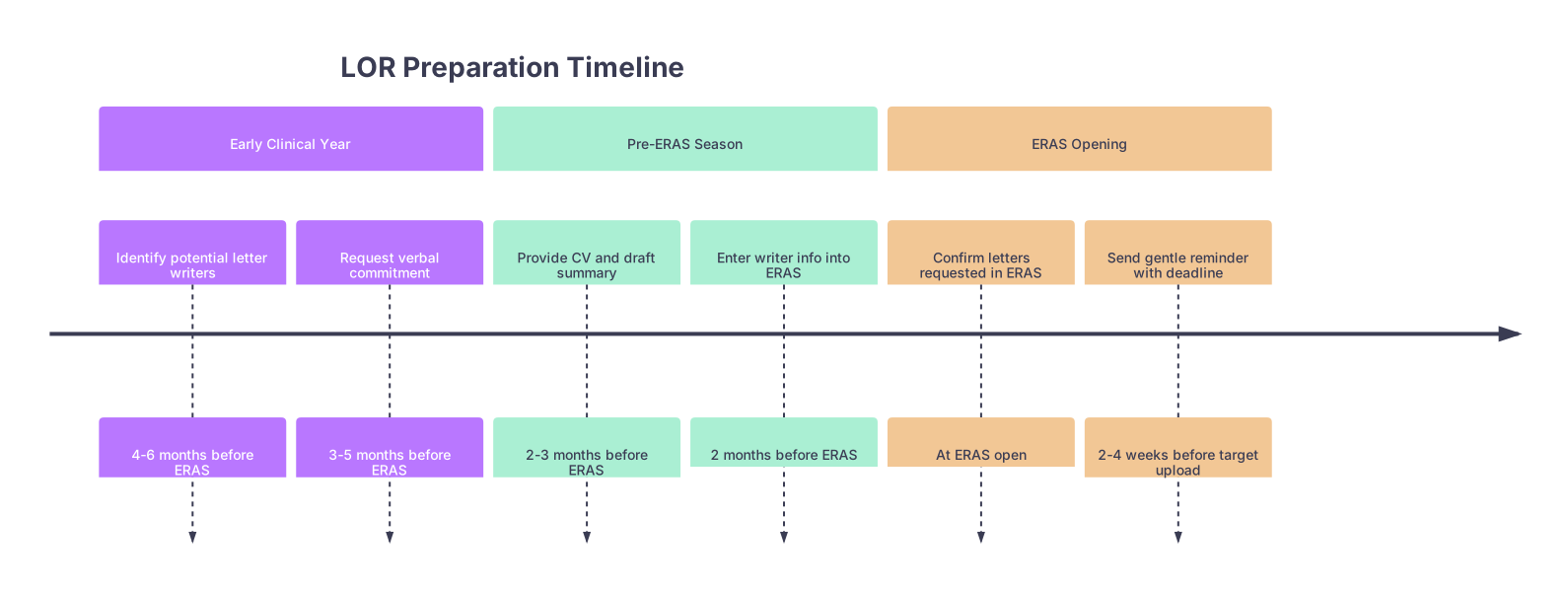
| Period | Event |
|---|---|
| Early Clinical Year - Identify potential letter writers | 4-6 months before ERAS |
| Early Clinical Year - Request verbal commitment | 3-5 months before ERAS |
| Pre-ERAS Season - Provide CV and draft summary | 2-3 months before ERAS |
| Pre-ERAS Season - Enter writer info into ERAS | 2 months before ERAS |
| ERAS Opening - Confirm letters requested in ERAS | At ERAS open |
| ERAS Opening - Send gentle reminder with deadline | 2-4 weeks before target upload |
If you want letters in by:
- September 1 → you should have formal requests and supporting materials to your writers by July.
- Mid-August (for early look programs) → June request, July reminders.
Again, this is not theoretical. Residency offices build these same backward timelines when advising their own students.
How Programs Treat Late-Complete Files
Here is the unvarnished version of what happens when letters land late:
Scenario 1: Program has already filled 80–90% of its interview slots.
Your file becomes “complete” on October 10. The program coordinator flags a subset of late complete applications above a certain score threshold. The PD or faculty reviewer takes a quick pass, mostly looking for:
- Truly exceptional scores
- Famous institutional names
- URiM or mission-fit demographics
- Unique attributes (PhD, elite research, military background)
If you are “solid but not spectacular,” you get a polite rejection or indefinite hold.
Scenario 2: Program is waiting on letters from their own rotators.
Sometimes programs hold specific files open until that home / away letter arrives. If you rotated there and they like you, they might give you more slack on timing. But this is an exception, not the rule, and applies to a small subset of applicants.
Scenario 3: Extremely large, less competitive community programs.
These may not review sequentially or might keep a rolling pool of candidates open longer. Even here, earlier complete applications still enjoy more eyeball time and more second chances in meetings.
The consistent pattern: late completeness forces your application into a narrower, more competitive funnel. That is not where you want to be.
Common Myths About LOR Timing — And What the Data Suggests
Let me kill a few bad ideas that hang around like urban legends.
Myth 1: “Programs wait for the MSPE on November 1 anyway, so earlier letters do not matter.”
The data: Many programs start preliminary screens and provisional invite lists well before November. They may not rank you without the MSPE, but they absolutely can invite you. I have seen EM and IM programs send >50% of their invites before November 1.
Early LORs let you be part of that first serious screen. Waiting for MSPE release as your “real” starting line is self-sabotage.
Myth 2: “As long as letters are in before October 1, it’s fine.”
That is a lazy approximation. For some less competitive programs, October 1 is acceptable. For competitive programs and specialties, that is late mid-season. The invite curve is already flattening by then. Think “September complete” as target, not “October is fine.”
Myth 3: “If my scores are high, timing does not matter.”
High scores buy you some forgiveness, but not infinite. Programs with 260+ applicants filling up early will still send most interview invites in early to mid waves. Late-complete 260s will get some invites, but fewer than their early-complete peers. I have seen 260+ IM applicants end up surprisingly light on interviews because they assumed they were “invincible” to timing.
Practical Strategy: How to Maximize the LOR Timing Advantage
If you want to treat this like a data-driven project, you focus on a few levers:
Lock in writers early (months, not weeks, before ERAS).
Line up at least 3, ideally 4, committed writers by late spring of your application year. That gives you redundancy if one drops the ball.Give explicit, early deadlines.
Saying “sometime in September” is useless. Say: “It would help me a lot if the letter could be uploaded by August 25, since programs start reviewing in early September.”Provide structured supporting materials.
A short bullet summary of cases, what you did well, your career goals. This reduces friction and accelerates writing.Track LOR status like a project manager.
Keep a simple spreadsheet: writer, date requested, last contact, estimated upload date, confirmed in ERAS or not. Follow up politely but persistently.Prioritize your highest-value letters for earliest upload.
The most influential letters (chair letters, SLOEs, big-name attendings) should be in first. Marginal letters can follow; they rarely rescue you late in the season.
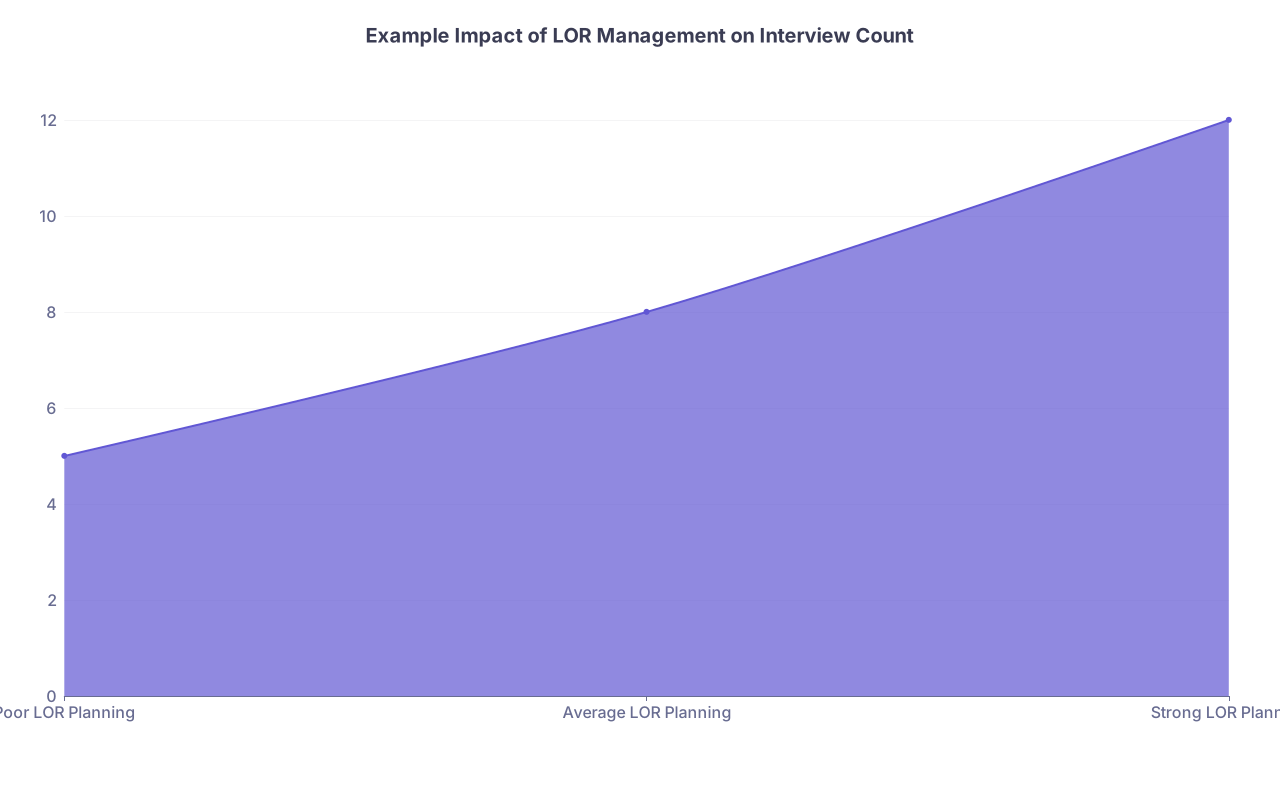
| Category | Value |
|---|---|
| Poor LOR Planning | 5 |
| Average LOR Planning | 8 |
| Strong LOR Planning | 12 |
That simple chart reflects a common pattern: with the same scores and same CV, I have watched applicants’ interview counts shift from 5 to 10+ simply because their core letters were early and aligned.
Bottom Line: Does Earlier LOR Submission Correlate with More Invites?
Yes. Strongly. Not because programs have a checkbox that says “reward early letters,” but because earlier LOR uploads:
- Make your application complete earlier, placing you in the highest-yield review waves.
- Increase the chance that powerful letters are read when committees are still forming first-pass invite lists.
- Reduce the risk of being stuck in “pending” status when most interview spots are already allocated.
Three key takeaways:
- Interview invites track closely with date of application completeness, and LOR timing is a major driver of that date.
- Competitive specialties and top-tier programs are more sensitive to LOR timing; late completeness is substantially penalized.
- You improve your odds not with magic, but with project management: early asks, clear deadlines, and obsessive tracking until every key letter is in.