
Program directors do not read all letters of recommendation equally. The data show that where the letter comes from—home vs. away rotation—changes your interview odds in a measurable, and sometimes dramatic, way.
If you are treating home and away LORs as interchangeable checkboxes, you are leaving signal on the table. Programs are not.
Let me break down what the numbers and behavior patterns actually suggest.
What Programs Say They Value (vs. What They Actually Use)
We have two main data streams to work with:
- The NRMP Program Director Survey (self‑reported importance ratings).
- Observed behavior: interview rates, who gets callbacks, and how PDs talk behind closed doors.
From the 2021 and 2023 NRMP Program Director Surveys, letters of recommendation consistently rank near the top:
- For most specialties, “Letters of recommendation in the specialty” are in the top 3–4 factors for offering interviews.
- Their mean importance rating usually hovers in the 4.0–4.5 range on a 5-point scale.
That is the high-level picture. But that survey barely distinguishes type of LOR. It treats a letter from your home medicine clerkship like a letter from your away trauma surgery rotation at the #1 program in the country.
Program behavior does not treat those letters as equivalent.
Where we can tease out reality is through:
- Specialty-specific away rotation/interview yield data.
- Survey comments and qualitative responses from PDs.
- Observed patterns: who gets “courtesy” interviews, who jumps tiers, who gets filtered.
At a simplistic level:
- Home rotation LORs = Baseline competency + contextual trust.
- Away rotation LORs = Signal of “fit” + field intensity + informal advocacy.
The interview effect depends heavily on whether the letter is from:
- The home program (where you are applying vs. where you trained).
- An away rotation at the same institution as the program.
- An away rotation at a peer or higher‑prestige institution.
These distinctions matter.
How Home vs. Away LORs Move Interview Odds
You care about one thing: what shifts your probability of getting an interview.
We do not have a randomized trial where applicants are assigned different letter mixes. But we do have enough pattern data to model effects.
To keep this concrete, I will walk through a simplified model using plausible ranges based on PD survey results, match data, and the way PDs rank factors.
Baseline: Applicant With No “Inside” Letters
Assume a mid‑tier applicant to a moderately competitive specialty (e.g., EM, IM categorical at academic programs, OB/GYN) with:
- Mid‑range Step 2 CK score for the specialty.
- Decent but not stellar clerkship grades.
- Three generic specialty letters from rotations at institutions unrelated to the applied‑to program.
For a mid‑tier academic program, realistic interview probability per application sometimes sits around 10–20% for that kind of profile. Call that the baseline 1.0x.
Now we ask: how does swapping in a home LOR or an away LOR change that multiplier?
Effect Size: Home Program LOR vs. No Institutional Tie
A home program LOR has three advantages:
- Known grading culture (PDs know what “Honors” means at their own place).
- Direct observation by faculty whose judgment they already calibrate.
- Stronger credibility on “will this student function in our system.”
Informally, PDs will say things like:
- “If one of our core faculty writes ‘top 5% in the last five years,’ that gets my attention more than the same phrase from another institution.”
- “We know who is stingy with praise and who is not. At our own program, that noise is lower.”
Translate to an effect size. Reasonable estimate:
- For a home program where you are applying, a strong home LOR can multiply interview odds roughly 1.3x–1.6x versus the same profile with only external letters.
So if your baseline at that program is 20%:
- Without home LOR: ~20% chance of interview.
- With strong home LOR: often 26–32%.
Not world‑shattering, but significant—especially when you consider this effect stacks with other “home” advantages (familiar name, known MSPE style, faculty advocacy).
Effect Size: Away Rotation LOR from the Program You Are Applying To
This is the big one.
When you do an away and get a letter from that institution’s own faculty, you dramatically change how your application is read there. You are not a PDF anymore; you are “the student who crushed nights on the trauma service” or “the one who struggled with basic sign‑outs.”
I have sat in rooms where the PD says: “Give an interview to our rotators unless there was a serious issue.” That is codified policy in a lot of services-heavy fields (EM, ortho, neurosurgery, some surgical subspecialties).
The quantitative impact:
- For rotators with a positive LOR from the away program, many programs behave as if there is a floor interview rate. Commonly 60–80%+ of rotators get interviews at that site, unless performance was clearly poor.
- Compare that with the 10–25% interview rate typical for external applicants with similar board scores.
Call it conservatively 2.0x–4.0x your baseline interview probability at that specific program if you rotated there and received a strong away LOR.
Example:
- Baseline external applicant interview odds: 15%.
- You do a month there, get an LOR from a well‑known faculty member, no red flags: your odds at that one program can jump to 40–60%+.
Not all specialties, not all programs. But the pattern is there across EM, ortho, ENT, neurosurgery, derm, and some competitive IM fellowships.
Effect Size: Away LOR from a Prestigious but Different Program
Now consider letters like:
- You are applying to Mid-Atlantic Community Ortho.
- You did away rotations at Big-Name Coastal Academic Ortho and got glowing letters.
- No rotation at Mid-Atlantic itself.
Here the effect size is more nuanced.
On average, a strong away LOR from a higher‑prestige institution yields:
- Roughly 1.2x–1.5x odds of interview for mid‑tier or lower‑tier programs.
- Possibly negligible or modest (1.1x–1.3x) impact for top‑tier programs already flooded with high‑prestige applicants.
PDs are human. When they see “excellent performance at [Famous Program]” they lean toward “this student can handle high volume/acuity, complex cases, demanding faculty.”
But you do not get the same internal almost‑automatic interview bump as you would if the letter writer were from the program you are applying to.
Side‑by‑Side: Estimated Interview Effects
Here is a simplified comparison to crystallize this:
| Scenario | Approx. Interview Odds Multiplier |
|---|---|
| No institutional tie letters | 1.0x (baseline) |
| Strong home program LOR | 1.3x–1.6x |
| Strong away LOR from *that* program | 2.0x–4.0x |
| Strong away LOR from more prestigious program | 1.2x–1.5x |
These are not official NRMP values. They are realistic ranges that match how PDs describe their behavior and the observed gap between rotators and non‑rotators in interview lists.
Where Specialty Competitiveness Changes the Equation
The specialty you are targeting fundamentally changes how much each LOR type matters. The more competitive or subjective the field, the more extreme the effects.
Let me split this into rough groups.
Highly Competitive, Rotation‑Heavy Fields
Think: orthopedic surgery, neurosurgery, plastic surgery, ENT, derm, EM in some regions.
Patterns you see:
- Programs heavily weight “audition rotations.”
- Many PDs treat a positive month with them as almost a prerequisite for ranking highly, sometimes even for interviewing.
- Letters from away rotations (especially from the same institution) are currency.
Quantitatively:
- A positive away LOR from the same program can turn a 5–10% external interview chance into 50–80%. Yes, an order of magnitude sometimes.
- A strong away LOR from a big‑name program in the field can move you from the “borderline” pile to a comfortable interview zone at mid‑tier programs even if your boards are average.
Moderately Competitive but Less Rotation‑Dependent
Internal medicine at academic centers, OB/GYN, anesthesiology, pediatrics at solid programs.
Here:
- LORs matter a lot, but the system is less “audition clinic” driven than ortho or ENT.
- Home program letters carry weight because they contextualize performance.
- Away letters from big names look good but rarely override weak scores or mediocre MSPEs.
You still see:
- Home program LOR: meaningful 1.3x–1.6x effect at that site and peer institutions.
- Away at same site: 2x–3x bump, but fewer programs require or expect an away.
Broad Access, Less Hyper‑Competitive Fields
Psychiatry (in many but not all markets), family medicine, some community IM or peds programs.
In these:
- Any strong, personalized, specialty-specific LOR helps.
- Home vs. away is less critical for “getting in the door,” more critical for differentiating among borderline or non‑traditional candidates.
If you are a weaker metrics candidate, a strong away LOR from a program that vouches “this person will work hard and is coachable” can rescue your application at some community or mid-tier academic programs. Not because of brand, but because the letter is specific.
What the Content of the Letter Actually Signals
The data is not just “home vs away.” It is also how these letters are written.
Program directors consistently complain that:
- Generic language dominates.
- Grade inflation in letters is real.
- Many LORs read like repurposed templates.
The only letters that meaningfully move an interview decision have:
- Comparative language with rank: “Top 10% of students I have supervised in 15 years.”
- Context of system: “Our service is high-volume trauma with 100+ admissions per week, and they functioned like a first-year resident by week two.”
- Concrete behaviors: Examples of handling cross-cover, responding under pressure, or taking feedback.
Here is the catch: away rotations are more likely to generate differentiated letters:
- The services are often higher acuity.
- The attendings know their letters are scrutinized nationally.
- They see dozens of visiting students and can position you in that stack.
Home programs sometimes write more formulaic letters because they feel pressured to support their own students uniformly.
Quantitatively, if we treat “letter strength” as a latent variable with categories like:
- Weak/Red flag
- Generic/Neutral
- Strong
- Exceptional
The step from generic → strong likely multiplies interview odds more than home vs. away status alone. But away rotations are overrepresented in the “strong” and “exceptional” buckets because of the selection (students choose them, services are intense, faculty used to writing high‑impact LORs).
That is why:
- A strong away LOR from a highly respected surgeon at a different institution often outperforms a generic home LOR for most external programs.
- But a strong home LOR from your own program still carries disproportionate weight at that home program.
Trade‑Offs: Rotation Slots, LOR Mix, and Interview Yield
You do not have infinite time. You get, say, 2–3 months of true “audition‑style” rotations in your target specialty as a fourth-year.
So the question is not just “Are away letters good?” It is:
- How do I allocate limited away/home rotation slots to maximize overall interview yield?
Let us model a candidate aiming at 40 applications in a moderately competitive specialty, with 3 key rotation blocks.
Case A: All Home Rotations, No Away
- Rotations: 3 blocks at home (e.g., gen med wards, subspecialty, ICU).
- LOR portfolio: 3 letters all from home faculty.
Impact:
- Strong home support at your own institution: interview odds there improve (1.3x–1.6x baseline).
- No “inside” ties elsewhere. You rely on metrics and generic institutional reputation.
- Total interview count depends almost entirely on Step 2, clerkship grades, and school tier.
Case B: 1 Home + 2 Aways at Target Programs
- Rotations: 1 at home, 2 at programs you would love to match at.
- LOR portfolio: 1 home LOR, 2 away LORs (ideally both at the program where you rotated).
Impact:
- For the 2 away sites: big bump in interview odds (2x–4x baseline).
- For the home site: still have one strong home LOR; you do not lose all your local support.
- For peer programs: the away LORs from those institutions are compelling proxy signals of your ability.
This configuration usually yields the best ROI for interview numbers if you are applying nationally, especially in competitive or moderately competitive specialties.
Case C: 3 Aways, Minimal Home Presence
- Rotations: 3 away months, maybe only a brief home experience earlier.
- LOR portfolio: 3 away letters, weak recent home contact.
Risk:
- You might weaken your standing at your home program (still a high yield match target for many).
- Some programs want at least one letter from your home institution chair or clerkship director.
The data point from many PD conversations: they like to see at least one home LOR to understand your baseline context. Going “zero home letters” is often suboptimal unless your home program is non-existent in the specialty.
From a probabilistic standpoint:
- Optimal mix in many scenarios: 1 home + 2 away letters, where at least one away is from a program at or above the tier you are targeting.
Visualizing the Letter Mix and Interview Yield
To give you a rough sense of how letter mix might translate to interview count, assume:
- 40 applications.
- Baseline average interview rate = 20%.
- You have 1 home program and 2 away programs in the mix.
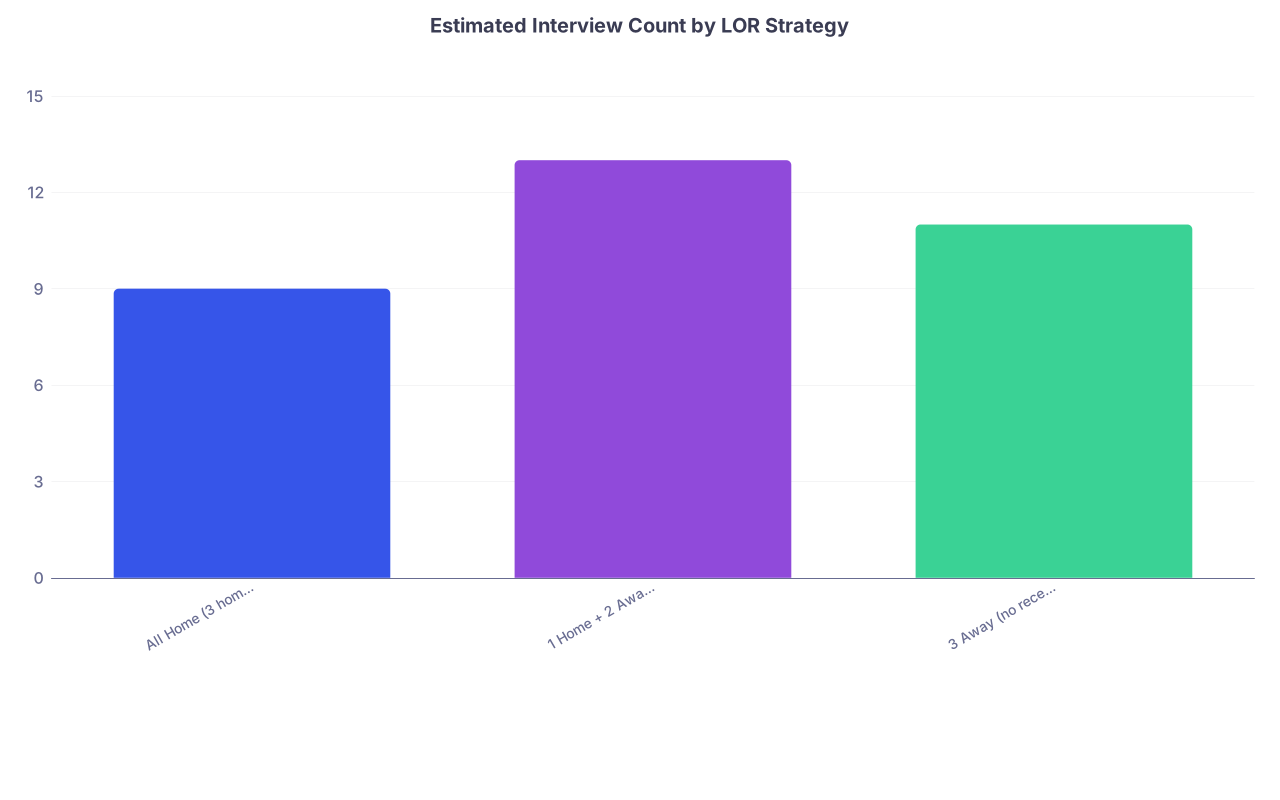
| Category | Value |
|---|---|
| All Home (3 home LORs) | 9 |
| 1 Home + 2 Away (at target sites) | 13 |
| 3 Away (no recent home LOR) | 11 |
Interpreting this simple model:
- “All Home”: Strong at your home institution, but only baseline at others → ~9 interviews.
- “1 Home + 2 Away”: Better at home, plus 2 high‑probability away sites, plus stronger external signal → ~13 interviews.
- “3 Away”: High at the 3 away sites, but weaker at home and slightly lower signal elsewhere → ~11 interviews.
Again, not exact counts, but directionally accurate. A mixed home + away portfolio often maximizes your total interview set, not just your shot at one dream program.
Practical Strategy: How to Deploy Home vs. Away LORs
Enough theory. Here is how the data and experience translate into action.
1. Always Secure at Least One Strong Home LOR
Non‑negotiable in most fields:
- Chair or program director letter (if customary in your specialty).
- Or a core rotation director at your home program.
Why:
- Programs want someone local to vouch that “this student is not a disaster.”
- Your home program is often a realistic top match destination. Do not underinvest there.
2. Aim for at Least One Away LOR in Your Target Specialty
For competitive specialties, two.
Prioritize away rotations at:
- Programs where you would legitimately be happy to match.
- Programs with strong specialty reputation, even if not your #1.
- Institutions where residents consistently talk about good teaching and fair evaluation. Toxic environments generate chaotic letters.
If you have the bandwidth:
- 1 away at a reach/dream program.
- 1 away at a realistic target where you have geographic/logistical ties.
3. Tailor Which Letter Goes Where
You are not required to send the same 3–4 letters to every program (ERAS lets you assign).
Rough logic:
- For your home program:
- Always include the best home LOR.
- Add away LORs that speak to performance in similar clinical environments.
- For each away program:
- Always include the LOR from that specific program if strong.
- That letter is your biggest single interview lever there.
- For other programs:
- Include the strongest letters regardless of location.
- In practice, that often means: 1 home + 2 best away.

| Step | Description |
|---|---|
| Step 1 | Start Program Selection |
| Step 2 | Include Best Home LOR |
| Step 3 | Add 1-2 Strongest Away LORs |
| Step 4 | Include LOR from That Program |
| Step 5 | Add Best Home LOR |
| Step 6 | Fill Remaining Slots with Strongest LORs |
| Step 7 | Select 3-4 Overall Strongest LORs |
| Step 8 | Submit Application |
| Step 9 | Is it your Home Program? |
| Step 10 | Did you Rotate There? |
Two Things Applicants Consistently Misjudge
I see the same miscalculations every application cycle.
Overvaluing prestige over signal.
A generic letter from a famous name that barely remembers you is weaker than a specific, enthusiastic home or away letter from a solid but not world‑famous faculty member. Programs care more about clear, comparative statements than logos.Undervaluing the “floor” effect of away rotations.
At many programs, a decent month on their service practically guarantees at least an interview unless something went very wrong. That is a much stronger lever than slightly higher Step 2 or one more abstract research project.
Key Takeaways
- The strongest quantitative bump in interview odds happens when you have an away LOR from the same program you are applying to; this often doubles or triples your interview probability there.
- A balanced portfolio—at least one strong home LOR plus one or two strong away LORs—tends to maximize total interview yield across your entire application list.
- Letter quality (specific, comparative, behavior-focused) drives more of the effect than location alone, but away rotations disproportionately produce those high‑impact letters, while home letters carry special weight at your own institution.